
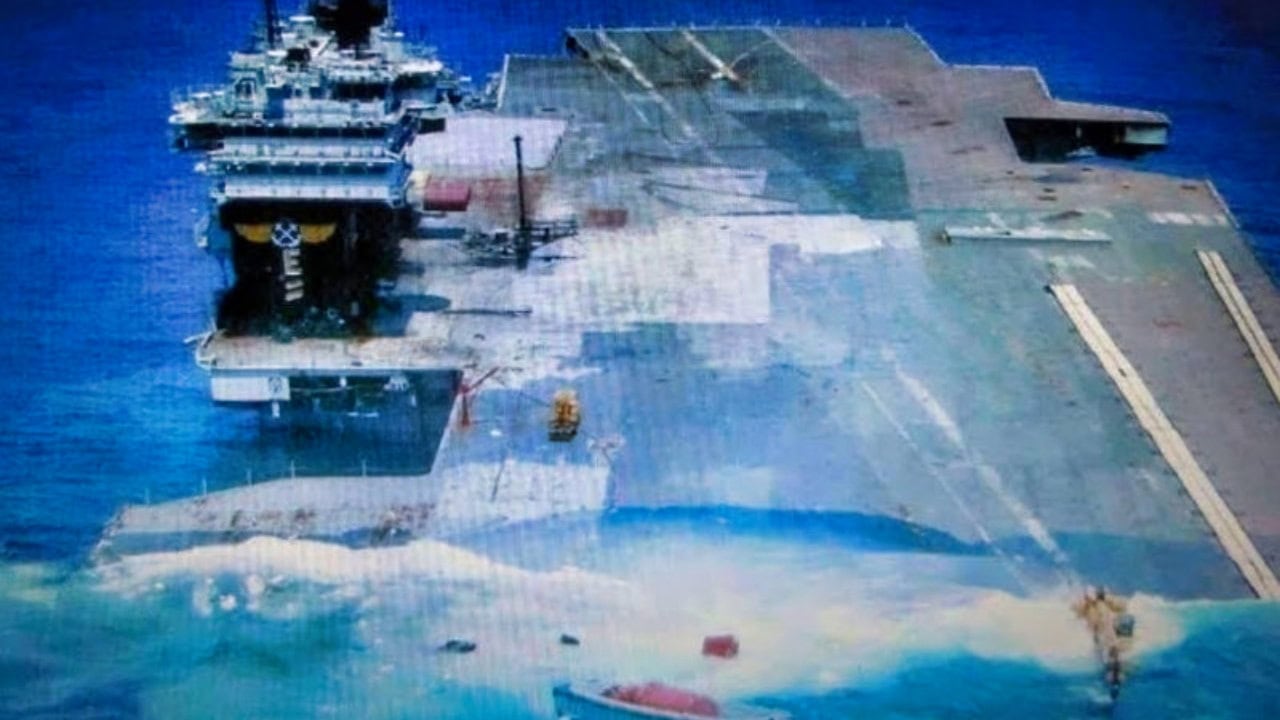
U.S. Navy Aircraft Carrier USS America Was Sunk By the U.S. Navy for a Reason
The USS America (CVA-66) was the third ship to carry that name. It was a supercarrier that, per the Navy’s official website, was laid down on New Year’s Day in 1961, launched three years later in 1964, and commissioned at Norfolk Naval Shipyard in January of 1965, going underway for the first time that March.
However, the story of what happened at the end of its life is surprising.
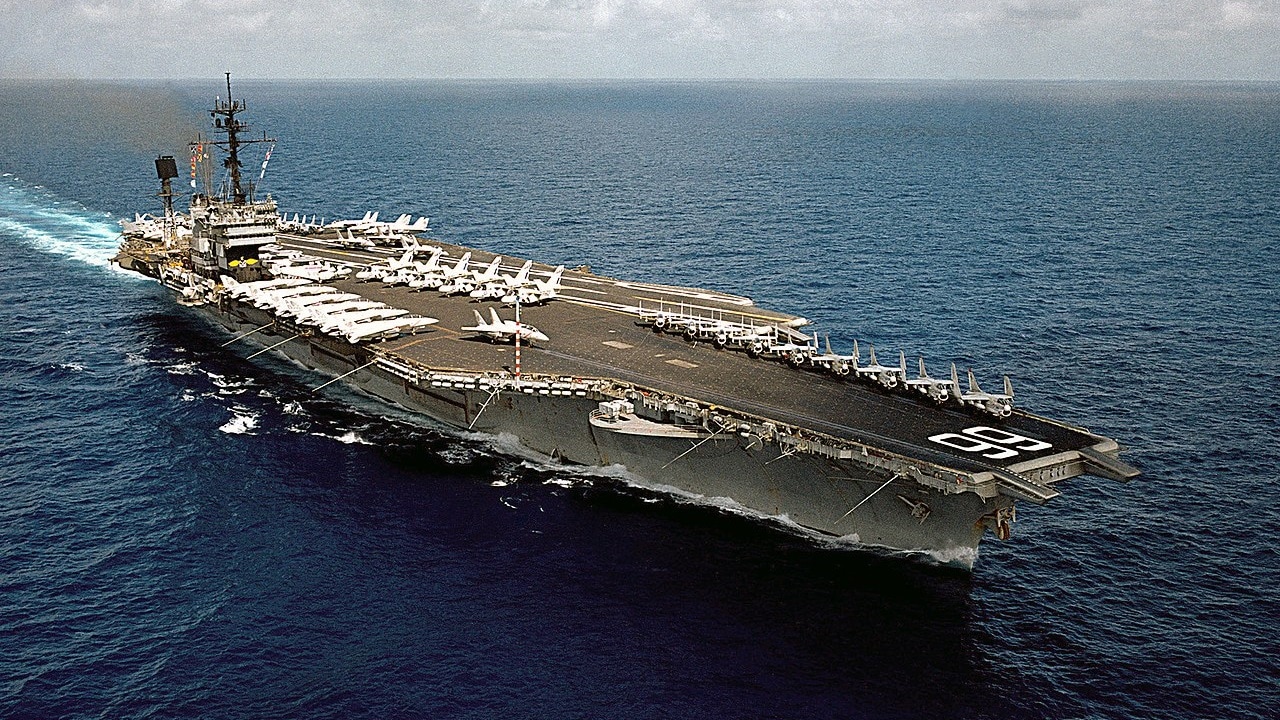
An aerial starboard bow view of the aircraft carrier USS AMERICA (CV-66) underway.
The USS America’s Life
The USS America sailed for its first deployment, to the Mediterranean, near the end of 1965. During that deployment, the supercarrier participated in the Franco-American exercise known as “Fairgame IV.” Upton returning hope, the USS America headed to Europe once again.
The supercarrier was in the Mediterranean in April 1967, when a coup brought the military junta to power in Greece.
Therefore, per the Navy account, the USS America led a group of ships eastward in case Americans needed to be evacuated from Greece, but no such evacuation proved necessary.
Just weeks later, tensions in the Middle East were building, culminating in the Six-Day War. In the days before the war, nearly 30 journalists from various countries boarded the ship. A Soviet destroyer noticed this, and soon “constantly cut in and out of the carrier’s formation.”
“Your actions for the past five days have interfered with our operations. By positioning your ship in the midst of our formation and shadowing our every move, you are denying us the freedom of maneuver on the high seas that has been traditionally recognized by seafaring nations for centuries,” Vice Admiral William I. Martin, Commander 6th Fleet, told the Russian ship.
On June 6, the war in the Middle East began. And just as USS America was tracking a possibly nearby submarine, the USS Liberty was attacked and destroyed.
“In the immediate aftermath, Israel did apologize, expressed deep regret, and offered assistance,” the Navy website said. “Debates continue about whether the Israeli attack was premeditated or a tragic accident resulting from negligent mistakes or the fog of war.”
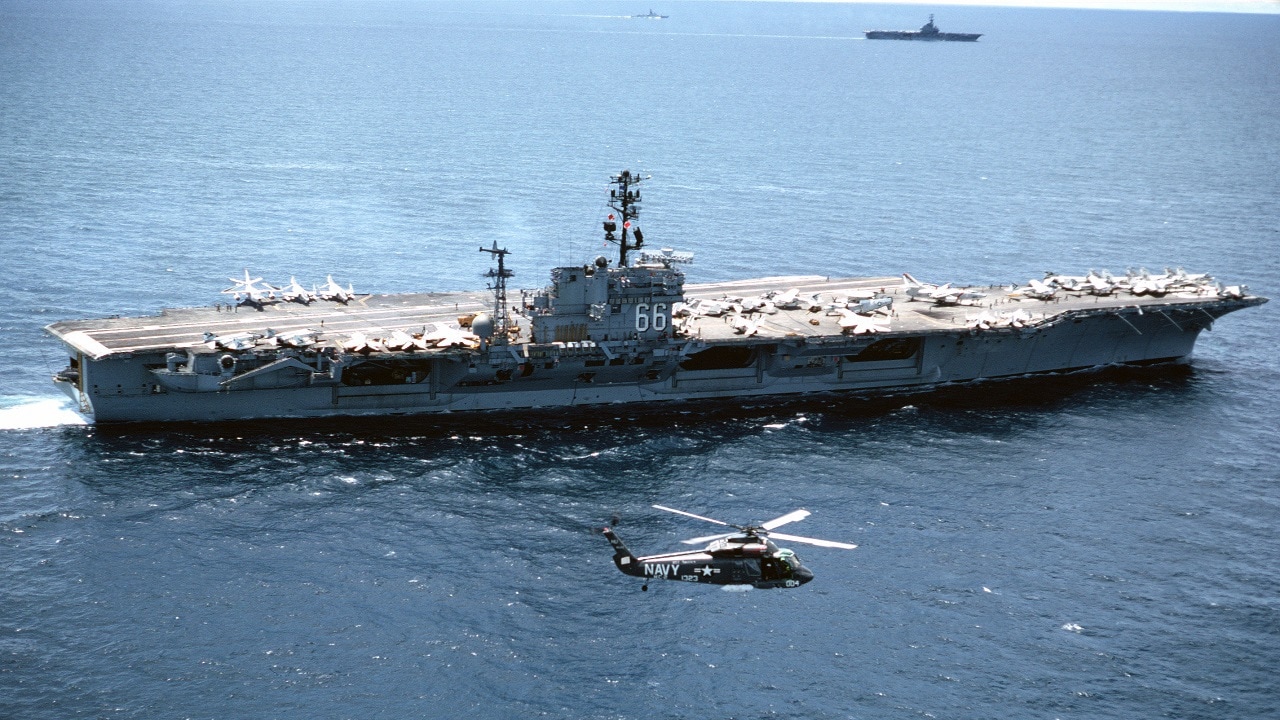
A Helicopter Combat Support Squadron 2 (HC-2) UH-2 Seasprite helicopter flies off the starboard side of the aircraft carrier USS AMERICA (CV 66) while the ship is underway. An unidentified aircraft carrier is in the background.
Aircraft launched from the USS America went to assist the Liberty following the attack.
“America’s medical team worked around the clock removing shrapnel and treating various wounds and burns,” the Navy history website said. And while the Arab side in the war accused the U.S. of providing air cover for the Israelis. However, per the Navy history site, “as witnessed and reported by the newsmen on board, these charges were completely false. The 6th Fleet, as with all other American forces, had remained neutral.”
Then, a year later, in April 1968, it was time for the USS America to head to Vietnam. It would have three deployments to that war.
“During four line periods, consisting of 112 days on “Yankee Station,” America’s aircraft pounded at roads and waterways, trucks and waterborne logistics craft (WBLCS), hammered at petroleum storage areas and truck parks and destroyed bridges and cave storage areas in the attempt to impede the flow of men and war materials to the south,” The Navy history account said.
The carrier’s first MiG kill of the conflict happened on July 10, 1968.
In 1970, the USS America returned to Vietnam, where it once again facilitated numerous missions. In August of that year, the carrier hosted Ferdinand E. Marcos, president of the Philippines.
That year, on its way back from Vietnam, the crew celebrated Thanksgiving, and then, after crossing the International Date Line, they celebrated it again.
In 1973, large-scale U.S. involvement in Vietnam came to an end, and the USS America was mostly away from any type of major combat for most of the 1970s.
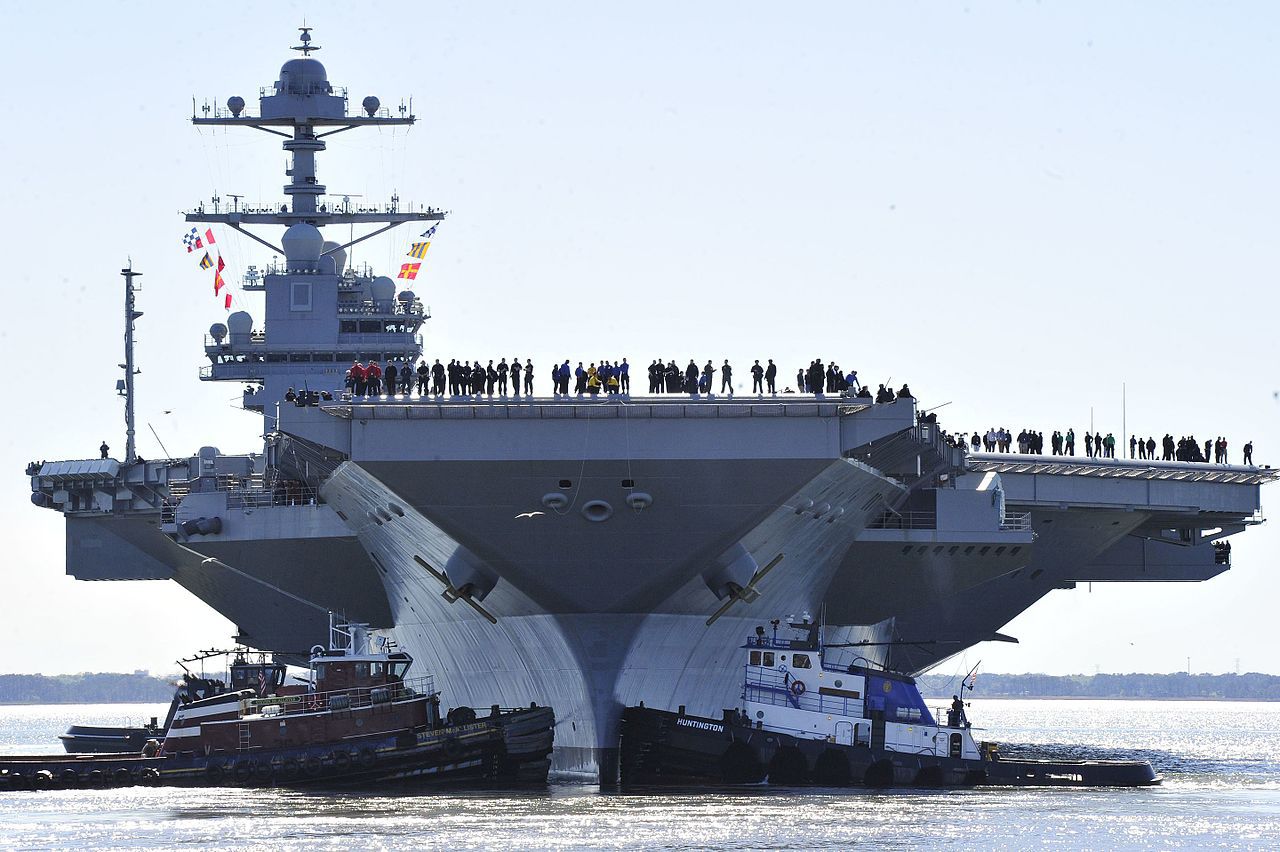
NEWPORT NEWS, Va. (April 8, 2017) – Pre-Commissioning Unit Gerald R. Ford (CVN 78) Sailors man the rails as the ship departs Huntington Ingalls Industries Newport News Shipbuilding for builder’s sea trials off the coast. The first- of-class ship—the first new U.S. aircraft carrier design in 40 years—will spend several days conducting builder’s sea trials, a comprehensive test of many of the ship’s key systems and technologies. (U.S. Navy photo by Chief Mass Communication Specialist Christopher Delano).
Attack on Libya
In 1986, after terrorist attacks on an airplane and in a German discotheque that killed two U.S. servicemen, the USS America was used for retaliatory attacks, in what was known as Operation “Eldorado Canyon.”
“America launched six Intruders (strike aircraft) from VA-34 and six A-7E “Corsair Us” (strike support),” the Naval history account said.
Then, after Iraq invaded Kuwait in 1990, the USS America headed to the Red Sea as part of Operation Desert Shield and remained in the region when it transitioned to Operation Desert Storm the following January, eventually heading to the Persian Gulf.
After that, the USS America headed off on its final deployment in 1995, before it was decommissioned in August of 1996.
The Long Sinking
The USS America’s final sinking was unique.
According to an Aviation Geek Club account from 2020, the USS America became the only supercarrier ever to be sunk. That happened in 2005, when the ship received a “classified SinkEx.” The sinking did not occur in combat; it was intentionally sunk, even though it took four weeks.
“It took four weeks, and they ended up having to scuttle her from on board due to her not sinking,” Blake Horner, Mechanical Engineer, told Quora. “It took four weeks, and they ended up having to scuttle her from on board due to her not sinking. She is not only far larger than WWII battleships, but she is also a lot tougher.”
A problem, Horner said, was the double-layered hull.
“On top of that, her internal compartmentalization was far better than that of battleships. She is so large, there are so many more rooms that must be filled in order to make her sink than that of a battleship.”
The Navy at one point released the exact coordinates of the sinking, which occurred off Cape Hatteras, a barrier island in North Carolina.
Per the AGC story, some objected to America being sunk on purpose, while others wished the carriers be preserved as a museum ship.
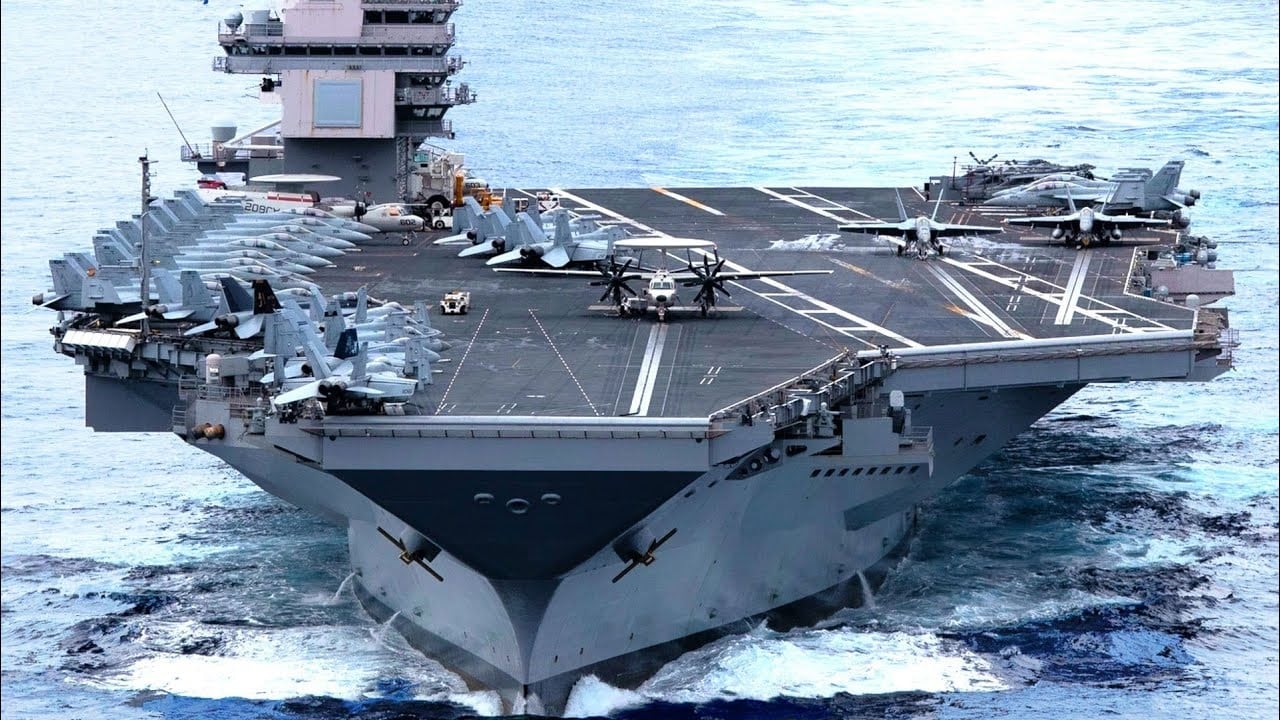
USS Gerald R. Ford. Image Credit: Creative Commons.
However, it was decided to sink it, with the hope that the Navy would learn lessons from the process.
“America will make one final and vital contribution to our national defense, this time as a live-fire test and evaluation platform,” Vice Chief of Naval Operations Admiral John B. Nathman wrote in a letter at the time.
“America’s legacy will serve as a footprint in the design of future carriers — ships that will protect the sons, daughters, grandchildren, and great-grandchildren of America’s veterans.”
MORE – Russia Is Out Of Aircraft Carriers
MORE – Russia’s Battlecrusier Might Never Battle Anyone
About the Author: Stephen Silver
Stephen Silver is an award-winning journalist, essayist, and film critic, and contributor to the Philadelphia Inquirer, the Jewish Telegraphic Agency, Broad Street Review, and Splice Today. The co-founder of the Philadelphia Film Critics Circle, Stephen lives in suburban Philadelphia with his wife and two sons. For over a decade, Stephen has authored thousands of articles that focus on politics, national security, technology, and the economy. Follow him on X (formerly Twitter) at @StephenSilver, and subscribe to his Substack newsletter.