
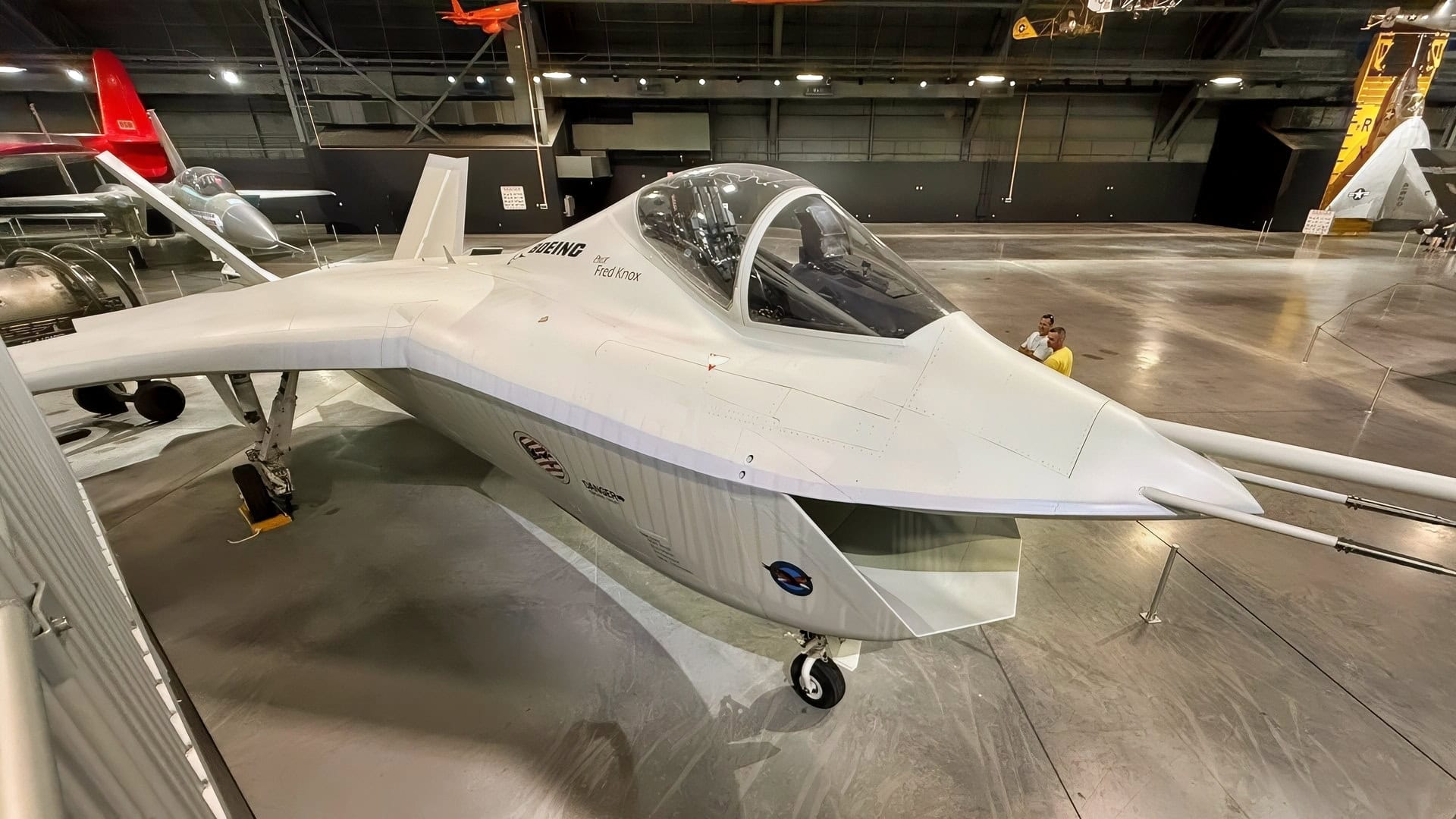
The X-32 is one of the more intriguing “what if” stories from the first decade of the post-Cold War era. Designed in the 1990s as Boeing’s entry into the U.S. military’s Joint Strike Fighter (JSF) competition, it ultimately lost to what we now know as the F-35 Lightning II.
Looking Back: The Why and the Wherefore
The raison d’être of the JSF program was to develop a stealth-enabled, lightweight air-to-air fighter and ground-attack aircraft designed with vertical/short takeoff and landing capabilities.
In other words, this plane would be a multirole jack-of-all trades that would complement and eventually replace the U.S. Air Force’s F-16 Fighting Falcon, the U.S. Navy’s F/A-18 Hornet, and the U.S. Marine Corps’ AV-8B Harrier II. It would also have the added bonus of stealth technology.
The JSF program traced its roots back to 1993, when the Defense Advanced Research Projects Agency launched the Common Affordable Lightweight Fighter project.
This merged with the Joint Advanced Strike Technology program in 1994, and in 1995, the merged venture was renamed the Joint Strike Fighter.

Boeing X-32 Fighter image taken by 19FortyFive back in July 2025.
Boeing’s X-32A variant made its maiden flight on September 18, 2000, and was submitted as the company’s candidate for the Air Force platform; the X-32B was Boeing’s entrant for Navy and Marine Corps consideration.
Why did the budding Boeing birds lose out to the X-35?
The X-35’s first problem was the core of the X-32B variant’s short takeoff and vertical landing (STOVL) system.
It caused hot air from the plane’s exhaust to be recirculated into its modified intake, weakening thrust and leading to overheating.
The plane’s massive chin intake and overall geometry also made radar signature management difficult. Direct visibility of the compressor blades enlarged the airplane’s radar cross-section. This compromised the plane’s stealth, defeating much of the purpose of the JSF program.
Finally, the warbird had a delta-wing design, and its lack of horizontal tail surfaces restricted pitch authority. This diminished agility and complicated approaches for carrier landings.

Boeing X-32 Fighter image taken by 19FortyFive back in July 2025.
As a result, the F-35A, F-35B, and F-35C now serve with the U.S. Air Force, Marine Corps, and Navy. (By contrast, the F-22 Raptor stealth fighter, which came from the Advanced Tactical Fighter program, is strictly an Air Force asset.)
The two X-32s were relegated to mere museum curios. In general, it is wonderful that both prototypes were preserved for posterity. However, even that turns out to be a mixed blessing.
The Good News: X-32 Static Display #1
The first prototype, the X-32A, is housed at the Research & Development gallery of the National Museum of the United States Air Force at Wright-Patterson Air Force Base, near Dayton, Ohio. 19FortyFive visited that fighter and included photos from that trip in this article.
This venue makes perfect sense, since, as already noted, the X-32A was built for Air Force consumption.
This specimen made a total of 66 flights during its four months of testing.
It was delivered to the National Museum in 2005 and, following restoration, was placed on display in May 2024.
Since it’s ensconced indoors, it remains in pretty good shape.
The Not So Good News: X-32 Static Display #2
The second specimen, the X-32B, sits at the Patuxent River Naval Air Museum (PRNAM) adjacent to Naval Air Station Patuxent River in St. Mary’s County, Maryland.

Boeing X-32 Stealth Fighter in Maryland. Image taken by 19FortyFive.com staff back in 2025.
As noted by the museum display’s info screen, “The sole X-32B, our aircraft first flew on 29 March 2001. It was never assigned a Navy Bureau Number. After initial testing at Edwards AFB, the aircraft moved to NAS Patuxent River, where it participated in JSF flight trials between May and July 2001. In March 2005, the X-32B was transferred to PRNAM. The demonstrator had flown 78 flights and logged 43 flight hours.”
The X-32B’s tech specs and vital stats include a fuselage length of 43.7 feet, a wingspan of 30.0 feet, a maximum gross weight of 50,000 lbs., a powerplant consisting of a single Pratt & Whitney F119 turbofan engine, and a max airspeed of about Mach 1.4.

Boeing X-32B. 19FortyFive.com Image.
Alas, this jet is an outdoor display and has severely deteriorated after prolonged exposure to the elements.
In September 2025, this writer witnessed the reality of that deterioration during an in-person visit to PRNAM. The signs of wear and tear, particularly the fading paint, were especially noticeable on the lower half of the X-32B’s fuselage.
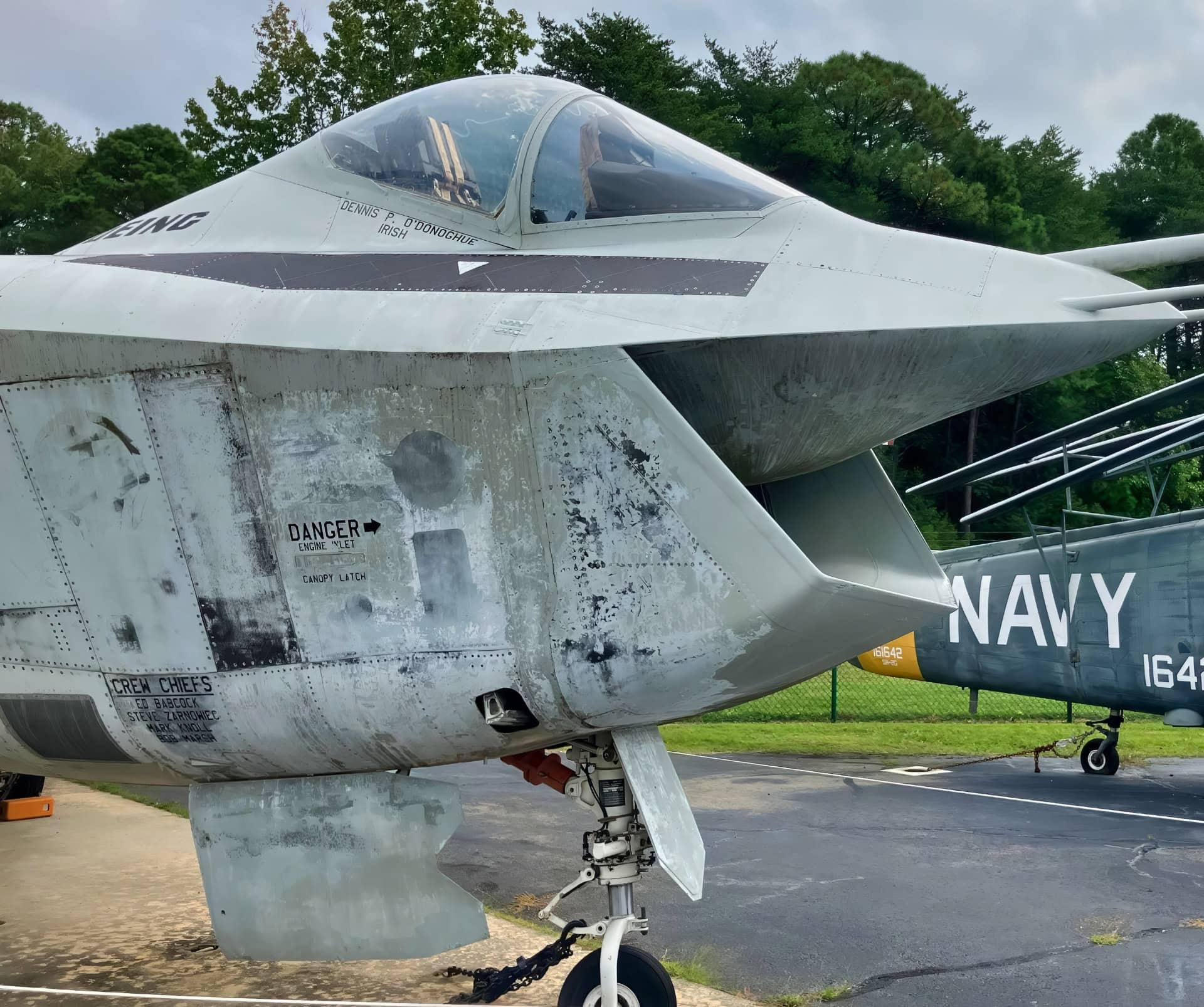
Side view of Boeing X-32B In Maryland. Image Credit: 19FortyFive.com
It is one thing to display vintage aircraft in a relatively non-humid climate that gets relatively little rainfall and no snow to speak of. Such is the case for The Proud Bird in sunny Southern California. It is quite another thing when you have a museum like PRNAM located in a region that is far more humid and truly experiences all four seasons.
One of the museum’s docents, Bill Russell, has been volunteering there for 35 years. Russell was nice enough to agree to an interview with this reporter about the museum’s X-32 exhibit.
Mr. Russell began his remarks by saying, “Actually, we have one of them, and they have another one at Wright-Patterson, which I understand is quite a bit cleaner-looking. … They had to repaint it because the [original] paint [job] got pretty much damaged, I guess, when they were doing the testing.” As to why the X-32 lost the JSF competition to the F-35, he wisecracked, “It’s because they’re so daggone ugly!”

X-32 Fighter. Image Credit: 19FortyFive.com
As for the aforementioned airframe decay, Russell lamented the lack of available volunteers to provide the necessary upkeep and maintenance. Regarding the fading paint job, he added that “in order to paint something like this, you have to take it to the Navy base. … they have a paint shop, you can’t just spray-paint outside, obviously. That’s what they have to do, and that’s why it just takes so long to get it done, because it’s almost ready to be painted, I mean, they’re still sanding down some of the surfaces.”
Poetically enough, PRNAM also has an X-35C static display. Unlike the X-32B, this is housed indoors, which unwittingly serves as a symbolic gesture of Lockheed’s triumph over Boeing in the JSF race … and dare we say a final slap in the face to the X-32.

X-32 Outside in the Elements. 19FortyFive.com Image.
Postscript and How You Can Help
Here’s hoping PRNAM will be able to recruit the necessary number of people willing and able to put in the labor needed to give the X-32B the full restoration she truly deserves.
If any of our dear readers live within a reasonable commuting distance of the museum and would like to volunteer, please click here.
About the Author: Christian D. Orr, Defense Expert
Christian D. Orr is a Senior Defense Editor. He is a former Air Force Security Forces officer, Federal law enforcement officer, and private military contractor (with assignments worked in Iraq, the United Arab Emirates, Kosovo, Japan, Germany, and the Pentagon). Chris holds a B.A. in International Relations from the University of Southern California (USC) and an M.A. in Intelligence Studies (with a concentration in Terrorism Studies) from American Military University (AMU). He is also the author of the book “Five Decades of a Fabulous Firearm: Celebrating the 50th Anniversary of the Beretta 92 Pistol Series,” the second edition of which was recently published.