
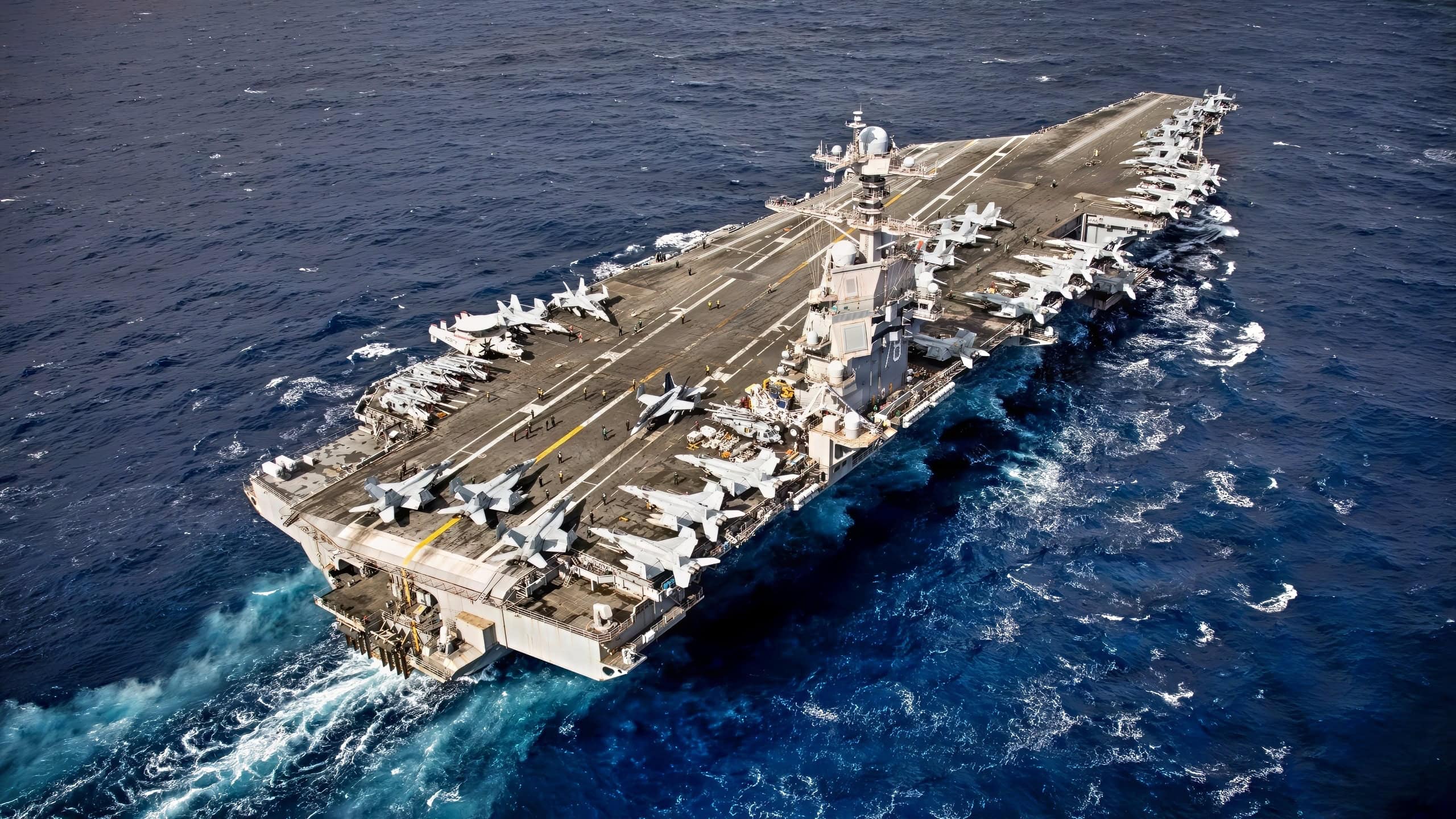
In mid-March, the USS Tripoli and the 31st Marine Expeditionary Unit threaded through the Strait of Malacca heading west — an American warship and a ship-borne MEU moving through one of the busiest shipping lanes on earth, bound for the Iranian theater. Local media in Singapore filmed them as they passed. Shipspotters tracked them on AIS. Within days, they were in the Indian Ocean, en route to join Operation Epic Fury.
Nobody much noticed the irony. The ships were leaving the strait that actually holds the global economy together to go defend the one we’ve spent fifty years worrying about.
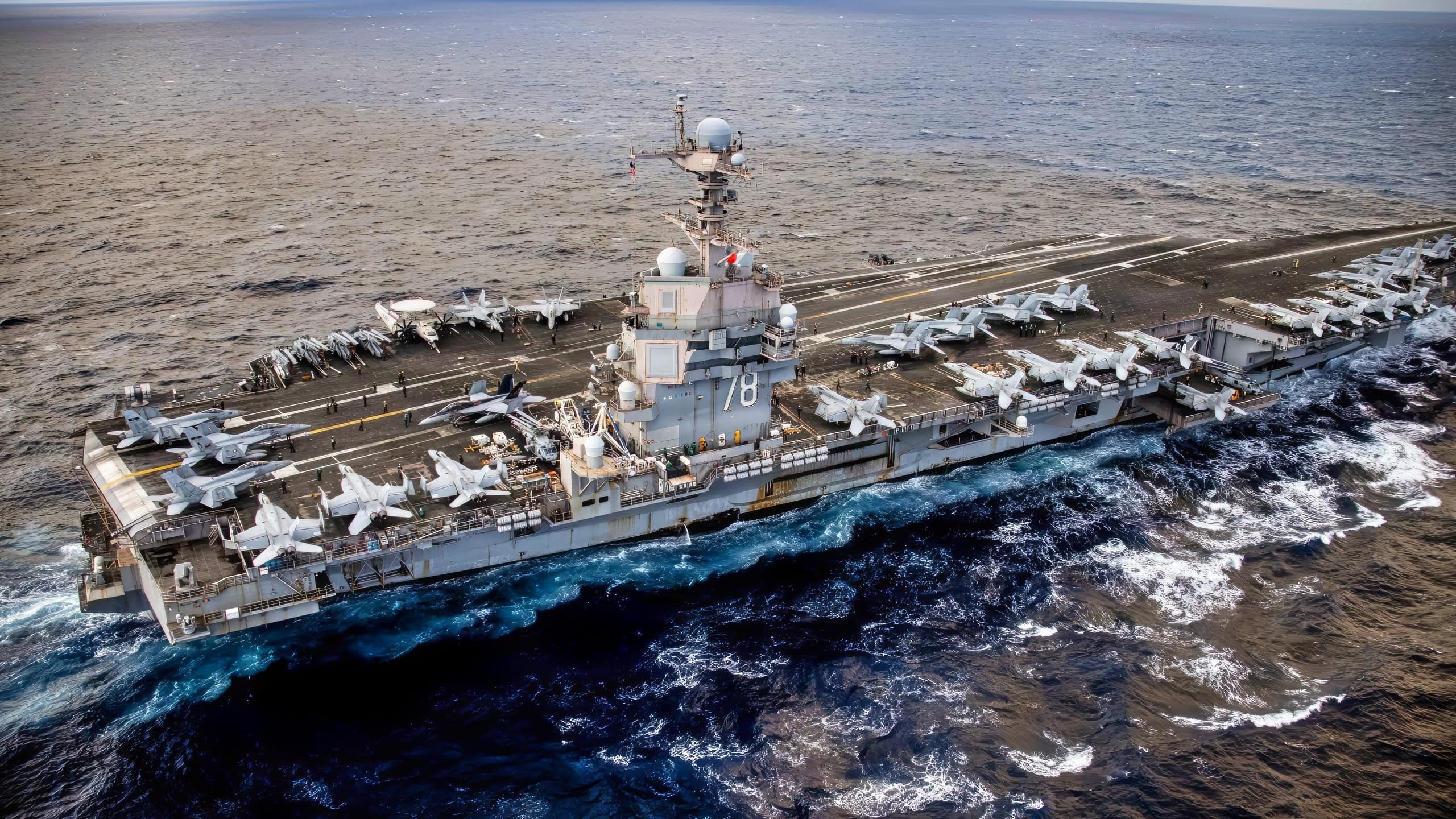
The world’s largest aircraft carrier, USS Gerald R. Ford (CVN 78), transits the Eastern Mediterranean Sea, March 22, 2026. Gerald R. Ford is on a scheduled deployment in the U.S. 6th Fleet area of operations to support the warfighting effectiveness, lethality and readiness of U.S. Naval Forces Europe Africa, and defend U.S., Allied and partner interests in the region. (U.S. Navy photo by Mass Communication Specialist 2nd Class Tajh Payne)
That’s worth sitting with.
Iran has effectively shut Hormuz. The carrier groups are in the Gulf, tanker insurance has gone through the roof, and Washington is doing what Washington does in a Persian Gulf crisis — obsessing about the Persian Gulf. The think tanks are running the same plays. The cable news hits sound identical. Hormuz!
Meanwhile, piracy in the Malacca Strait just hit a 19-year high. One hundred and eight incidents in 2025, per ReCAAP. Malaysia and Singapore are having conversations — not entirely behind closed doors — about whether ships transiting the strait should start paying for the privilege. Five years ago, that idea died in a committee room. Right now it has legs.
Washington isn’t paying attention.
Strait of Malacca: A Different Kind of Chokepoint
Hormuz moves oil. Malacca moves everything.
Roughly 40 percent of global trade by volume passes through it every year — north of $3.5 trillion in goods. Oil and LNG are flowing east toward China, Japan, South Korea, and India. Semiconductors and finished goods are flowing out from the production hubs of East and Southeast Asia.
Raw materials are cycling through to feed factories across the region. The Strait isn’t one supply chain. It’s where most of them converge, in a channel so narrow that a single disabled supertanker at the wrong angle creates a problem with no clean solution.
Hit Hormuz, and you generate an energy shock — serious, painful, something the global economy has absorbed versions of before. Hit Malacca, and you do something the global economy hasn’t had to absorb, because nothing like it has happened in the modern era.
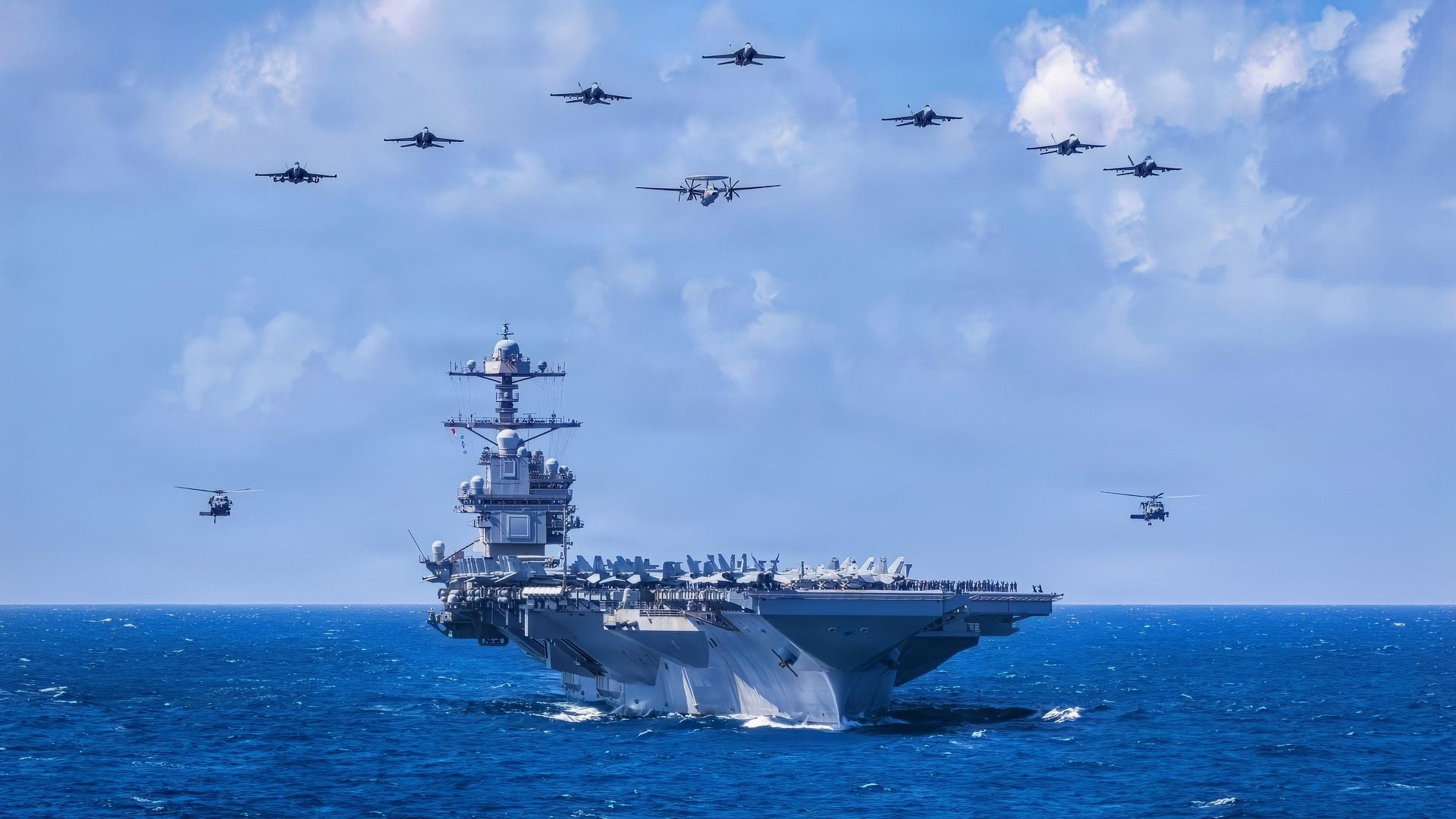
USS Ford Supercarrier U.S. Navy. Image Credit: U.S. Navy.
You don’t raise prices. You stop the inputs.
Chips stop arriving. Components stop arriving. The just-in-time manufacturing model that underpins production from Stuttgart to Guadalajara to Chengdu starts seizing up within weeks—not because energy has gotten expensive, but because the material flow sustaining it has been cut.
There’s no strategic petroleum reserve for semiconductors or rare earths.
When those supply lines stop, they stop.
It’s Already Being Tested
The 19-year piracy record isn’t a footnote. It’s a signal.
Armed robbery of vessels, boarding attempts, AIS spoofing, unattributed shadowing that doesn’t fit the pattern of ordinary criminal opportunism — the ReCAAP data tells a consistent story across 2025 and into this year. Some of it is random. Some of it isn’t.
The line between freelance piracy and systematic reconnaissance of a strategic waterway is genuinely hard to draw. For anyone mapping vulnerabilities in a chokepoint this consequential, that ambiguity is the point. It allows probing without accountability. It generates intelligence without triggering a response.
The governance structure makes it worse. Malacca runs under a tripartite arrangement among Malaysia, Singapore, and Indonesia — three sovereign states with real disagreements over managing shared maritime space, genuine limitations on naval capacity relative to the traffic they oversee, and deep sensitivity to outside powers operating in their waters. No unified command. No standing multinational force. Nothing that functions the way Combined Maritime Forces does in the Gulf.
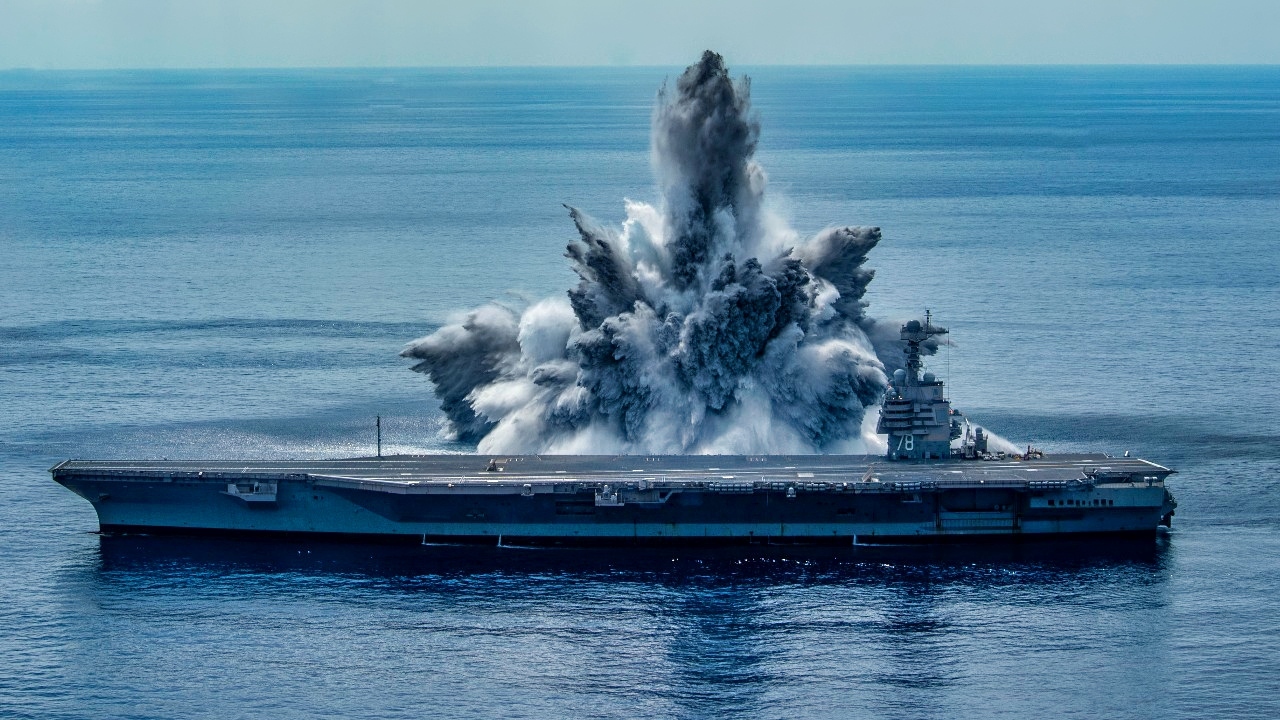
The aircraft carrier USS Gerald R. Ford (CVN 78) successfully completes the third and final scheduled explosive event of Full Ship Shock Trials while underway in the Atlantic Ocean, Aug. 8, 2021. The U.S. Navy conducts shock trials of new ship designs using live explosives to confirm that our warships can continue to meet demanding mission requirements under harsh conditions they might encounter in battle. (U.S. Navy photo by Mass Communication Specialist 3rd Class Novalee Manzella)
The Jakarta Treaty, signed between Indonesia and Australia in February, is a step — a real one, worth noting.
But bilateral information-sharing and coordinated patrols are not a substitute for a coherent security architecture. They are an acknowledgment that one doesn’t exist.
The corridor is being tested. The architecture meant to protect it is patched together.
What Beijing Figured Out in 2003
China has a name for this vulnerability. The “Malacca Dilemma” — a phrase Hu Jintao used at an economic conference in November 2003- and Beijing has been engineering around it ever since. Overland pipelines through Myanmar and Pakistan.
Port development along the Indian Ocean rim. Sustained interest in Arctic routes that bypass the strait entirely. The Chinese understand that their economic lifeline runs through water they don’t control, and that a capable adversary could interdict it. This keeps senior planners in Beijing up at night.
Washington could draw the same conclusion from the same map and reach a very different set of implications. It largely hasn’t — not in ways that register in posture, resourcing, or the public conversation about Indo-Pacific security.
The US Navy just routed an amphibious ready group through Malacca to reinforce a shooting war in the Gulf. That’s the operational priority. It’s understandable. It also illustrates exactly the problem: every asset pulled toward Hormuz is an asset not present in the waters that matter more for a China contingency.
Any serious escalation in the Indo-Pacific — Taiwan, South China Sea — almost certainly involves Malacca as a pressure point in the opening days. An adversary that can threaten or disrupt the strait doesn’t need to win every engagement. Cutting the supply chain does the work while the carriers are pointed somewhere else.
What Actually Needs to Happen
This isn’t a call for a new fleet. It’s a call for honesty about where the exposure actually is.
The toll conversation is where to start — not because it’s the biggest problem, but because it’s the one already in motion and the one Washington can actually influence without firing a shot. When Singapore and Kuala Lumpur start asking why they should drain their own treasuries to maintain a waterway that underwrites global supply chains while Washington weaponizes trade as a foreign policy instrument, that’s not a bureaucratic dispute about UNCLOS.
That’s a political deterioration in the stability of a corridor that doesn’t have a backup. A diplomatic presence and a cost-sharing framework won’t make the headlines. They’ll keep the Strait open. That’s the job.
The USS Tripoli transited Malacca in March, heading for a war in the Gulf. The strait it left behind logged 108 piracy incidents last year and is now the subject of toll discussions that would have been unthinkable half a decade ago.
Iran had to decide to close Hormuz.
Malacca is closing on its own.
About the Author: Dr. Andrew Latham
Andrew Latham is a professor of international relations and political theory at Macalester College in Saint Paul, MN. You can follow him on X: @aakatham. He writes a daily column for 19FortyFive.com.