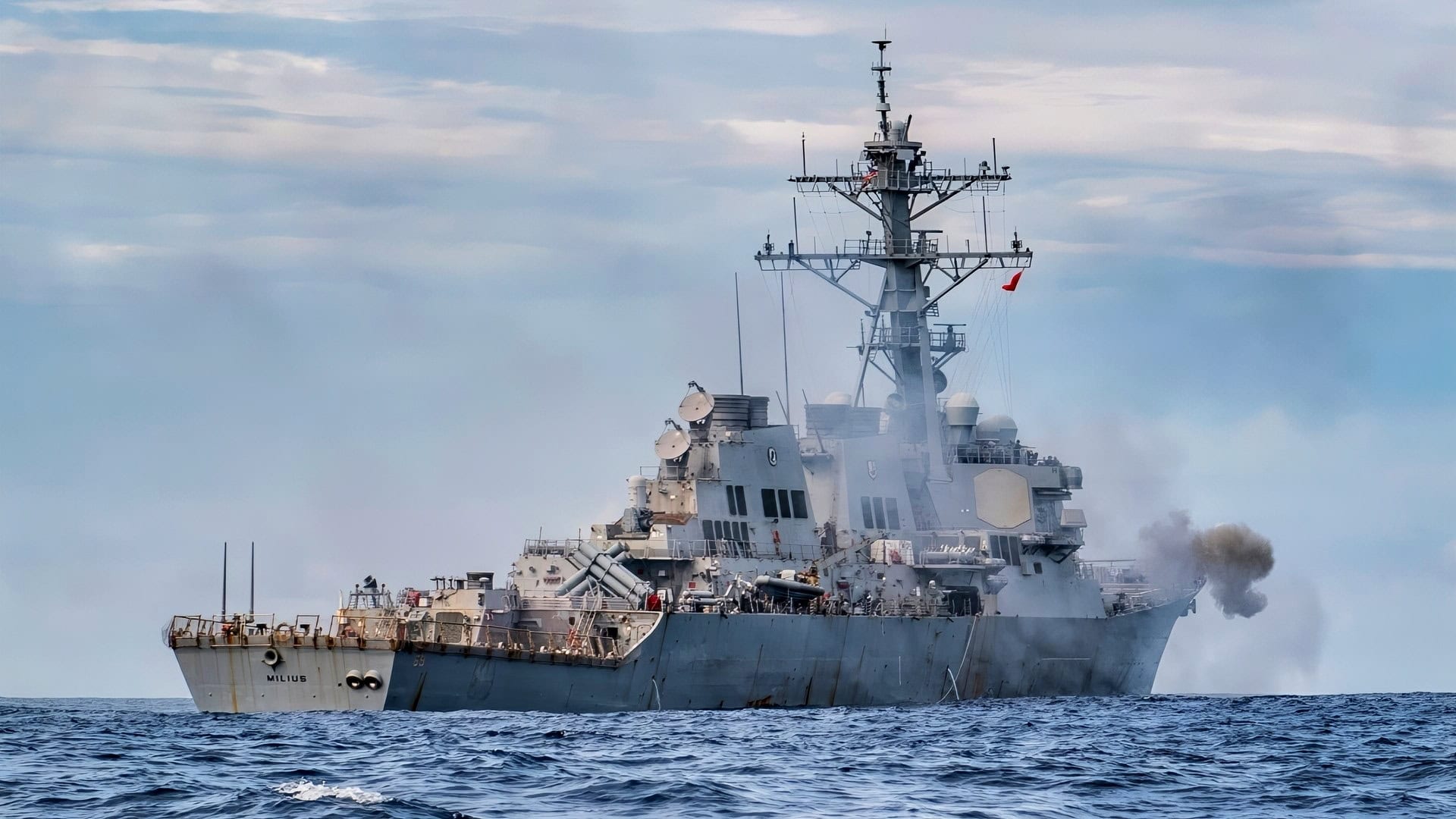
The Iran Crisis Isn’t Exactly Over: The U.S. Navy has a near-perfect record of shooting down drones and missiles at sea. Oil tanker crews still won’t sail through the Strait of Hormuz — because ‘near-perfect‘ isn’t good enough when your ship is full of crude.
The Strait of Hormuz, the U.S. Navy, and the Fear Factor
The U.S. Navy’s record defending drone and missile attacks in the Red Sea was essentially “perfect,” and many lessons were learned, weapons were acquired, and new tactics were refined.
Navy commanders explained the success in a multi-fold fashion, referring to sailor weapons training, effective doctrine, multi-domain sensing, and breakthrough levels of “joint” command and control.
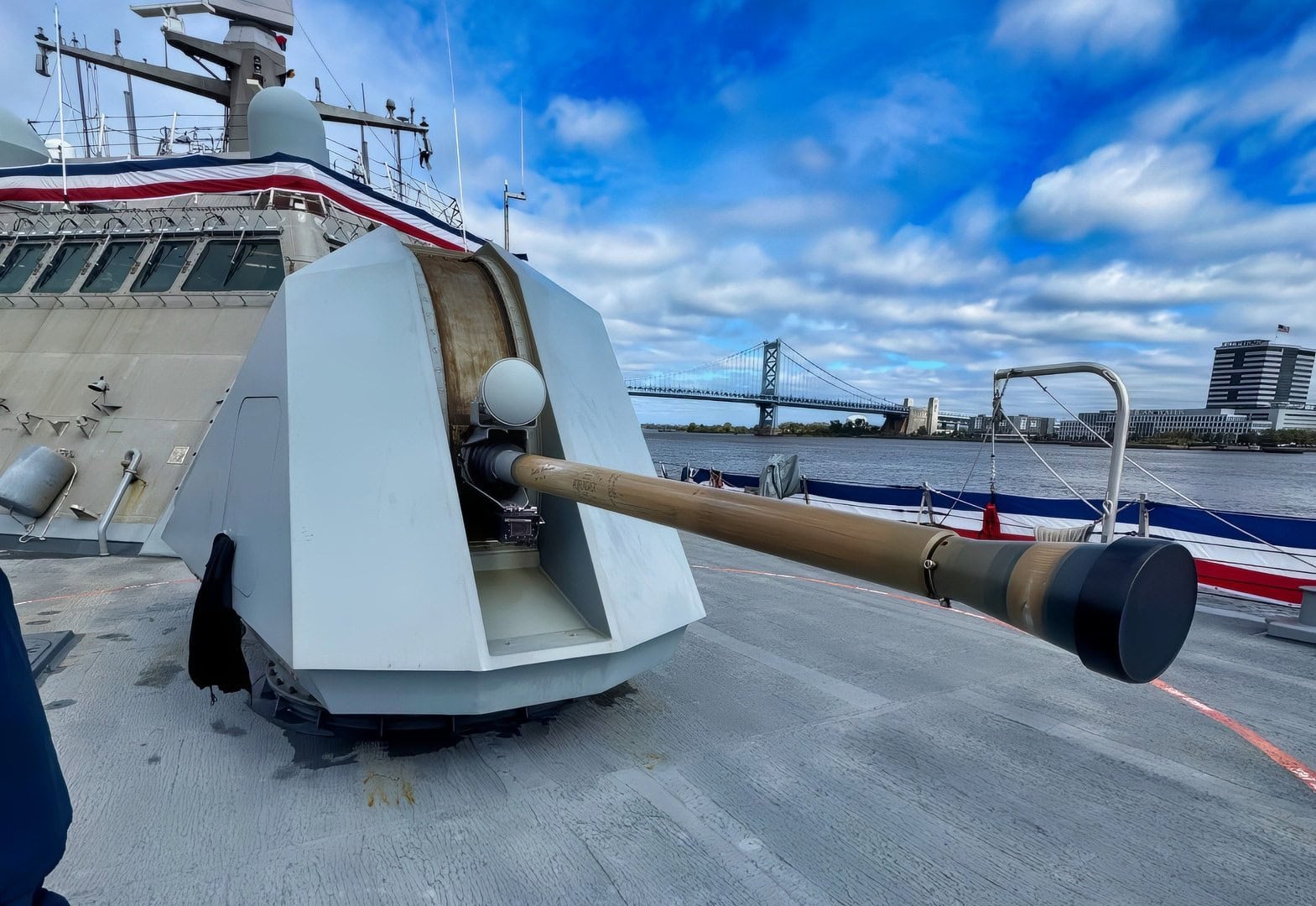
Littoral Combat Ship Deck Gun U.S. Navy. Image Credit: 19FortyFive.com
For the USS Eisenhower Carrier Strike Group in the Red Sea, which includes the USS Laboon destroyer, tracking and eliminating incoming Houthi attacks was a consistent, focused sailor focus on training, tactics, and doctrine.
Could this success inspire some to posit that perhaps U.S. Navy warships could simply “escort” and protect ships passing through the Strait of Hormuz?
Would U.S. Navy experience countering drones and missiles, combined with weapons and trained sailors, be sufficient to allay the fears of commercial oil tankers seeking peaceful transit?
This is a key question as there are many variables central to this equation, and Iran is known to randomly and at times indiscriminately attack commercial vessels unrelated to the ongoing military conflict.
The intent here would simply be to create global political and economic chaos and instability by making the Strait of Hormuz essentially “too dangerous” to transit.
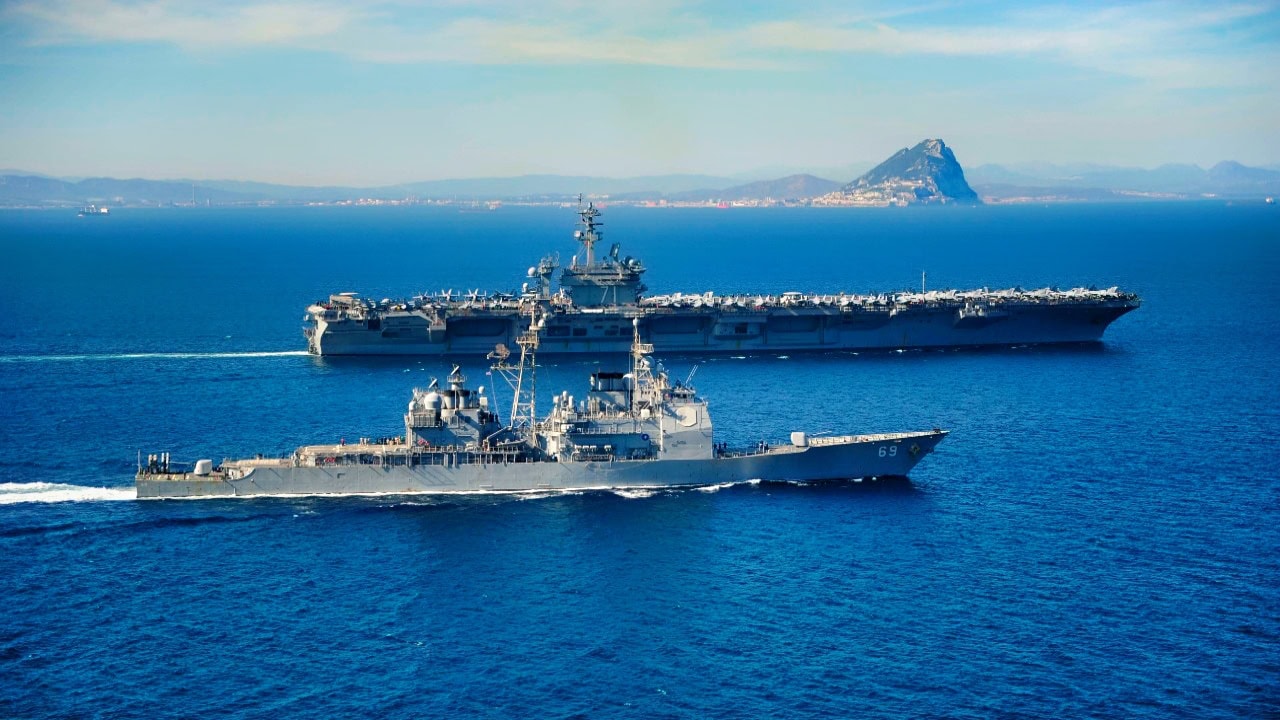
Ticonderoga-Class Cruiser U.S. Navy. Image Credit: Creative Commons.
U.S. Navy “Could” Protect Ships in the Strait
Analyzing the tactical and technological circumstances surrounding Iranian missile and drone attacks in the Strait of Hormuz, one can discern two colliding trajectories.
In one sense, yes, the U.S. would be well-positioned to “protect” ships passing through the Strait from Iranian attack, yet the mere “promise” of surface warship protection may not be sufficient to quell the hesitations and concerns of commercial oil traffickers who are all too well aware that they would be targeted without restraint.
At the same time, while “perfection” in the realm of drone and missile defense at sea is not something which can be “guaranteed,” U.S. Navy warships do operate with an advanced suite of layered drone and missile defenses which have been proven extremely effective.
Not only can incoming drones now be “seen” consistently from long stand-off distances with ground, air, space, and surface ship sensing, radar, and ISR, but U.S. Navy warships increasingly operate with advanced countermeasures.
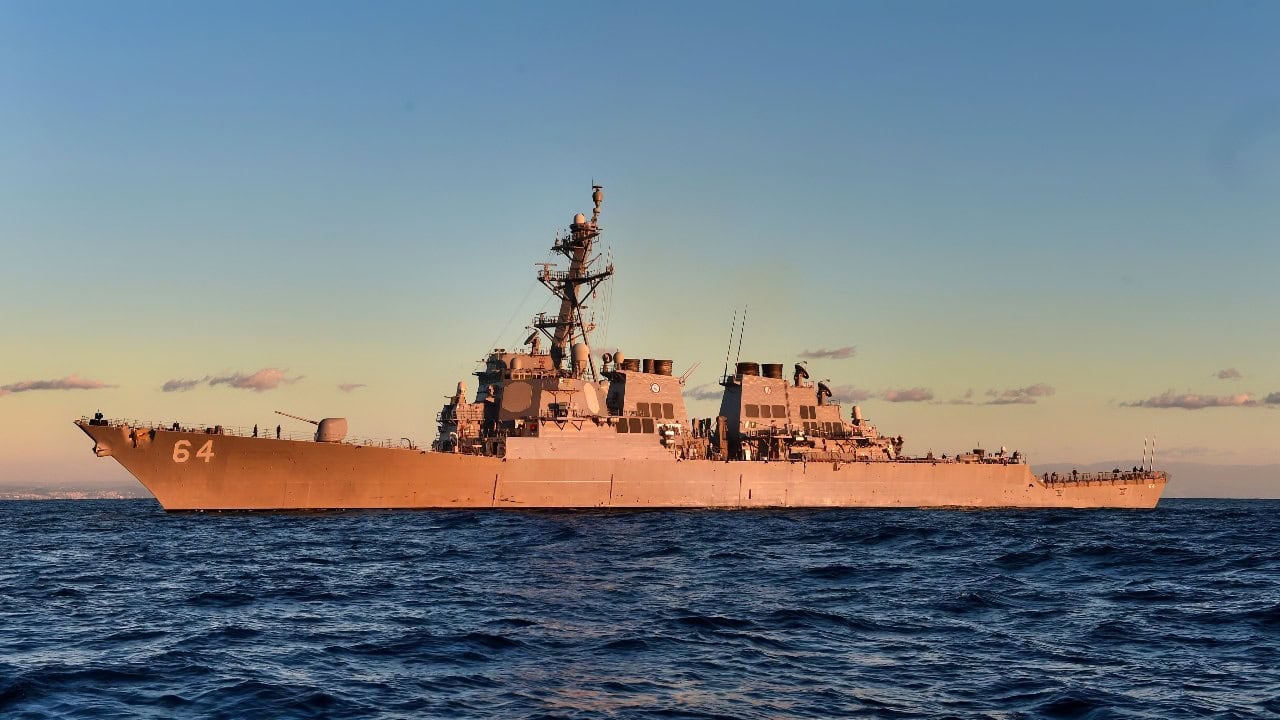
(Dec. 6, 2015). USS Carney (DDG 64) awaits the return of its small boat crew during a passenger transfer Dec. 6, 2015. Carney, an Arleigh Burke-class guided missile destroyer, forward deployed to Rota, Spain, is conducting a routine patrol in the U. S. 6th Fleet area of operations in support of U.S. national security interests in Europe. (U.S. Navy photo by Mass Communication Specialist 1st Class Theron J. Godbold/Released)
Ship-integrated drone defenses have been improved in recent months following the U.S. Navy’s experience in the Red Sea with new counter-drone weapons, longer-range, high-fidelity sensors, multi-domain “joint” networking and command and control, and improved threat detection systems.
Ship-Fired Coyote
For instance, the U.S. Navy has integrated a maritime variant of the well-known Coyote land-based counter-drone interceptor.
Coyote is a mini-drone and missile which can operate in both an offensive and defensive capacity; the weapon can conduct standard drone surveillance with EO/IR cameras or fire out from armored vehicles with a proximity fuse and “explode” in the air to disperse fragmentation across an “area” and potentially disable an entire attacking drone swarm.
Now, the U.S. Navy has integrated the Coyote into its layered ship defense systems so the weapon-drone-counterdrone weapon can fire out from the deck of a surface warship to detonate across an “area” to disable, stop, jam or fully “destroy” attacking drone swarms by “detonating” at a specific designated “spot” to destroy groups of drones at one time.

Littoral Combat Ship from Fleet Week 2025. Image Credit: Stephen Silver/19FortyFive.com
Overall, the question invites a juxtaposition or contradiction, because while yes, the U.S. Navy most likely “could” protect non-military ships with its experience, surveillance, weaponry, and countermeasures … yet the promise of U.S. protection is likely not enough to assuage the fears and hesitations fundamental to ship crews seeking to transit the Strait of Hormuz.
Kris Osborn: Warrior Maven President
Kris Osborn is the President of Warrior Maven – Center for Military Modernization. Osborn previously served at the Pentagon as a highly qualified expert in the Office of the Assistant Secretary of the Army—Acquisition, Logistics & Technology. Osborn has also worked as an anchor and on-air military specialist at national TV networks. He has appeared as a guest military expert on Fox News, MSNBC, The Military Channel, and The History Channel. He also has a Masters Degree in Comparative Literature from Columbia University.