
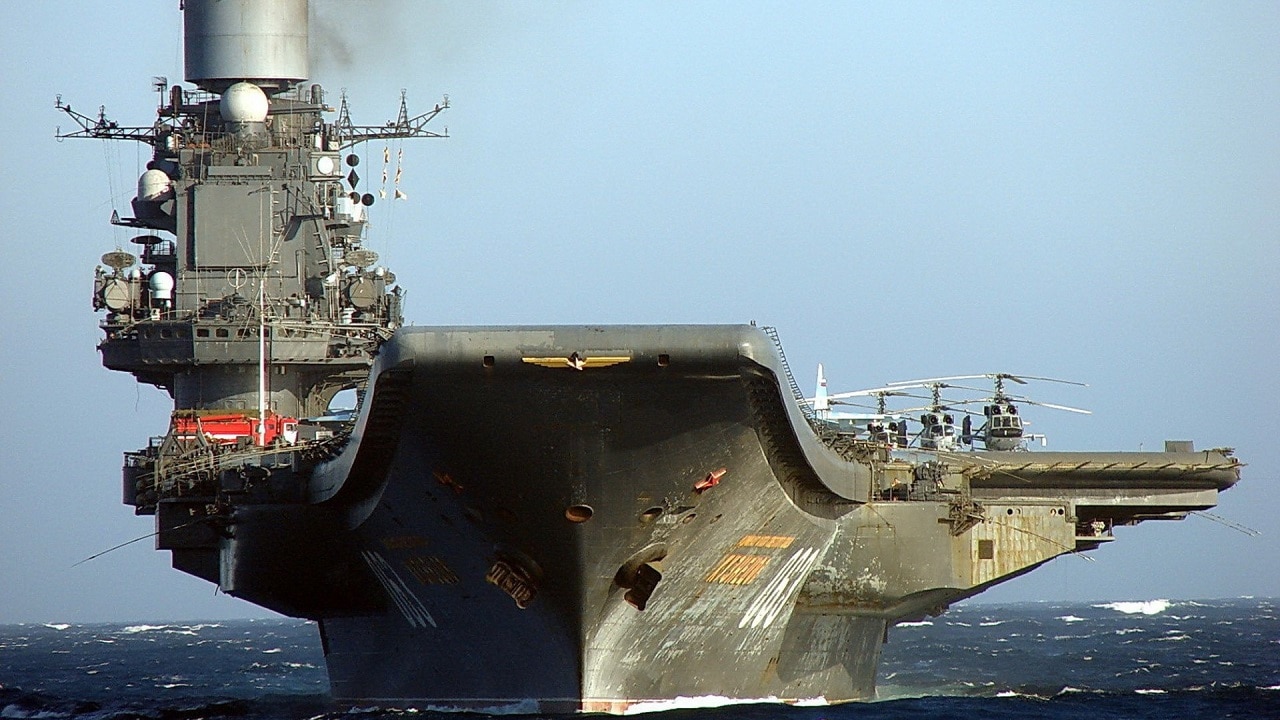
The Soviet Union’s top admiral begged Stalin for aircraft carriers. Stalin gave him zero, and seven decades later, Russia still hasn’t built a single carrier that works.
Russia’s Aircraft Carrier Problem Is Decades in the Making
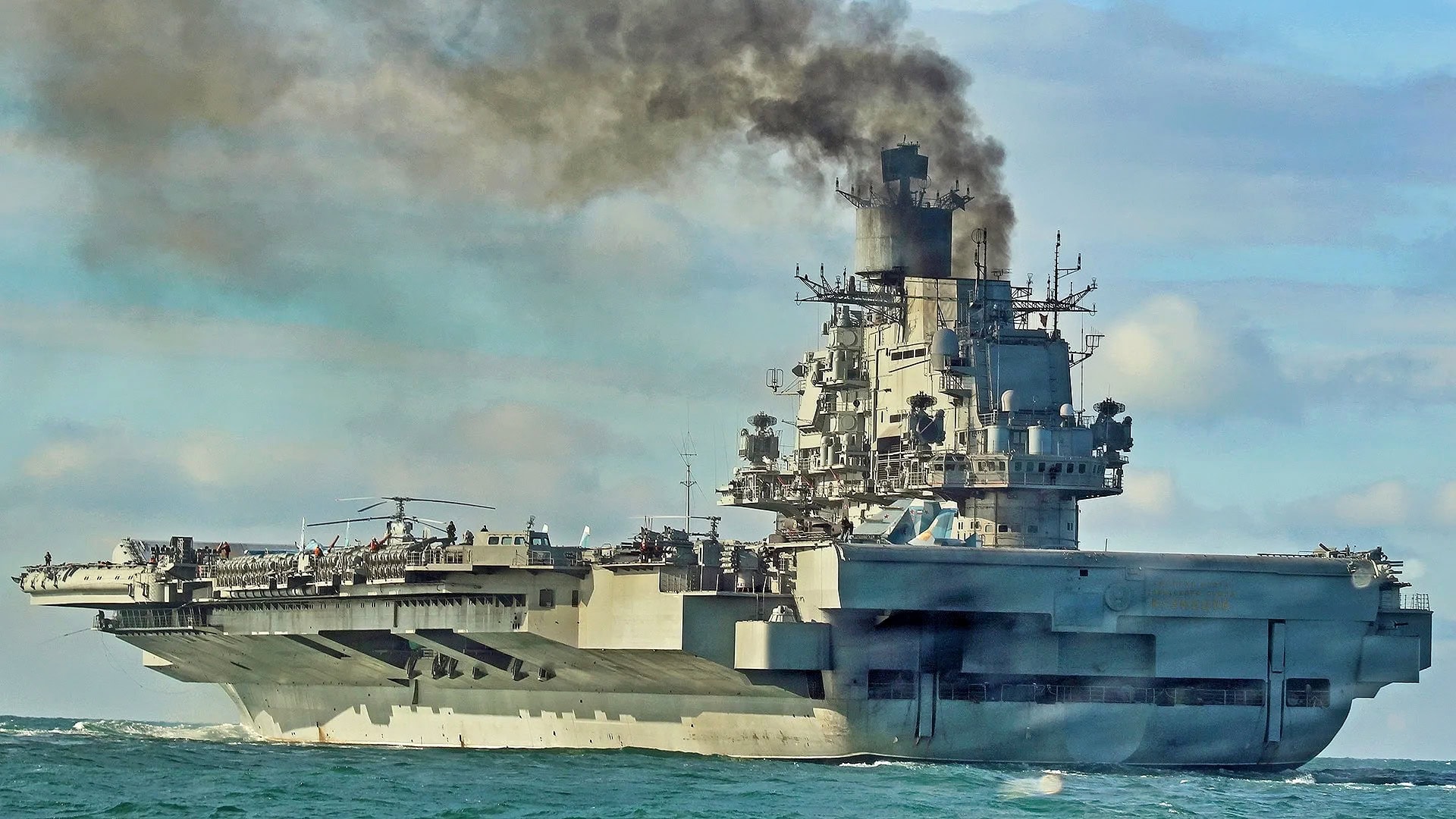
Aircraft Carrier Admiral Kuznetsov Russian Navy. Image Credit: Creative Commons.
Former U.S. President Ronald Wilson Reagan rightfully referred to the Soviet Union as an “Evil Empire” (and if he were alive today, he’d probably view Vladimir Putin’s rule of the post-Cold War Russian Federation as an attempt to resurrect that Empire).
However, as the saying goes, “Give the devil his due.” That Evil Empire, despite the woeful inefficiency inherent to a centrally planned statist economy, built an array of impressive military machines, from assault rifles to tanks to nuclear submarines to spacecraft. Yet in the oh-so-important arena of aircraft carriers (aka “flattops”), the Soviet Union and post-Soviet Russia alike failed miserably.
So then, why couldn’t the Russkies, for all their vaunted industrial might, build a decent flattop?
Lack of Precedent
Part of it could be a poor historical head start, thanks in turn to a closed-minded head honcho. During World War II, the U.S., U.K., and Imperial Japan alike churned out a goodly number of carriers that had quality to match the quantity.
By contrast, Soviet head of state Joseph Stalin was not keen on them; he believed Soviet battles would be fought near their own shores and did not see the need for such large symbols of power projection.
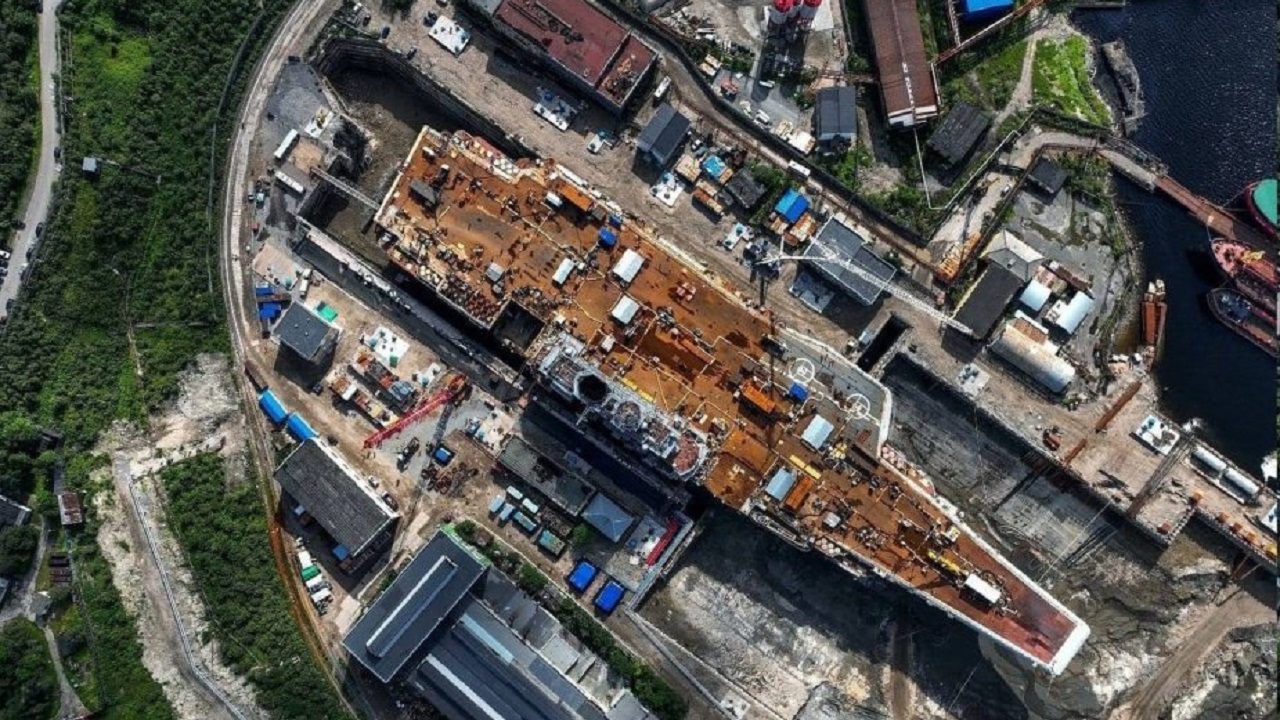
Russian aircraft carrier Admiral Kuznetsov (Picture source: Creative Commons.)
He therefore overruled his Minister of the Navy, Nikolai Gerasimovich Kuznetsov, who had conceptualized a fleet of carriers for the Soviet Navy. Admiral Kuznetsov’s request was whittled down, first down to two measly light carriers, and then down again to nol’ (“zero”).
The Late 1960s: Finally Getting Underway (Somewhat)
Even after Stalin’s death, much of the USSR’s military and political intelligentsia questioned the legitimacy of aircraft carriers, especially given improvements in missile technology; “Why invest in such large capital ships, when a small submarine or missile boat can sink them?” they rationalized.
Therefore, Adm. Kuznetsov’s carrier fleet dream made no progress under Nikita Khrushchev than it had under “Uncle Joe.”
It wasn’t until Leonid Brezhnev became General Secretary of the Communist Party of the Soviet Union that the Soviet aircraft carrier program finally got underway, sort of.
The Soviet Navy’s first class of helicopter carrier, Project 1123 Kondor, kicked off with the commissioning of the Moskva on Christmas Day 1967, followed by the second and final ship of the class, the Leningrad, which was commissioned on June 2, 1969. (Both vessels were launched in Mykolaiv, Ukraine.)
Having thus witnessed at least a partial realization of his original vision, Admiral Kuznetsov passed away in 1974.
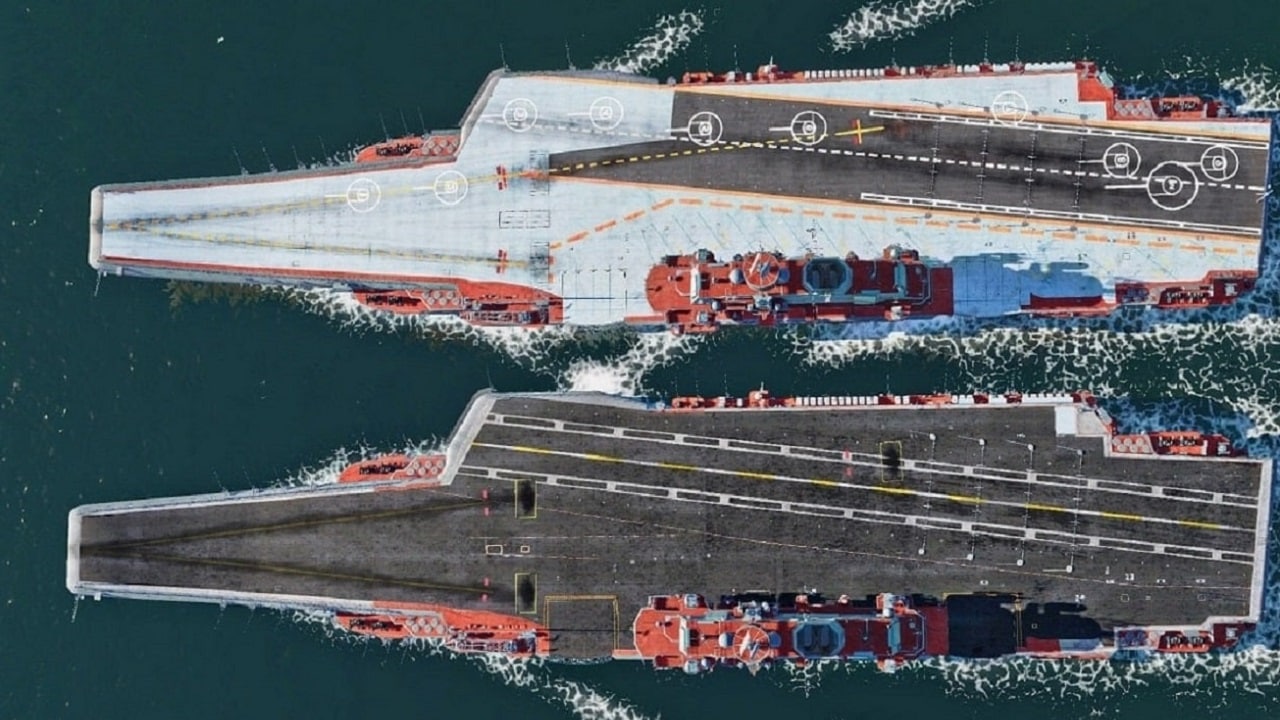
Admiral Kuznetsov before and after a refit. Image Credit: Creative Commons.
However, even this was an incomplete fulfillment of the dream, as neither the Moskva nor the Leningrad hosted fixed-wing warplanes (they only carried rotary-wing assets).
These two ships were designed as anti-submarine warfare (ASW) vessels and assigned to the Black Sea Fleet; a third ship of the class, the Kiev, was laid down in December 1967 and intended for surface warfare, but was canceled in 1969.
Reportedly, these vessels were plagued with poor handling and a disappointing speed (a maximum sustainable speed of 24 knots).
To make matters worse, on February 2, 1975, whilst in the roadstead of the Northern Bay of Sevastopol, the Moskva experienced a massive fire starting in her anti-ship missile bay after a short circuit.
The shipboard fire raged for 7 hours and claimed the lives of three matrosiy (“seamen”) via carbon monoxide poisoning before finally being contained and extinguished. (Contrast this with the zero lives lost during the recent fire aboard the supercarrier USS Gerald R. Ford [CVN-78]).
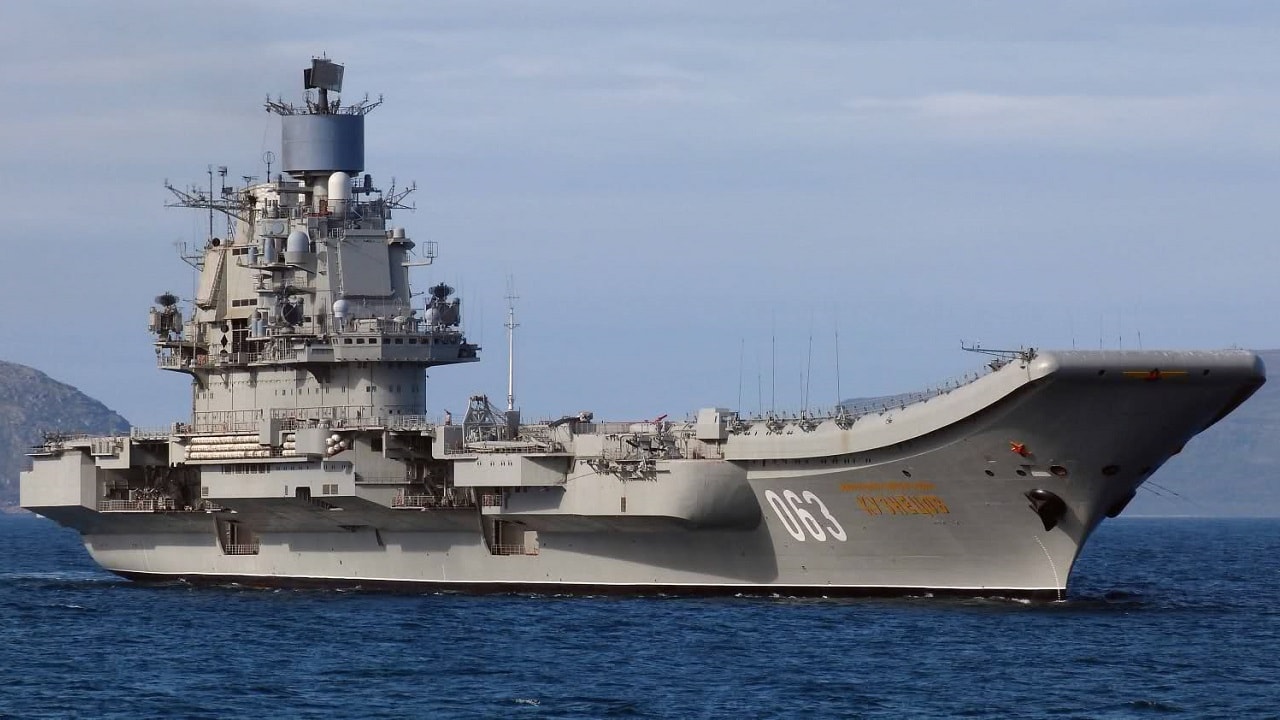
Admiral Kuznetsov Aircraft Carrier. Image Credit: Creative Commons.
Moskva and Leningrad were scrapped in 1997 and 1995, respectively.
The Late 1970s and Early 1980s: Enter the Kiev-Class
Although the Moskva-class helicopter carrier Kyiv never came to fruition, that Ukrainian city’s name would still be honored (so tragically ironic with the benefit of 20/20 hindsight, n’est-ce pas?) via an entire class of true fixed-wing Soviet aircraft carriers, the Kiev-class aka Project 1143 Krechyet (“gyrfalcon”).
A total of four of these “gyrfalcons” were completed:
-Kiev, commissioned on December 28, 1975
-Minsk, commissioned September 27, 1978
-Novorossiysk, commissioned September 14, 1982
-Admiral Gorshkov (formerly the Baku), commissioned December 11, 1982
Semantically, these 45.000 ships were designated as “heavy aviation cruisers” rather than pure aircraft carriers.
Reason being: the 1936 Montreux Convention, which prohibited aircraft carriers heavier than 15,000 tons from passing through the Turkish Straits (the Dardanelles and the Bosphorus). Gotta love legalese, or as Juliet said to Romeo, “What’s in a name?”
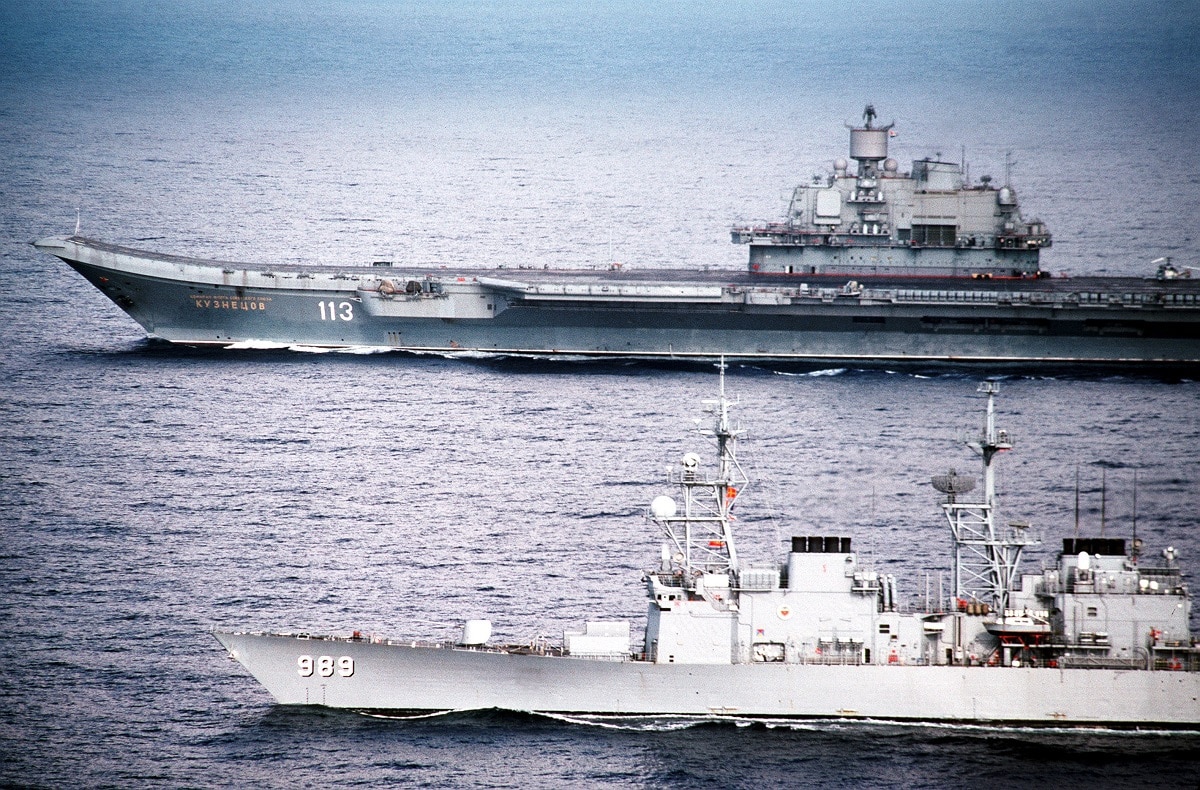
Admiral Kuznetsov in the waters south of Italy with USS Deyo, foreground, steaming off her port side.
The problem that plagued the Kievs is that they tried to do too much all at once, taking on American aircraft carriers while at the same time hunting down NATO submarines. Because responsibilities were split between two vastly different mission profiles, their ability to excel at either was severely curtailed—a classic example of “jack of all trades, master of none” syndrome.
As bluntly stated by Kyle Mizokami, “Ships that are half one type of ship and half another, like Japan’s World War II Ise–class aircraft carrier/battleships, are usually a failure at being both. The Kiev class was no exception.”
The Mid-to-Late 1980s: Initial High Hopes…
The Soviet Navy underwent a major expansion in the mid-1980s. At first, it looked like the USSR’s flattop program would be amongst the beneficiaries of this expansion, as they began construction on two carriers in the fifty-thousand-ton class and one nuclear-powered supercarrier, Ulyanovsk, that (at least on paper) was nearly on par with the U.S. Navy’s Nimitz-class carriers.
However, the collapse of the Soviet Union (and resultant end of the Cold War) occurred in 1991.
Even before that transpired, expenditures on the disastrous Soviet-Afghan War of 1979-1989 were a higher budgetary priority than building more aircraft carriers (remember Afghanistan is a landlocked country, ergo denying a role for the Soviet Navy during the invasion and occupation).
Only the Admiral Kuznetsov was completed before the Cold War ended, and, as this publication’s team of writers has extensively documented, the Kuznetsov has been plagued by persistent defects and will probably never sail again.
Christian D. Orr, Defense Expert
Christian D. Orr is a Senior Defense Editor. He is a former Air Force Security Forces officer, Federal law enforcement officer, and private military contractor (with assignments worked in Iraq, the United Arab Emirates, Kosovo, Japan, Germany, and the Pentagon). Chris holds a B.A. in International Relations from the University of Southern California (USC) and an M.A. in Intelligence Studies (with a concentration in Terrorism Studies) from American Military University (AMU). He is also the author of the book “Five Decades of a Fabulous Firearm: Celebrating the 50th Anniversary of the Beretta 92 Pistol Series,” the second edition of which was recently published.