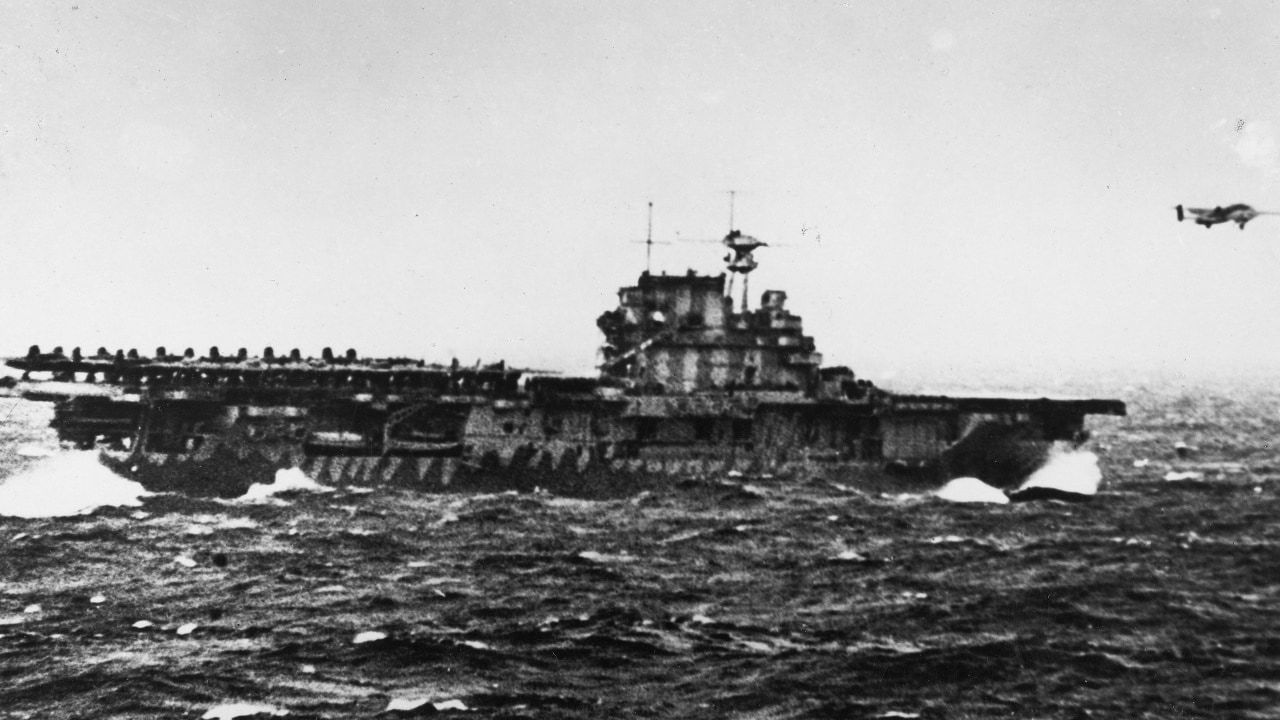
The worst aircraft carrier title is one that could go to several ships. And if you were looking to give this dubious distinction, one would likely assume that a foreign country’s navy would be given that particular crown of thorns. Yet, that sad moniker belongs to the United States. And it makes sense on some level, given how ubiquitous the aircraft carrier is for the US Navy, that it’d have the worst aircraft carrier ever created.
That ship was the USS Wasp (CV-7).
Built to Fit a Treaty, Not a Battlefield
During the Interwar Years, the Washington Naval Treaty, signed by the United States, the British Empire, and the Empire of Japan, imposed tonnage restrictions on each fleet. This was an arms control agreement.
Yet, the US Navy found that it had leftover tonnage. So, the Navy tried to push out one more carrier with that leftover tonnage. Thus, the Wasp was born. It was a ship that was around 25 percent smaller than the Yorktown-class, but she was expected to do the same job.
To comply with the Washington Naval Treaty, designers compromised her design everywhere–from armor to protection systems, even to crew survivability. Wasp in no way reflected the requirements of modern naval warfare at that time.
She was a thin-skinned ship (even for an aircraft carrier). There was minimal armor protection, little resistance to bomb or torpedo damage, and no real torpedo defense system to protect the ship’s vital fuel and machinery.
So, if the Wasp got hit, the thing would go up like fireworks on the Fourth of July with relative ease.
A Death Trap at Sea: Failed Damage Control
To top it off, the Navy installed inferior damage control systems. Inside the vulnerable ship, the firefighting systems were subpar. That’s a real killer, too, because fire on any ship at sea is one of the most dangerous things imaginable.
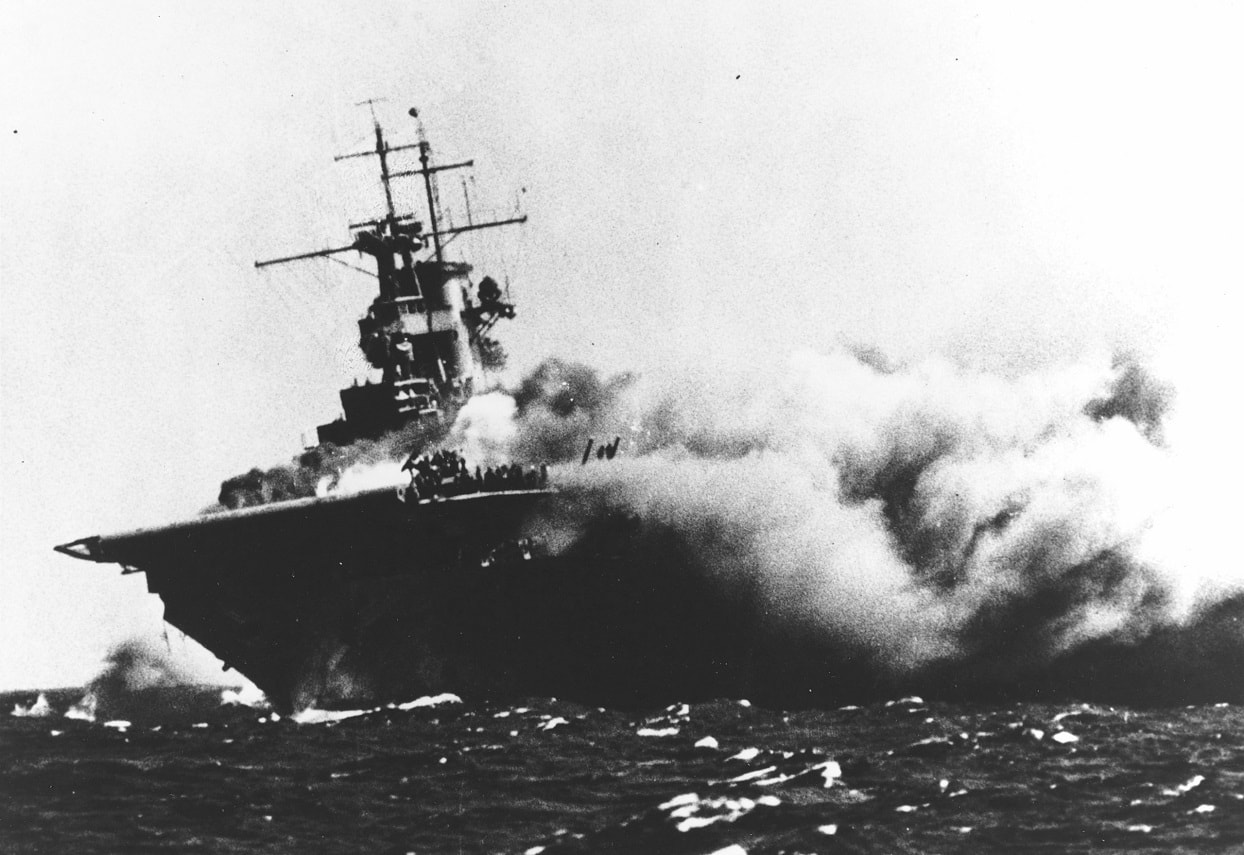
The U.S. Navy aircraft carrier USS Wasp (CV-7) burning and listing after she was torpedoed by the Japanese submarine I-19, on 15 September 1942, while operating in the Southwestern Pacific in support of forces on Guadalcanal. Note that the wartime censor has removed the CXAM-1 radar antenna, only its lower frame is still visible.
Add in poor firefighting systems, and you’ve got yourself a sure loss of the ship on your hands.
There were also poorly protected aviation fuel lines and vulnerable water mains. Let’s get it straight: the Wasp was given bad firefighting systems, unprotected fuel lines, and weak water mains (essential for firefighting)? It’s like the Navy tried to make the worst carrier in history.
They succeeded.
Fire was the Real Killer of This Aircraft Carrier
When carriers catch fire, everything depends on damage control. The crew’s speed and disciplined response to the fire, along with the availability of water, ensure that the fire does not destroy the ship. But Wasp’s systems failed when it mattered most. Because, naturally, fire is what ultimately destroyed the Wasp.
What’s more, the Navy packed people, airplanes, and equipment into the tiny USS Wasp like sardines. The idea was to maximize capability in a small hull. So, aircraft, fuel, and munitions were squeezed together. As a result, there was less space onboard for survivability.
Everything the Navy crammed into the Wasp ensured that they had built for themselves a floating tinderbox. One hit could trigger a chain reaction of epic proportions onboard the ship.
Everything that could go wrong for the tragic warship did go wrong on September 15, 1942. During the Battle of Guadalcanal in the Pacific Theater of the Second World War, the Wasp was struck by two or three torpedoes fired at it from Japanese submarine I-19.
The resulting explosions were so severe that they knocked out the ship’s power and, of course, the water systems. The loss of those vulnerable water lines at the start of the onboard crisis allowed for the inevitable fires to spread madly throughout the doomed vessel.
Around 193 people on board were killed, and hundreds more were wounded. The real tragedy was that the carrier suffered so little damage and loss of life only because of the irresponsible design decisions made when the Wasp was first built.
Bureaucracy Over Warfighting
Those design decisions had nothing to do with engineering needs.
They were made based on the political cogitations of American bureaucrats who failed to understand that by making a carrier–squeezing one more system out while still respecting the limits of the Washington Naval Treaty–and those bad choices led to the deaths of so many Americans and the destruction of the ship.
After all, several other US warships sustained damage during the Battle of Guadalcanal, and they did not suffer the same fate as did the Wasp.
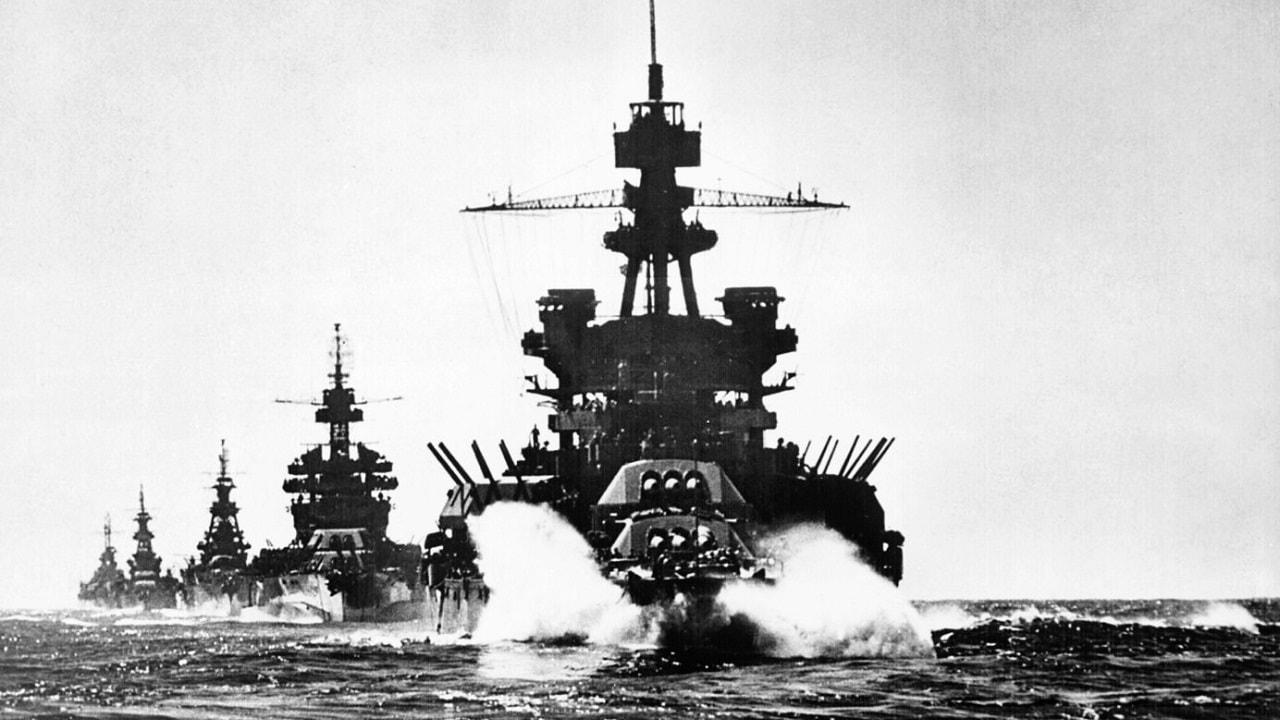
USS Pennsylvania, which was attacked at Pearl Harbor.
USS Wasp wasn’t built for war after all. It was built to satisfy a treaty, and the Pacific War exposed every compromise at once.
About the Author: Brandon J. Weichert
Brandon J. Weichert is the Senior National Security Editor at 19FortyFive.com. Recently, Weichert became the editor of the “NatSec Guy” section at Emerald.TV. He was previously the senior national security editor at The National Interest. Weichert is the host of The National Security Hour on iHeartRadio, where he discusses national security policy every Wednesday at 8pm Eastern. He hosts a companion show on Rumble entitled “National Security Talk.” Weichert consults regularly with various government institutions and private organizations on geopolitical issues. His writings have appeared in numerous publications, among them Popular Mechanics, National Review, MSN, and The American Spectator. And his books include Winning Space: How America Remains a Superpower, Biohacked: China’s Race to Control Life, and The Shadow War: Iran’s Quest for Supremacy. Weichert’s newest book, A Disaster of Our Own Making: How the West Lost Ukraine, is available for purchase wherever books are sold. He can be followed via Twitter/X @WeTheBrandon.