
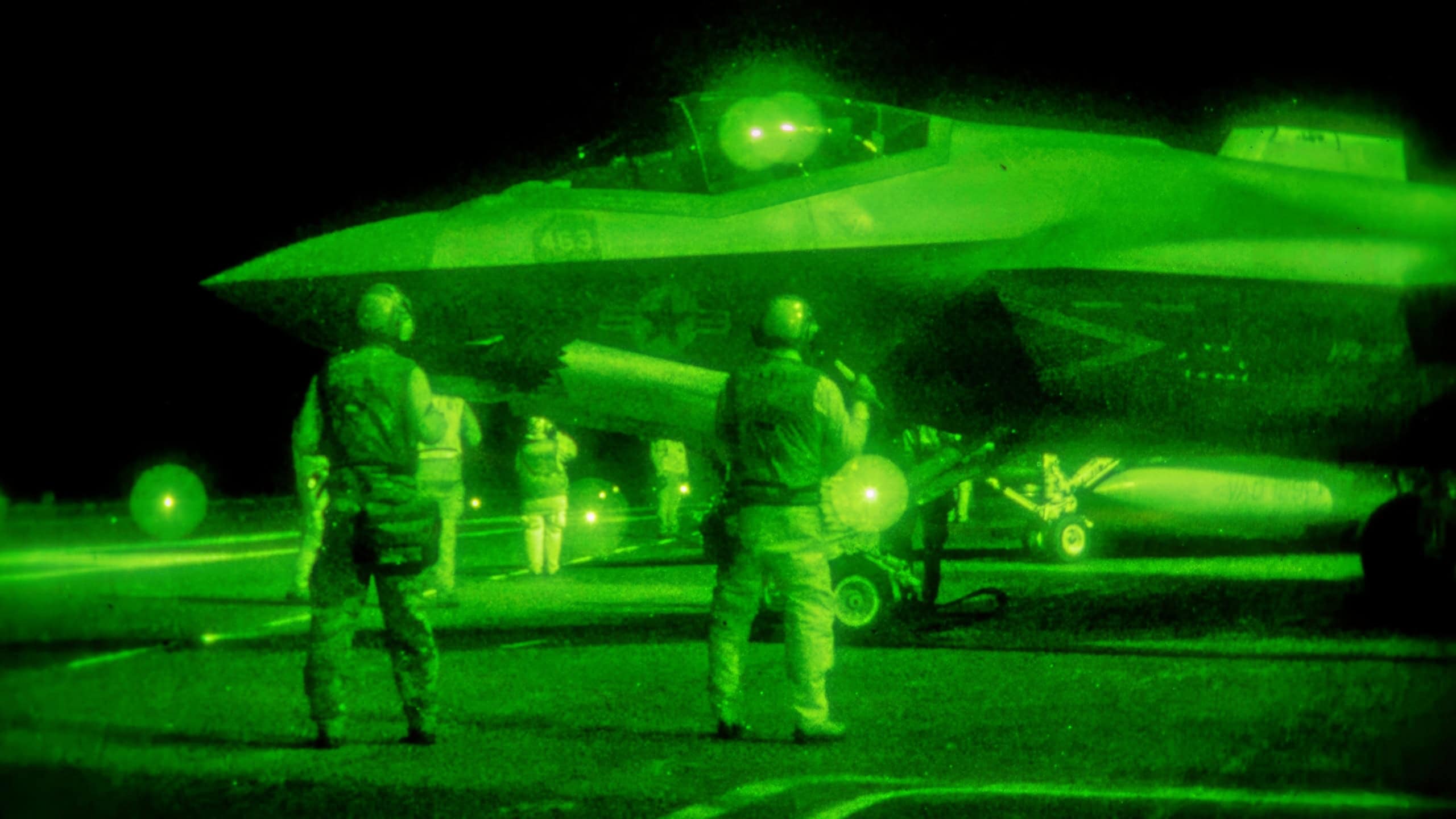
Key Points and Summary – United States Navy and Marine Corps aviators consistently report higher stress levels landing high-performance fighter aircraft on aircraft carriers at night than flying actual combat missions over hostile territory.
-The landing approach is conducted at approximately 155 knots toward a 49-foot target zone on a deck that pitches and rolls up to 30 feet in near-total darkness.
-Former U.S. Navy F-14 Tomcat and F-4 Phantom pilot John Chesire: “I would most always choose the combat mission over a bad weather night trap.”
Naval Aviators Are More Stressed By Night Landings On An Aircraft Carrier Than By Combat
The act of landing on an aircraft carrier is one of the most difficult tasks a pilot has to execute… And the most stressful.
The flight deck is just long enough to stop the aircraft, measuring only about 150 meters.
Unlike pilots in other military services or pilots of commercial aircraft, aircraft carrier pilots don’t have the luxury of landing on 6,000-10,000-foot runways.
Naval and Marine aviators are trying to land on a “postage stamp” in total blackness, often facing spatial illusions such as a false horizon.
Landing At Night Is Like A “Controlled Crash”
Navy pilots experience higher stress landing on aircraft carriers at night than in combat because it requires extreme precision, dealing with near-total darkness, and managing a “controlled crash” onto a small, moving deck.
Typically, aircraft are traveling at 155 knots and stop in 1.2 seconds. Some pilots equate this feeling as if one’s arms and legs are trying to separate from their torso.
Physiological studies show higher heart rates and blood pressure during these landings compared to combat, as they demand total focus to avoid fatal errors.
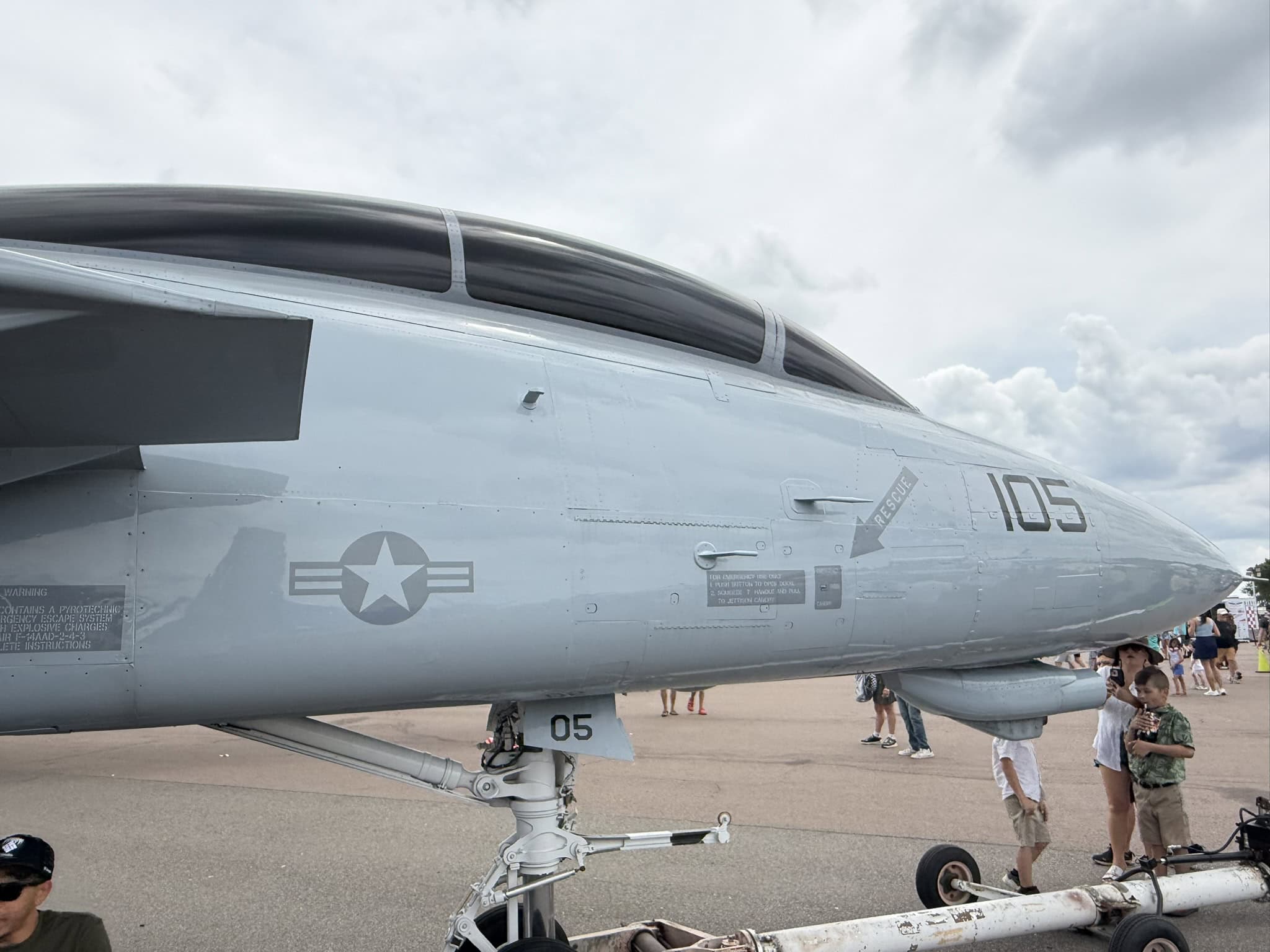
F-14D Tomcat from Lakeland, Florida Airshow. Image Credit: 19FortyFive.com. Taken on 4/19/2026.
Significant Factors In Accomplishing Night Carrier Landings
The carrier’s landing deck can pitch or roll up to 30 feet, requiring precise timing to hook one of the four cables.
As the “executive” controller, the pilot bears total responsibility for the complex, high-stakes landing, which causes higher adrenaline than being a passenger or in a passive role.
Pilots use the Optical Landing System (Meatball). Pilots rely heavily on the Fresnel Lens Optical Landing System (FLOLS) or newer electronic systems to maintain the correct glide slope.
Landing Signal Officers (LSOs) are invaluable to incoming pilots. LSOs monitor the approach, provide voice corrections, and can command an abort if the approach is unsafe.
Unlike civilian landings, carrier pilots do not “flare” (lift the nose) to land softly. They maintain a strict, high-sink-rate descent path straight into the deck, often likened to a controlled crash.

National Naval Aviation Museum F-14. Image Credit: Creative Commons.
Pilots must advance throttles to maximum power upon contact. If the tailhook fails to catch the arresting cable (a “bolter”), they must have sufficient speed to fly away. Turbulence, low ceilings, and high winds dramatically increase the difficulty of the approach.
Traveling At 155 Knots And Hitting a 49-Foot Target
High-performance demands and life-or-death stakes create extreme mental and physical stress, unlike combat, which is intermittent. Every single night, landing requires absolute perfection to avoid disaster, causing chronic fatigue and stress.
There is absolutely no margin for error. Pilots must approach at high speed, keeping the nose up 8 degrees while aiming for a 49-foot zone, knowing a “bolter” (missing wires) requires an immediate, dangerous go-around.
Navy Aviators Explain The Feeling Of Night Carrier Landings
John Chesire, a former US Navy F-14 Tomcat and F-4 Phantom pilot, wrote on Quora that he’d rather fly combat missions than execute night carrier landings.
“Some combat missions are much more risky than others. However, in general, I think they are riskier than night traps in bad weather.
“However, and having said that, given a choice between a night carrier landing in bad weather and a combat mission, I would most always choose the combat mission over a bad weather night trap.
“I always was more apprehensive about night carrier landings – especially in bad weather – than I was on most combat missions, even the really dangerous ones, ‘downtown’.
Doug Connell, another former US Navy fighter pilot with more than 400 night traps in multiple aircraft during his career, spoke about the fear of endangering the sailors on board the carrier.
“Another factor is the anxiety difference. In combat, if shot down, it’s just you and your NFO in trouble. Coming aboard the ship if screwed up, it may be you and many aircraft and sailors on the flight deck.
“This knowledge, though deep in the conscience, makes everything tougher. I survived more than 400 night traps in A-7, A-6, F-14, and F-18 and remember many of them to this day.”
Landing On An Aircraft Carrier At Night, “Alone And Unafraid”
TWZ hosted a former naval aviator, LCDR Joe “Smokin” Ruzicka, in a series of intriguing articles on various aspects of being a carrier pilot. But arguably, his best piece centered on landing a fighter aircraft in the dark on a carrier in bad weather.
Ruzicka wrote that “under normal flight operations, the ship has 10 to 12 aircraft airborne during what is known as a ‘cycle.’ Each cycle lasts about 1.5 hours. The ship launches airplanes at the start of each cycle to clear the flight deck, giving the deck crew enough space to reposition remaining aircraft for the next recovery.
“The most aft wire on the ship is #1 wire. The most forward wire is #4. The target wire is #3,” he said. “You always try to avoid #1 because it is uncomfortably close to the back end of the ship.
“Truthfully, catching any of them is considered a success. While each pilot is graded on each pass at the ship, this business is difficult enough that pretty much any arrested landing is a welcome return.
He wrote that the aircraft in a holding pattern waiting to land in adverse weather is called a “Marshall Stack”, similar to a stack of pancakes. He takes the reader through a “bolter,” a quick aerial refueling, and finally his approach.
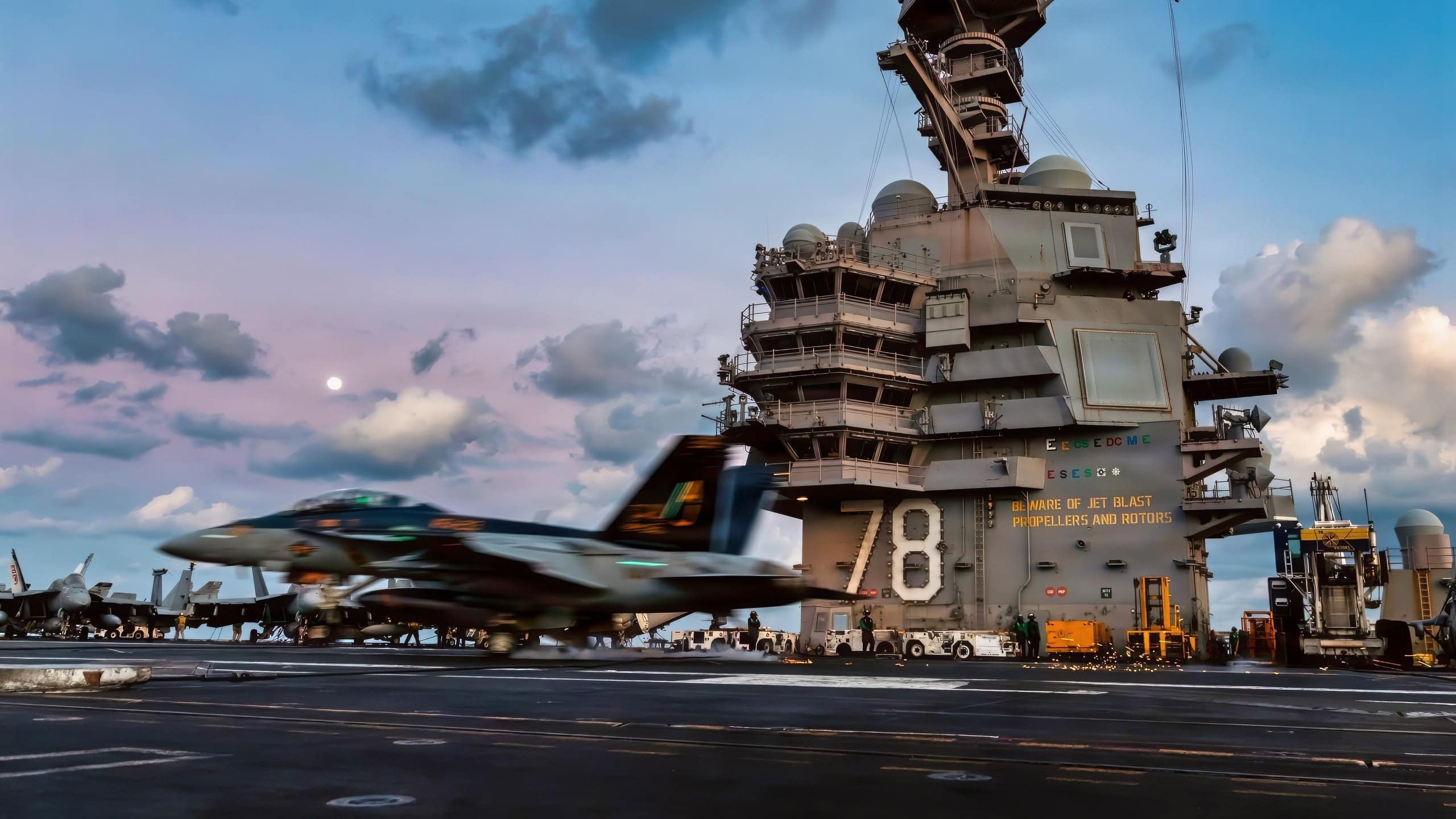
An F/A-18F Super Hornet aircraft, attached to Strike Fighter Squadron 213, lands on the flight deck of the world’s largest aircraft carrier, USS Gerald R. Ford (CVN 78), while operating in the Eastern Mediterranean Sea in support of Operation Epic Fury, March 2, 2026. (U.S. Navy photo)
“You arrive at ¾ of a mile behind the ship, and pick up the meatball. You are confident and cautiously optimistic.
“From this position, there is only about 20 seconds to touchdown. The ship has very few lights on it, just a small box-shaped outline in the landing area and a few lights off to the starboard side near the tower.
“Darkness is the theme. You continue to focus on the meatball, listening to the LSO’s give you a soft “little power” call. You adjust your throttles ever so slightly and find an angle of attack to keep the aircraft just above glideslope…
“The plane descends over the stern of the ship and down into the landing area. The few ship lights whiz past. At the moment of touchdown, you can feel the landing gear thud into the carrier deck. You already have the throttles at full military power. There is a split-second where you are waiting for that feeling of deceleration, knowing the hook has grabbed a wire.
“You feel the deceleration first in your shoulder harness straps, then your head, and finally your whole body as you violently move forward in the ejection seat,” he said.
“The aircraft tugs on the wire and pulls it out like a rubber band, bringing you to a violent—but very welcome—stop. The initial feeling is a sense of relief, followed by a recognition of just how difficult that entire evolution was.
“You notice your knees shaking as you retract the arresting hook and flaps, and then taxi out of the landing area,” he added.
Night carrier landings are not for the faint of heart.
About the Author Steve Balestrieri
Steve Balestrieri is a National Security Columnist. He served as a US Army Special Forces NCO and Warrant Officer. In addition to writing on defense, he covers the NFL for PatsFans.com and is a member of the Pro Football Writers of America (PFWA). His work was regularly featured in many military publications.