
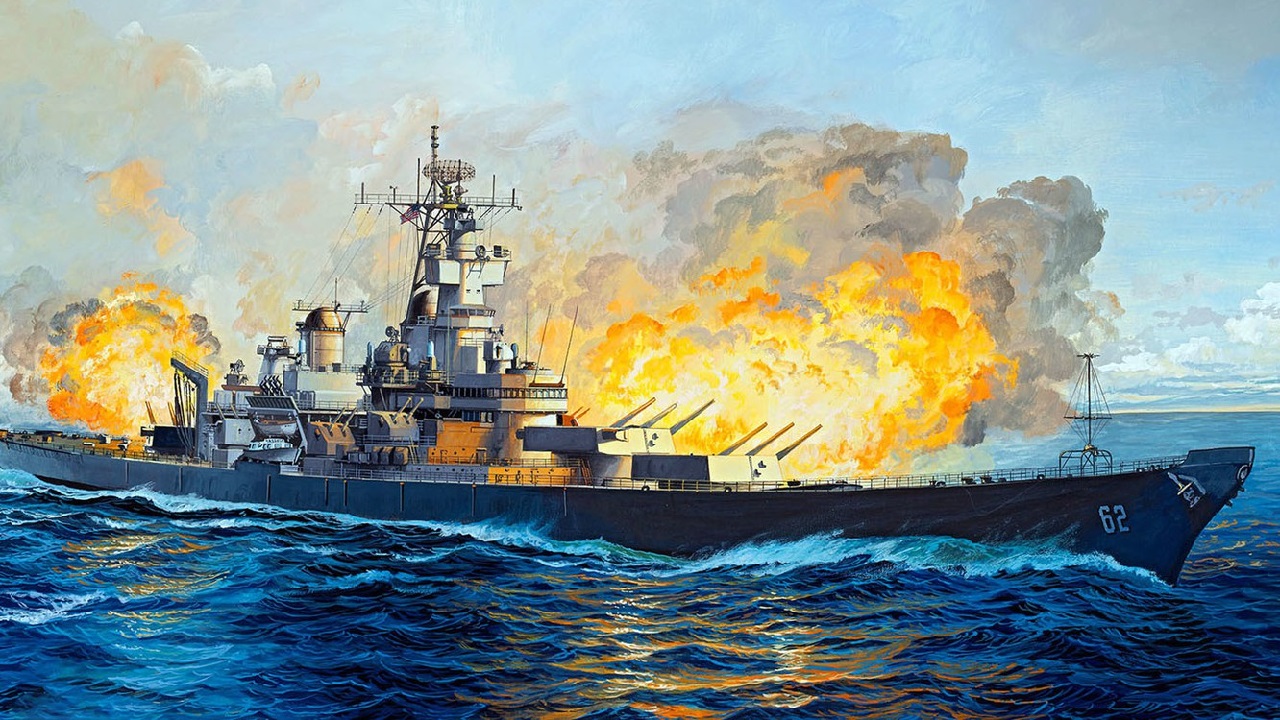
The Trump-class battleship (BBG(X)) is no longer just rhetoric; it is now a formally budgeted program.
The administration’s FY2027 request included $1.8B for R&D and early procurement, marking a shift from concept to funded program, with plans set for a lead ship, the USS Defiant (BBG-1).
Yet, while the program has been elevated, obstacles still remain—along with significant controversies over the merits of investing in the first US battleship since the 1940s. Closer to reality than ever, the Trump-class battleship represents a high-cost, high-risk approach that runs against the direction of modern naval warfare, raising questions about the wisdom of the investment.
Trump-Class Battleship: Scale of the Program
The program is not cheap. The lead ship is expected to cost between $17B and $21B, assuming costs don’t spike. The five-year spend is projected at $46B. And the long-term ambition is to field 20-25 ships in class.
To put those costs in perspective, consider that the Trump-class is expected to cost more than the Ford-class supercarrier, whose lead ship costs just $13B. To spend so much on a battleship is hard to fathom.
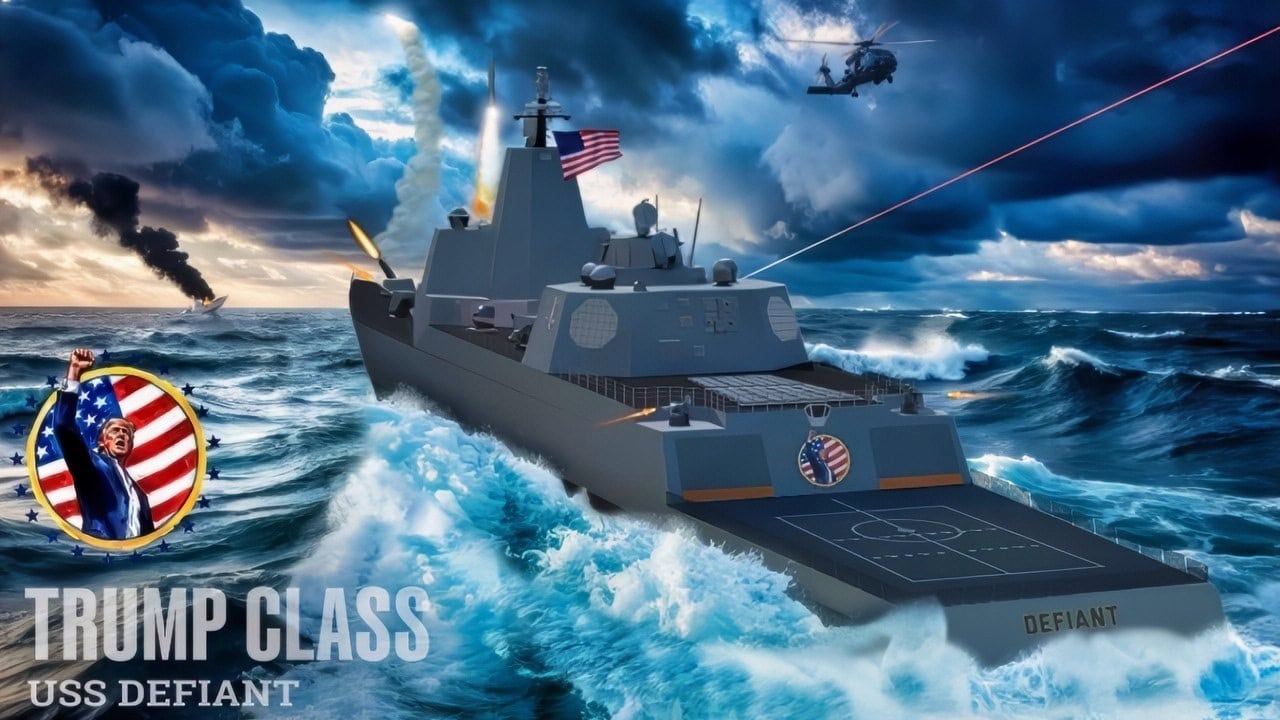
Trump-Class Battleship. Image Credit: Creative Commons/White House Photo.
The FY2027 cost breakdown includes $1B for advanced procurement, $837M for R&D, and $134M for design work—suggesting that this is not a niche program but a major fleet-shaping investment.
Defining the Ship’s Role
The ship is expected to displace between 30,000 and 40,000 tons, with an intended “quarterback” surface combatant role. With 128 VLS cells and 12 hypersonic CPS missiles, the Trump-class should be brimming with offensive capability.
And in the future, possibly, the platform will include a 32-megajoule railgun and a 600 kW laser system. Basically, the Trump-class will feature concentrated firepower, high-energy weapons, and a fleet command node.
The BBG(X) aims to combine the destroyer, the cruiser, and a future tech testbed into one platform. Whether that is possible remains unclear.
But the history of weapons development suggests that ambitious consolidation and ambitious novel technology development rarely go smoothly.
Why It’s Real Now
Yet, despite the skepticism, the Trump-class is more real now than ever. Funding has been allocated, meaning the thing isn’t just a proposal anymore.
The targeted start for construction is FY2028, and the Trump administration has made the ship a political priority, the centerpiece of its defense vision, which will likely be protected even as the larger $1.5T budget proposal is whittled down. The momentum is real—this is no longer hypothetical.
But major obstacles remain.
The Obstacles
As the name suggests, the Trump class is closely tied to a specific administration.
Naturally, programs tied so closely to a specific administration are vulnerable to election outcomes and congressional pushback. When Trump’s second term ends, a Democrat replacement may be unwilling to forge ahead with Trump’s favored defense projects.

The Ohio-class guided-missile submarine USS Florida (SSGN 728) departs Naval Submarine Base Kings Bay. Florida will perform routine operations while at sea. (U.S. Navy photo by Mass Communication Specialist 1st Class James Kimber/Released)
Beyond the political reality is the industrial reality. US shipyards are already strained. Submarine programs have taken priority despite bottlenecks that seem unlikely to be resolved due to workforce and shipyard shortages.
The program is already prohibitively expensive—and likely to rise further. As costs rise, expect support to shrink. And even if the first boat were started in 2028, it wouldn’t be operational until the early to mid-2030s. So Trump’s funding allocation may start the program, yes, but sustaining the program is an entirely different challenge.
The Strategic Case For
The BBG(X) hopes to address the gap left by the cancellation of the DDG(X) and the resultant need for a large surface combatant. Ideally, the BBG(X) will be able to support railguns and directed-energy weapons—and serve as a control node for manned and unmanned systems.
The high missile capacity creates firepower density, a platform for next-gen weapons, all of which is an attractive prospect for the Navy.
The Strategic Case Against
But the ship poses an immense risk due to its “all-in-one” design. Adversaries will recognize any future Trump-class battleships as high-value targets. The design concept runs counter to trends in modern warfare, which favor volume, distribution, and saturation.
While adversaries are developing cheaper missiles and drone swarms—cost-effective systems that can disrupt and disable vastly more expensive platforms, thereby creating asymmetries—the US appears to be doubling down on expensive, concentrated platforms. If the BBG(X) were fielded, it would be exorbitantly expensive, yet vulnerable to cheap drones and missiles. Put simply, the battleship concentrates capability in a way that modern warfare seems to punish, a cut against the doctrine shift towards distributed lethality.
And the Zumwalt Comparison
The Zumwalt comparison is inevitable; the Zumwalt was supposed to be the US Navy’s next-gen destroyer, with an intended procurement run of 32 ships. In reality, only three were ever built. The program was beset with cost overruns, mission drift, and technological immaturity.
The platform was eventually repurposed for hypersonic missiles. The parallels to the BBG(X) are stark: ambitious tech stacks with unclear mission clarity and the risk of becoming a niche platform. The BBG(X) looks poised to potentially repeat Zumwalt’s cycle of overpromising, underdelivering, and then being quietly repurposed.
Would It Be Relevant?
Even if the Trump-class were eventually built and fielded, would it be a relevant platform?
China is building anti-ship ballistic missiles and hypersonic weapons, and an ISR network of satellites and drones. Large surface ships are easier to track, harder to defend, and make a tantalizing target. Can the BBG(X) survive inside contested zones? The ship would likely be forced to operate from further out, possibly in a stand-off role or as a command node, which is probably not worth $20B per ship.
Now What?
Because the program is important to the administration, expect Trump-class funding to be preserved even as the larger funding package is whittled down; expect the program to advance. Construction may start in the near future, possibly during the Trump term.
But long-term risks still exist, including the prospect of redesign, scaling down, partial or outright cancellation. The likelihood that the Navy fields the 20-25 ships currently planned is quite low. And if the ship is ultimately fielded, expect the mission profile to change. The program may survive, but likely not in its current form.
The Trump-Class Is Still in Trouble
The Trump-class is certainly appearing to be more real than it did just a few weeks ago.
The administration is indeed serious about the concept. But the program still faces structural, political, and strategic challenges. The technical ambition, paired with strategic questionability, could spell trouble for the program.
About the Author: Harrison Kass
Harrison Kass is a writer and attorney focused on national security, technology, and political culture. His work has appeared in City Journal, The Hill, Quillette, The Spectator, and The Cipher Brief. He holds a JD from the University of Oregon and a master’s in Global & Joint Program Studies from NYU. More at harrisonkass.com.