

The latest change to how things work in the military is the U.S. Army’s recent announcement of new retirement rules.
The announcement came in a memo dated April 17 from the Secretary of the Army, Dan Driscoll.
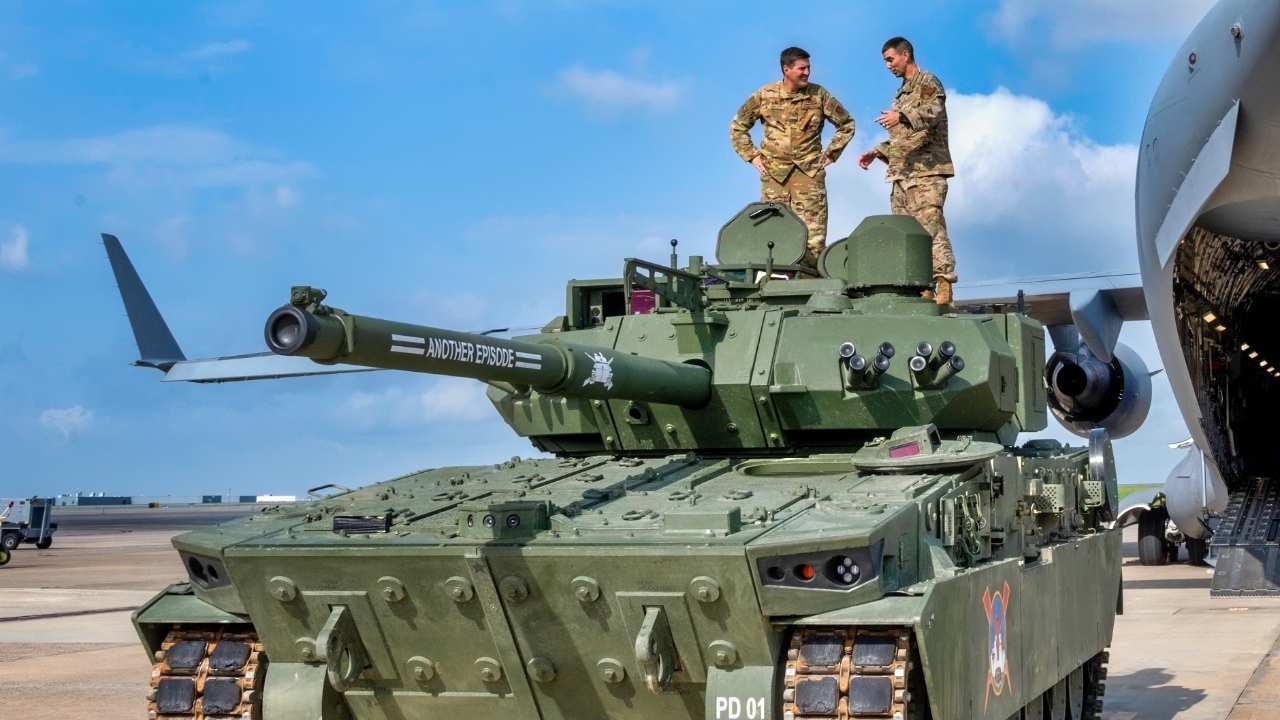
Members of the North Carolina Air National Guard assess an Army M10 Booker Combat Vehicle before it is loaded onto a C-17 Globemaster III aircraft, at the North Carolina Air National Guard base, Charlotte-International Airport, August 3, 2024. Portions of this photo were masked for security reasons. (U.S. Air National Guard photo by Staff Sgt. Reanna Hartgrove)
Under the new rules, as described by Federal News Network, “soldiers can submit voluntary retirement requests at least 12 months, and no more than 24 months, before their preferred retirement date.”
There are some restrictions, though, as soldiers will not be able to request retirement if they are “being considered for a new assignment or have received official orders for a permanent change of station,” the Army memo said.
The change applies to the Regular Army, Army National Guard/Army National Guard of the United States, and the U.S. Army Reserve.
“This directive modifies the retirement request timeline for Soldiers,” the memo says. “The provisions of this directive will enhance the accuracy of forecasting unanticipated losses, synchronize personnel movement cycles with the United States Army Human Resources Command (HRC), and provide greater support to Soldiers transitioning out of military service.”
Who Can Retire?
According to the Army memo, soldiers can put in to retire if they “have at least 18 years of active Federal service (AFS), and be able to complete all service obligations by the requested retirement date.”
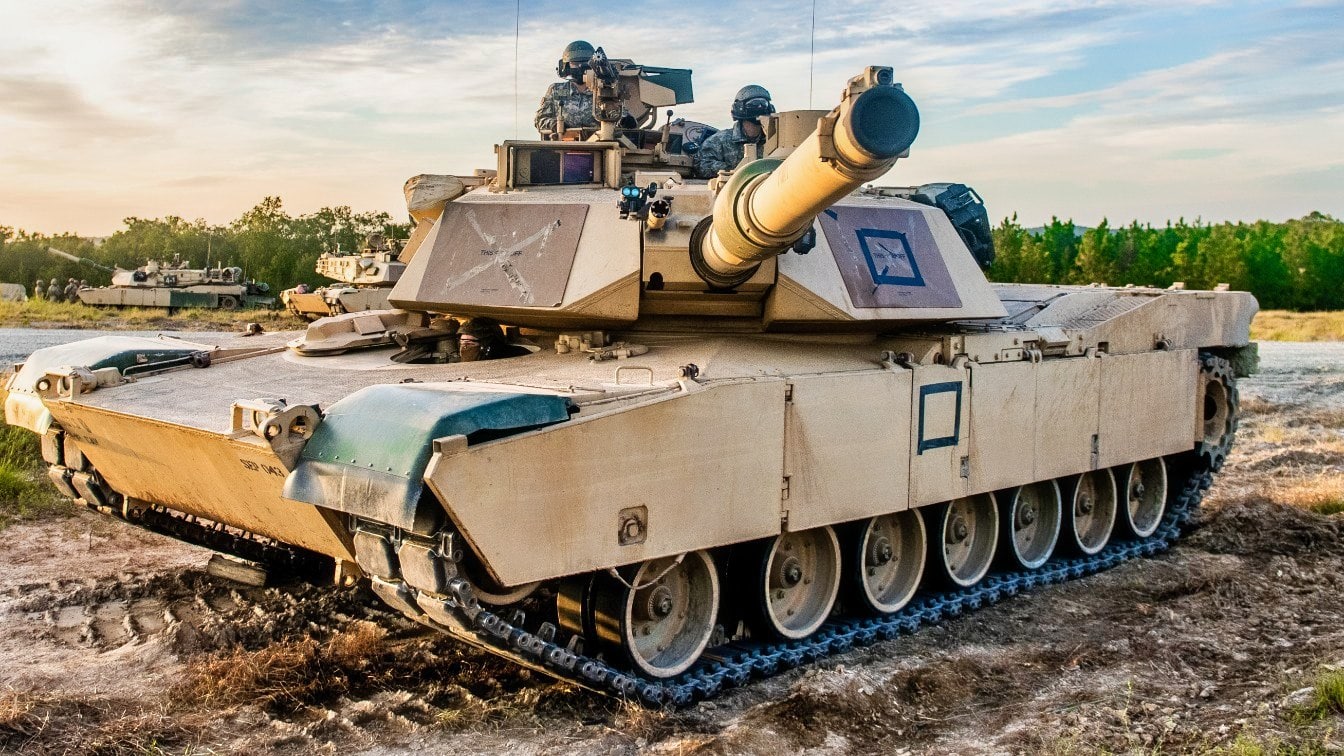
FORT BENNING, Ga. – Students in Armor Basic Officer Leader Course Class 20-005 conduct a platoon situational training exercise, Sept. 22, 2020, at Good Hope Maneuver Training Area on Harmony Church. Students train as both an attacking force and a defending force using the U.S. Army’s M1 Abrams Main Battle Tank. (U.S. Army photo by Patrick A. Albright, Maneuver Center of Excellence and Fort Benning Public Affairs)
There are other rules now in place as well for those at ranks between lieutenant colonel and colonel, chief warrant officer 4 and chief warrant officer 5, and master sergeant through command sergeant major.
“Commanders will provide a thorough, comprehensive, and candid assessment of each Soldier’s complete career record when rendering recommendations on requests for greater than 12 months, but no more than 24 months, before the requested retirement date,” the Army memo says.
“Battalion and brigade commander endorsements do not constitute an approved retirement. These endorsements represent a recommendation to permit the Soldier to submit a packet to HRC for final adjudication.”
Those planning to retire may also avail themselves of the Transition Assistance Program (TAP).
“Soldiers may begin planning for transition and may engage with Transition Assistance Program (TAP) resources on submission of a retirement request; however, participation in transition activities will not detract from assigned duties or mission requirements until the Soldier is within 365 days from separation,” the Army memo says. “Command-approved transition activities— including permissive temporary duty, Career Skills Program/Skill Bridge participation, installation clearing, or other separation-related actions—will not commence prior to 365 days from separation.”

Lance Cpl. Alex Rowan, a combat engineer with 4th Combat Engineer Battalion, 4th Marine Division, stationed out of Bessemer, Ala., runs to take cover before the Anti-Personnel Obstacle Breaching System detonates during the SAPPER Leaders Course aboard Camp Lejeune, N.C., June 26, 2015. During the course, the Marines used assault and breaching techniques to clear a wire obstacle using line charges that utilized C4 explosives and their APOBS. (U.S. Marine Corps photo by Cpl. Krista James/Released)
And those who are approved for retirement “remain subject to all normal duties, standards, and obligations,” the Army Secretary’s memo says. “Such approval does not relieve a Soldier of accountability, utilization requirements, deployability, or compliance with all Army policies.”
Also, ironically, the Army’s top general recently retired, although it wasn’t voluntary.
Exit George
On April 2, Secretary of Defense Pete Hegseth asked U.S. Army Chief of Staff Gen. Randy George to step down and retire, effective immediately, a move widely interpreted as a firing.
George sent a letter to his men, as CBS News reported, on the occasion of his retirement.
“It has been the greatest privilege to serve beside you and lead Soldiers in support of our country,” he wrote. “I know you’ll all continue to stay laser-focused on the mission, continue innovating, and relentlessly cut through the bureaucracy to get our warfighters what they need to win on the modern battlefield.
According to the New York Times that week, it was a move that “reflects growing hostility between Mr. Hegseth and the Army’s leadership.”
Gen. David Hodne of the Army’s Transformation and Training Command and Maj. Gen. William Green of the Army’s Chaplain Corps were also removed, along with George.

the Army’s goals are to train incoming civilians to become more than they once were — warfighters capable of managing the stresses of their role within the defense apparatus.
Appointed the Army Chief of Staff in 2023, George “led the Army out of one of its worst recruiting crises in history in 2024 and more recently has pushed the service to accelerate its acquisition of cheap drones and other kinds of weapons that have come to dominate the war in Ukraine,” the Times reported upon the news in early April.
It was described by the newspaper as “the product of Mr. Hegseth’s long-running grievances with the Army, battles over personnel, and his troubled relationship with Army Secretary Daniel P. Driscoll,” as Driscoll and the deposed general were said to be close.
A New York Post story, also in the days following George’s ouster, attributed the move to “paranoia” on the part of Hegseth, who was said to fear that Driscoll would replace him as Defense Secretary. Driscoll was a Yale Law School classmate of Vice President JD Vance, leading to speculation that he could succeed Hegseth in a Trump cabinet that has seen some turnover of late.
“This is all driven by the insecurity and paranoia that Pete has developed since Signalgate. Unfortunately, it is stoked by some of his closest aides who should be trying to calm the waters,” one official told the Post, in reference to the scandal in early 2025 in which a journalist had accidentally been added to a group chat, on the app Signal, in which top officials discussed plans to strike the Houthis in Yemen. Axios reported, also in early April, that the firings “blindsided military leaders and have generated concern among defense officials about the implications for the war in Iran and the longer-term adoption of new tech and tactics.”
The Post added that Sean Parnell, the Pentagon spokesman, is “pushing himself” to possibly replace Driscoll should he be fired.
Just weeks after the Army purge, John Phelan was removed as secretary of the Navy, reportedly as part of “ feuds with senior leaders in the Pentagon,” including Hegseth.
About the Author: Stephen Silver
Stephen Silver is an award-winning journalist, essayist, and film critic, and contributor to the Philadelphia Inquirer, the Jewish Telegraphic Agency, Broad Street Review, and Splice Today. The co-founder of the Philadelphia Film Critics Circle, Stephen lives in suburban Philadelphia with his wife and two sons. For over a decade, Stephen has authored thousands of articles that focus on politics, national security, technology, and the economy. Follow him on X (formerly Twitter) at @StephenSilver, and subscribe to his Substack newsletter.