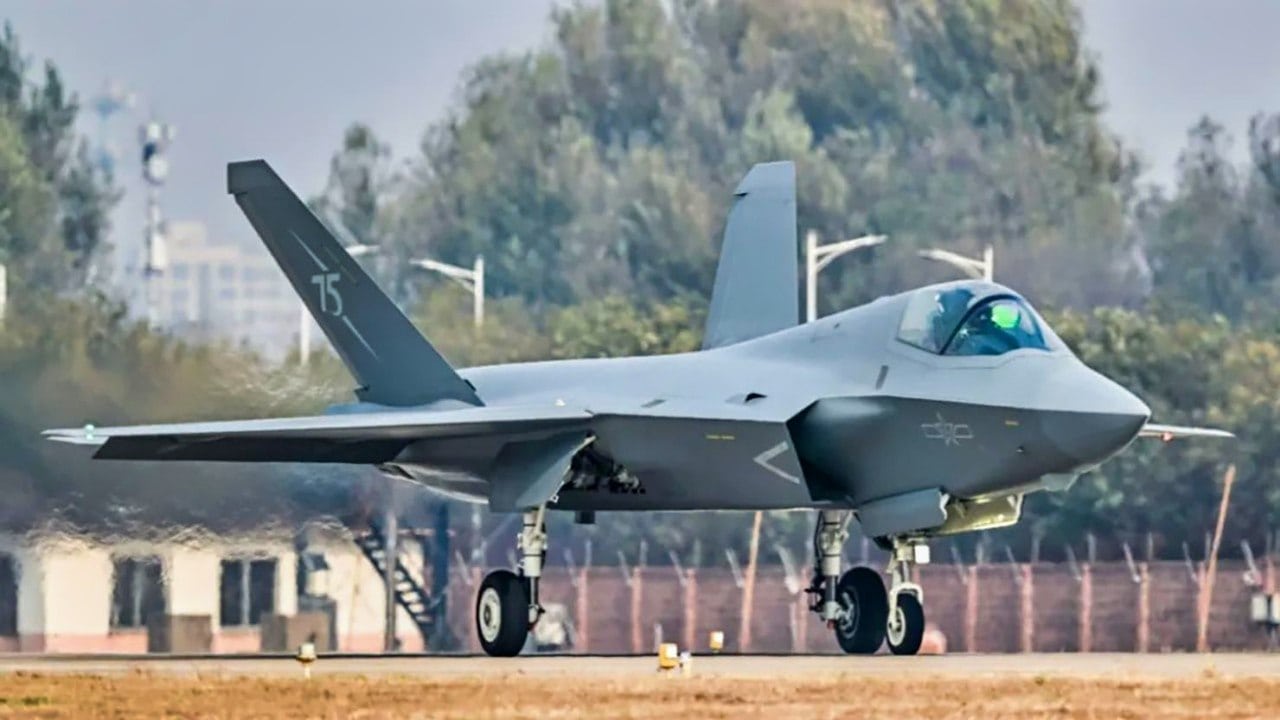
China is reportedly preparing to sell up to 40 of its J-35A (or J-35AE) stealth fighters to Pakistan in what would be the first export sale of a Chinese stealth aircraft in history. The deal would shatter the Western monopoly on fifth-generation airpower—giving Pakistan a stealth fleet to balance against India’s Rafales and Su-30MKIs, and dramatically expanding Beijing’s defense-industrial influence across Asia.
The J-35AE Might Be Headed to Pakistan
The sale of an export version of the Shenyang J-35A land-based model of this stealth fighter has been an on-again, off-again proposition for some time now. If current reports are to be believed, just such a sale appears to be back in the “on again” category.
According to sources inside the People’s Republic of China (PRC) aerospace industrial sector, as well as its export arm, China Aero-Technology Import-Export Corporation (CATIC), this is part of a planned strategy to develop an export market for the J-35. It calls for Beijing to – unsurprisingly – approach those nations that are barred from purchasing advanced tactical aircraft from Western nations.
According to the same sources, the plans for this first-ever sale of a PRC-made stealth platform would involve the purchase of up to 40 twin-engine fighter aircraft. The variant to be supplied to Pakistan would be designated J-35AE.
“First-ever” sales of an aircraft, which is markedly above the current level of any nation’s fluency in military technology, tend to be more in the range of 12 or 16 fighters for an initial purchase,” said a retired Western aerospace industry executive with experience in sales in Asia. “You of course assume that there will be follow-on sales, but depending on how much of a challenge the aircraft is going to be for a country’s air force to support, the sales tend to be smaller deliveries to give the country in question time to scale up its ground support and maintenance infrastructure.”
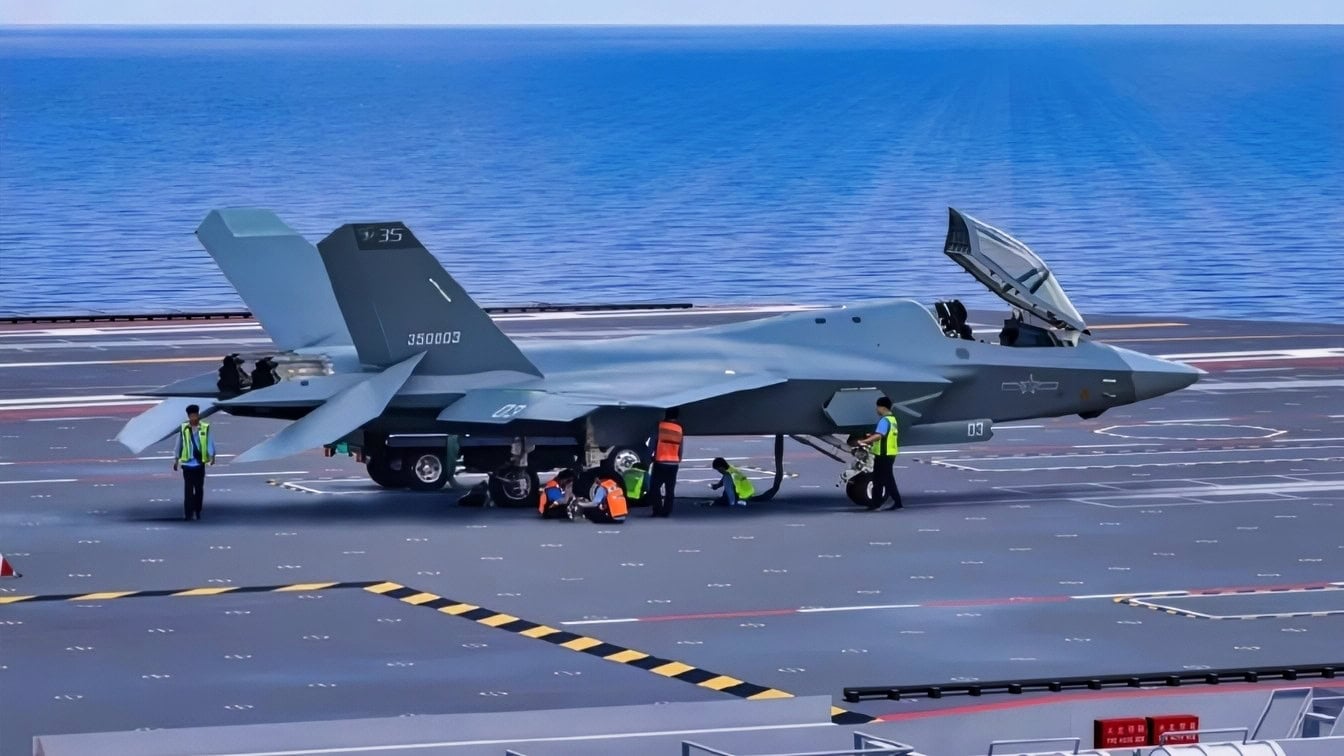
China J-35 Blue Shark Stealth Fighter
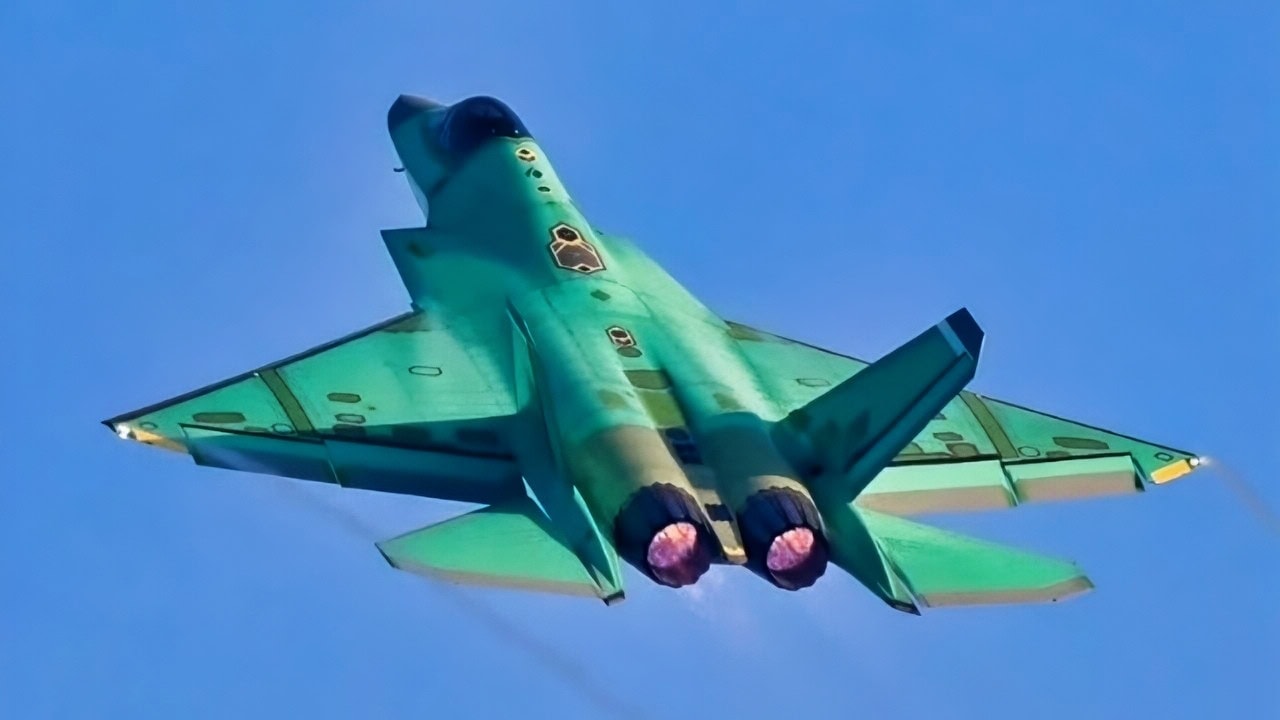
J-35A Stealth Fighter. Image Credit: Social Media Screenshot.
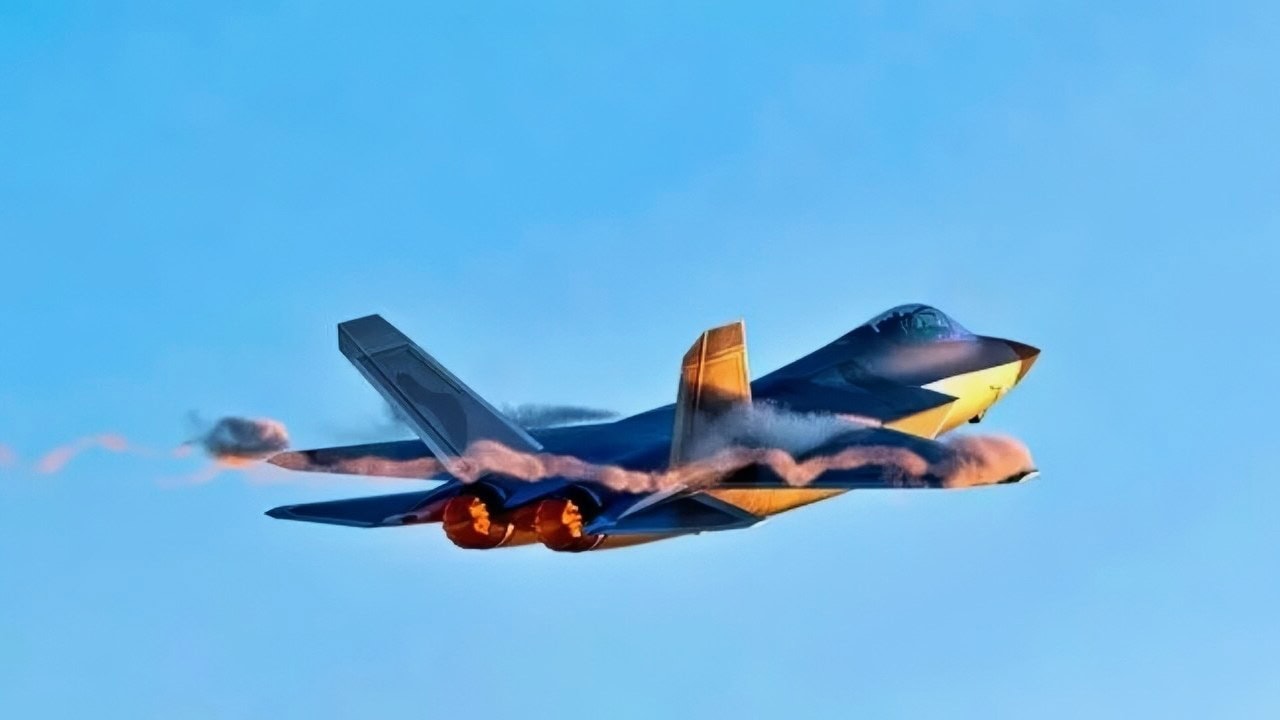
J-35A Fighter from China PLAAF. Image Credit: Creative Commons.
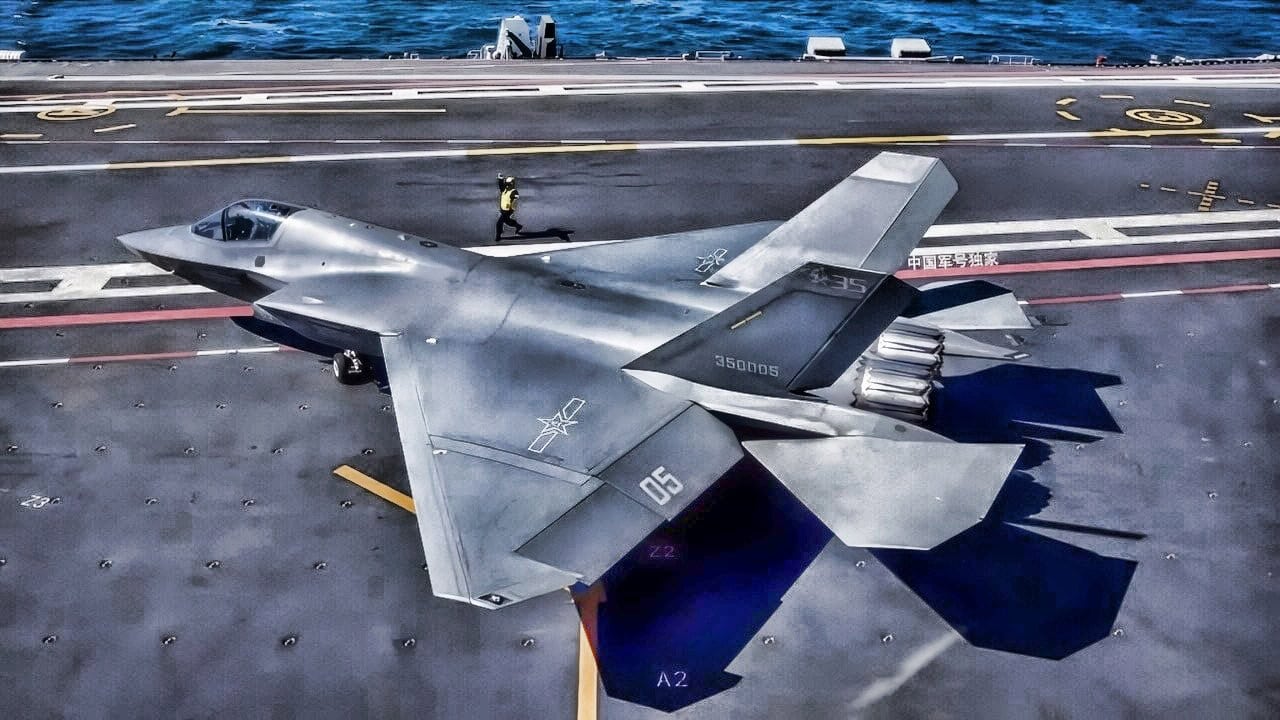
China J-35 Naval Stealth Fighter. Image Credit: PLAN.
The other ingredient required for an export sale is that the purchaser be in that category of a “friendly” or partner nation that would be a logical customer, said a Korean defense contractor with significant experience in the Asian market.
“But therein lies the problem for the Chinese,” he explained. “This is a country that does not really have many friends to speak of. There is also the fact that when the Chinese make an offer of something with a price tag like a high-performance fighter, they are also saying ‘please fall into our debt trap’.”
Restoring Reputation
The one country – perhaps the only country – that fits the bill as a friendly partner and is not bothered by indebtedness to Beijing is, of course, Pakistan. It is also perhaps the only nation in the PRC’s “club” of defense industrial partners that has an industrial complex sufficient to support a Chinese-designed fighter that at least appears to be a 5th-generation design – and not destined to be overwhelmed by taking on 40 J-35s.
The Pakistan Aeronautical Complex (PAC) in Kamra has also been building the Chengdu Aerospace-designed JF-17 light fighter for its own air force since 2009. The air force also operates between 25-26 J-10CE fighters, the export variant of this more advanced Chengdu aircraft. Pakistan claimed several kills against the Indian Air Force (IAF) in a four-day series of air-to-air engagements with this J-10 model in May 2025, but the numbers and types are still in dispute.
“With the J-10s in their air force and the experience in building the JF-17, the J-35 is a fairly logical fit for Pakistan, and it rounds out their air force by providing it with a ‘silver bullet’ option on the first few days of a war,” said the retired US aerospace executive.
Pakistan is now also building the JF-17 for sale to third nations. Bangladesh, which was part of Pakistan until its independence, is discussing the purchase of as many as 48 JF-17s. Indonesia, Saudi Arabia, Sudan, and Libya are potential buyers as well, and a contract for the aircraft has already been signed with a former Soviet republic that is now independent: Azerbaijan.
Indian air power observers tell 19FortyFive that exporting 40 of the export version of the Shenyang fighter is not just about the PRC wanting to provide Pakistan with a technological capability that would balance the IAF’s air power potential. India enjoys an advantage with its fleet of French-made Dassault Rafale aircraft and its hundreds of license-built Sukhoi Su-30MKI fighters manufactured in India at the Hindustan Aeronautics Ltd (HAL) plant in Nasik.
They claim that the damage to the Pakistan Air Force’s reputation in the May 2025 cross-border air engagements needs repair due to the sheer number of aircraft launched against the Indian force, to little effect. Pakistan launched 42 air defense fighters and fired dozens of missiles, but the only kills appear to have been from the J-10CEs firing the LETRI PL-15 long-range air-to-air missile.
Stealth Proliferation with J-35AE
By introducing the J-35AE into Pakistan, Beijing is also proving that there is no longer a Western monopoly on stealth technology. The J-35 may not have a radar cross-section as small as an F-35’s, but its unit price is also markedly lower.
As such, this export deal represents a very clear challenge to Western technological superiority on the part of the PRC. The sale is also an expansion of Beijing’s defense-industrial influence across an emerging strategic theatre and a region that is projected to be the major battlefield of the future.
The J-35AE being exported in this manner should be viewed not just as the introduction of more capable airpower assets into the region. It is a shift in the structure of global force posture, making access to stealth technology an increasingly multipolar proposition and no longer limited by whether a nation enjoys a close relationship with the US.
The J-35AE being officially rolled out and this sale being accelerated to the extent possible are, lastly, also acts of defense diplomacy. It is designed to expand PRC influence in Asia and the Middle East. In the end, as the aircraft is likely to be eventually sold to nations that have already committed to the JF-17, this sale may be the first step in changing the global air combat balance.
About the Author: Reuben F. Johnson
Reuben F. Johnson has thirty-six years of experience analyzing and reporting on foreign weapons systems, defense technologies, and international arms export policy. Johnson is the Director of Research at the Casimir Pulaski Foundation. He is also a survivor of the Russian invasion of Ukraine in February 2022. He worked for years in the American defense industry as a foreign technology analyst and later as a consultant for the U.S. Department of Defense, the Departments of the Navy and Air Force, and the governments of the United Kingdom and Australia. In 2022-2023, he won two awards in a row for his defense reporting. He holds a bachelor’s degree from DePauw University and a master’s degree from Miami University in Ohio, specializing in Soviet and Russian studies. He lives in Warsaw.