
The Iran Ceasefire Isn’t Dead. That’s Exactly the Problem: The ceasefire is holding, and Iran is the reason. Not because Tehran has any interest in the peace process Washington is trying to construct, but because a ceasefire in place is, for the moment, the most advantageous position available — better than accepting American terms, and cheaper than absorbing the consequences of ending it.
Thirty-three days in, with a tanker seized last week in the Gulf of Oman and a subsequent exchange near the Strait that Trump dismissed as “just a love tap,” the pattern should be legible. One side is managing a fragile truce. The other is managing it toward a specific outcome.
Iran Is Playing for Time
Washington has spent seven weeks trying to make Iran stop fighting. The more productive question is whether Iran wants to stop at all — not because the IRGC is winning outright, it isn’t, but because the terms available at the end of a protracted negotiation are considerably better than those available at the end of an American ultimatum, and Tehran has understood this since before the ceasefire was signed.
The deadlines tell the story.
Trump demanded unconditional surrender on March 21, then March 23, then April 7. None of them produced movement. When Pakistan brokered the two-week ceasefire on April 8, Tehran accepted within hours: strikes stopped, and nothing else changed. What each walked-back deadline communicated to Tehran — whatever Washington intended — was that the red lines move. That inference has been driving Iranian behavior ever since.
The Counter-Proposals Aren’t Posturing
The fifteen-point proposal Washington pushed through Pakistani intermediaries on March 25 — end the nuclear program, constrain the missile force, reopen the Strait, pull back from armed groups — was rejected outright.
Tehran’s counter ran to five points: halt US-Israeli strikes, provide security guarantees, pay reparations, and accept Iranian sovereignty over the Strait of Hormuz.

The crew of a U.S. Air Force B-1B Lancer display their mascot from the cockpit window during a presence patrol above the U.S. Central Command’s area of responsibility Oct. 30, 2021. Multiple partner nations’ fighter aircraft accompanied the B-1B Lancer at different points during the flight, which flew over the Gulf of Aden, Bab el-Mandeb Strait, Red Sea, Suez Canal, Arabian Gulf, Strait of Hormuz and the Gulf of Oman before departing the region. (U.S. Air Force photo by Senior Airman Jerreht Harris)
The gap between those two documents is not a misunderstanding awaiting the right mediator. It is a disagreement about who holds leverage, and both sides know exactly what they’re arguing about.
Tehran’s calculation isn’t complicated. Washington needs three things: a Strait that functions, a nuclear program that stops, and an agreement it can sell at home. Iran can obstruct all three at a cost it considers manageable, while accepting American terms would cost considerably more.
Every week the negotiation continues, Iran avoids the concessions Washington is actually after — on enrichment, on missiles, on Hezbollah — while the conditions determining the eventual settlement drift in its direction.
Controlled Escalation as Operating Policy
The exchange near Qeshm Island follows a pattern that has now repeated enough times to have a shape: Iranian forces probe, CENTCOM responds, both sides accuse the other of being the violator, Trump downplays it, and the ceasefire survives on paper.
Reading that sequence as diplomatic messiness misses what it actually is.

STRAIT OF HORMUZ (Nov. 12, 2021) Guided-missile destroyer USS O’Kane (DDG 77) performs a Strait of Hormuz transit with the amphibious assault ship USS Essex (LHD 2), Nov. 12. Essex and the 11th Marine Expeditionary Unit are deployed to the U.S. 5th Fleet area of operations in support of naval operations to ensure maritime stability and security in the Central Region, connecting the Mediterranean and the Pacific through the western Indian Ocean and three strategic choke points. (U.S. Navy photo by Mass Communication Specialist 1st Class Joe Rolfe)
Each controlled provocation that fails to trigger escalation delivers the same lesson to Tehran — that Washington is managing this conflict rather than resolving it — and as long as that assessment holds, there is no structural reason for Iran to move on the concessions the US is demanding.
This morning’s tanker seizure sharpens the point. Rubio is waiting on a diplomatic response to a peace proposal; Iran answered with an operational one. The asymmetry in how the two sides are reading the calendar is about as explicit as these things get.
Washington Has a Deadline. Tehran Has Leverage
An analyst described Iran’s approach this week as requiring “time and patience.” The phrasing is polite. What it describes is a side that has watched its counterpart set deadlines and step past them, watched “unconditional surrender” quietly exit the diplomatic language, and observed the traffic of senior American officials through Islamabad and other intermediary capitals — Vance, Witkoff, Kushner — without drawing the conclusion that Washington has time on its side.
The United States is under real pressure to produce something that looks like a result. Iran’s leadership needs to show that it didn’t bend. Those incentives are not equivalent, and they don’t resolve on the same timeline. Only one side in this negotiation is watching a clock. The other is letting it run.
What The Ceasefire Has Actually Bought
Iran’s objective here is not a return to February. Tehran is negotiating toward something durable: a nuclear program that survives in some viable form, a Strait that doesn’t get permanently demilitarized, and a regional network — Hezbollah and the rest — that remains intact.
None of that is available through an American negotiating victory, and all of it becomes more available the longer the current situation persists.
The coalition Washington assembled is not uniform in its patience.
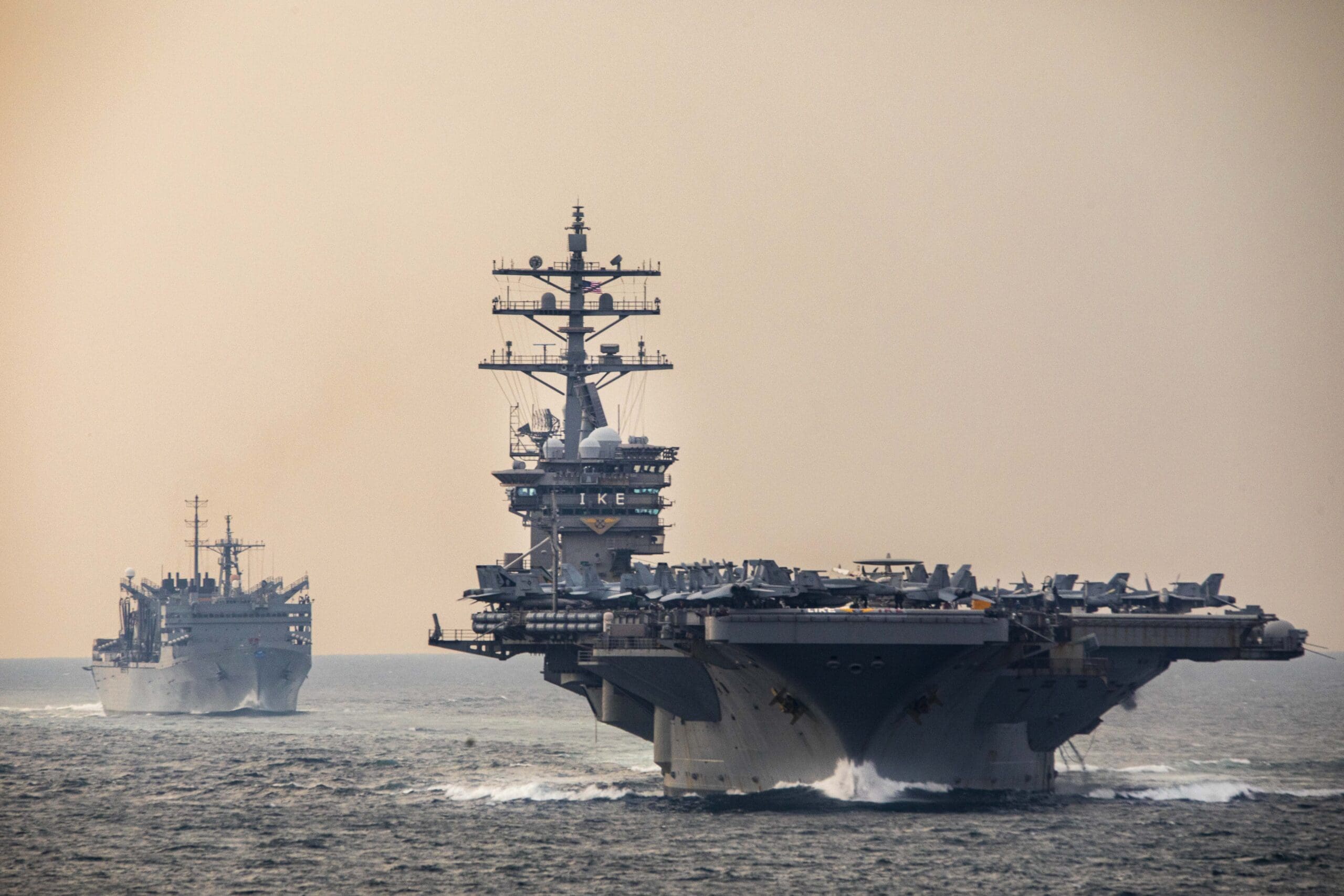
Components of the Dwight D. Eisenhower Strike Group (IKECSG) and the fast combat support ship USNS Supply (T-AOE 6) transit the Strait of Hormuz, Dec 14, 2023. As part of the Dwight D. Eisenhower Carrier Strike Group (IKECSG), the Philippine Sea is deployed to the U.S. 5th Fleet area of operations to help ensure maritime security and stability in the Middle East region. (U.S. Navy photo by Mass Communication Specialist 2nd Class Keith Nowak)
Oil markets remain a problem. Domestic political capital for an open-ended engagement is finite. And each exchange in the Strait that gets absorbed without a decisive response makes the next decisive response marginally harder to justify — because every incident Washington manages rather than resolves is evidence, accumulating quietly, that the credibility of returning to maximum pressure has real limits.
The ceasefire isn’t failing. It is converting military pressure into negotiating space, one incident at a time, for the side that never agreed to Washington’s timeline.
If that continues much longer, the agreement that eventually emerges won’t look like what the United States was asking for in March.
It will look like what Iran was willing to accept, which is a different outcome entirely, and one with consequences that will outlast this administration’s ability to manage them.
About the Author: Dr. Andrew Latham
Andrew Latham is a professor of international relations and political theory at Macalester College in Saint Paul, MN. You can follow him on X: @aakatham. He writes a daily column for 19FortyFive.com.