

The YF-23 Black Widow II has spent thirty-five years collecting what-ifs, and the least known of them wears a tailhook. While Northrop and McDonnell Douglas were building the stealthiest fighter prototype ever flown for the Air Force competition, they were also drawing a very different version of it for the Navy — a carrier-capable Black Widow meant to replace the F-14 Tomcat as the fleet’s air defender. The NATF-23 never left the drawing board; the program around it died months before the Air Force even picked a winner, and the decision that killed it rested on an assumption about the Tomcat that was off by nearly a decade. This column traces how the Navy lost the A-12, refused the Seahawk twice, and waited until 2019 for stealth at sea. The carrier Black Widow is the missing chapter.
The NATF Program: A Stealth Tomcat Replacement And A Pentagon Horse Trade
The Naval Advanced Tactical Fighter program emerged in the late 1980s, when Congress pressed the Navy to consider a carrier version of whatever fighter won the Air Force’s ATF competition, with the program taking shape from 1988 as the planned replacement for the F-14 — a procurement of 546 aircraft alongside the Air Force’s 750.
The arrangement was half of a genuine Pentagon horse trade: in exchange for the Navy considering the ATF derivative as its next fighter, the Air Force agreed to evaluate the Navy’s carrier stealth bomber — the Advanced Tactical Aircraft that became the A-12 — as a replacement for its F-111s. Each service would leverage the other’s development billions, and on paper, the deal promised a stealth fighter and a stealth bomber on every carrier deck by the early 2000s.
Both ATF teams drew naval variants. Lockheed produced the concept that got the attention, and Northrop produced the one history forgot.
The NATF-23: Rebuilding The Black Widow For The Boat
The original YF-23 was hopeless as a carrier aircraft, and Northrop knew it — the long, slender airframe, the extreme wing sweep, and the V-tails that made it a stealth marvel also made it unsuited to flight deck handling, storage, catapult stress, and the low-speed precision of an arrested landing. The naval design that answered those problems, known through schematics that surfaced publicly in the 2010s, was nearly a different airplane wearing the Black Widow’s skin. The diamond wing moved as far aft as the fuselage allowed.
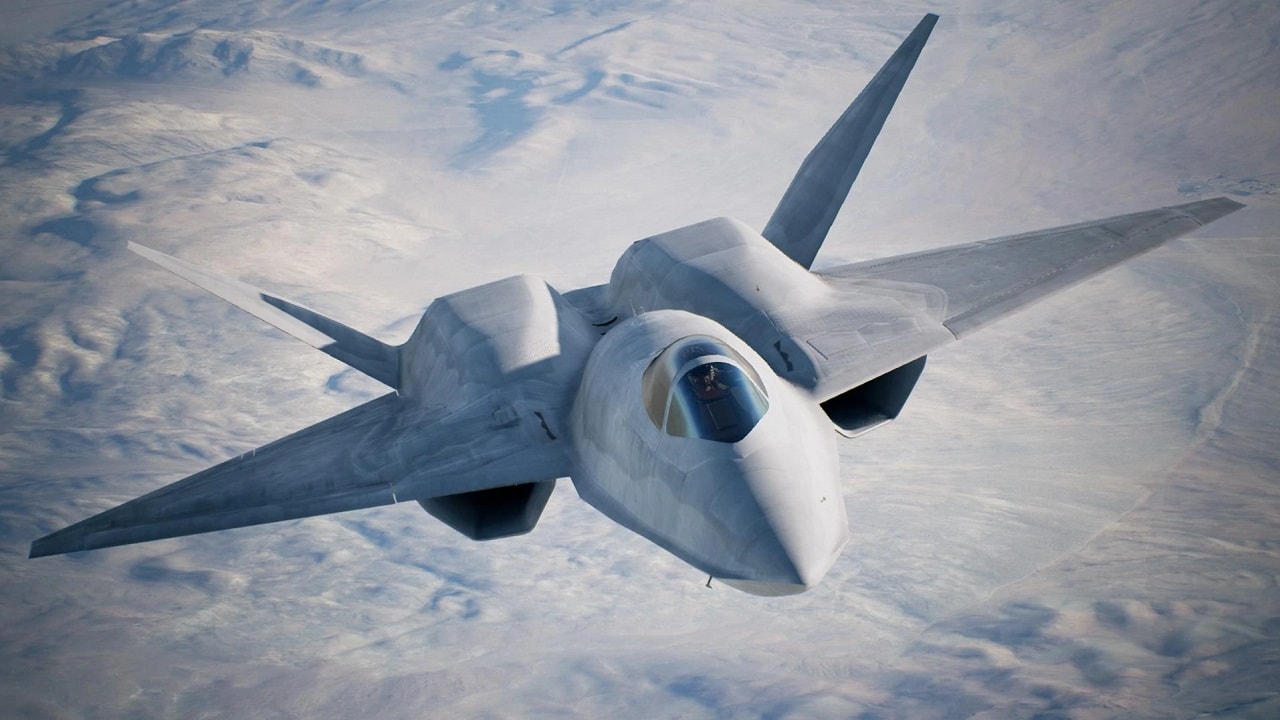
YF-23. Image Credit: Screenshot/Artist Rendering of Possible Final Design.
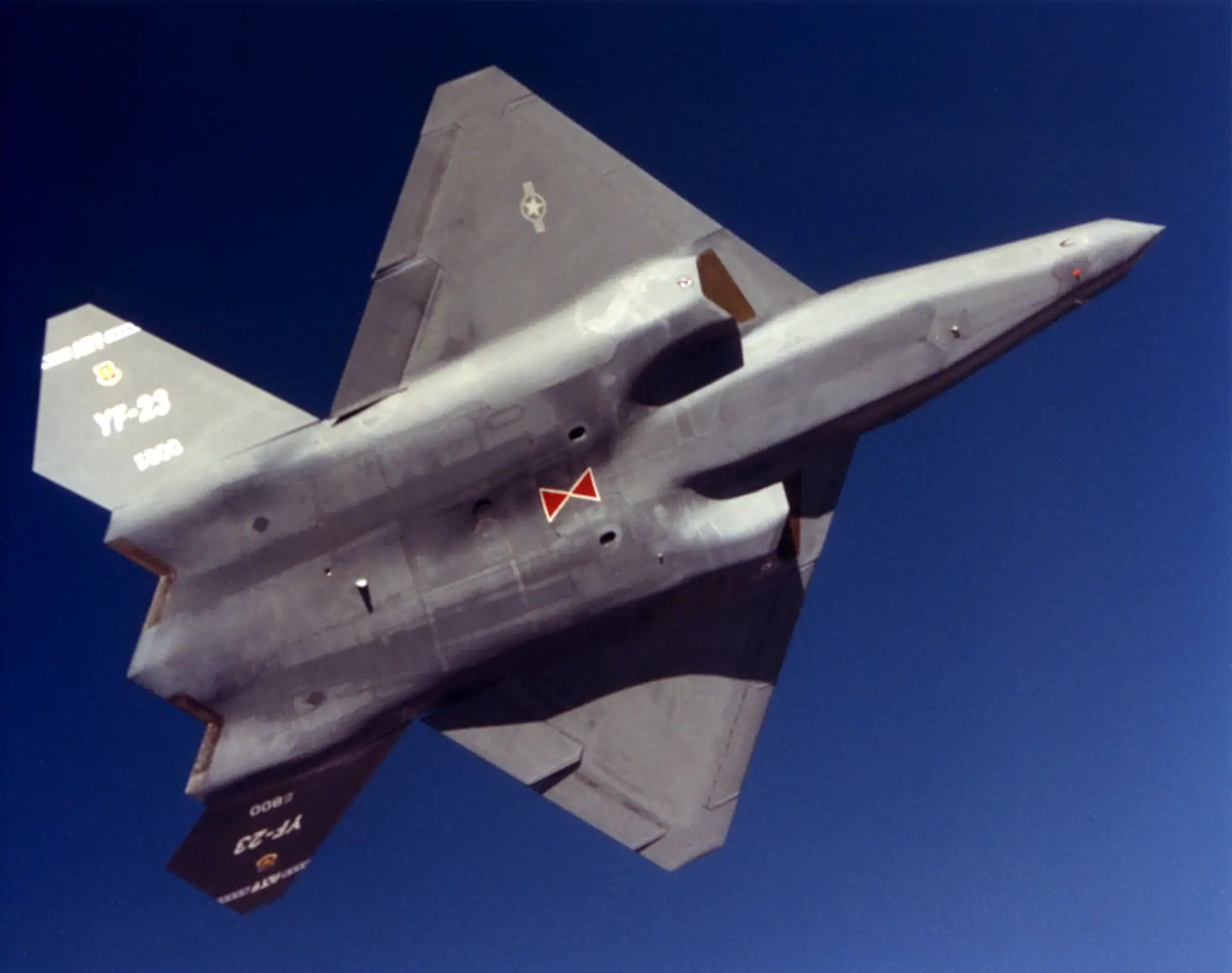
To prevent injury to ground personnel while under the aircraft, the ram air scoop was highlighted with a set of red and white triangles for visibility. The unintended coincidence looked like a Black Widow hourglass while the aircraft was in flight.
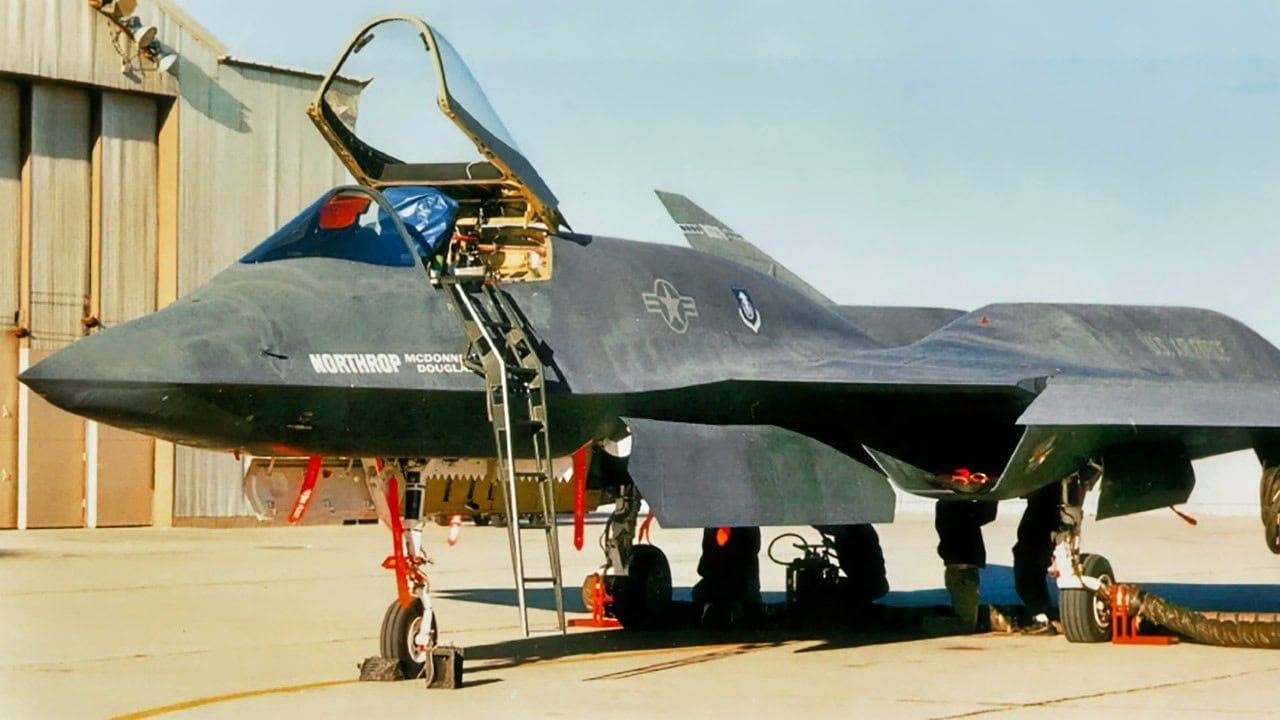
YF-23 Fighter. Image Credit: USAF.
The signature V-tails gave way to conventional canted twin fins for low-speed control in the landing pattern, joined by canards at the nose and thrust-vectoring nozzles. The wings folded for deck storage, the landing gear was reinforced for the violence of carrier operations, a tailhook went in, and the geometry changed throughout — span grew to about 48 feet while the fuselage shortened to roughly 62 feet.
The pattern matches every navalized stealth proposal of the era, from the A/F-117X’s new wing to the changes Lockheed contemplated: the carrier does not accept land-based stealth designs; it forces their redesign; and the redesign costs some stealth. Nonetheless, the NATF-23 on paper offered the fleet exactly what its doctrine wanted — the YF-23’s long legs, high-speed efficiency, and all-aspect signature mapped naturally onto the blue-water intercept mission, killing bombers and missile carriers hundreds of miles from the carrier, the job the Tomcat and its Phoenix missiles were built for.
The Sea Raptor Problem: Lockheed’s Swing-Wing Alternative
The competition’s other naval entry shows why the whole enterprise was harder than the renderings suggested. Lockheed’s NATF concept put a variable-sweep wing on the YF-22’s body — a swing-wing stealth fighter in the Tomcat tradition — and the engineering contradiction sat in plain sight: sweep wings were maintenance-intensive to begin with, and integrating them into a stealth aircraft may have been nearly impossible without surrendering meaningful low observability. The pivots, gaps, and moving seams of a swing wing are everything a radar return loves. Beyond the wing, any naval ATF needed the strengthened fuselage and tailhook every carrier aircraft carries, with all the weight and signature penalties attached.
The Navy reportedly preferred Lockheed’s swing-wing concept over Northrop’s canard-equipped Black Widow, a preference the program histories suggest fed back into the Air Force’s own ATF deliberations during the same months.
Whatever the merits of either design, both shared the same fatal arithmetic: a naval stealth fighter meant a second development program nearly as expensive as the first, for a service whose budget was already carrying the A-12.
1991: The F-14-Until-2015 Decision That Killed Naval Stealth
The end came quickly and quietly. Secretary Cheney’s 1990 Major Aircraft Review cut the planned production rates of both the ATF and NATF, driving unit costs up just as the Cold War’s end was driving budgets down, and by that August, the admiral overseeing Navy aircraft requirements was saying publicly that he could not see how the NATF fit into any affordable naval aviation plan.
The Pentagon requested no NATF funding after 1990, and in early 1991, the Navy dropped the requirement entirely, on the determination that the F-14 could cover the fleet air superiority mission through 2015. A restart option penciled in for fiscal 1997 was later abandoned.
Months after the NATF died, the Air Force chose the YF-22 on April 23, 1991, and the carrier Black Widow’s last theoretical path to existence closed with the land-based one.
The assumption underneath the decision deserves its own sentence: the F-14 did not serve until 2015. It retired in 2006, nine years early, killed by maintenance costs and a fleet that had moved on to Super Hornets — meaning the Navy canceled its stealth fighter on a Tomcat lifespan estimate that missed by nearly a decade, and then spent that decade and another beyond it flying fourth-generation aircraft against air defenses designed to kill them.
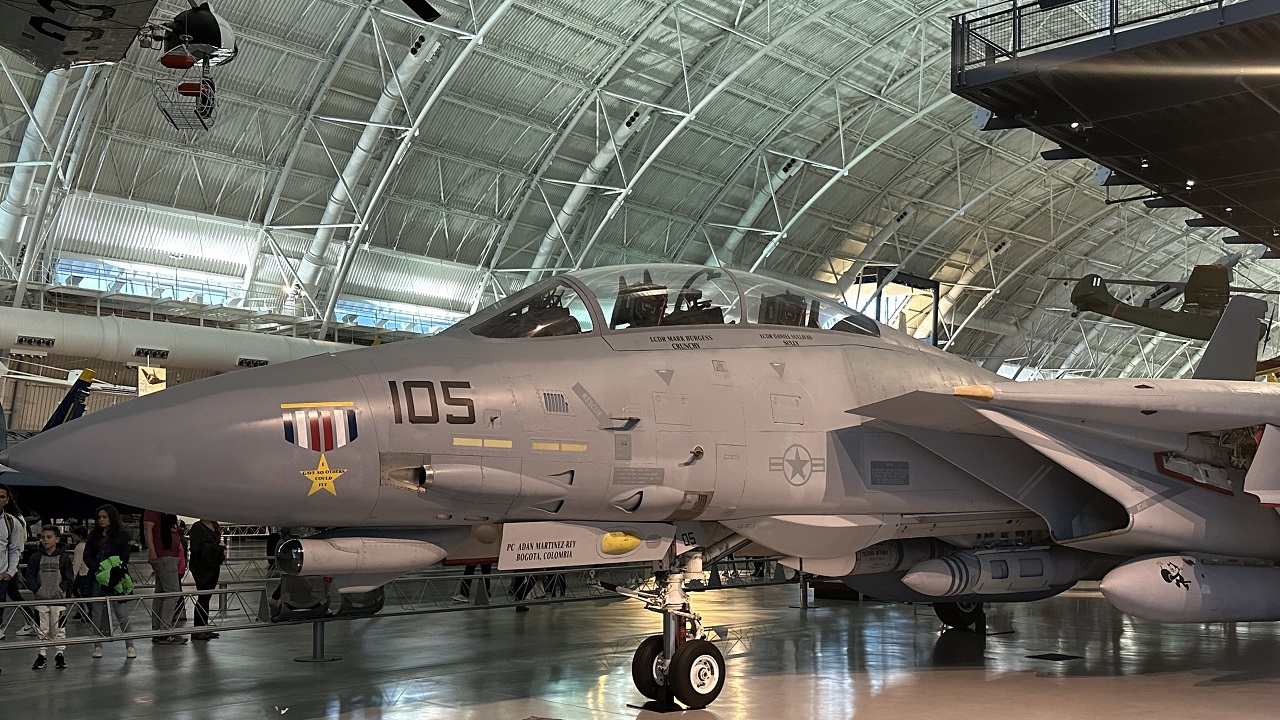
F-14 Tomcat. Image Taken at U.S. Air and Space Museum outside of Washington, D.C. Image Credit: 19FortyFive.com
Put the full sequence of 1991 to 1995 in one place, and the pattern this series has traced becomes unmistakable: the A-12 canceled in January 1991, the NATF dropped weeks later, the Seahawk refused in 1993, and again by 1995.
Four separate paths to stealth on a flight deck, all closed within five years, with the bill arriving as the twenty-eight-year gap that ended only when the F-35C reached the fleet. The NATF-23 was probably the longest shot of the four — a paper redesign of a losing prototype, priced for a budget that no longer existed.
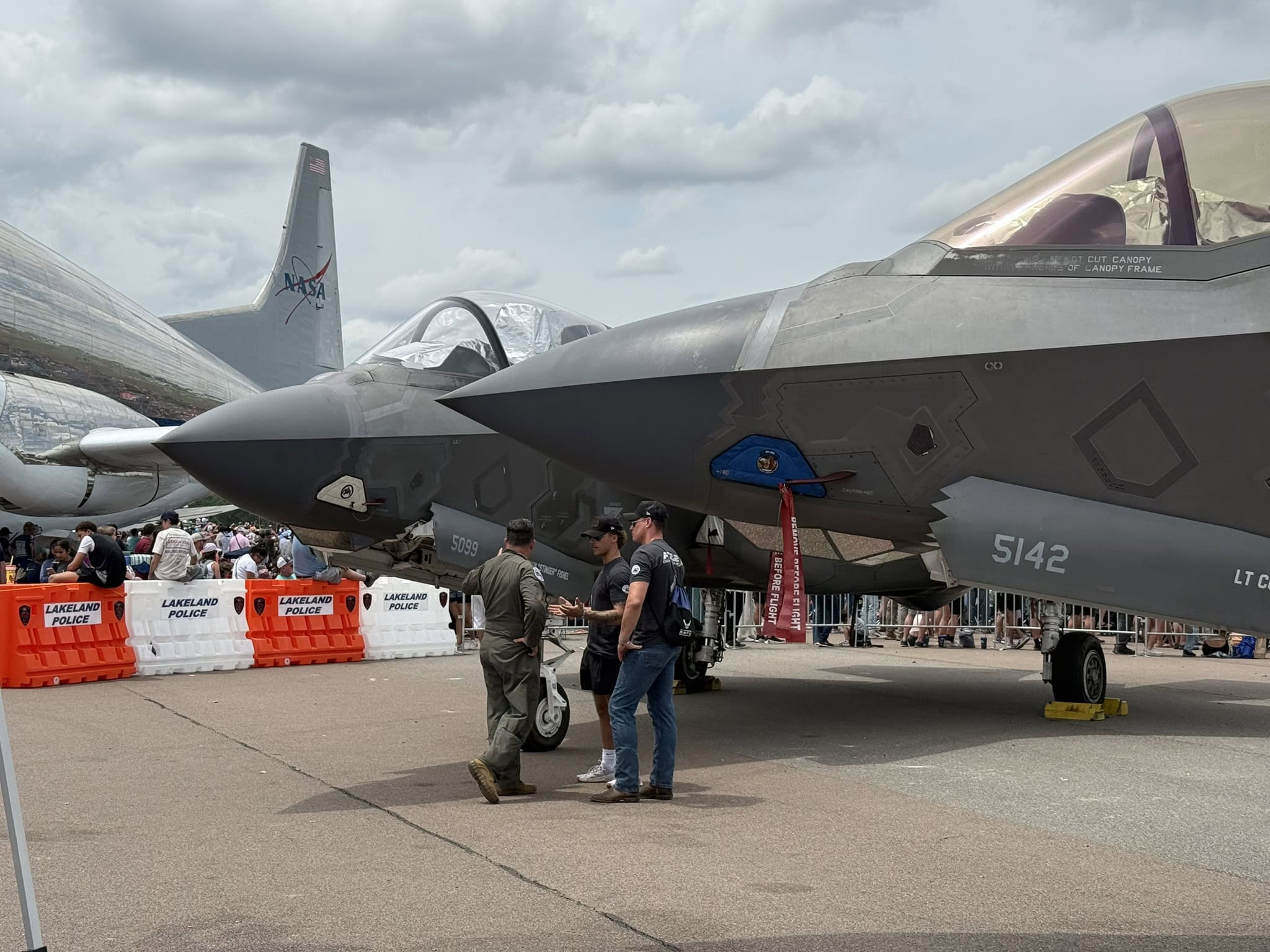
F-35C. Image Credit: 19FortyFive.com taken on 4/19/2026.
It was also the only one of the four that would have given the Navy a stealth air-superiority fighter, a thing it does not fully possess to this day, and the renderings of a folded-wing Black Widow on a carrier deck remain the cheapest reminder of how differently the fleet’s last thirty years could have run.
About the Author: Harry J. Kazianis
Harry J. Kazianis (@Grecianformula) was the former Senior Director of National Security Affairs at the Center for the National Interest (CFTNI), a foreign policy think tank founded by Richard Nixon based in Washington, DC. Harry has over a decade of experience in think tanks and national security publishing. His ideas have been published in the NY Times, The Washington Post, The Wall Street Journal, CNN, and many other outlets worldwide. He has held positions at CSIS, the Heritage Foundation, the University of Nottingham, and several other institutions related to national security research and studies. He is the former Executive Editor of the National Interest and the Diplomat. He holds a Master’s degree focusing on international affairs from Harvard University.

