
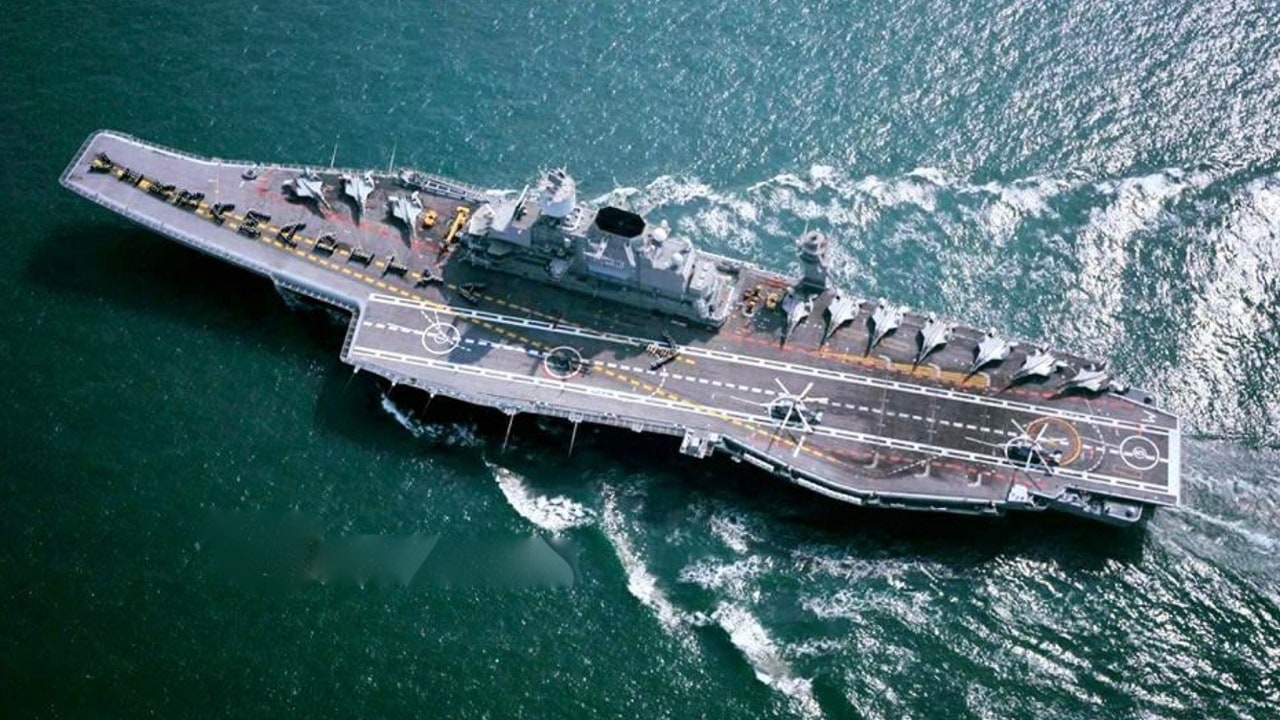
Russia has never enjoyed good luck with aircraft carriers. Just take the example of a cursed bucket of bolts called the Admiral Kuznetsov aircraft carrier that will never sail again.
The Russian navy does not even have a functioning carrier today.
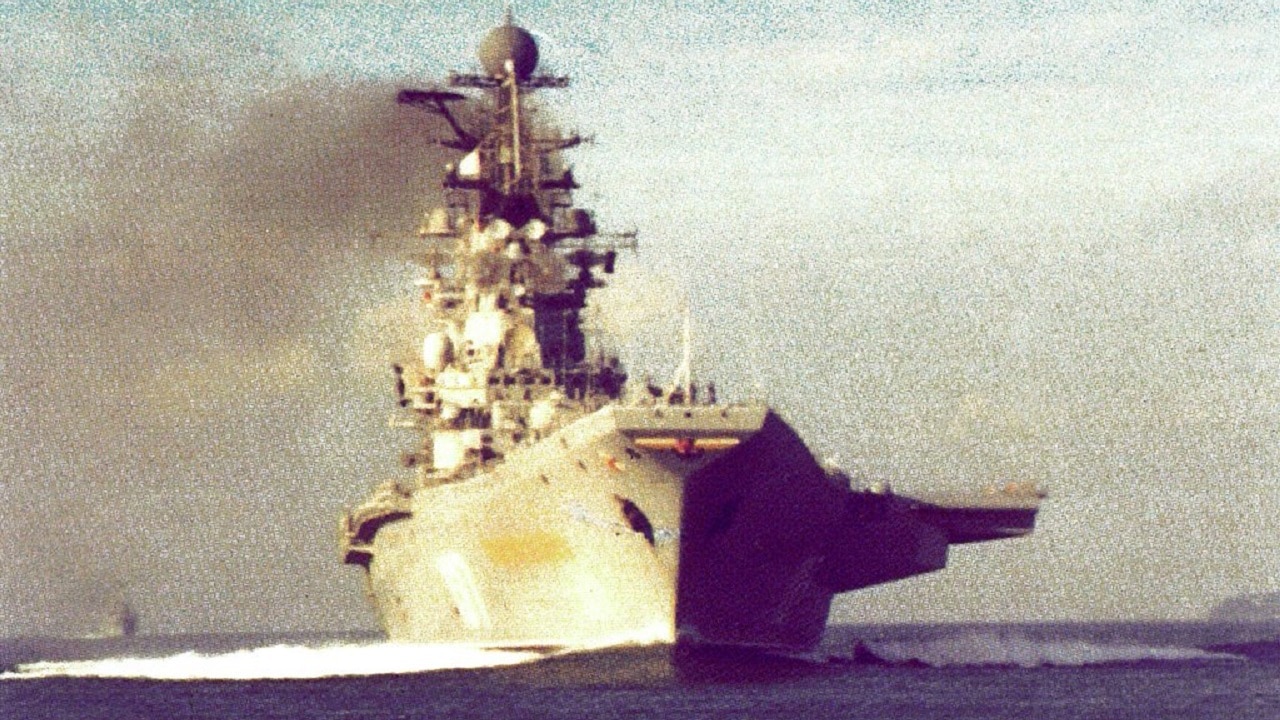
A bow view of a Soviet Kiev-class aircraft carrier (CVHG) underway

Artist concept of a Soviet Kiev-class aircraft carrier in a floating drydock. “Soviet Military Power,” 1983, Page 82-83
The history of the carrier program has been fraught with difficulties.
The Kiev-class experiment with a hybrid carrier-cruiser design was another ambitious attempt by the Soviet Union to achieve seaborne dominance, and the outcome was less than desired.
The State of Geopolitics During the Advent of the Kiev-class
The Soviet Union’s navy was confident in the 1970s. The United States was reeling from the Vietnam War.
The U.S. Navy’s own aircraft carriers were worn out from the strain of years at war, with sailors and pilots often operating around the clock to bomb North Vietnam and targets in South Vietnam.
The Navy was exhausted. The Soviet Union sensed weakness and wanted to usher in a new era of carrier warfare.
The New Heavy Aviation Cruisers
The naval engineers and designers went to work on something new.

An aerial port bow view of the Soviet aircraft carrier KIEV underway.
The concept was the Kiev-class “heavy aviation cruisers.” With these floating beasts, the Soviets figured they would have a leg up on the Americans if World War Three broke out.
No Need for a Complete Carrier Strike Group
These hybrid models could operate independently with heavy firepower. The Soviets would not need a carrier strike group like the Americans.
Since there were ample surface-to-surface weapons onboard, the Russians believed they could use the Kiev-class to take on all comers with a bevy of anti-ship missiles to go along with strike aircraft.
The Fighter Jets Onboard Were Not Effective
The Kiev-class featured the Yak-38 STOVL aircraft that could take off and land on the Kiev-class quickly and adroitly. This was the first jump-jet the Soviet Navy ever deployed.

Yak-38: Only 50 of these VTOL-jets were built. This year (1993) was the last year they were in active service.
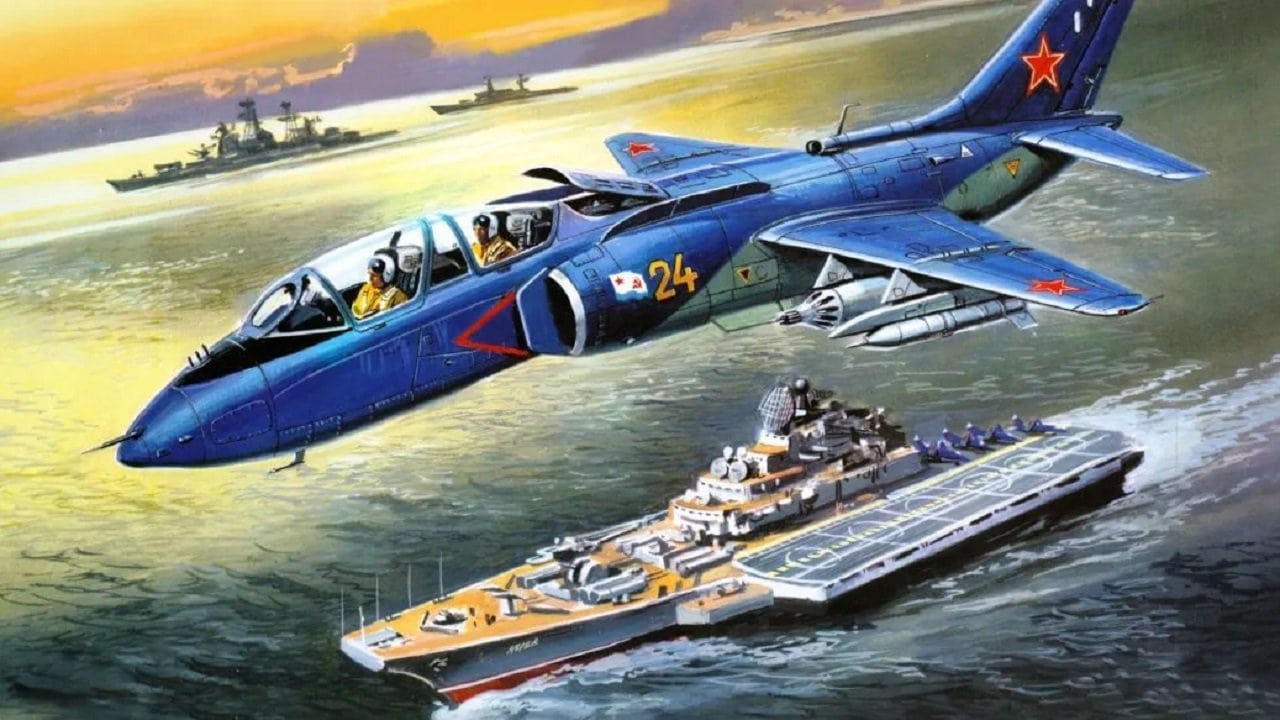
Yak-38. Image Credit: Creative Commons.
The Yak-38s were equipped with three engines for takeoff and landing. However, this created more drag from the extra weight and limited the weapons’ payload.
The Soviets may have been overconfident about the Yak-38, and this would have been a gamble on the Kiev-class with airplanes that were less than stellar.
The Soviet Union built four Kiev-class hybrid carriers. China later bought two as museum ships. India purchased one, and the other was scrapped.
Not a Diverse Number of Aircraft
The Kiev-class was akin to U.S. Navy amphibious assault ships with a much shorter flight deck than regular Nimitz-class carriers.
The weapons on board were impressive, but the Kiev-class just did not have enough aircraft to make a difference in a fight.
The squadrons needed airborne early warning aircraft and sufficient space for anti-submarine assets to protect against torpedoes and anti-ship missiles.
Not having other escort ships was another problem. The Kiev-class just did not have enough protection to accomplish the mission of a bona fide floating air base.
The Missile Cruiser Aspect
The Kiev-class, originally known as Project 1143 Krechyet, was an idea that seemed promising to the Soviets at that point in the Cold War.
The Kiev-class had eight SS-N-12 Sandbox missiles, a powerful, massive anti-ship and ground-strike munition, plus two SA-N-3 Goblet surface-to-air missile systems, several close-in weapons systems, and anti-submarine rocket launchers. There were also a handful of Ka-25 anti-submarine “Hormone” helicopters.
History Was Not Kind to the Kiev-class
One important aspect of the Kiev-class’s history was the requirement of the carriers to function as “Blue Water” assets. This goal was never accomplished.
They could only be deployed to the Black Sea. This limited their effectiveness as a deterrent against the Americans.
The Kiev-class ships were regional assets, and that was important for homeland defense, but they were never going to pursue and destroy a U.S. strike group.
Plus, the designers erred. The Kiev-class had very short flight decks – almost 300 feet shorter than the U.S. Nimitz-class. This would always limit the number of aircraft that could be launched and recovered.
They Lacked the Range to Be a Global Threat
They were also around 45,000 tons in displacement and could only carry a limited amount of fuel. This hurt their range and ability to carry the flag far beyond the Soviet Union’s territory.
This was a problem. The point of the carrier was to be able to deploy close to American shores.
The Cuban Missile Crisis identified a problematic aspect of the Soviet Navy.
There were not enough aircraft carriers to break the naval blockade around Cuba during the crisis.
Still Not Able to Carry the Flag in Far-off Oceans
Admiral Sergei Gorshkov wanted the Kiev-class to transform the Soviet navy into a force capable of challenging U.S. defenses with a ship that would have awesome firepower and enough strike aircraft to menace the Americans in their own neighborhood.
The Kiev-class could not accomplish both missions. The range was insufficient, the jump-jet strike aircraft would not be a decisive factor in an air war, and the onboard missiles were suspect.
Thus, the Kiev-class was a problematic hybrid carrier that could not fulfill all the wishes of the Soviet designers and engineers. The Kiev-class should be considered a cautionary tale that the Russians did not want to repeat.
The Soviets wanted a revolutionary ship, and what they got was a carrier that was not competitive in the Cold War. It was another example of naval ambition gone awry.
About the Author: Dr. Brent M. Eastwood
Author of now over 3,500 articles on defense issues, Brent M. Eastwood, PhD, is the author of Don’t Turn Your Back On the World: A Conservative Foreign Policy and Humans, Machines, and Data: Future Trends in Warfare, plus two other books. Brent was the founder and CEO of a tech firm that predicted world events using artificial intelligence. He served as a legislative fellow for US Senator Tim Scott and advised the senator on defense and foreign policy issues. He has taught at American University, George Washington University, and George Mason University. Brent is a former US Army Infantry officer. He can be followed on X @BMEastwood.