
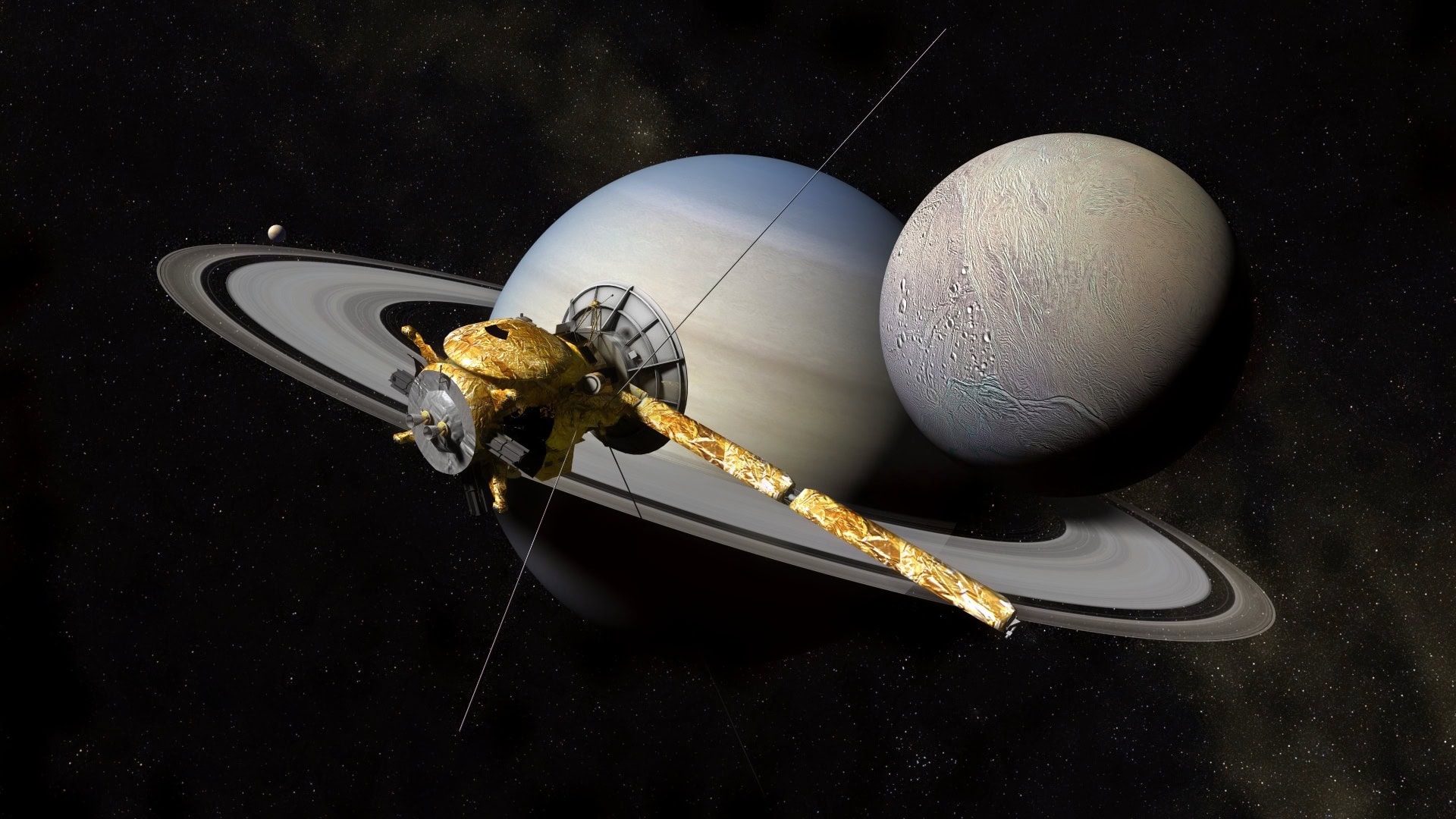
In September 2017, after twenty years in space and thirteen years orbiting Saturn, NASA pointed the Cassini spacecraft into the planet and let it burn up like a meteor. The probe was not broken. It had just spent more than a decade transforming Saturn from a distant ringed world into a system of storms, seas, plumes, and hidden oceans, and one discovery above all sealed its fate. Cassini found that Enceladus, a small icy moon, hides a global saltwater ocean beneath its shell and sprays that ocean into space through cracks at its south pole, an ocean with some of the chemistry that could, in principle, support life. That discovery is why Cassini had to die. A spacecraft built on Earth carries Earth microbes, and a dead, uncontrollable Cassini drifting through the Saturn system could one day have crashed into Enceladus and contaminated the very ocean it had found. So NASA chose the cleanest ending available, wringing the last science from the last fuel, and then steering the probe into Saturn itself, where the planet would erase the spacecraft and every microbe aboard. Like Galileo at Jupiter before it, Cassini was not destroyed for failing. It was destroyed for succeeding.
The Mission That Remade Saturn
Cassini launched from Cape Canaveral on October 15, 1997, a joint project of NASA, the European Space Agency, and the Italian Space Agency, with a lifetime cost widely put at around $3.4 billion. It took a seven-year, looping route to Saturn, stealing speed from gravity assists at Venus, Earth, and Jupiter before slipping into orbit on June 30, 2004.
A four-year prime mission stretched into two extensions and thirteen years in orbit, producing more than 450,000 images and thousands of scientific papers. Cassini also carried a passenger from Europe, the Huygens probe, which it released toward Saturn’s largest moon.
On January 14, 2005, Huygens descended to the surface of Titan, parachuting for two and a half hours through the moon’s thick orange haze and then transmitting from the ground, the first landing ever made in the outer solar system and still the most distant landing from Earth ever achieved.
The Ocean Moon That Sealed Its Fate
The discovery that doomed the spacecraft came from one of Saturn’s smaller moons. Soon after arriving, Cassini spotted geysers of water vapor and ice erupting from “tiger stripe” fractures near the south pole of Enceladus, a bright moon only a few hundred miles across. The material traced back to a global ocean of salty liquid water beneath the moon’s icy crust, and the implications grew sharper with every flyby.
On October 28, 2015, Cassini made a deep dive directly through the plume, passing about 30 miles above the surface, and its mass spectrometer detected molecular hydrogen in the spray. That detection mattered enormously. The peer-reviewed analysis concluded that the most plausible source of the hydrogen is hydrothermal reactions between ocean water and seafloor rock, the same kind of chemistry that drives Earth’s deep-sea vents, providing a potential source of chemical energy for life.
It was not the only sign. Cassini’s dust analyzer had earlier found tiny grains of silica in Saturn’s rings that most likely form where hot water meets the cooler ocean, and its instruments kept measuring more methane in the plume than ordinary chemistry could explain, both pointing to hydrothermal activity on the ocean floor. Taken together, the findings made Enceladus one of the most promising places to look for life anywhere beyond Earth. As the mission’s project scientist summarized it, Cassini revealed on the tiny moon a global salty ocean containing organics, ammonia, hydrogen, and silicates, with hydrothermal vents on its seafloor. None of that means anything lives there. What it means, as one summary of the hydrogen result put it, is that habitability is essentially manifested in the interior ocean of Enceladus.
A moon was spraying a possibly habitable ocean into space, and Cassini had flown through it and tasted it.
Seas Of Methane On Titan
Titan deepened the problem. Beneath its smog-thick atmosphere, Cassini and Huygens found a world with lakes and seas of liquid methane and ethane in its northern latitudes, the first stable bodies of surface liquid found anywhere beyond Earth, along with rivers, hydrocarbon dunes, and evidence of a deep subsurface ocean of water and ammonia. The chemistry on the surface turned out to be startlingly complex.
Cassini’s instruments showed that Titan’s hydrocarbons are produced by atmospheric chemistry rather than by life, with complex organic molecules drifting down to coat the surface, a natural laboratory for the kind of prebiotic chemistry that may have preceded life on Earth. Before Cassini, the short list of worlds in the solar system that might host life was essentially Mars and Europa. After Cassini, Enceladus joined that list, and Titan became one of the most chemically interesting places known.
Why Success Became The Problem
By 2017, Cassini was running low on the propellant it used to steer and to keep its antenna pointed at Earth. Once that fuel ran out, mission controllers would lose control of the spacecraft’s trajectory, leaving a dead orbiter adrift in a system that now contained ocean worlds.
The danger was not an imminent crash. It was uncertainty over very long timescales, the possibility that, over decades or centuries, an uncontrolled Cassini could eventually strike Enceladus or Titan, and the fact that the spacecraft had not been sterilized to the standard required for contact with a habitable environment.
Depositing hardy Earth microbes on a world with a subsurface ocean would be scientifically catastrophic, ruining any future attempt to search for life that arose there on its own. This is the same planetary-protection logic that doomed Galileo at Jupiter, applied a decade later at Saturn, with the stakes raised because Enceladus is an even sharper astrobiology target than Europa. The decision was not made at the last minute. The plan to end the mission with a plunge into Saturn was set back in 2010, and the Enceladus discoveries only hardened it.
Two disposal options met the requirement to guarantee the moons stayed clean: either eject Cassini from the Saturn system entirely or destroy it. Ejection would have demanded far more fuel than the spacecraft had left. The decision, as Scientific American described it, was a fiery end chosen to ensure the moons would remain unsullied by any microbes that may have hitchhiked from NASA’s clean rooms. The 33 kilograms of plutonium that powered the spacecraft factored into the planning, but the contamination concern was biological, not radioactive. The worry was the microbes, not the fuel.
The Huygens Paradox
There is an obvious objection, the same one that shadows the Galileo story. If contamination was the concern, why was it acceptable to land Huygens on Titan in 2005, but not acceptable to risk Cassini striking Titan later?
The answer is that planetary protection is not a single blanket rule. It depends on the target, the chemistry, the temperature, and the judged contamination risk. Titan’s surface is intensely cold and chemically alien, with liquid water frozen rock-solid, so the risk to its surface from Earth microbes is low.
Enceladus is different because it vents material from its subsurface ocean directly into space, putting that ocean within reach in a way Titan’s buried sea is not. As the mission’s project scientist explained, when Huygens was sent, it was not yet known what either moon held, and it was precisely the discoveries of Cassini and Huygens that drove the new protection requirements. The rules around the world tighten the moment a probe reveals it is more interesting than anyone knew. That is the hidden cost of discovery, and Cassini paid it in the same currency Galileo did.
The Grand Finale
NASA turned the disposal into a final mission of its own. Beginning April 22, 2017, Cassini flew 22 weekly orbits that threaded the unexplored gap between Saturn’s cloud tops and the inner edge of its rings, a corridor roughly 1,200 to 1,500 miles wide that no spacecraft had ever crossed.
The maneuver was set up by a final close flyby of Titan on April 22, nicknamed the goodbye kiss, which used the moon’s gravity to bend Cassini’s path so that it leaped over the rings and dropped into the gap, traveling at 75,000 to 78,000 miles per hour at closest approach. On its first dive, the team turned the high-gain antenna forward to act as a shield against ring particles, uncertain what the spacecraft would hit.
The dives returned with science impossible to gather any other way. Cassini measured Saturn’s gravity and magnetic fields from inside the rings, mapping the planet’s interior, and it weighed the rings themselves, a measurement bearing directly on one of Saturn’s oldest mysteries. Scientists have long debated whether the rings formed 4.5 billion years ago with the planet or only about 100 million years ago, and the Grand Finale data leaned toward youth.
Cassini found a surprising amount of material raining from the rings into Saturn, fast enough that at the current rate the inner rings would last only tens of thousands of years, supporting the view that the rings are far younger than the planet they encircle, though the question is not fully settled. After the goodbye kiss, there was no longer enough fuel to escape, and the impact was locked in.
The Last Ninety Seconds
On September 15, 2017, Cassini made its final dive, this time into Saturn’s atmosphere rather than past it. Its cameras were already off. The data rate during the plunge could not support imaging, so the final pictures had been taken and sent home hours earlier, including last looks at Enceladus and Titan and at the spot where the spacecraft would enter.
What kept transmitting was the science. The mass spectrometer was among the last instruments running, sampling the composition of Saturn’s upper atmosphere in real time and sending it back as the spacecraft fell. Cassini’s small thrusters fired at increasing power to hold the antenna on Earth against the thickening atmosphere, and for a while, they held.
Then the atmosphere won. The thrusters reached full capacity and could do no more, and Cassini survived a total of 91 seconds in the dense air before tipping over backward in its last eight seconds and losing its lock on Earth. The final signal was caught by the Canberra Deep Space Communication Complex in Australia, arriving at 4:55:46 in the morning Pacific time, with the spacecraft burning up like an artificial meteor about 45 seconds after the signal cut out, hitting the atmosphere at roughly 75,000 miles per hour.
In a small parting gift to the engineers, many of whom had spent decades on the mission, the data ran about 30 seconds longer than predicted. And because Saturn was so distant that its radio signal took roughly an hour and a half to reach Earth, Cassini had in truth been gone for about that long by the time controllers heard it end. They were listening to a spacecraft that no longer existed.
The Discovery Outlived The Discoverer
Cassini’s ending was the second act of an ethic that Galileo had established at Jupiter, and the lineage runs forward from here. NASA’s Juno spacecraft, still orbiting Jupiter, is slated for its own deliberate plunge into the planet to protect Europa, and the next mission to Titan is already being built around the world, Cassini revealed, rather than a blank one. NASA’s Dragonfly, a car-sized nuclear-powered rotorcraft confirmed for launch in 2028, will fly between dozens of sites on Titan to study its carbon chemistry, a mission only possible because Cassini and Huygens mapped the moon first.
The instrument lead for Cassini’s mass spectrometer went on to build a related instrument for the Europa Clipper, now on its way to Jupiter, carrying the Saturn mission’s methods to the moon Galileo had flagged.
The spacecraft is gone, but its discoveries are not. Cassini’s plume data is still producing new findings about the chemistry of Enceladus, years after the orbiter burned up, the ocean it found growing more interesting even as the probe that found it has become part of Saturn.
That is the strange shape of the mission’s end. NASA spent two decades and billions of dollars building and flying Cassini, and then deliberately destroyed a working spacecraft, not because it had stopped mattering but because what it had found mattered too much to put at risk. Cassini was not thrown away. It was spent, deliberately and to the last second of useful data, to protect a small moon’s ocean from the one contaminant the spacecraft could never fully shed, which was itself.
About the Author: Harry J. Kazianis
Harry J. Kazianis (@Grecianformula) was the former Senior Director of National Security Affairs at the Center for the National Interest (CFTNI), a foreign policy think tank founded by Richard Nixon based in Washington, DC. Harry has over a decade of experience in think tanks and national security publishing. His ideas have been published in the NY Times, The Washington Post, The Wall Street Journal, CNN, and many other outlets worldwide. He has held positions at CSIS, the Heritage Foundation, the University of Nottingham, and several other institutions related to national security research and studies. He is the former Executive Editor of the National Interest and the Diplomat. He holds a Master’s degree focusing on international affairs from Harvard University.

