
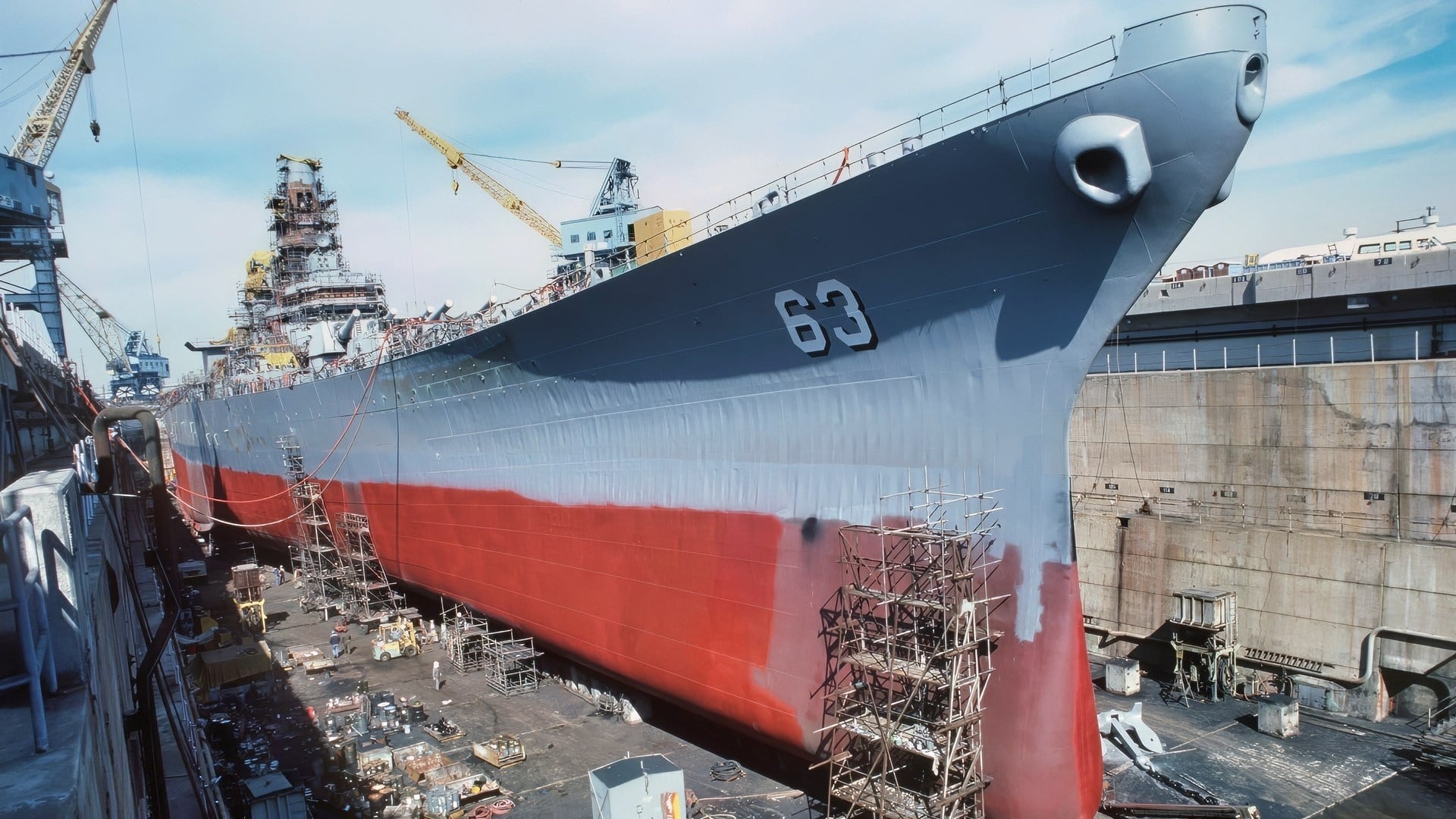
Summary and Key Points: USS Kentucky was the last American battleship left under construction, and the Navy never commissioned her. For fourteen years, it tried to find her a job instead: an aircraft carrier, an anti-aircraft ship, the guided-missile battleship that would have been BBG-1. Her real career turned out to be a donor. Workers cut her bow free in 48 hours to save USS Wisconsin, and her engines went to sea in other hulls for four decades after the battleship era ended. Every one of her four completed sisters is a museum today. Kentucky survives as sixty-eight feet of another ship’s bow.
Meet the Iowa-Class Battleship USS Kentucky: Naval History
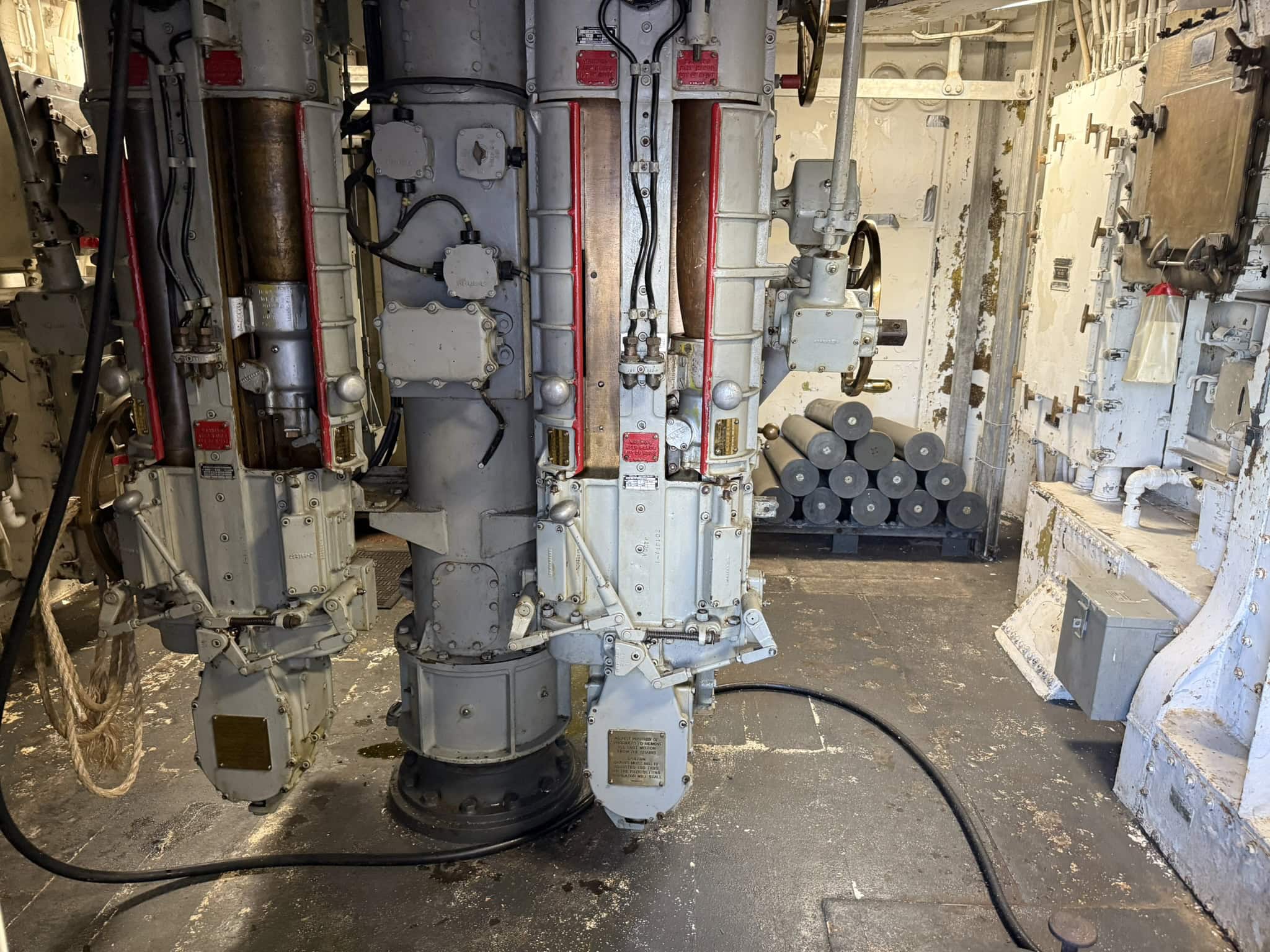
USS Iowa Battleship visit by Harry J. Kazianis for 19FortyFive.com. Taken back in August 15, 2025.
The U.S. Navy laid Kentucky’s keel at the Norfolk Navy Yard in Portsmouth, Virginia, in March 1942, three months after Pearl Harbor, and stopped building her three months later. The yard needed the space for landing craft, and the Navy needed carriers more than it needed a sixth Iowa-class battleship. That opening stutter set the pattern for everything that followed. Kentucky, hull number BB-66, would spend sixteen years on the Navy’s books without a single day in commission, and she would end up mattering to the fleet anyway, one piece at a time.
From Montana class to Iowa class: how BB-66 became America’s final battleship hull
Kentucky was not even supposed to be in Iowa. When Congress cleared hulls BB-63 through BB-66 for construction on July 12, 1940, the last two, Illinois and Kentucky, were slated to become the first ships of the Montana class, slower giants carrying twelve 16-inch guns. One week later, the emergency war-building program of July 19, 1940, reordered both as the fifth and sixth Iowas instead, because the Navy had concluded it needed fast battleships that could keep pace with the new Essex-class carriers, and it needed them sooner than any new design could deliver.
The decision made Kentucky the sixth and final Iowa, and ultimately the last American battleship left under construction anywhere. The war then rendered her unnecessary. Suspended in June 1942, resumed in December 1944 when planners still expected a long fight against Japan, and halted for good in February 1947, she sat at roughly three-quarters complete, a hull with no war left to fight.
Fourteen years of plans: a carrier deck, an anti-aircraft ship, and the missile battleship BBG-1
The Navy kept trying to finish her as something. A 1944 study looked at completing her as an aircraft carrier with an 864-foot flight deck and rejected the idea as inferior to purpose-built carriers. A plan to complete her as an anti-aircraft battleship, born of the kamikaze experience, died in the postwar drawdown by 1947. On January 20, 1950, the incomplete hull was launched with no ceremony worth the name, simply to clear her building dock for other work, and she went to the mothball fleet at Philadelphia as a parts hulk.
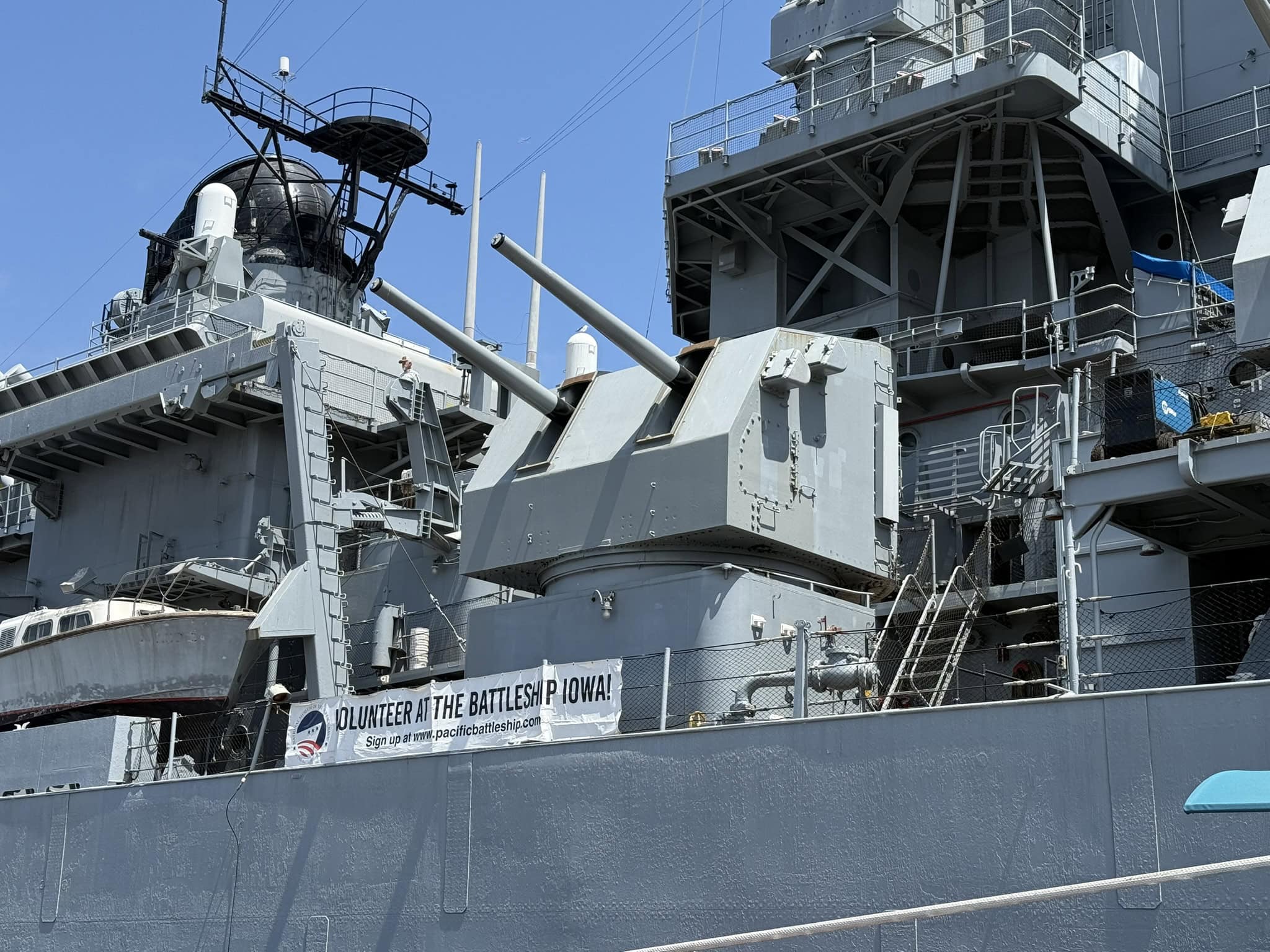
USS Iowa Battleship visit by Harry J. Kazianis for 19FortyFive.com. Taken back in August 15, 2025.
Even retirement was eventful: Hurricane Hazel tore her from her moorings on October 15, 1954, and ran her aground in the Delaware River. Through the 1950s, the most serious proposal of all took shape, completing her as a guided-missile battleship, armed with Regulus and later discussed for Polaris, under plans that would have made her the Navy’s first BBG.
The studies kept colliding with the same problem: missile technology was changing faster than a conversion could be designed, and the cost kept climbing toward new-construction money. The Navy killed the conversion in July 1956. By then, Kentucky had already performed the one operation she would be remembered for.
May 6, 1956: forty-eight hours to take her bow, sixteen days to give it to Wisconsin
On a foggy Sunday afternoon off Hampton Roads, the battleship USS Wisconsin collided with the escorting destroyer USS Eaton, mangling the battleship’s bow and putting one of the Navy’s four active Iowas out of action. The fix came from the fifth. Workers at Newport News Shipbuilding cut the bow from the unfinished Kentucky within 48 hours, and over the next sixteen days, Norfolk Naval Shipyard fitted the 120-ton, 68-foot section onto Wisconsin’s hull. The graft ran from the bulbous bow aft; only the bull-nose above the anchor wells remained original Wisconsin.

USS Iowa Seal 19FortyFive.com Original Image Taken By Harry J. Kazianis Onboard Battleship USS Iowa in 2025.
The famous nickname deserves its honest version, which the City of Norfolk’s own historical marker carries: Wisconsin’s crews had called her “Wisky” since her commissioning in 1944, and the “WIS plus KY” reading is a sea tale layered on after the surgery. The tale stuck because it deserved to. A battleship that never sailed had given a battleship her bow back in just over two weeks, and the evidence is still welded in place on the museum ship at the Norfolk waterfront today.
Kentucky’s engines outlived the battleship era by four decades
The bow was the famous donation. The engines were the productive ones. Kentucky’s four 600-psi boilers and turbine sets were removed, stored, and installed in the Navy’s first two Sacramento-class fast combat support ships, USS Sacramento and USS Camden, laid down in 1961 and 1964. A battleship powerplant gave the huge replenishment ships the speed to keep station with carrier task forces, and the two vessels ran on Kentucky’s machinery from Vietnam through the Cold War and the Gulf, serving into the mid-2000s.

16-Inch Guns of USS Iowa 19FortyFive Image taken by Harry J. Kazianis on the Deck of the Battleship USS Iowa.
The transfer paid a second dividend nobody planned: when the Navy reactivated USS New Jersey for Vietnam and recalled all four Iowas in the 1980s, the sailors experienced on 600-psi plants were the ones who had been running Kentucky’s boilers aboard Sacramento and Camden all along. The last battleship America built never fired a gun, but her engines logged more than forty years at sea, longer than most of the battleships that were finished.
A Kentucky congressman, $1,176,666, and the only Iowa with nothing left
The end came over one home-state objection. Representative William Huston Natcher of Kentucky tried to block the sale in August 1957, and the Navy struck the ship from the Naval Vessel Register on June 9, 1958, anyway. On October 31, 1958, the hulk was sold for scrapping to the Boston Metals Company of Baltimore for exactly $1,176,666, and tugs towed her from Norfolk in February 1959 with spare parts stacked on her deck for the trip.
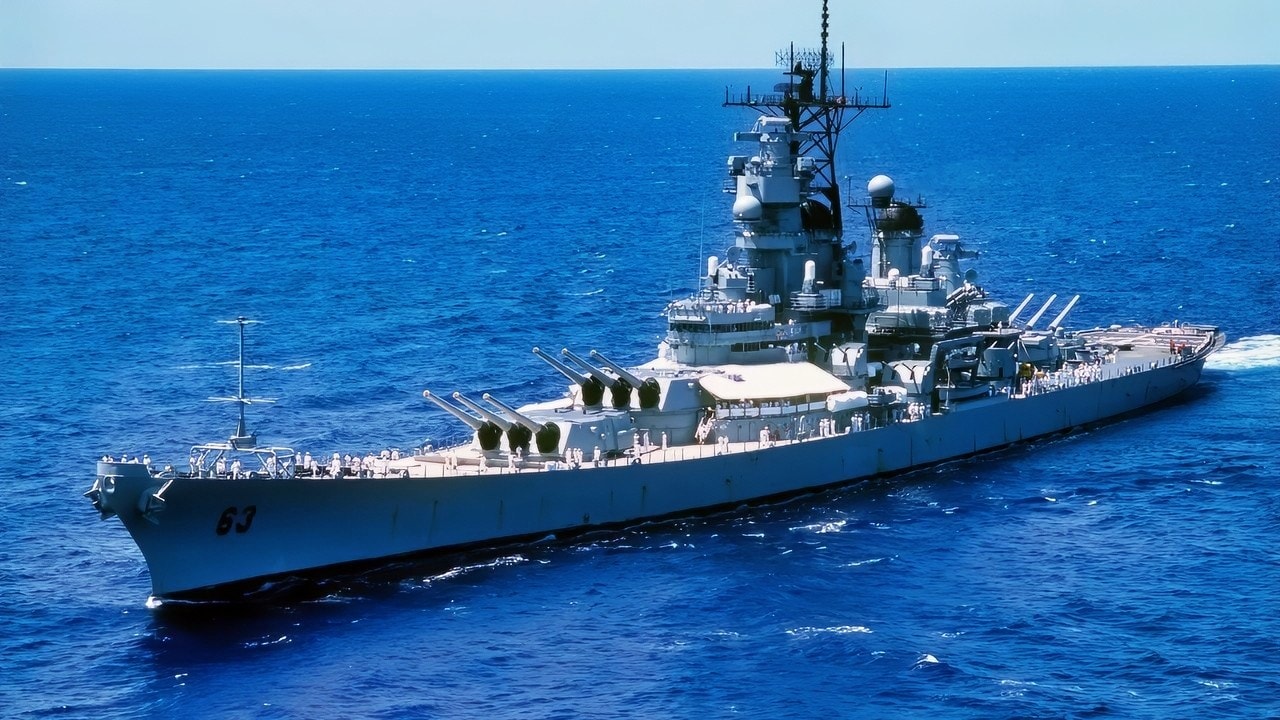
Iowa-Class Battleship Sailing. Image Credit: Creative Commons.
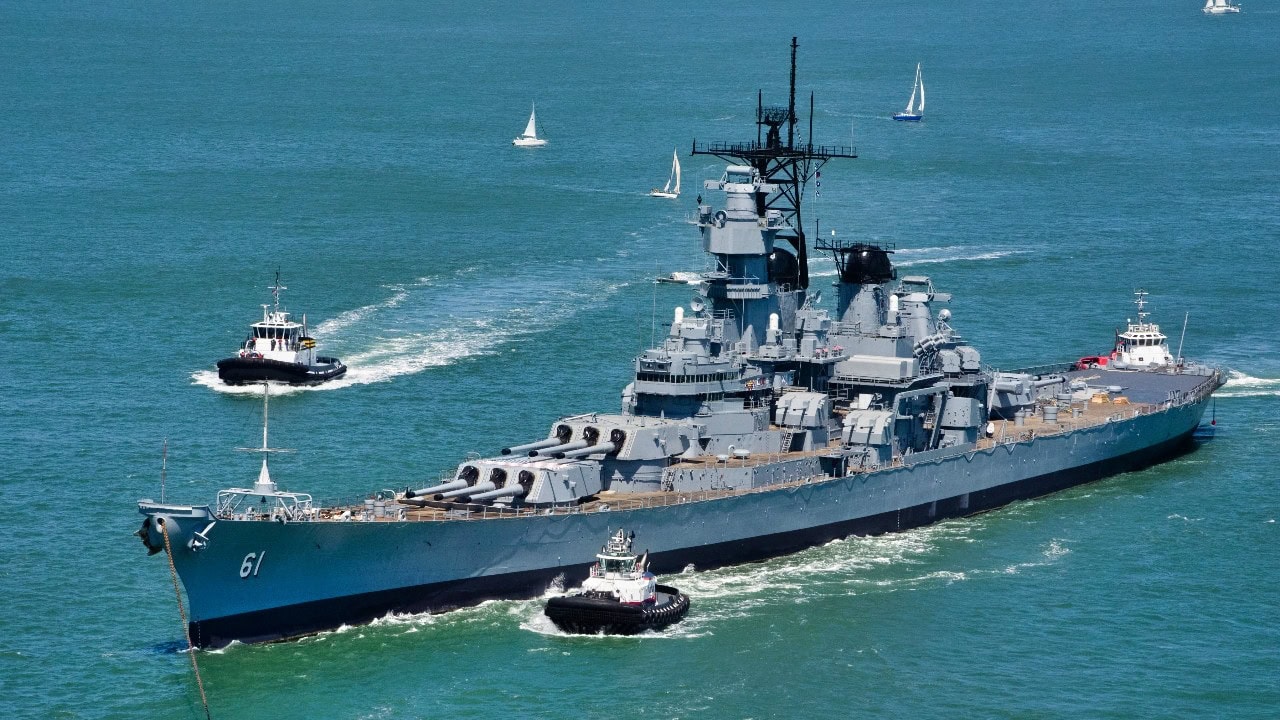
Iowa-Class Battleship Heading Into Port for U.S. Navy. Image Credit: Creative Commons.
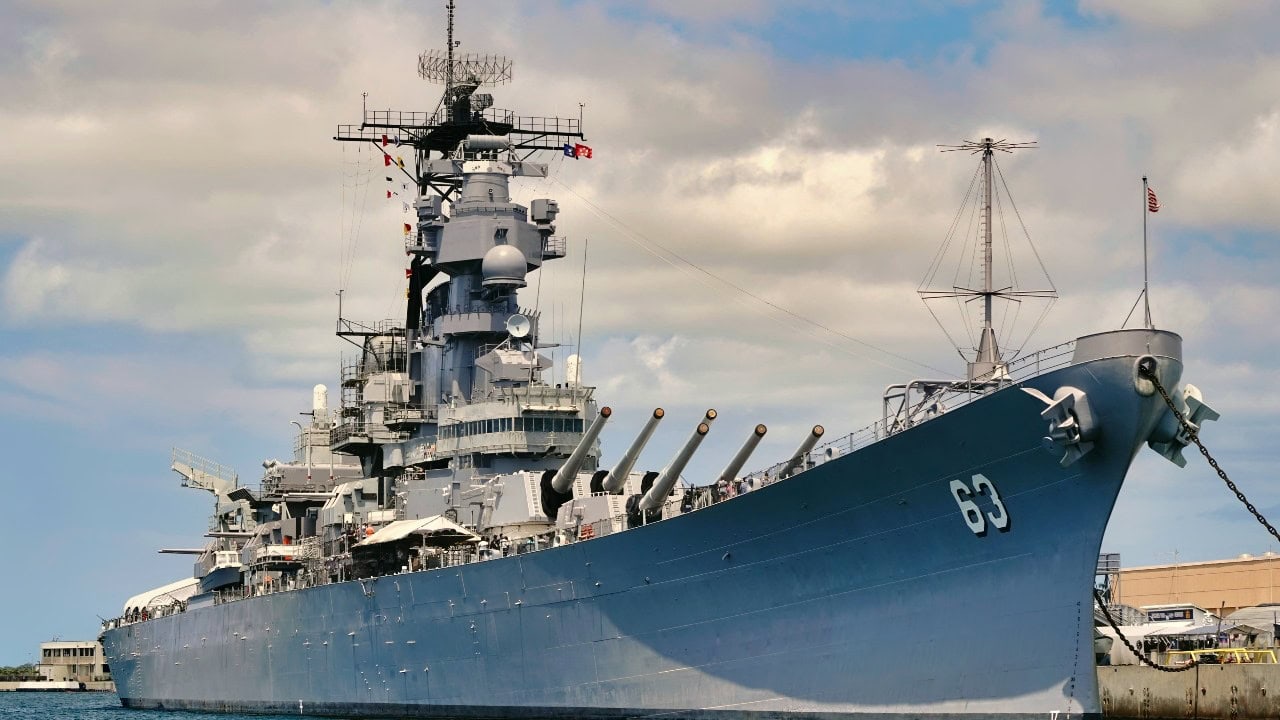
Iowa-Class Battleship at Port. Image Credit: Creative Commons.
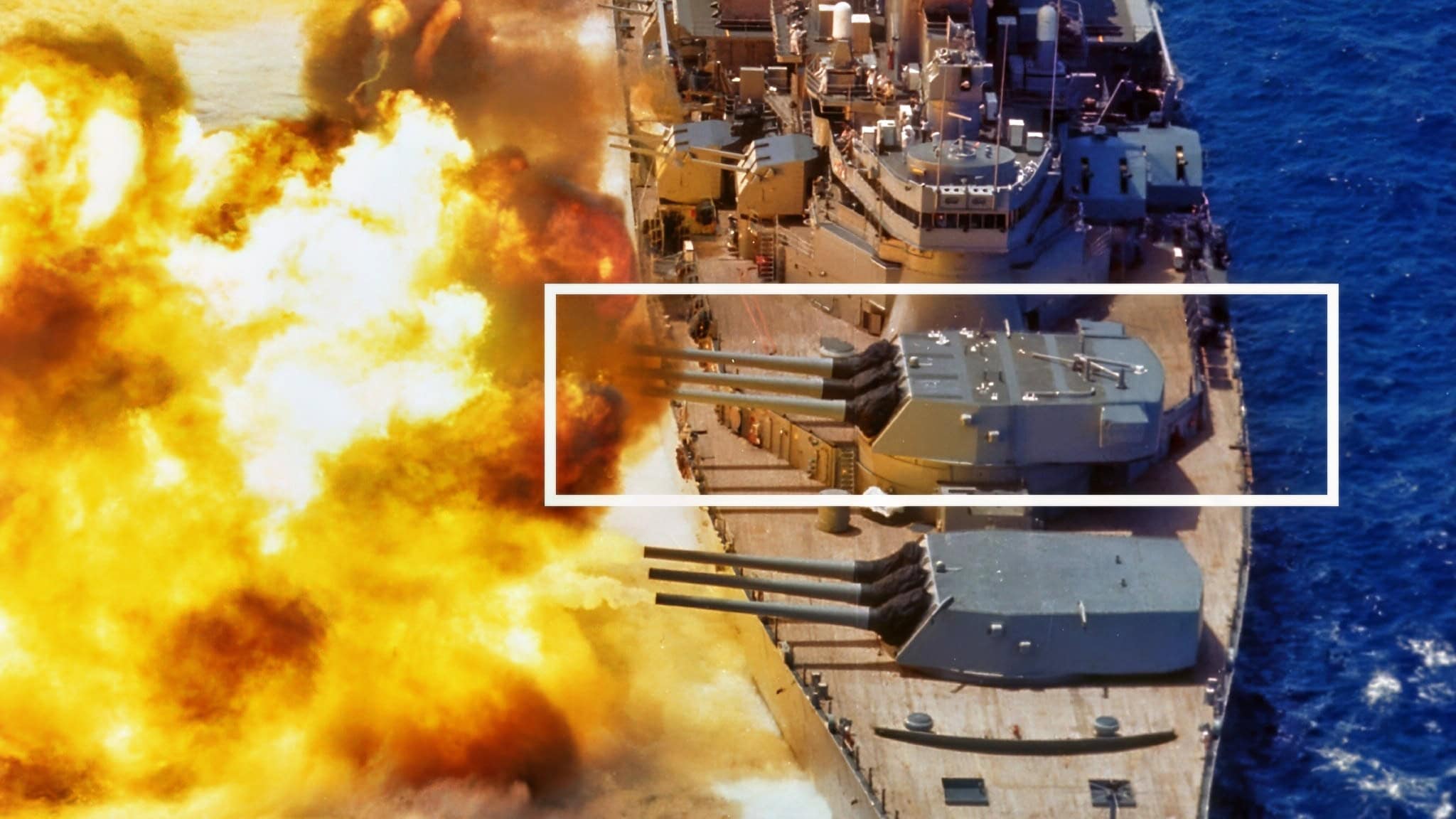
Iowa-Class Battleship 16-Inch Gun. Image Credit: Creative Commons.
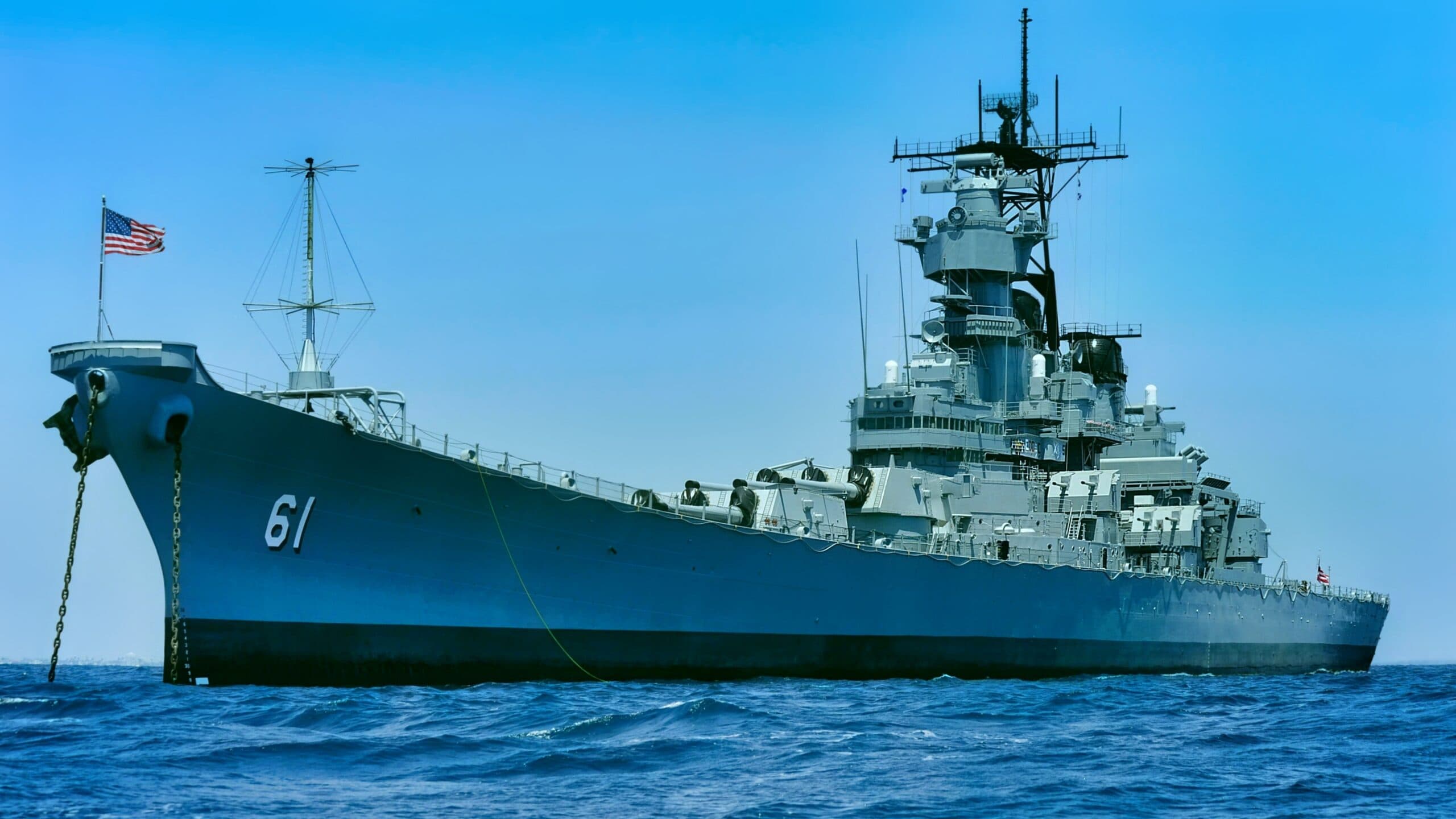
USS Iowa of the Iowa-Class Battleships. Image Credit: Creative Commons.
The four Iowas that were completed all survived: Iowa at Los Angeles, New Jersey on the Camden waterfront, Missouri over Pearl Harbor, Wisconsin at Norfolk. Kentucky, three-quarters of a battleship for sixteen years, got the scrapper’s torch, and the Navy eventually passed her name to an Ohio-class ballistic missile submarine commissioned in 1991 that patrols today.
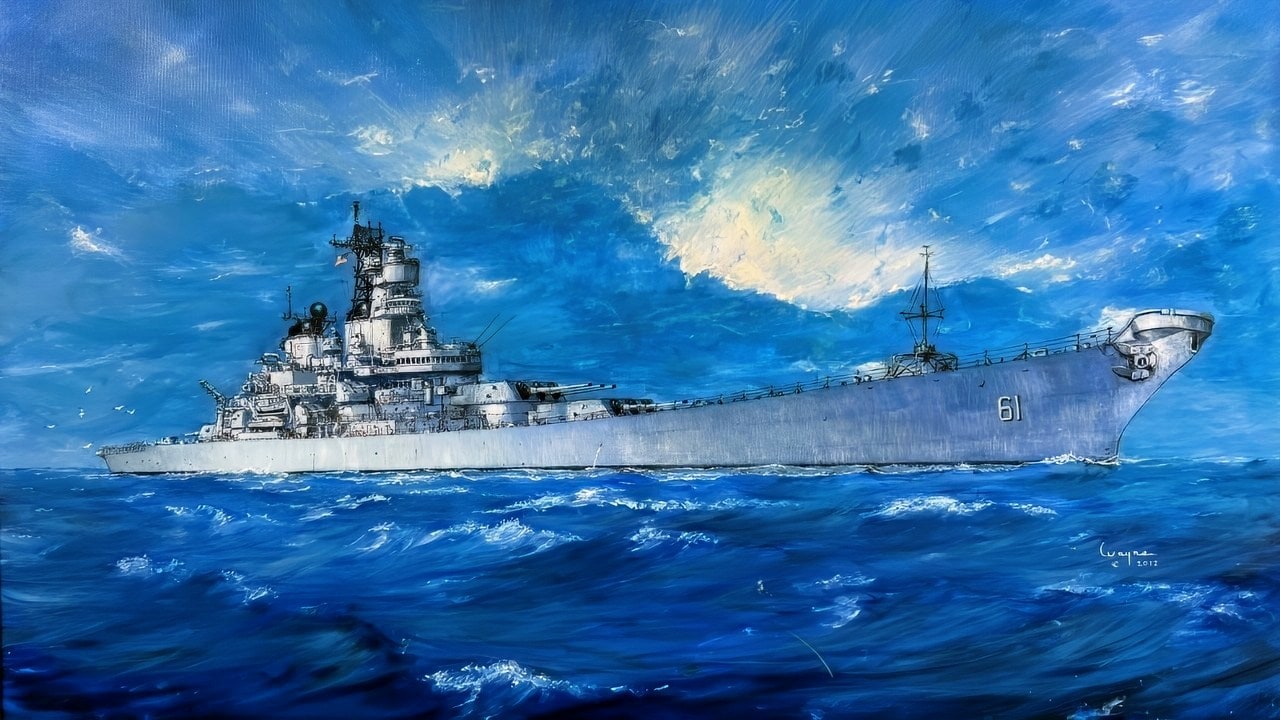
Image taken by Harry J. Kazianis aboard the USS Iowa on August 15, 2025. The image is of a painting of the USS Iowa, an Iowa-class ship. USS New Jersey is also an Iowa-class battleship.
Her only physical monument is the one hiding in plain sight: sixty-eight feet of her bow, still riding on Wisconsin in Norfolk, marked by a small city plaque that most visitors walk past on their way to see somebody else’s battleship.
About the Author: Harry J. Kazianis
Harry J. Kazianis (@Grecianformula) was the former Senior Director of National Security Affairs at the Center for the National Interest (CFTNI), a foreign policy think tank founded by Richard Nixon based in Washington, DC. Harry has over a decade of experience in think tanks and national security publishing. His ideas have been published in the NY Times, The Washington Post, The Wall Street Journal, CNN, and many other outlets worldwide. He has held positions at CSIS, the Heritage Foundation, the University of Nottingham, and several other institutions related to national security research and studies. He is the former Executive Editor of the National Interest and the Diplomat. He holds a Master’s degree focusing on international affairs from Harvard University.

