
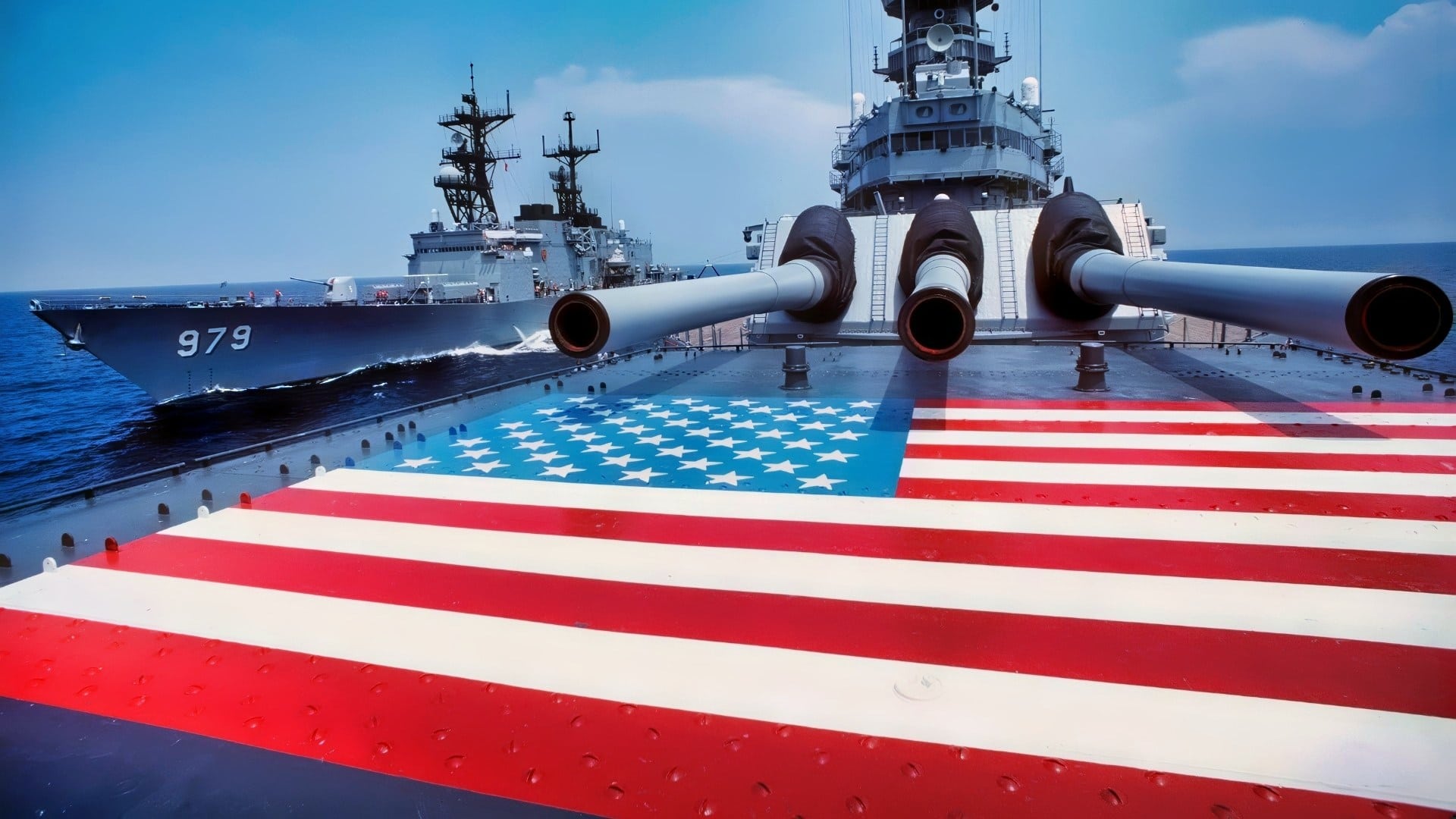
Summary and Key Points: The U.S. Navy, the Congressional Budget Office, and Newport News Shipbuilding are now tied to the most expensive surface warship program in a generation — a nearly $19 billion vessel the Trump administration unveiled in December and that Congress is already fighting over. The Pentagon’s own cost analysts price the lead ship at more than a nuclear aircraft carrier, and the shipyards that would build it are the same ones already struggling to deliver the Navy’s carriers and submarines on time. Before a single hull is laid down, the fight is less about firepower than about whether American industry can build the thing at all.
The Battleship Debate Is Back in 2026
On December 22, the Trump administration announced the first battleships the Navy has ordered since World War II: the Trump-class, lead ship USS Defiant, centerpiece of a promised “Golden Fleet.” The word is doing heavy lifting — the design carries no armor belt and no 16-inch rifles, and the Congressional Budget Office prices the first hull above an aircraft carrier. And the idea is older than it looks. The Navy has tried to resurrect the battleship three times since it buried the type, each time by bolting the newest missile onto the biggest hull available. This time it wants fifteen new battleships. Wow. Just wow.
My Time on a Real Battleship
Last August, I spent a day aboard USS Iowa at the Pacific Battleship Center in San Pedro, walking the teak deck of the last battleship class the United States ever built. The object that stayed with me was not one of the nine 16-inch rifles. It was a gray armored box on the deck amidships, a Tomahawk missile container from the 1980s, bolted where anti-aircraft guns once stood. That box was the first time the Navy answered a hard question — what is a battleship for when there is no gun battle left to win — by turning the biggest hull it owned into a missile magazine.
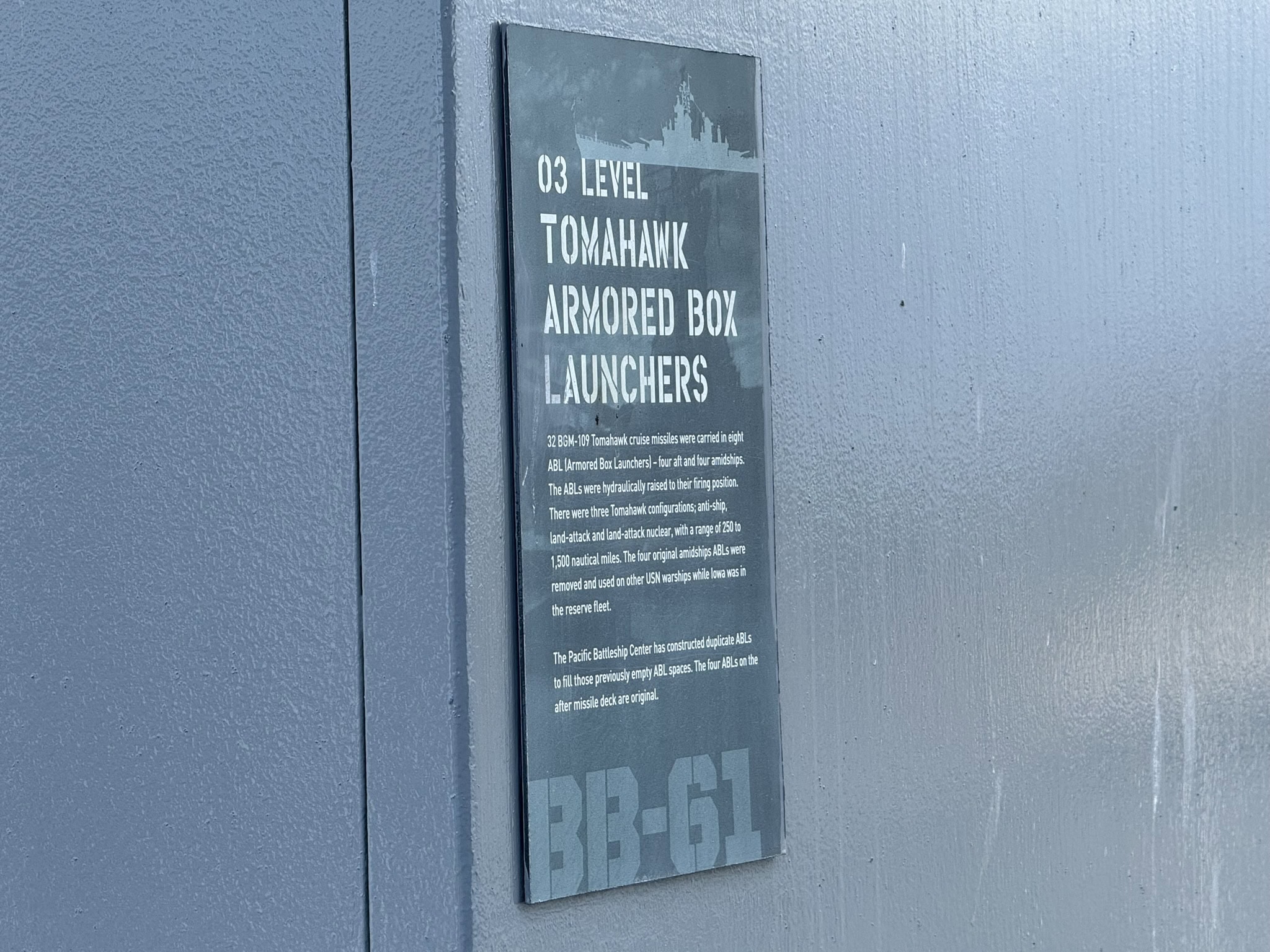
Tomahawk Box on USS Iowa. 19FortyFive.com Image.
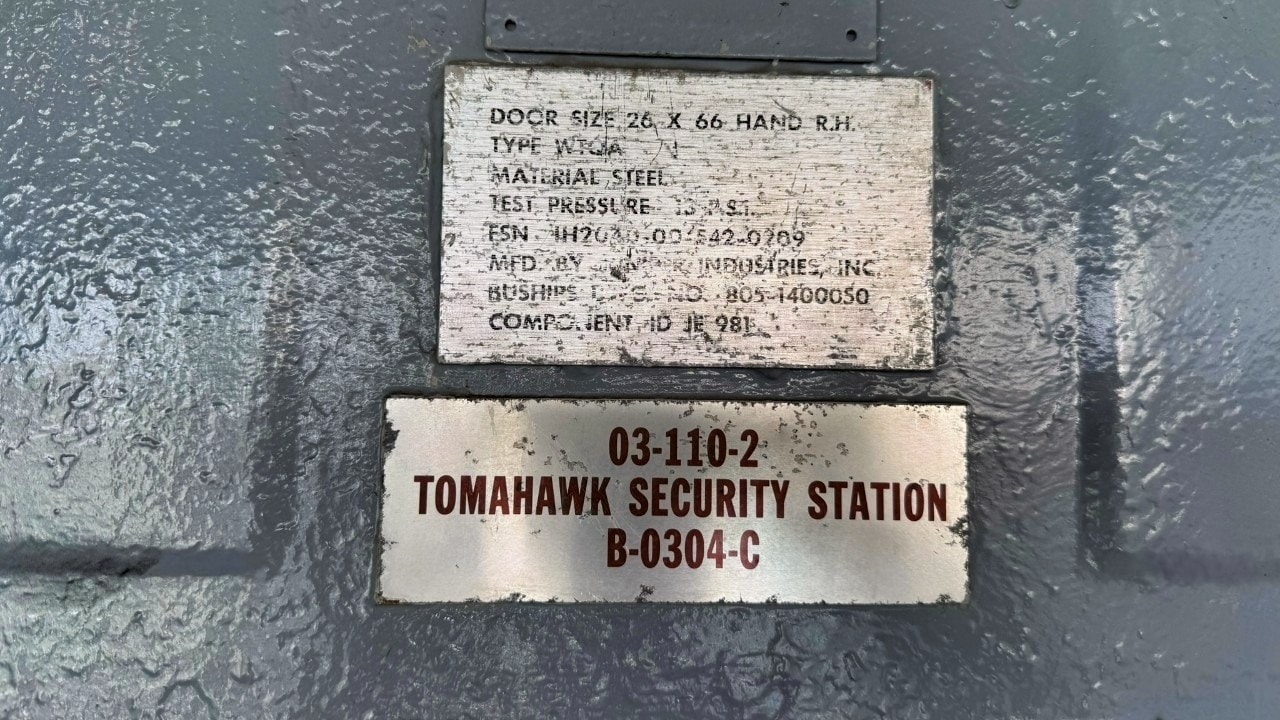
Battleship USS Iowa Tomahawk Missile Container. Taken by Harry J. Kazianis for 19FortyFive.com abord USS Iowa.
Four months after that visit to Mar-a-Lago, the Navy’s civilian leadership announced it wants to ask the question again, this time with a clean slate.
Understanding why the battleship died and why the Navy keeps reaching back to its job description explains what the Trump-class actually is and what it is not.
Why the Navy Stopped Building Battleships After 1944
The Iowa-class was designed in the late 1930s for a specific fight: a gun duel against Japanese capital ships, won by armor thick enough to withstand 16-inch hits and rifles capable of returning fire at more than 20 miles.
Six were planned; four were finished — Iowa, New Jersey, Missouri, and Wisconsin — and the Missouri, delivered in 1944, became the last battleship the United States ever commissioned.
The remaining two hulls, Illinois and Kentucky, were never completed because by the time they could have mattered, the verdict was already in. The war the Iowas were built for was decided by aircraft carriers launching strikes at ranges no gun could answer, and the battleships spent the Pacific campaign escorting the carriers that had replaced them and shelling shorelines the air wings had already reached.
Peace finished what aviation started. The ships were magnificent and ruinously expensive to run, with wartime crews approaching 2,700 sailors and operating costs no peacetime budget could bear, and all four were decommissioned by 1958. New Jersey came back alone for a single Vietnam tour in 1968-69, firing her guns at targets ashore, and went right back into mothballs.
The type looked permanently dead: too much steel, too many men, too little reach.
The Battleship Kept Coming Back — With Missiles
The resurrection attempts started almost immediately, and the first was the historical rhyme that the current program never mentions. In 1950, the unfinished hull of the Kentucky was floated out of dry dock so the space could be used to repair the grounded Missouri, and throughout the 1950s, the Navy studied completing the Kentucky not as a gunship but as a guided-missile battleship.
The idea died of cost. The designation the Navy assigned to its new ship in December — BBG — is that seventy-year-old study with a hull number.
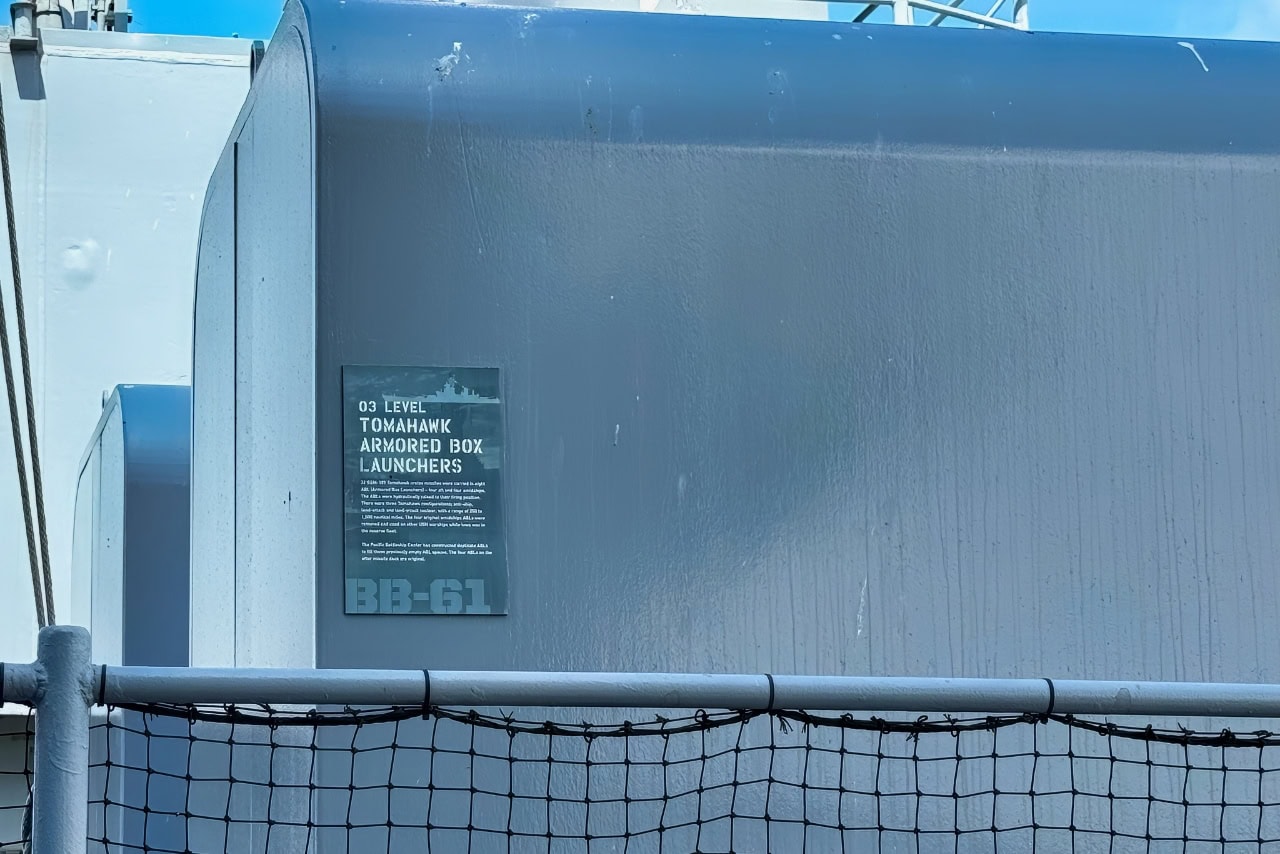
USS Iowa 19FortyFive image of Tomahawk Missiles on USS Iowa.
The second resurrection actually sailed. Under the Reagan administration’s 600-ship Navy, all four Iowas were reactivated between 1982 and 1988, in part to counter the Soviet Union’s new nuclear-powered Kirov-class battlecruisers, the heavy missile ships that had Western planners rattled.
Each battleship kept its nine 16-inch rifles and gained the 1980s arsenal: 32 Tomahawk cruise missiles in armored box launchers, 16 Harpoon anti-ship missiles, and Phalanx guns for self-defense, at a reactivation cost that Navy officials of the era put at around $435 million per ship, roughly $1.7 billion for the four, according to the Government Accountability Office’s later accounting. It worked, briefly and vividly. In Desert Storm, Missouri and Wisconsin fired Tomahawks and put more than 750 sixteen-inch shells into Iraqi positions, the last battleship rounds ever fired in anger.
Then the logic that killed them the first time killed them again, faster. The Soviet Union collapsed, and the vertical launch cells spreading through the destroyer force meant an Arleigh Burke could carry the same Tomahawks with a fraction of the crew and none of the 1940s steam plant.
All four battleships were gone by 1992, and though gunfire-support advocates kept Iowa and Wisconsin on the Naval Vessel Register for years afterward, the last two names did not leave the list for good until 2006. The service retired the hulls and their enormous crews; the appetite for the firepower survived every decommissioning, which is why the idea kept finding new hulls.
USS Zumwalt: The Bridge Between the Last Battleships and the Next Ones
The third resurrection is afloat right now, wearing a destroyer designation.
The Zumwalt class was built around two 155mm advanced guns for shore bombardment, the old battleship mission in miniature, and lost that purpose when the specialized ammunition became unaffordable. The Navy’s answer, decided in 2023, was the Iowa treatment in reverse: pull the guns out entirely and install four 87-inch launch tubes in the bow, each triple-packed with Conventional Prompt Strike hypersonic missiles, twelve rounds that glide to targets at more than five times the speed of sound. USS Zumwalt completed builder’s sea trials in January after the conversion; the first at-sea hypersonic test shot is planned for 2027, and the Navy’s new shipbuilding plan explicitly casts the class as the precursor to the future battleship, the pathfinder for putting very large weapons on very large surface hulls.
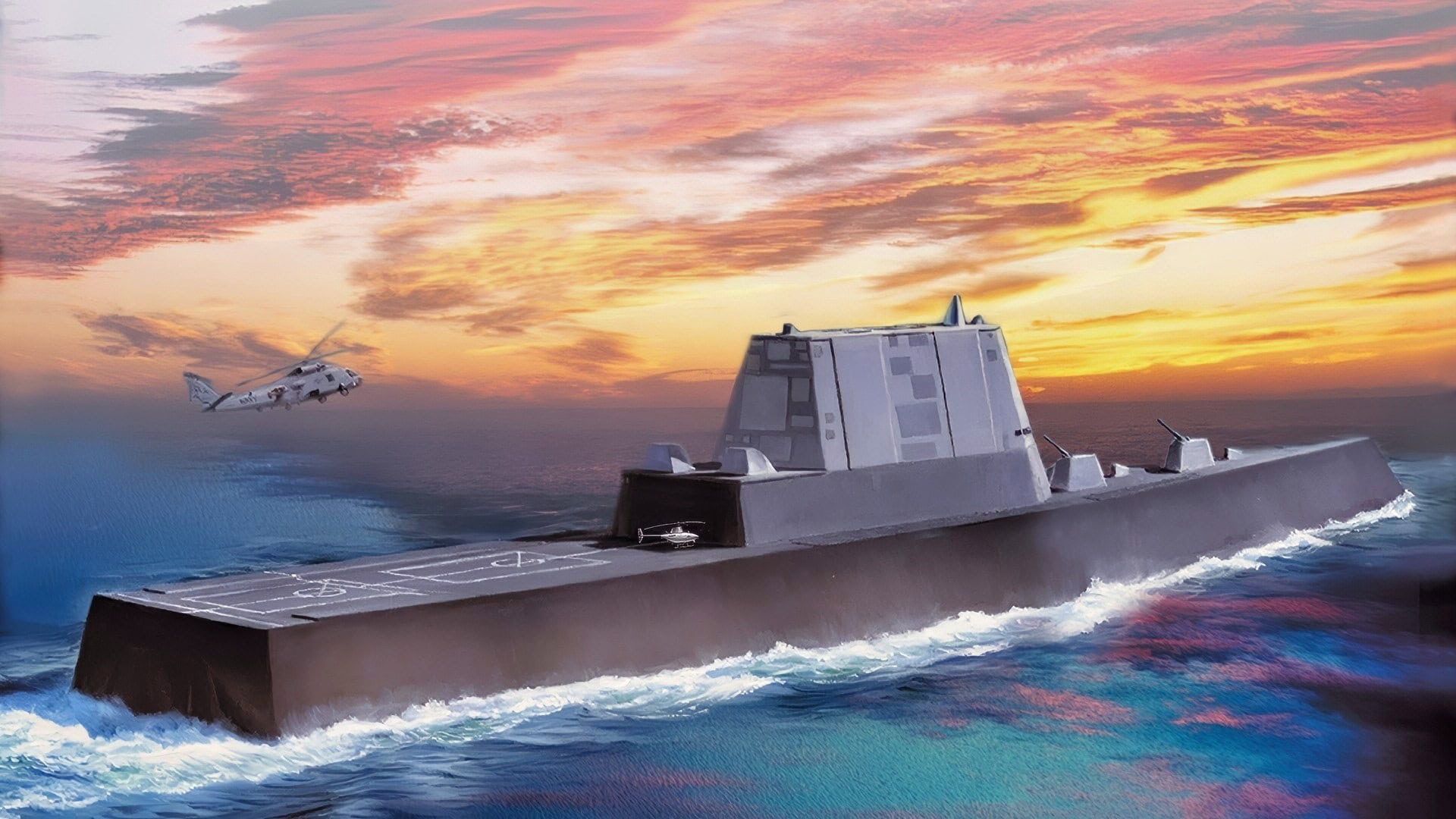
Zumwalt-Class Artist Rendering. Image Credit: Creative Commons.
A 16,000-ton ship that traded its guns for hypersonic tubes is the connective tissue between the Tomahawk box I photographed on Iowa’s deck and the Navy’s December announcement.
The Trump-Class Battleship: What the Navy Actually Announced
The December 22 announcement set the scale immediately: the USS Defiant, first of two ships, then ten, with an eventual goal of 20 to 25, the biggest surface warship America has attempted since the 1940s. The armament briefed to reporters is the “armed very differently” thesis in a single list: 128 vertical launch cells, twelve Conventional Prompt Strike hypersonic missiles, five-inch guns, and growth margin for directed-energy weapons, an electromagnetic railgun, and the nuclear-armed sea-launched cruise missile — that last item, in the assessment of the National Institute for Public Policy’s Mark Schneider, being what the president’s “100 times more powerful than the old battleships” claim actually refers to.
The Congressional Research Service’s backgrounder for Congress supplies the calibration that the announcement did not. The Navy’s parameters describe a ship 840 to 880 feet long, displacing more than 35,000 tons, a vessel that would outsize and outgun every cruiser and destroyer the Navy has bought since 1945, and still come in roughly 20,000 tons lighter than the 57,000-ton, heavily armored Iowas the branding invokes.
The Congressional Budget Office’s estimate inside that report is the number that reframes the whole debate: the first ship at $17.6 to $18.9 billion in 2025 dollars, more than the $15.2 billion the Navy is paying for a Ford-class aircraft carrier procured in 2019, with follow-on battleships at $12.2 to $13.1 billion each, against about $2.7 billion for an Arleigh Burke.
The requirement beneath the price has a specific geometry: Rear Adm. Derek Trinque said in January that the planned DDG(X) destroyer’s hull was simply too small to carry the desired number of hypersonic launch cells plus a gun mount. Hypersonic weapons at volume need a hull on a scale American shipbuilding has not attempted in generations, and the Navy’s FY2027 budget put real money behind the argument: $1 billion in advance procurement now, $16.47 billion for the lead ship in FY2028, three hulls and $43.5 billion through FY2031. Then-Navy Secretary John Phelan answered the skeptics at Sea-Air-Space by pointing at carriers and submarines, which drew the same objections in their day: “When it matters most, those are the platforms combatant commanders call for first.”
The Trump-class Keeps Changing
The program’s specifications have been mutating quarter to quarter. The January CRS report described a conventionally powered ship; the 30-year shipbuilding plan published May 11 made the class nuclear-powered and set the buy at fifteen, describing a ship for high-volume, long-range offensive fires at the top of a high-low fleet mix, insisting it is not meant to replace destroyers, and asserting that even the cancelled DDG(X) would have made “undesirable capability and weapon system compromises.”
The 128 launch cells of December became 200 in Acting Secretary Hung Cao’s May testimony. Construction planned for 2030 at the announcement became a 2028 start for 2036 delivery in May reporting. The shipyard went from Hanwha’s Philadelphia yard, named by the president, to Newport News, named by Navy officials once the reactor made the choice for them. A warship that changes propulsion, magazine size, schedule, and builder inside five months is a concept still being argued into existence.
The Case Against: “This Ship Will Never Sail”
The strongest critique arrived before the renderings dried. Mark Cancian at the Center for Strategic and International Studies wrote flatly that “this ship will never sail”: the design will take years, his cost estimate ran $9 billion per hull even before the Navy’s own figures came in higher, and a handful of enormous, expensive, findable ships contradicts the distributed-operations concept the Navy itself has spent a decade preaching. He also filed the taxonomy objection that with no heavy armor and no large-caliber guns, the ship is a guided-missile battlecruiser in the Kirov mold wearing a grander name, along with the wry observation that the “100 times more powerful” comparison collapses at short range, where an actual Iowa, built for exactly that fight, would chew the new ship up.
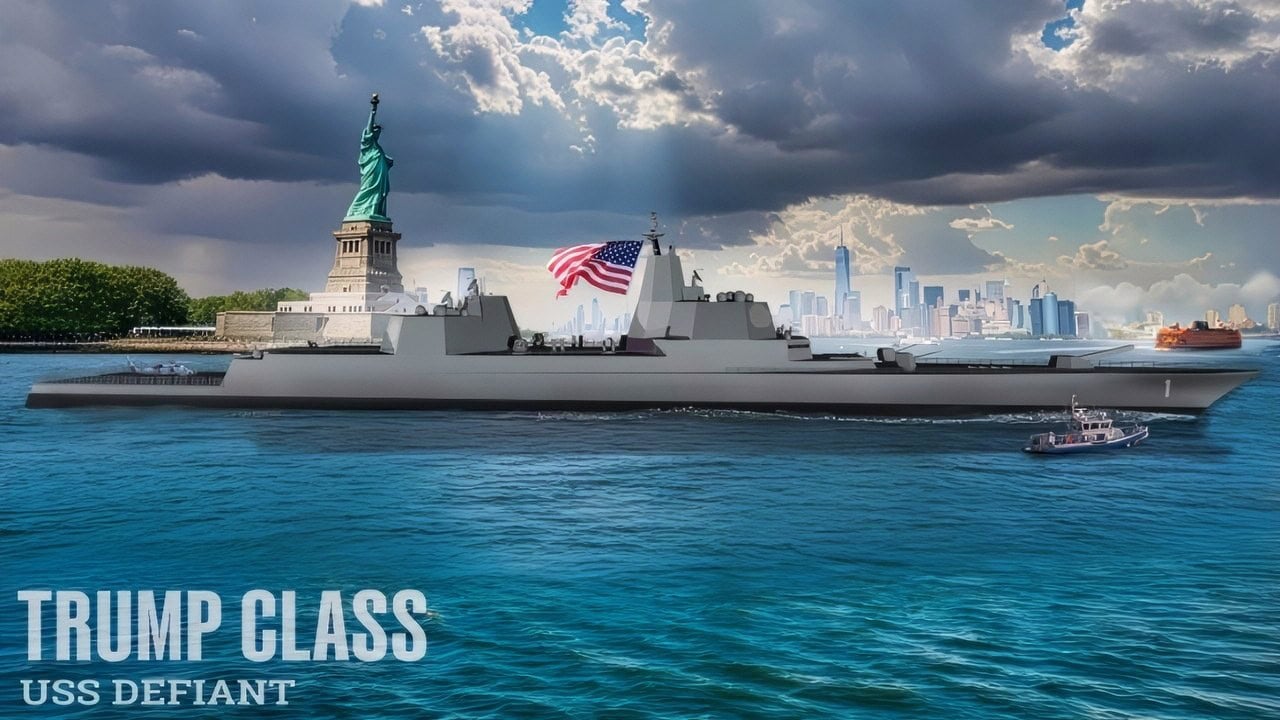
Trump-Class Battleship. Image Credit: Creative Commons/White House.
The program has already cost its champion his job: Phelan was ousted in April, with Politico and the New York Times reporting, via anonymous defense officials, that Pentagon leadership had tired of a battleship push they saw crowding out cheaper priorities, and that meeting the president’s timeline might have required building in European yards. And the House has moved from applause to conditions, voting on June 4 to demand a report on how the battleship would affect the already-late Ford-class carriers sharing Newport News, while Rep. Adam Smith tried and failed to strip the advance procurement money in favor of drone ships. Chairman Mike Rogers’s defense of the program is the pro case in one sentence: “there has been a requirement for a large surface combatant for decades,” and no current hull has the space or power for the weapons coming.
The Industrial Challenge
Every piece of the skeptics’ case is serious, and the prediction of cancellation has a history on its side. It is also a description of every large-combatant attempt since the cruiser force began aging out — the CG(X), the truncated Zumwalts, the DDG(X) — and the requirement outlived each cancellation, which is precisely how the Navy talked itself, seventy years after the Kentucky study, into printing the letters BBG again.
For now, the USS Defiant exists as renderings, two design-contract notices with six-year clocks, and a budget line Congress has already tried once to strip. The Iowa sits in San Pedro with the first draft of the whole idea bolted to her deck, a missile box where the gun tubs used to be. The Navy that spent decades explaining why battleships had to die is asking, one more time, for the biggest surface combatant since the ships it swore off — because the weapons it wants to take to sea stopped fitting in anything smaller.
About the Author: Harry J. Kazianis
Harry J. Kazianis (@Grecianformula) was the former Senior Director of National Security Affairs at the Center for the National Interest (CFTNI), a foreign policy think tank founded by Richard Nixon based in Washington, DC. Harry has over a decade of experience in think tanks and national security publishing. His ideas have been published in the NY Times, The Washington Post, The Wall Street Journal, CNN, and many other outlets worldwide. He has held positions at CSIS, the Heritage Foundation, the University of Nottingham, and several other institutions related to national security research and studies. He is the former Executive Editor of the National Interest and the Diplomat. He holds a Master’s degree focusing on international affairs from Harvard University.

