
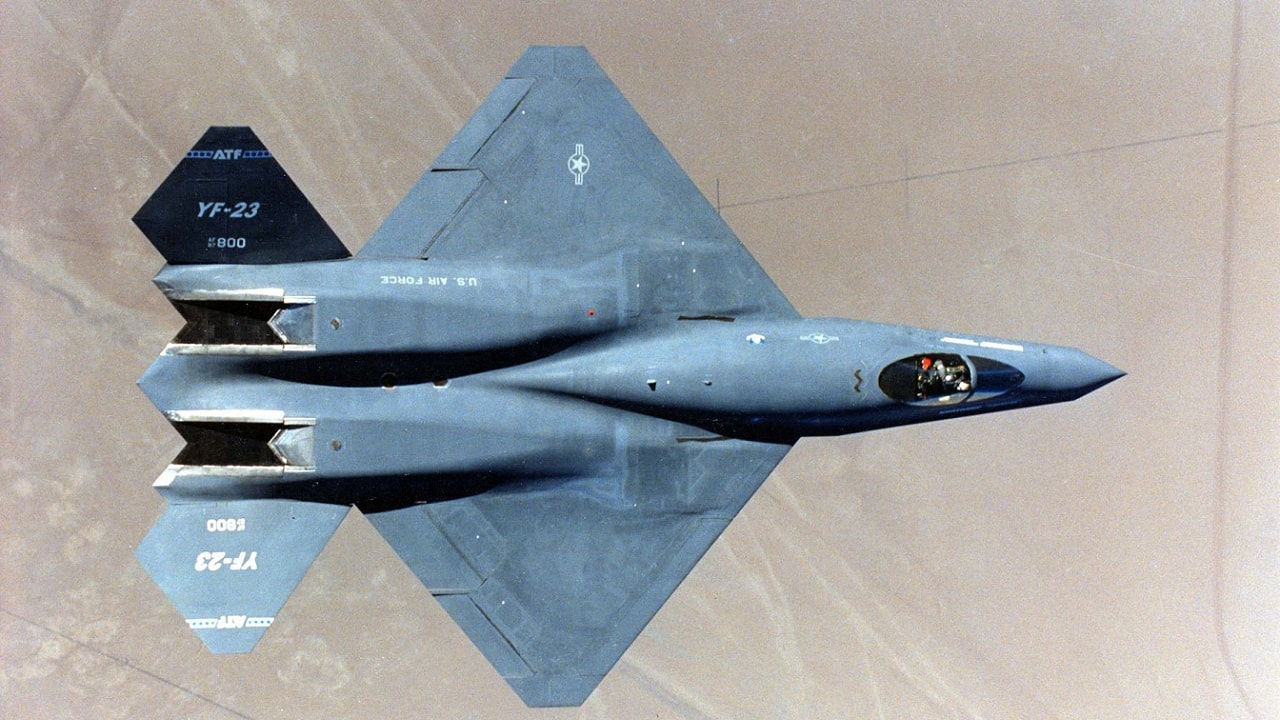
Summary and Key Points: Only two examples of the stealth fighter that lost to the F-22 were ever built, and both still exist on opposite sides of the country. I stood next to each of them in the summer of 2025, about a month apart — one enshrined indoors in a hall of America’s most important experimental aircraft in Ohio, the other sitting outdoors in the California weather with its engines gone and a hollow where its heart used to be. This is not the worn-out argument about which jet should have won. It’s the story of what actually became of the two airplanes, and how the same revolutionary design ended up living two completely different afterlives.
The Stealth Fighter That Lost to the F-22 Still Exists — Both of Them Do, and They’ve Led Very Different Afterlives
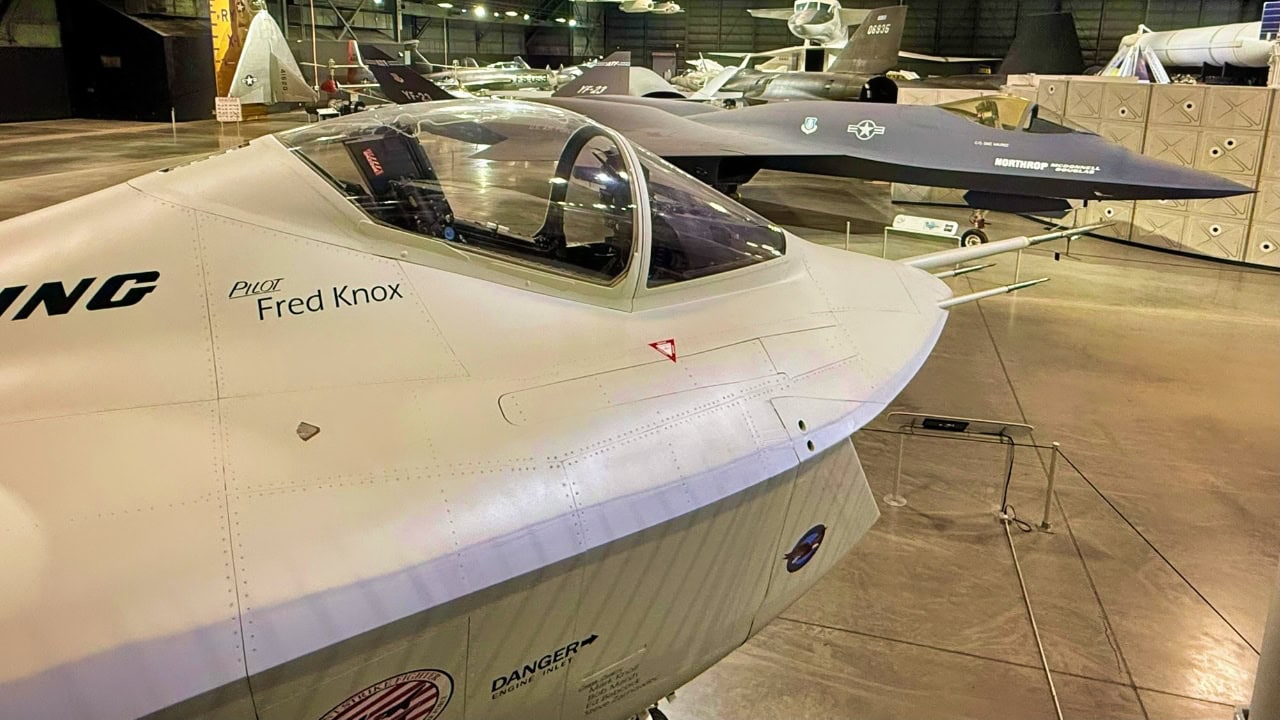
X-32 and YF-23 Together at U.S. Air Force Museum. 19FortyFive.com Image.
Northrop and McDonnell Douglas built exactly two YF-23 prototypes for the competition that produced the F-22 Raptor, and both still exist.
I have stood next to each of them at the National Museum of the U.S. Air Force in Ohio and at the Western Museum of Flight in California, roughly a month apart, last summer, my boyhood dreams fulfilled.
They are the same design, and they have led very different afterlives. One sits in a hall of honored experimental aircraft. The other sits outside, hollow where its engines used to be.
The story of the YF-23 is usually told as an argument about which fighter should have won the Advanced Tactical Fighter competition.
That debate has been run into the ground. Less examined is what physically became of the two airplanes Northrop actually built, because unlike most losing prototypes, both YF-23s were preserved rather than scrapped, and they ended up on opposite sides of the country in institutions of very different scales.
Having visited both aircraft in the summer of 2025, I want to profile them as the two distinct objects they are, PAV-1 and PAV-2, the only two YF-23s ever made.
Northrop and McDonnell Douglas Built Only Two Prototypes for the ATF Competition
The Advanced Tactical Fighter program was the U.S. Air Force’s search for a successor to the F-15 Eagle, launched to counter advanced Soviet fighters such as the Su-27 and MiG-29, as well as the increasingly dangerous surface-to-air missile threat.
Northrop, teamed with McDonnell Douglas, entered a radical design against the Lockheed, Boeing, and General Dynamics YF-22. The Air Force ordered two Northrop flying prototypes, designated Prototype Air Vehicle 1 and Prototype Air Vehicle 2, and the two aircraft were built to test two competing engines rather than to be identical twins.
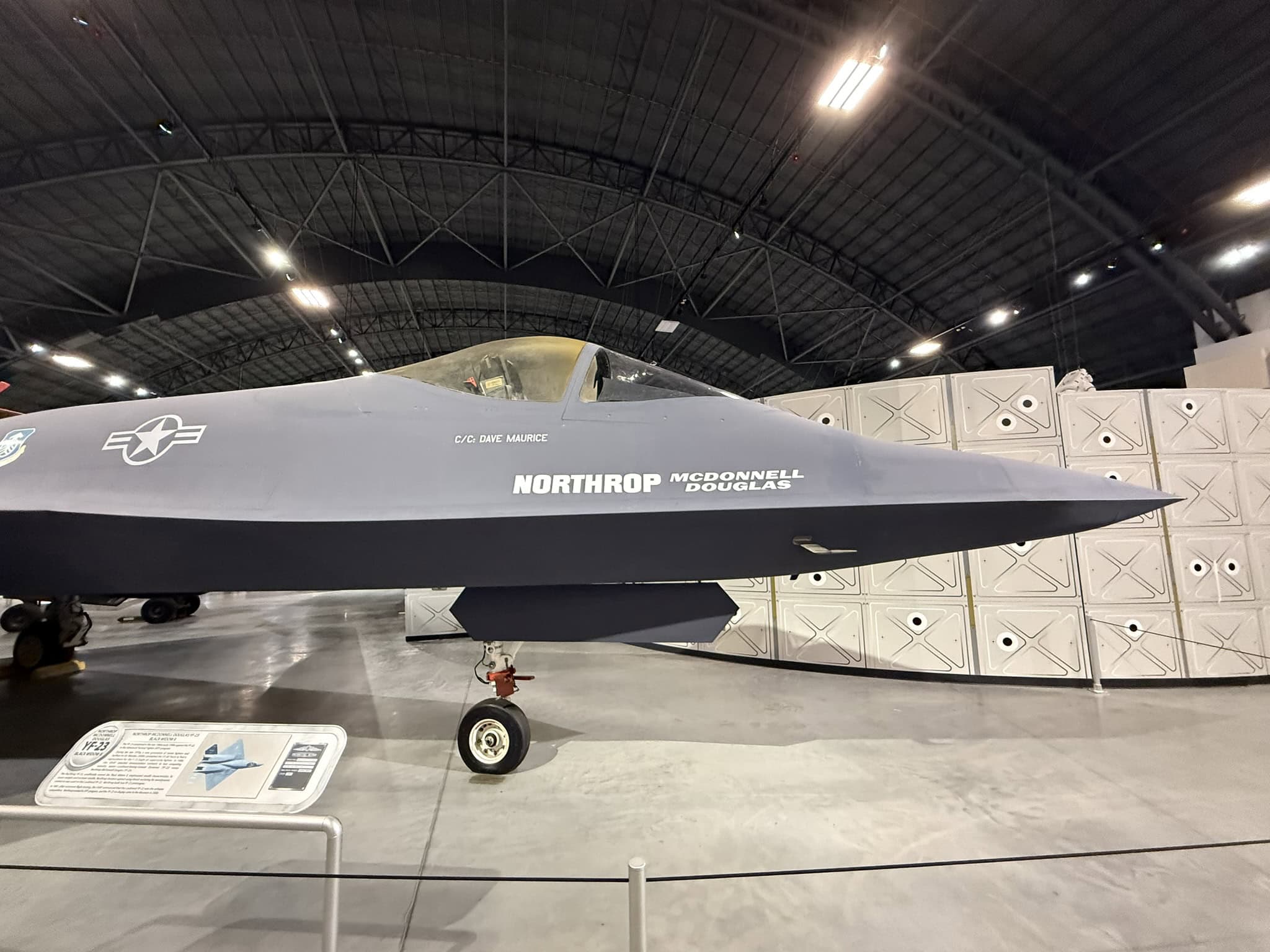
YF-23 Stealth Fighter. Image taken by Harry J. Kazianis for 19FortyFive.
That engine split is the cleanest way to tell the two airframes apart. PAV-1, serial number 87-0800, flew with Pratt & Whitney YF119 engines. PAV-2, serial number 87-0801, flew with General Electric YF120 engines. Both engines were also competing for the ATF propulsion contract, so each YF-23 was simultaneously testing an airframe and an engine, and the same was true across the Lockheed camp.
The design shared by both aircraft is what made the YF-23 famous: a blended wing-body, diamond-shaped wings, deeply canted V-tail surfaces that served as both rudders and elevators, and S-duct intakes that hid the engine faces from radar, all optimized for stealth and sustained supersonic speed rather than close-in dogfighting.
The whole design carried the unofficial name Black Widow II, a nod to the eight-lobed shape of its radar signature plot and to the Northrop P-61 Black Widow of World War II, which is why both surviving aircraft are labeled Black Widow II today.
The individual callsigns painted on each jet’s nose gear door are, for the record, so widely muddled across books and the internet that they are best left out entirely; the serials and the engines are the reliable identifiers.
PAV-1 First, Then PAV-2: A Short and Productive Flight-Test Program
PAV-1 rolled out on June 22, 1990, and took its first flight on August 27, a 50-minute sortie with Northrop chief test pilot Alfred “Paul” Metz at the controls. The aircraft performed well from the start, climbing so efficiently that its F-16 chase plane reportedly needed afterburner to keep pace while the YF-23 stayed in dry thrust. PAV-2 followed on October 26, first flown by Jim Sandberg.
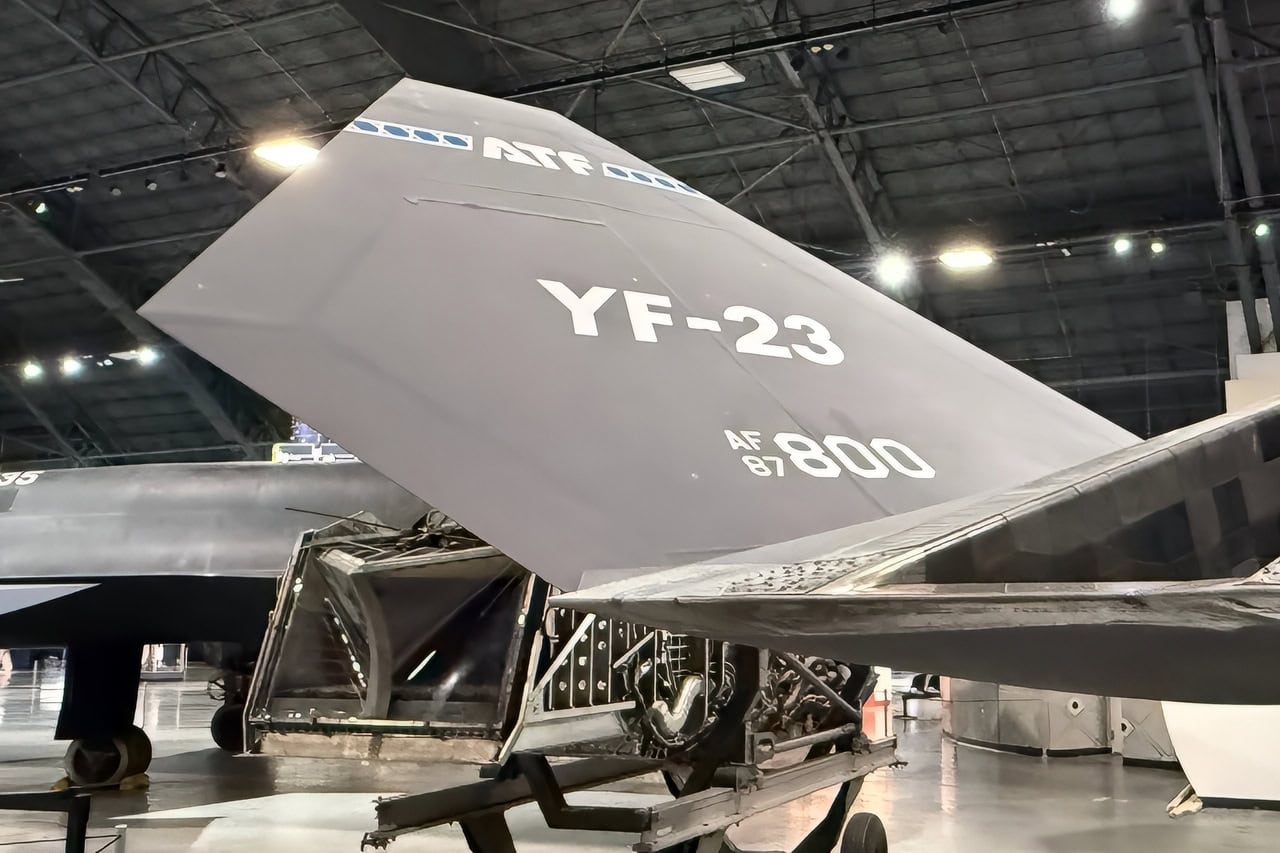
YF-23 Back End. 19FortyFive.com image.
Between them, the two prototypes flew a compressed and demanding test program, qualifying for aerial refueling early to maximize flight time and pushing into supercruise, the ability to sustain supersonic flight without afterburner that the ATF requirement demanded. The two engines produced different supercruise results: the YF119-powered aircraft reached roughly Mach 1.43, and the YF120-powered aircraft achieved about Mach 1.6, the program’s best sustained supersonic figure.
The flight testing was not without incident, and both aircraft had close calls, including a shattered outer windscreen layer on one and a fuel-tank overpressure scare on the other, each of which ended safely. On April 23, 1991, the Air Force announced that the Lockheed YF-22 had won the competition, citing lower perceived risk and the agility provided by its thrust-vectoring. The YF-22 became the F-22 Raptor. The two YF-23s, having flown for less than a year, would never fly again.
Both Airframes Lost Their Engines Before They Ever Reached a Museum
What happened next is the detail most retellings skip, and it explains the condition of one of the aircraft today.
After the competition ended, both YF-23s had their engines and all usable government equipment removed, then were placed in outdoor storage at Edwards Air Force Base in California.
On December 1, 1993, NASA took ownership of both airframes, intending to use their composite structures for loads-calibration research at its Dryden Flight Research Center. The funding for that research never materialized.
After roughly 18 months of the aircraft sitting in outdoor storage at various locations within the center, NASA concluded that no testing would occur and offered both YF-23s to museums. The engines were long gone from both jets by then.
PAV-1 was transferred to the National Museum of the U.S. Air Force, where it spent a period on temporary display at the Air Force Flight Test Center Museum at Edwards before moving to Ohio. PAV-2 was taken apart in 1995 and shipped to the Western Museum of Flight, then located in Hawthorne, California. From that shared starting point, the two airframes diverged sharply in how they have been treated and displayed ever since.
PAV-1 in the Research and Development Hangar at Dayton
The YF-23 at the National Museum of the U.S. Air Force near Dayton, Ohio, is PAV-1, and it occupies a place of genuine honor. It sits right across from the Boeing X-32. I took so many photos that the museum staff came up to me as I stood there for over two hours taking various shots.
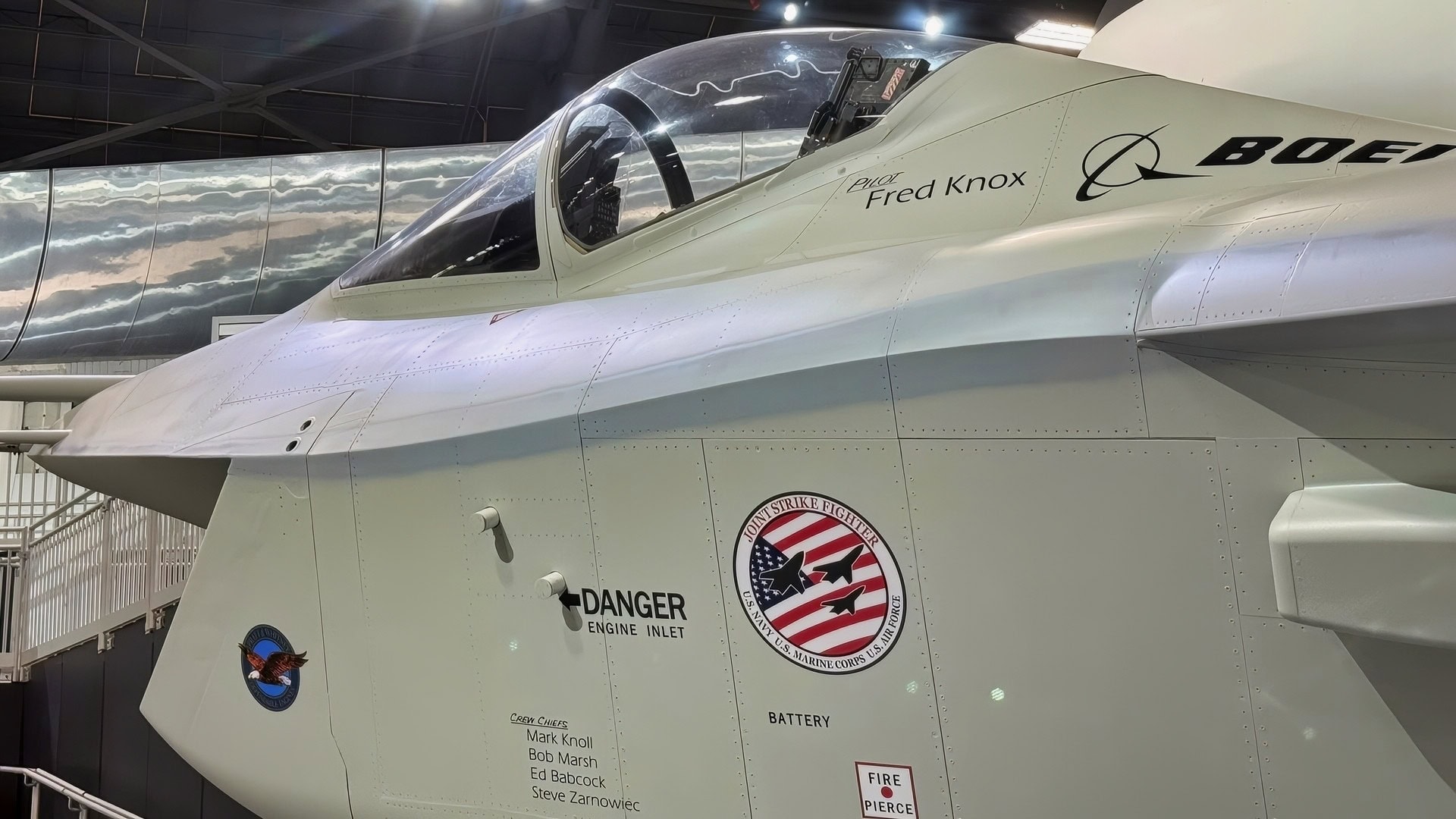
Boeing X-32 Stealth Fighter 19FortyFive Photo.
And the location really does matter. It sits in the museum’s Research and Development Gallery, the hangar reserved for the most significant experimental and prototype aircraft the United States ever built, and its neighbors are a roll call of American aerospace ambition: the enormous North American XB-70 Valkyrie, the tiny Northrop X-4 Bantam, the forward-swept-wing Grumman X-29, and the Lockheed YF-12, the interceptor sibling of the SR-71. There is no place like it on Earth.

YF-23 Stealth Fighter. Image taken by Harry J. Kazianis for 19FortyFive.
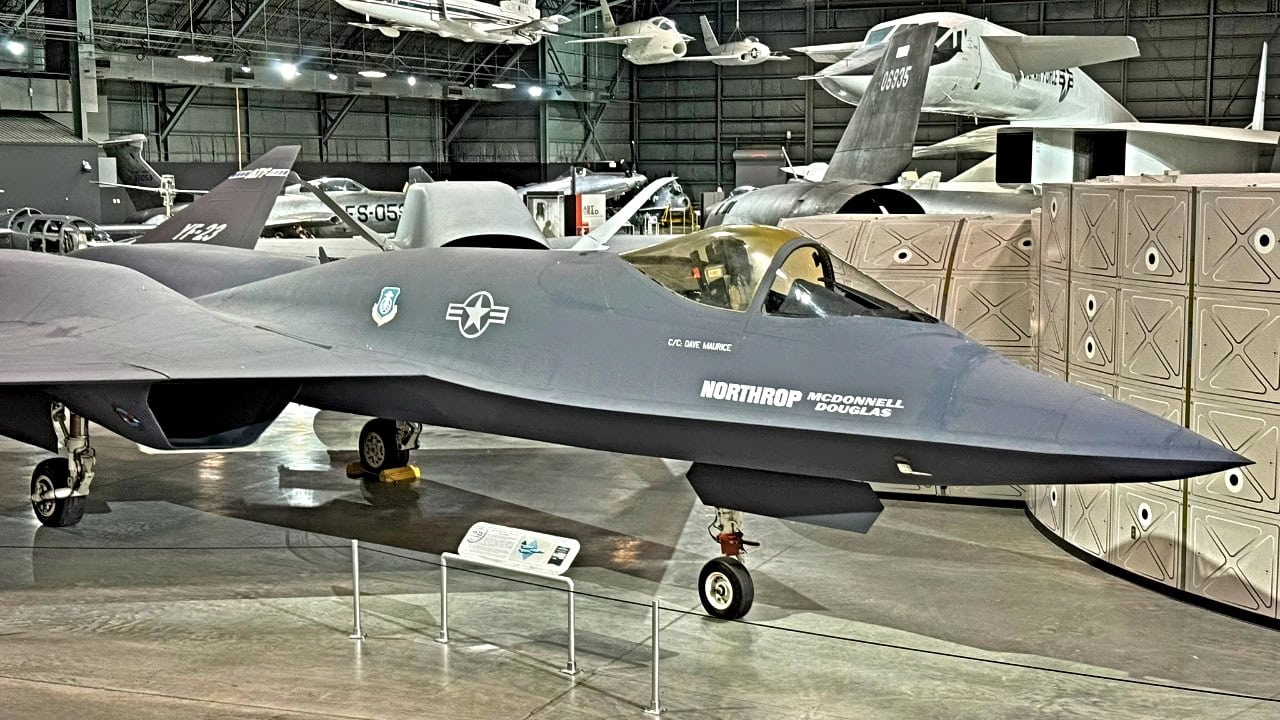
YF-23 Stealth Fighter. Image taken by Harry J. Kazianis for 19FortyFive.
Being displayed indoors in climate-controlled conditions, alongside those aircraft, places PAV-1 among the machines the Air Force considers most historically important, and by some accounts, the two surviving YF-23s are among the most visited exhibits at their respective museums, drawing more interest than the F-22 that beat them.
For a visitor, seeing the YF-23 in that company makes the aircraft’s reputation legible in a way no specification sheet does.
It is treated not as a failure but as a landmark of what was attempted.
PAV-2 Outdoors at the Western Museum of Flight, and the Hollow Where Its Engines Were
The YF-23 at the Western Museum of Flight in Torrance, California, is PAV-2, and its history and its display could hardly be more different.
This airframe had an unusual second act: in 2004, Northrop Grumman reclaimed it and modified it to serve as a display model for a proposed YF-23-based regional bomber, an interim-bomber concept the company was pitching against designs like the FB-22.
That effort ended by around 2006 when Pentagon planning shifted toward a longer-range bomber, the program that eventually became the B-21 Raider, and PAV-2 was returned to the Western Museum of Flight in 2010 after the museum relocated to Zamperini Field in Torrance.
It remains there today on long-term loan from NASA, which still technically owns both aircraft.
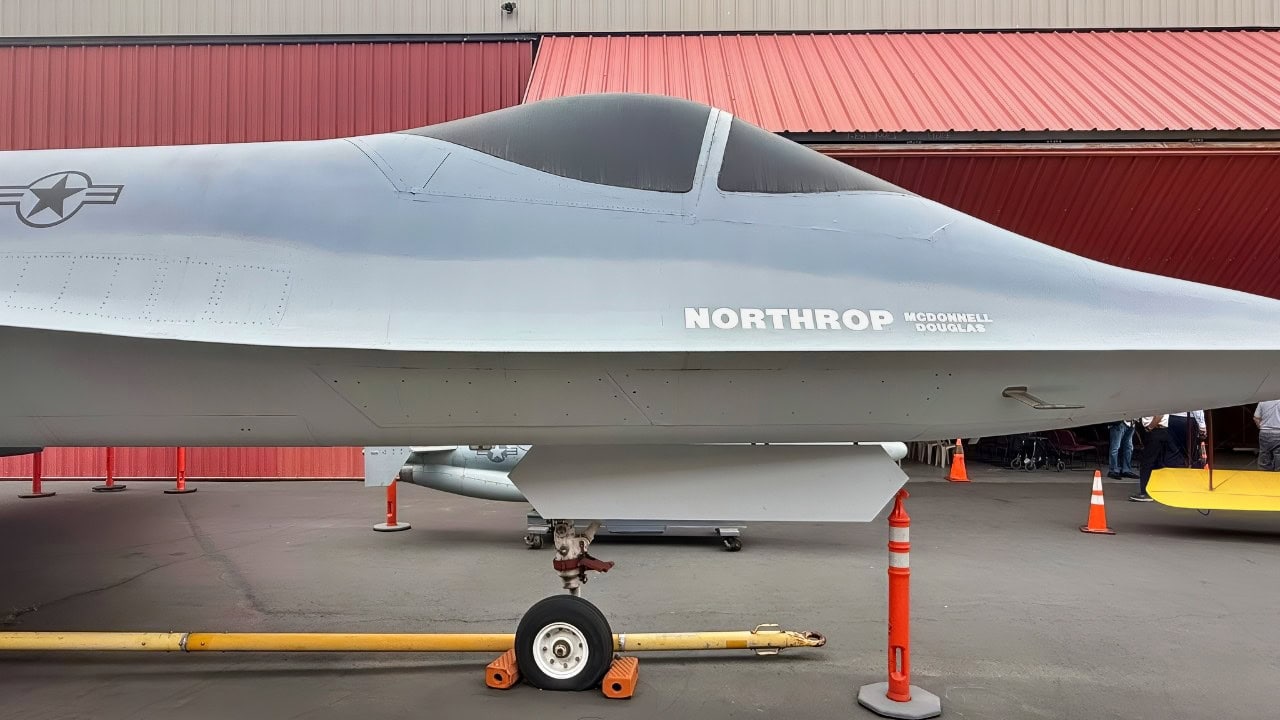
YF-23A Black Widow II 19FortyFive Image Taken by Harry J. Kazianis.
Unlike its indoor sibling, PAV-2 is displayed outdoors, exposed to the Southern California elements, and it is visibly incomplete.
On my visit, museum staff walked me to the aircraft and showed me directly that it has no engines, pointing out the hollowed-out section of the airframe where the powerplants would have been installed, an emptiness that traces back to the strip-down at Edwards more than three decades ago.
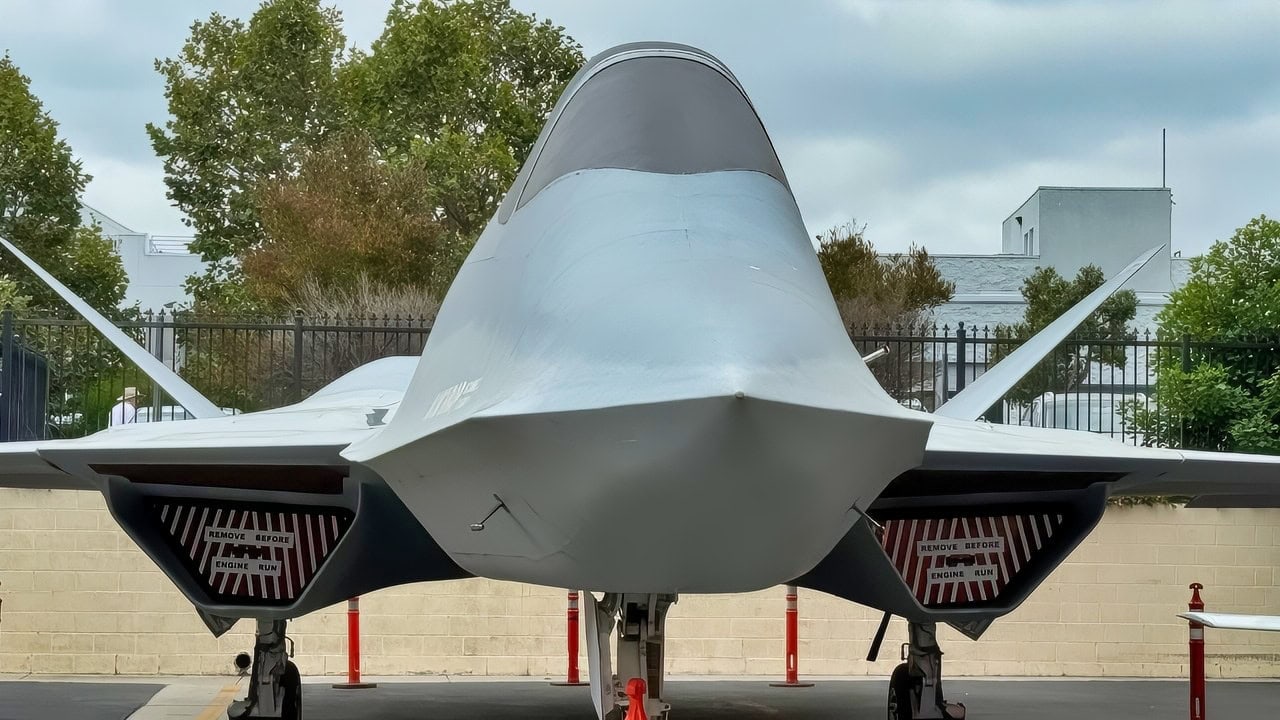
YF-23 at Western Museum of Flight. Image: 19FortyFive.com
Standing at that open bay, looking into the space inside one of only two YF-23s ever built, is a different experience from viewing the honored jet in Dayton.
The same revolutionary design, conceived to fly higher, faster, and more invisibly than anything of its era, sits outside as a hollow shell, its stealth shaping intact and its heart removed. The contrast between the two airframes is the real story of the YF-23’s afterlife.
One prototype was enshrined; the other was borrowed, modified, returned, and parked outdoors, and both now stand as the only physical evidence of the fighter that came within one decision of changing the shape of American airpower.
About the Author: Harry J. Kazianis
Harry J. Kazianis (@Grecianformula) was the former Senior Director of National Security Affairs at the Center for the National Interest (CFTNI), a foreign policy think tank founded by Richard Nixon based in Washington, DC. Harry has over a decade of experience in think tanks and national security publishing. His ideas have been published in the NY Times, The Washington Post, The Wall Street Journal, CNN, and many other outlets worldwide. He has held positions at CSIS, the Heritage Foundation, the University of Nottingham, and several other institutions related to national security research and studies. He is the former Executive Editor of the National Interest and the Diplomat. He holds a Master’s degree focusing on international affairs from Harvard University.

