

Summary and Key Points: The US Navy aircraft carrier USS Gerald R. Ford (CVN-78) is home at Naval Station Norfolk after 326 days at sea, the longest American carrier deployment since Vietnam, and now enters an extended repair and maintenance period covering fire damage, chronic plumbing failures, and recalibration of its EMALS electromagnetic catapults and Advanced Arresting Gear. The overhaul begins just as the USS Nimitz retires and the USS John F. Kennedy (CVN-79) slips to a March 2027 delivery, shrinking the pool of deployable decks. With the Navy’s three carrier-capable shipyards at Norfolk, Puget Sound, and Newport News finishing carrier work an average of 113 days late, according to the GAO, a repair period of a year or more is entirely plausible.
The USS Gerald R. Ford Is Headed for a Long Repair Period, and the U.S. Navy Doesn’t Have the Carriers to Cover for Her
After the longest US carrier deployment since the Vietnam War, the USS Gerald R. Ford is finally home, facing months of repairs for fire damage, chronic plumbing failures, and heavy wear on its first-in-class systems.
On paper, the Navy has eleven carriers to absorb the loss of one. In reality, only a handful are ever available at any moment; one just retired, the next is running two years late, and the repair yards the Ford is headed for are already missing their deadlines. Sidelining the newest carrier for a year or more is a bigger problem than it looks.

Aircraft Carrier USS Gerald R. Ford Diagram. Image Credit: Creative Commons.
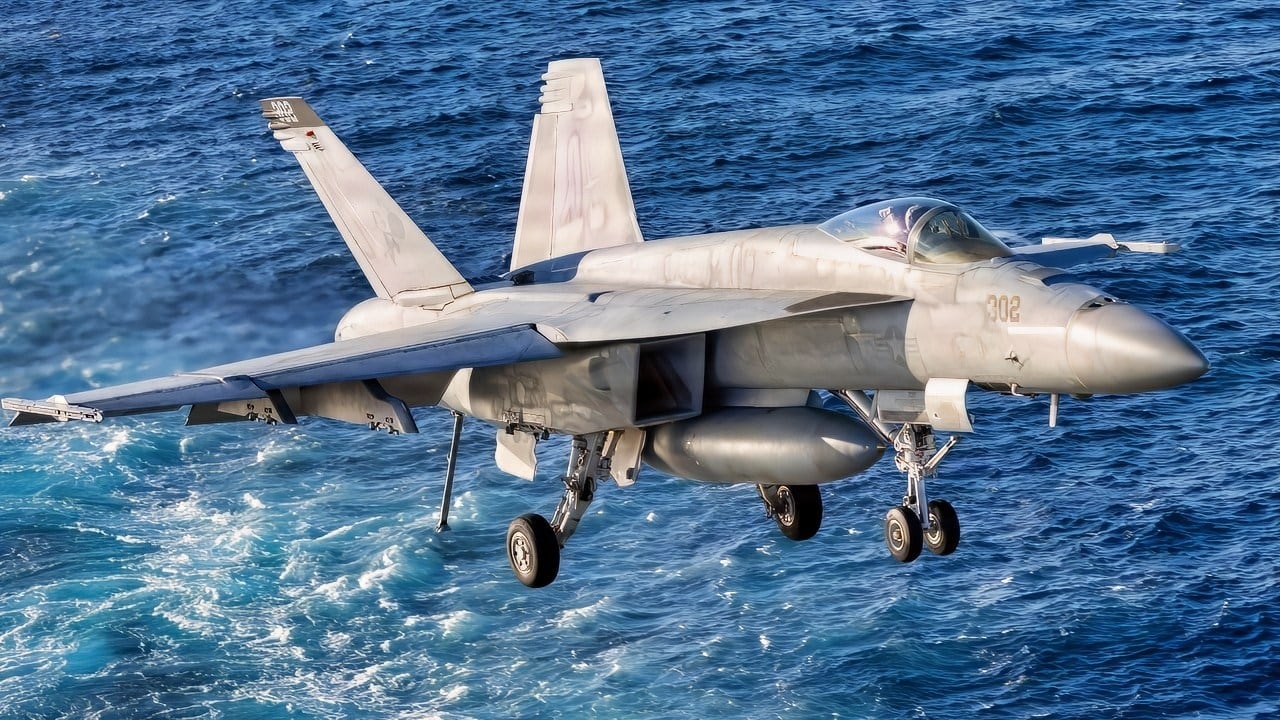
An F/A-18E Super Hornet aircraft approaches the flight deck of the world’s largest aircraft carrier, Ford-class aircraft carrier USS Gerald R. Ford (CVN 78), Nov. 17, 2025. U.S. military forces are deployed to the Caribbean in support of the U.S. Southern Command mission, Department of War-directed operations, and the president’s priorities to disrupt illicit drug trafficking and protect the homeland. (U.S. Navy photo)
Introduction: The Navy’s Aircraft Carrier Problem
The USS Gerald R. Ford returned to Norfolk in May 2026 after 326 days at sea, the longest deployment by an American aircraft carrier since the Vietnam War. It was a punishing tour that ran from the Atlantic to the Caribbean to the Middle East, and it left marks.
A March fire in the ship’s laundry burned for more than 30 hours and spread through the ventilation system into the berthing areas, displacing hundreds of sailors. The carrier’s troubled vacuum plumbing system failed repeatedly throughout the deployment.
And its first-in-class launch-and-recovery gear logged thousands of cycles of hard use. Now the ship goes in for an extended period of repairs and maintenance.
The Navy has not announced how long that will take, and independent analysts have floated estimates ranging from a year to a year and a half. What matters more than the exact number is the context into which Ford is retiring. Losing any single carrier to the yards is routine.
Losing this one, now, is not because the American carrier force is thinner and more fragile than the headline number of eleven suggests.
Eleven Carriers, But Only a Handful That Can Sail
The United States operates the largest and most capable carrier fleet in the world, but the number of hulls is misleading.
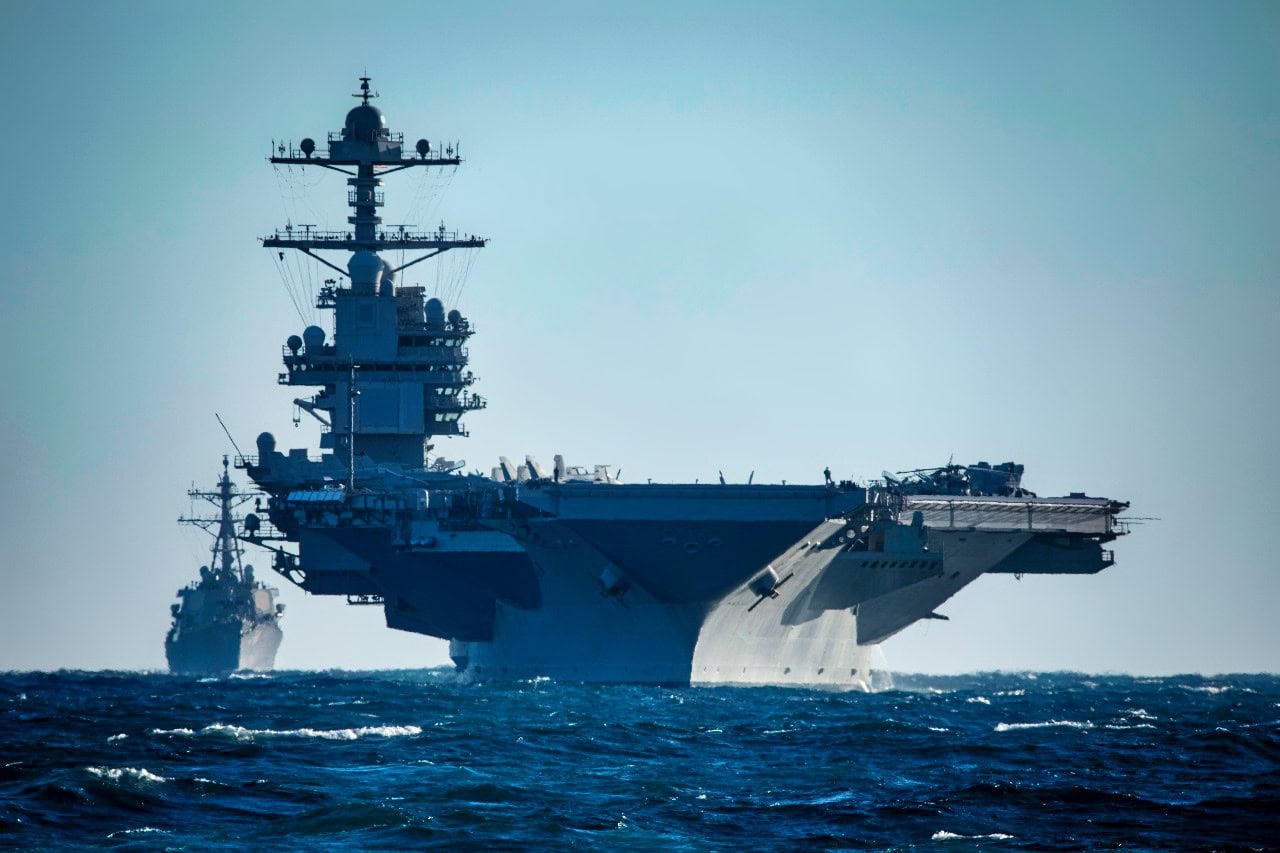
A view from the Ticonderoga-class guided missile cruiser USS Normandy (CG 60) of the first-in-class aircraft carrier USS Gerald R. Ford (CVN 78) and the Arleigh Burke-class guided missile destroyers USS Thomas Hudner (DDG 116), USS Ramage (DDG 61) and USS McFaul (DDG 74) as the ships steam in formation during a drill while underway as part of the Gerald R. Ford Carrier Strike Group March 5, 2023. Ford Carrier Strike Group is underway in the Atlantic Ocean executing its Composite Training Unit Exercise (COMPTUEX), an intense, multi-week exercise designed to fully integrate a carrier strike group as a cohesive, multi-mission fighting force and to test their ability to carry out sustained combat operations from the sea. As the first-in-class ship of Ford-class aircraft carriers, CVN 78 represents a generational leap in the U.S. Navy’s capacity to project power on a global scale. (U.S. Navy photo by Mass Communication Specialist 2nd Class Malachi Lakey)
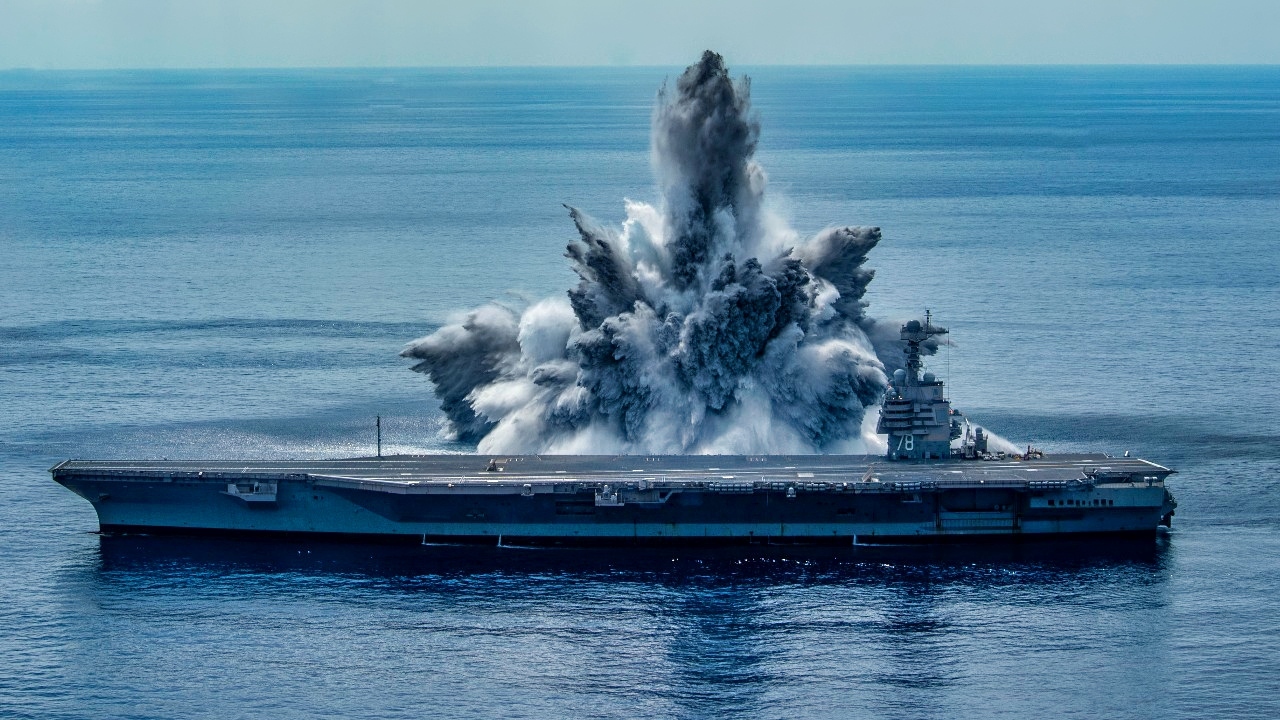
The aircraft carrier USS Gerald R. Ford (CVN 78) successfully completes the third and final scheduled explosive event of Full Ship Shock Trials while underway in the Atlantic Ocean, Aug. 8, 2021. The U.S. Navy conducts shock trials of new ship designs using live explosives to confirm that our warships can continue to meet demanding mission requirements under harsh conditions they might encounter in battle. (U.S. Navy photo by Mass Communication Specialist 3rd Class Novalee Manzella)
Under the Navy’s maintenance and deployment cycle, a carrier spends the bulk of its life not deployed but in the yard, in workups, or in training, and only a fraction of the fleet is ready to sail at any given moment. The rule of thumb across the force is that roughly a third of the carriers are available at any given time.
The rest are tied up in the long rhythm of maintenance and certification that keeps a nuclear-powered warship safe to operate.
That rhythm is constrained by a hard physical limit: only three shipyards in the continental United States, at Norfolk, Puget Sound, and Newport News, can perform the depot-level work a carrier requires.
As one US Naval Institute analysis has argued, the nation’s shipyard base is simply too small to keep eleven carriers running at the tempo the Navy has set. The eleven-carrier force looks robust on a budget chart. In practice, the deployable pool is far smaller, and every ship pulled offline shrinks it further.
The Gap Is Worse Right Now Than Usual
The Ford is going into repair at an unusually bad moment for the fleet’s arithmetic. The carrier count is not even eleven at present. The USS Nimitz, the oldest ship in the fleet, retired in May 2026, dropping the force to ten.
The obvious replacement, the second Ford-class ship USS John F. Kennedy, is running badly late. Its delivery has slipped roughly two years to March 2027, so the new hull that should be filling the gap is nowhere near ready.
That leaves the Navy covering a demanding set of commitments with a reduced deck. When the Ford was still deployed, the service sent the USS George H.W. Bush out of Norfolk in part to cover its commitments, a signal of how little slack there is. With the Ford now down, one older carrier retired, and the next-generation ship a year from delivery at best, the United States is asking a smaller carrier force to cover the Middle East in the aftermath of a war with Iran and to deter China in the Pacific at the same time. The newest, most capable carrier in the world is the one now sitting pierside.
The Repair Yards Are Already Behind
The other reason Ford’s downtime matters is that the maintenance system it is entering has a long record of running late. This is not a matter of one troubled ship. It is systemic.
The Government Accountability Office found that roughly 75 percent of the maintenance periods for aircraft carriers and submarines at the Navy’s shipyards were completed late over a recent five-year span, with carrier availabilities finishing an average of 113 days behind schedule. The Navy has been carrying a deferred-maintenance backlog measured in the billions, and the shipyards are chronically short of skilled workers.
The consequences are not hypothetical. The USS George H.W. Bush’s own maintenance availability ran for more than 20 months, well past its plan, and at times in recent years, the fleet has had carriers unable to deploy during moments of real tension because they were stuck in the yard.
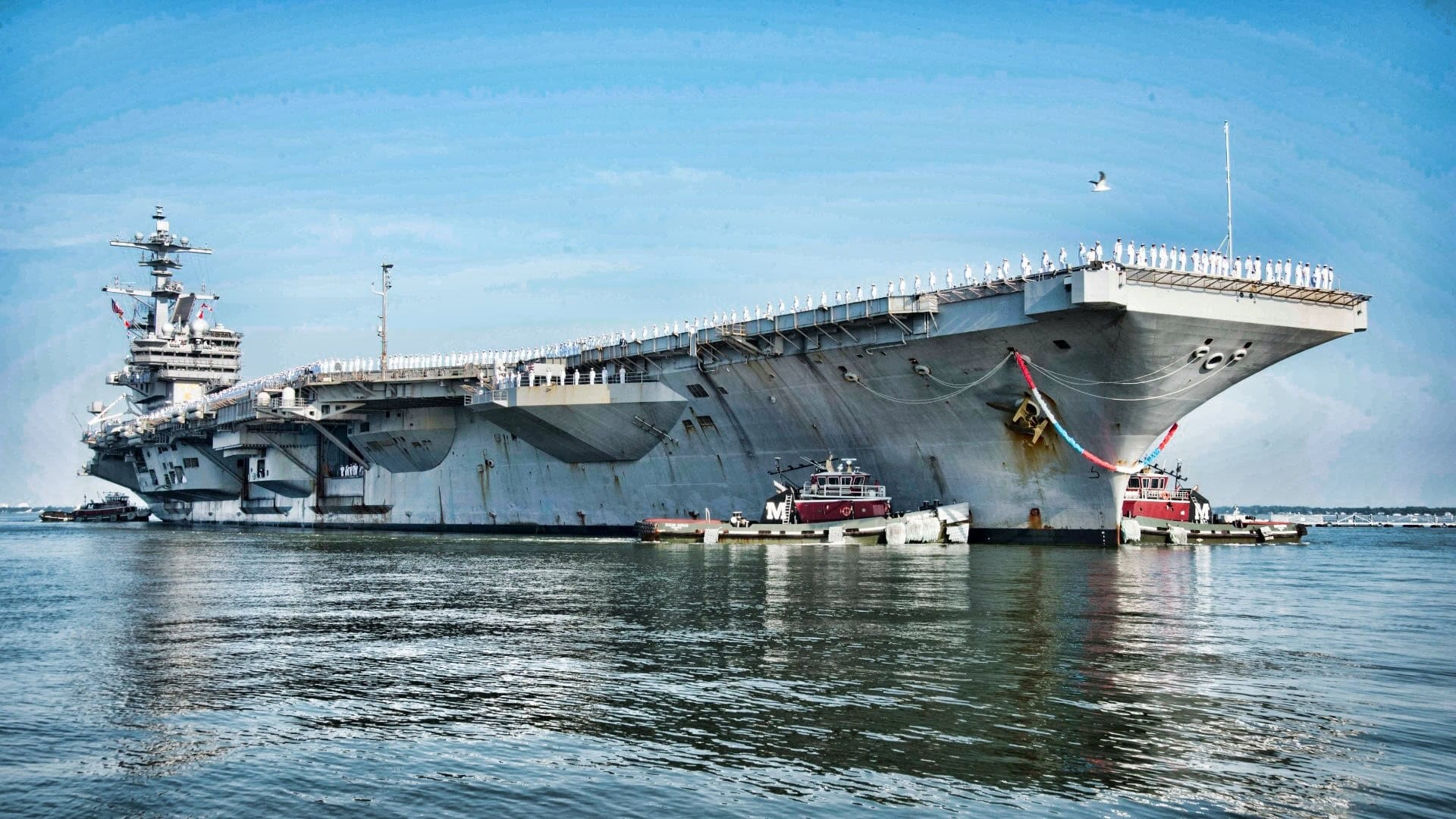
NORFOLK (Aug. 18, 2017) Tugboats guide the aircraft carrier USS George H.W. Bush (CVN 77) into port at Naval Station Norfolk (NSN). George H.W. Bush arrived at NSN with its carrier strike group following a seven-month deployment in support of maritime security operations and theater security cooperation efforts in the U.S. 5th and 6th Fleet areas of operation. (U.S. Navy photo by Mass Communication Specialist 2nd Class Patrick Ian Crimmins/Released)
Analysts who study the problem note that a large share of the fleet is unavailable at any given time precisely because of this backlog.
That track record is why any estimate for the Ford should be read as a floor. Given the scope of the work, the fire repairs, a plumbing overhaul, recalibration of the launch and arresting systems, a flight-deck recoat, and hull treatment, and the yards’ history of overruns, a repair period that runs a year or more, and possibly well beyond, is entirely plausible.
The First-in-Class Problem Cuts Both Ways
The Ford’s downtime is also entangled with the technology that made it revolutionary and troublesome in equal measure. As the lead ship of a new class, it introduced systems that had never gone to sea before, and several have struggled to hit their reliability targets.
The electromagnetic catapult, EMALS, was designed to launch thousands of aircraft between failures; in Pentagon testing, it has managed only a small fraction of that: at one 2021 assessment, it averaged around 181 launches between failures, against a requirement of more than 4,000. The Advanced Arresting Gear that recovers landing aircraft, built to run some 16,500 cycles before failure, has, in testing, broken down after only a few hundred cycles. Pentagon testers have repeatedly warned that the reliability of these systems continues to affect the carrier’s ability to launch and recover aircraft at the rate a carrier is supposed to.
This is where the two ends of the problem meet.
The same immature launch-and-recovery technology that needs inspection and recalibration on the Ford after a hard deployment is a major reason the Kennedy is two years late, because certifying that gear on the second hull has paced the whole delivery schedule. The first-in-class gamble that produced a more capable carrier is now working against the Navy on both ends at once: it deepens the uncertainty around how long the Ford will be down, and it delays the ship that was supposed to cover for her.
What Happens Next to the U.S. Navy’s Supercarriers?
None of this means the carrier is useless or that the Ford will be gone forever. It will be repaired, and when it returns, it will be the most powerful warship afloat. The point is narrower and more uncomfortable.
The United States has built a carrier force whose real availability is far below its headline size, tied to a repair base that cannot keep up, at a moment when demand for carriers is rising rather than falling.
China, by contrast, is expanding its own fleet at a pace American shipyards cannot match. When the newest American carrier can be taken off the board for a year or more by a hard deployment, a fire, and a set of systems that were rushed to sea before they were ready, the deeper vulnerability is not any one ship. It is the thinness of the force behind it and the yards that are supposed to keep it whole.
The question the Ford’s repair period raises is not whether the Navy can fix one carrier.
It is whether a fleet this stretched can absorb the loss of a single ship without leaving a gap that an adversary might notice.
About the Author: Harry J. Kazianis
Harry J. Kazianis (@Grecianformula) was the former Senior Director of National Security Affairs at the Center for the National Interest (CFTNI), a foreign policy think tank founded by Richard Nixon based in Washington, DC. Harry has over a decade of experience in think tanks and national security publishing. His ideas have been published in the NY Times, The Washington Post, The Wall Street Journal, CNN, and many other outlets worldwide. He has held positions at CSIS, the Heritage Foundation, the University of Nottingham, and several other institutions related to national security research and studies. He is the former Executive Editor of the National Interest and the Diplomat. He holds a Master’s degree focusing on international affairs from Harvard University.

