
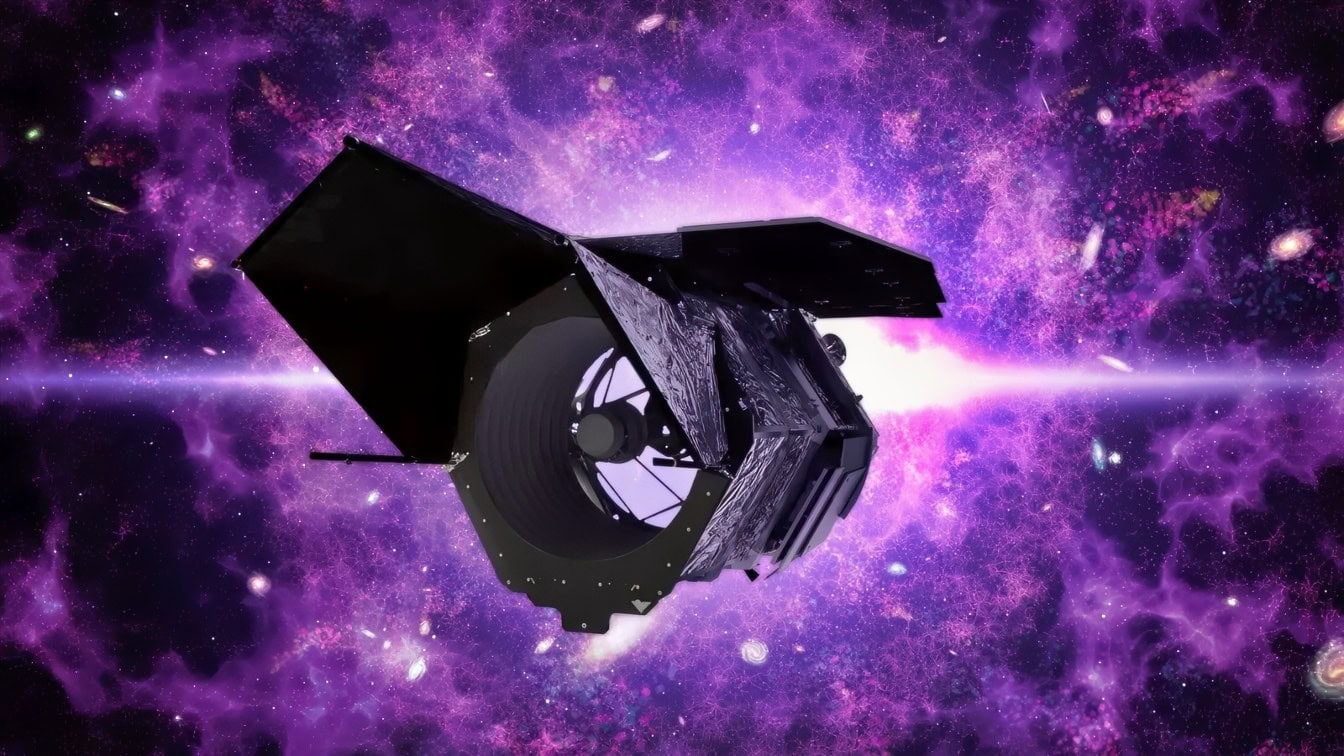
Summary and Key Points: NASA’s Nancy Grace Roman Space Telescope, scheduled to launch in 2026, is designed to survey enormous regions of the sky at the same sharpness Hubble reserves for single targets, capturing roughly 100 times as much sky per image. Named for NASA’s first Chief of Astronomy, the woman known as the Mother of Hubble, Roman carries a 2.4-meter mirror originally built by the National Reconnaissance Office. Its microlensing survey could reveal on the order of 100,000 planets beyond our solar system, while its wide-field instrument maps dark matter and measures the accelerating expansion of the universe driven by dark energy. Rather than replacing Hubble and Webb, Roman is built to complement them, mapping the sky to find the targets they will study in detail.
NASA History Is About to Be Made
NASA already operates two famous space telescopes, the Hubble and James Webb, but there is a third forthcoming: the Nancy Grace Roman Space Telescope.
Often described as the third pillar of NASA’s modern space observatory fleet, Roman is scheduled for launch later this summer—not to replace Hubble or Webb, but to do something the others can’t: rapidly survey enormous portions of the sky while still producing extremely detailed images.
Scientists hope that the mission will help answer some of astronomy’s biggest questions, from dark energy to exoplanets.
Who Was Nancy Grace
Often called the Mother of Hubble, Nancy Grace was NASA’s first Chief of Astronomy.
Instrumental in developing the Hubble Space Telescope program, Grace was a strong advocate for space-based astronomy at a time when relatively few women held senior scientific leadership positions.
The telescope was renamed in her honor in 2020.
What is Roman
The Roman telescope is a 2.4-meter space telescope—interestingly, the same primary mirror diameter as Hubble.
This is not a coincidence; the mirror was originally built by the National Reconnaissance Office and later transferred to NASA.
But the mirror isn’t what makes Roman revolutionary. What makes Roman revolutionary is the field of view.
The Hubble, Webb, and Roman all have different fields of view. Imagine the three telescopes were used to document your local neighborhood rather than space.
The Hubble would be capable of zooming in on one house. Webb would be able to zoom in on one room of that house.
But Roman would be capable of photographing the entire neighborhood—in the same resolution that Hubble and Webb capture a single house. Roman’s Wide Field Instrument captures about 100 times as much sky per image as Hubble’s while maintaining comparable image sharpness.
Instead of spending years stitching together thousands of images, Roman can map vast regions of the universe much more efficiently.
Roman’s Instruments
Roman carries two primary instruments. The first is the Wide Field Instrument, which serves as the telescope’s main science instrument.
The WFI will be used to map galaxies, observe galaxy clusters, survey billions of stars, discover thousands of exoplanets, investigate dark matter, and study dark energy.
It will be the largest space camera NASA has ever flown, at roughly 300 megapixels.
The second instrument is a coronagraph.
The purpose is to block starlight, allowing astronomers to directly observe faint planets orbiting nearby stars. Normally, a star is billions of times brighter than a planet—but the coronagraph suppresses starlight, kind of like putting your hand over the sun to see something nearby.
This is an important step toward eventually imaging Earth-like planets.
Reason for Excitement
Scientists are excited because Roman has the potential to address several major mysteries.
Dark energy, for starters: the universe is expanding, and that expansion is accelerating—and no one knows why. Roman will measure millions of galaxies across cosmic history to better understand what’s driving accelerated expansion.
Roman will also study dark matter, which cannot be seen directly.
Instead, scientists must infer its existence from gravity; Roman will map how gravity bends light through gravitational lensing, allowing researchers to construct enormous maps showing where dark matter is distributed throughout the universe.
Roman will also be used to search for planets using gravitational microlensing.
When one star briefly passes in front of another, gravity acts like a magnifying glass, revealing small dips and distortions in the other star’s light.
Using this method, Roman could discover thousands of new exoplanets, including planets farther from their stars than many previous surveys could detect.
Comparing the Three
The three NASA telescopes are quite different. Hubble, which has been in service for nearly 35 years, offers detailed visible-light observations of individual targets.
Webb is an infrared specialist that looks deeper into cosmic history to study the earliest galaxies and examine planetary atmospheres.
Roman will offer wide-field surveys to map huge portions of the universe, generating massive astronomical datasets to identify targets for closer observation from Hubble and Webb.
As such, these three telescopes don’t compete but rather complement one another.
About the Author: Harrison Kass
Harrison Kass is a writer and attorney focused on national security, technology, and political culture. His work has appeared in Tablet, City Journal, The Hill, The Spectator, and The Cipher Brief. He holds a JD from the University of Oregon and a master’s in Global & Joint Program Studies from NYU. More at harrisonkass.com.