Since 1947, the British have struggled through a clear identity crisis and an inability to accept reality. Before that year, the British Empire was the world’s dominant power.
From that year onward, though, the great decline and collapse of the British Empire began in earnest. Still, Britain fancies itself as one of the big powers today.
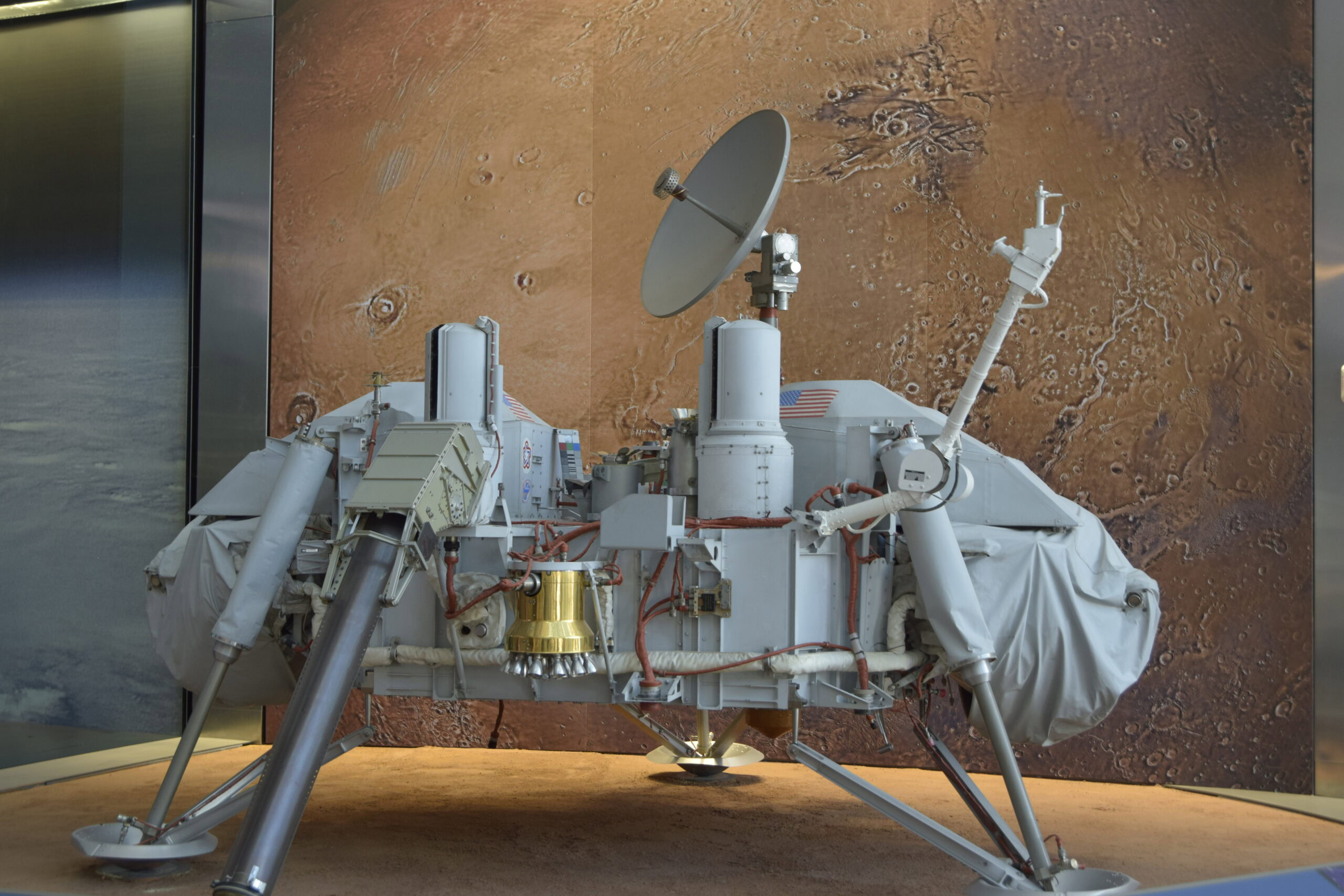
NASA Mars Viking Lander. Image Taken by 19FortyFive at the Smithsonian on June 24, 2026.
And one of the things that London wanted to achieve was to get to Mars, just like the big countries of the world were doing.
Enter Britain’s Beagle 2. And it was a failure.
Britain’s Bold Bid for Mars
Beagle 2 was Britain’s first attempt to land on another planet. Built under the leadership of Colin Pillinger, the lander rode to Mars attached to Mars Express, which launched in June 2003.
Unlike NASA’s large, expensive Mars missions, Beagle 2 was designed as a relatively inexpensive scientific laboratory.
It weighed 152 pounds and was intended to answer one of humanity’s oldest questions: had life ever existed on Mars?
Beagle 2’s scientific payload included a robotic arm, a miniature mass spectrometer, microscopes, rock grinders, environmental sensors, and instruments capable of searching for organic molecules and isotopic signatures associated with past life.
The lander was named after HMS Beagle, the ship that carried Charles Darwin around the world.
Christmas Day Disaster…Or So Everyone Thought
Mars Express released Beagle 2 on December 19, 2003. Six days later, on Christmas Day, the tiny spacecraft entered the Martian atmosphere. Everything after that went silent. No radio signal. No telemetry. No confirmation of landing.
After weeks of unsuccessful attempts to contact the probe, the mission was declared lost in early 2004. Most experts assumed one of several catastrophic failures had occurred.
They assumed the parachute failed or that the airbag failed. Some speculated that the system impacted the ground at too great a speed.
It was destroyed on entry. There was also an electronic failure during descent.
For more than 11 years, nobody knew what had happened.
NASA Solves the Mystery
Suddenly, in January 2015, NASA’s Mars Reconnaissance Orbiter used its extraordinarily powerful HiRISE camera to photograph the Beagle 2 landing zone. The images caught the world by surprise.
It turned out that Beagle 2 wasn’t destroyed.
In fact, the lander was photographed sitting upright at its landing spot, its parachutes were nearby, and overall film evidence suggested that entry, descent, and landing had all worked almost perfectly.
The spacecraft had landed within roughly five kilometers of its intended target–an exceptional achievement.
One Stuck Solar Panel Changed Everything
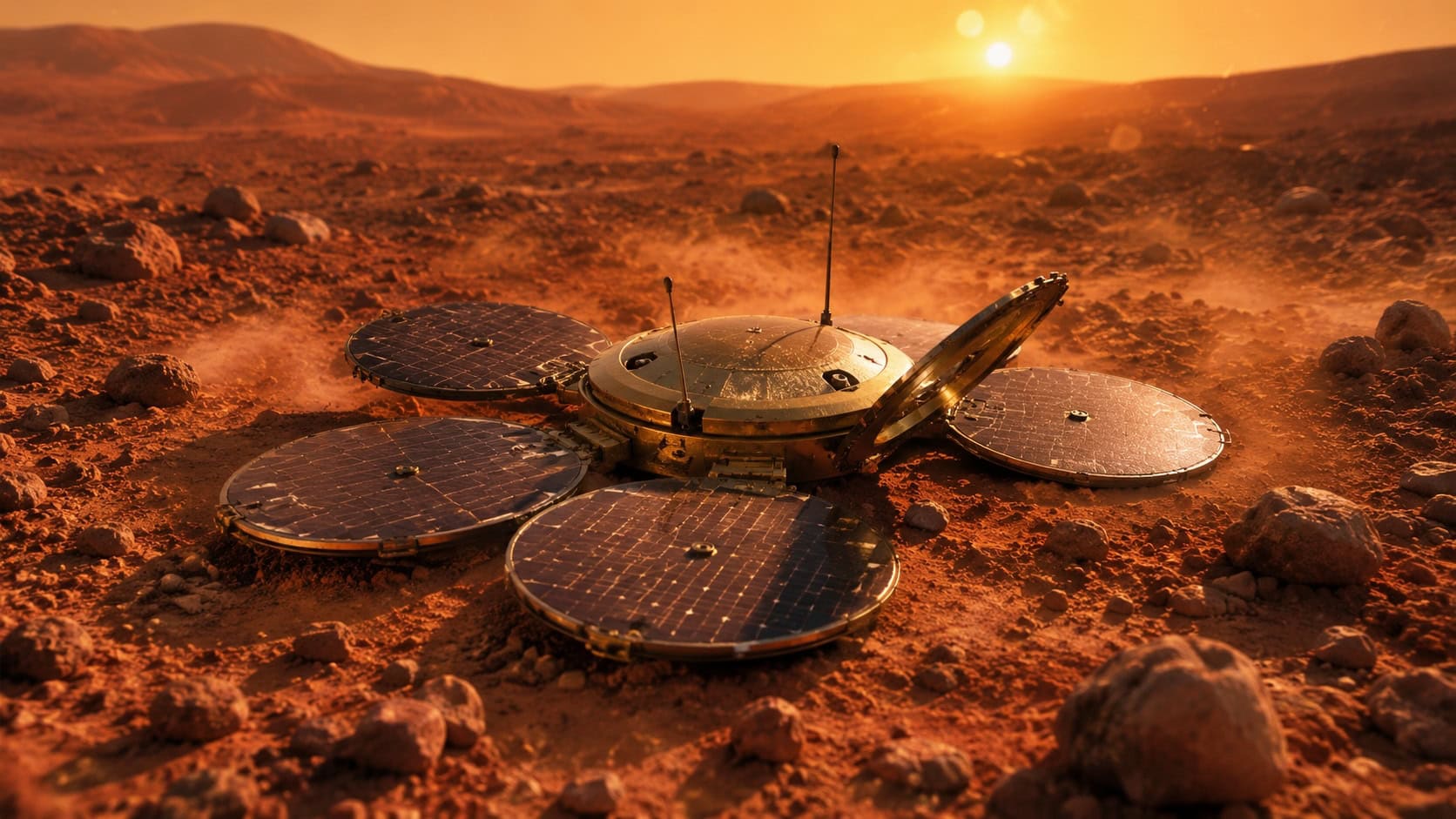
The images also revealed the fatal flaw behind Beagle 2’s failure. It was designed like a mechanical flower. After landing, four circular solar panels (“petals”) were supposed to unfold one after another. Hidden beneath the final petal sat the spacecraft’s communications antenna.
HiRISE images showed that one panel never fully opened.
That single partially deployed panel blocked the antenna from communicating with orbiting spacecraft overhead.
So, the results were devastating. Beagle 2 likely survived landing. It may have even successfully powered up. It may have performed some surface operations, too. But it could not send a signal back to Earth.
One small mechanical failure transformed a successful landing into a silent mission.
Was Beagle 2 Actually a Failure?
Ironically, the discovery completely changed how engineers judged the mission. Before 2015, Beagle 2 appeared to be another failed Mars landing.
After NASA found it, investigators realized that the atmospheric entry had succeeded. The heat shield worked fine. Parachutes were even deployed.
Airbags inflated correctly.
The spacecraft landed safely–and it even deployed normally.
The only confirmed failure appears to have occurred during the final stage of surface deployment.
Some later engineering analyses even suggested the spacecraft may briefly have carried out programmed surface activities before communications became impossible.
Why Mars Makes Landing So Difficult
Beagle 2 illuminates why Mars remains one of the hardest (costliest, too) destinations in the Solar System.
The atmosphere is thick enough to create enormous heating during entry. Yet it is too thin for parachutes alone to slow a spacecraft sufficiently.
Landing requires a carefully choreographed sequence that works seamlessly.
The difference between success and failure can be measured on a single jammed hinge.
That lesson would echo years later with Europe’s failed Schiaparelli lander on Mars. That system, too, crashed into Mars in 2016 after a software-related error in the landing sequence.
Britain’s Place in Mars History
For years, Britain remembered Beagle 2 as an ambitious project that never reached Mars. The 2015 discovery rewrote that history. Today, the mission is recognized as the first British and European spacecraft to successfully land on another planet, even though it never established communications or completed its mission.
In June 2026, the UK Space Agency began unveiling 13 commemorative plaques across Britain–including at the National Space Center, Jodrell Bank, the Science Museum, the Open University, and Airbus in Stevenage–to honor the scientists and engineers behind the mission and to emphasize that Beagle-2 did, in fact, achieve a successful landing.
Legacy
Beagle 2 occupies a unique place in space history. It was simultaneously one of the most famous lost spacecraft ever made.
It was also one of the closest calls in the history of Mars exploration.
More importantly, though, the fact that Beagle 2 successfully landed proved in Britain’s mind that it could design a successful interplanetary lander.
For more than a decade, the little spacecraft lay quietly on the Martian plains, exactly where it was supposed to be.
Humanity simply lacked the eyes to find it. When those eyes finally arrived aboard NASA’s Mars Reconnaissance Orbiter, they revealed that Beagle 2 had accomplished almost everything it had been asked to do.
A single unopened solar panel prevented it from telling anyone it had made it. That single solar panel failure also held back Britain’s space ambitions.
Considering how close London came to becoming a Mars exploration power, one must wonder if they will ever contemplate trying again.
About the Author: Brandon J. Weichert
Brandon J. Weichert is the Senior National Security Editor at 19FortyFive.com. He also manages The Weichert Brief on Substack. Weichert also hosts “National Security Talk” on Rumble. He is the author of four bestselling national security books, the most recent of which is A Disaster of Our Own Making: How the West Lost Ukraine (Encounter Books). Follow him via Twitter/X @WeTheBrandon.