

Mars 6 remains one of the strangest missions of the Cold War space race. On March 12, 1974, the Soviet lander successfully entered the Martian atmosphere, deployed its parachute, and transmitted valuable scientific data during a 224-second descent. But then, at the exact moment Mars 6 was expected to land on the Martian surface, the signal terminated.
The mission is remembered today as both a scientific success and an engineering disaster, an example of how tight the mechanical margins are during space exploration.
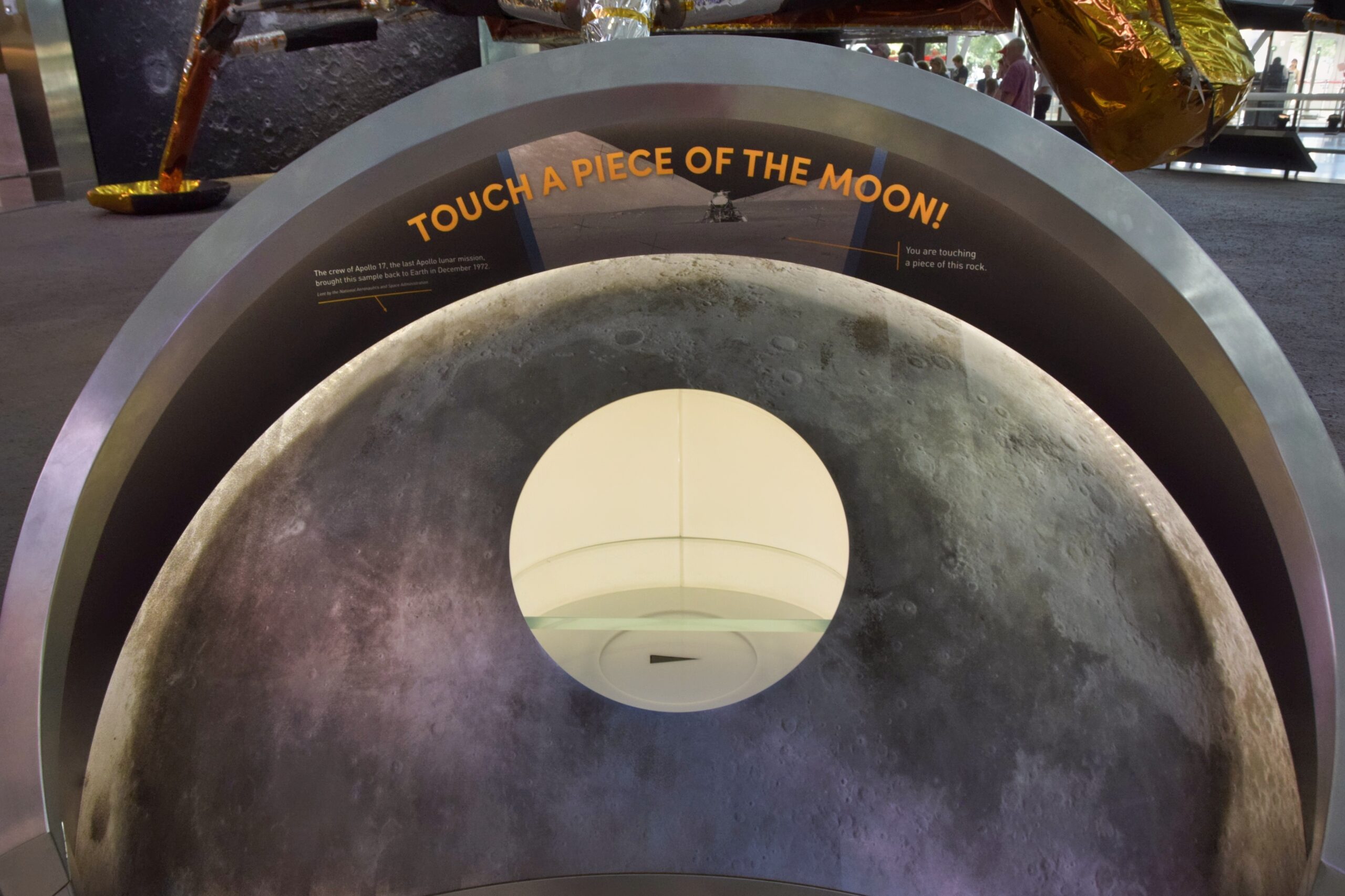
Touch a Piece of the Moon at the Smithsonian. Image Credit: 19FortyFive Image Taken at the Smithsonian on 6/24/2026
Height of the Cold War: The Mars 6 Story
Mars exploration became another front in the Cold War competition between the Soviet Union and the United States.
The Americans dominated the Moon, of course, through the Apollo program. And while the Soviets dominated Venus exploration through the Venera program, Mars proved more difficult to explore. Mars 6 was an effort to place hardware on and around the Red Planet—and it almost worked.
The descent worked almost perfectly. Mars 6 separated from its carrier spacecraft and entered the Martian atmosphere at roughly 12,500 miles per hour, using a large ablative heat shield to absorb enormous thermal loads during its hypersonic entry.
As the probe decelerated, it automatically deployed its supersonic parachute, initiating a descent sequence that lasted approximately 224 seconds, during which instruments transmitted atmospheric measurements.
The telemetry continued to transmit, all the way to the surface, until it abruptly cut out.
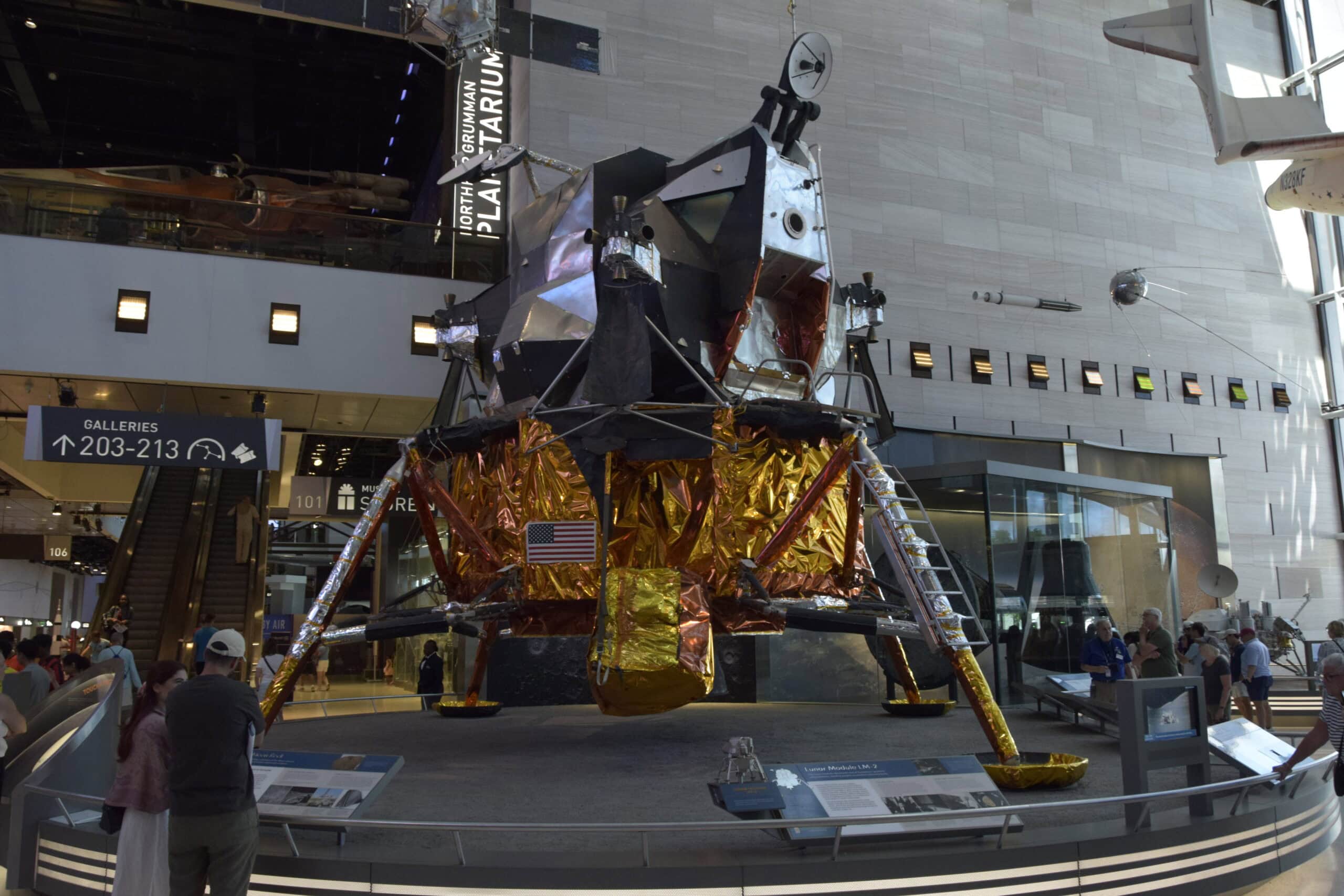
Apollo 11 Lander. Image Taken by 19FortyFive on 6/24/2026 in Washington, DC.
Valuable Yields
The mission was still a success from a scientific perspective.
Although the lander never transmitted from the surface, the descent itself produced valuable scientific information, including the first direct atmospheric measurements ever, temperature, pressure, and density profiles, and data on atmospheric structure.
The mission helped improve Western and Soviet understanding of how Mars’ atmosphere behaved close to the surface. And later, Mars landing systems incorporated data harvested by Mars 6 to improve their performance.
The Engineering Behind Mars 6
The Mars 6 spacecraft relied on several major systems working together.
A large ablative aeroshell protected the vehicle during atmospheric entry. Multi-stage parachute deployments slowed the lander as it entered the thin Martian atmosphere. A radar altimeter is prepared for terminal descent.
A retrorocket sequence was intended to soften the final landing.
Various instruments continuously relayed data through the flyby spacecraft rather than directly back to Earth.
Basically, the Mars 6 probe acted as a communications relay, forwarding telemetry to Soviet tracking stations back on Earth. But of course, the spacecraft ultimately failed. Why?
Why Did Mars 6 Fail?
For decades, the exact cause of the Mars 6 failure remained uncertain.
Popular accounts often defaulted to a crash on the Martian surface. But later Soviet documentation suggested a more complicated explanation.
The leading theory is that degraded onboard electronics caused the crash, not an aerodynamic failure.
Specifically, a faulty batch of semiconductor components appears to have deteriorated during the seven-month cruise through deep space, probably due to radiation exposure.
So by arrival, portions of the onboard computer were already corrupting telemetry.
Fortunately, later engineering assessments showed that the probe’s mechanical sequences operated largely as designed.
For example, the heat shield functioned, the parachute deployed, and the descent computer worked.
But telemetry became increasingly corrupted, and either the retrorockets failed to ignite properly, or an electrical failure disabled the transmitter precisely during touchdown, as contact was lost immediately.
Engineers never confirmed which scenario took out the probe, however.
The Legacy of Mars 6
Mars 6 illustrates an important reality of space exploration: deep-space missions are highly dependent on sensitive electronic components.
Despite the massive rockets and sophisticated parachute systems, microscopic defects inside a transistor can tank a multi-month mission.
And the conditions of space are witheringly harsh, with radiation, vacuum, and temperature extremes that push the reliability envelope of every component aboard an outgoing spacecraft.
Today, Mars 6 is remembered as one of the Soviet Union’s closest attempts at a successful Mars landing.
The mission demonstrated that atmospheric entry and descent to Mars were absolutely possible.
But the mission also exposed weaknesses in Soviet electronics manufacturing during the Cold War—a reality that would plague later Soviet Mars efforts, including the Phobos missions.
To this day, no Soviet or Russian lander has ever established a lasting presence on Mars.
About the Author: Harrison Kass
Harrison Kass is a writer and attorney focused on national security, technology, and political culture. His work has appeared in Tablet, City Journal, The Hill, The Spectator, and The Cipher Brief. He holds a JD from the University of Oregon and a master’s in Global & Joint Program Studies from NYU. More at harrisonkass.com.