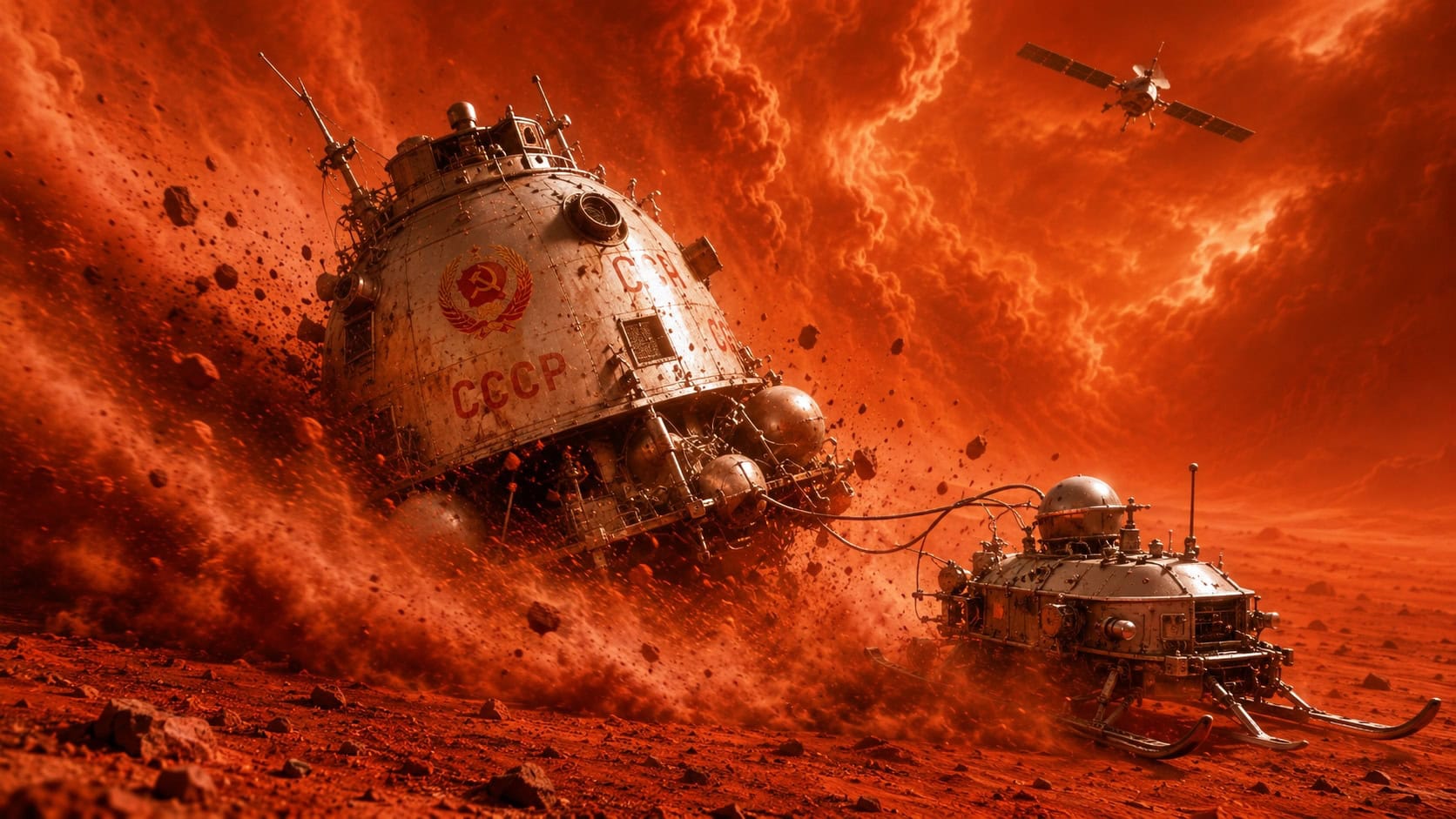
The Cold War Race for Mars: When the Space Race, which defined much of the Cold War, began, the Americans were behind their Soviet competitors.
The Reds had put the world’s first artificial satellite, Sputnik, into orbit around Earth.
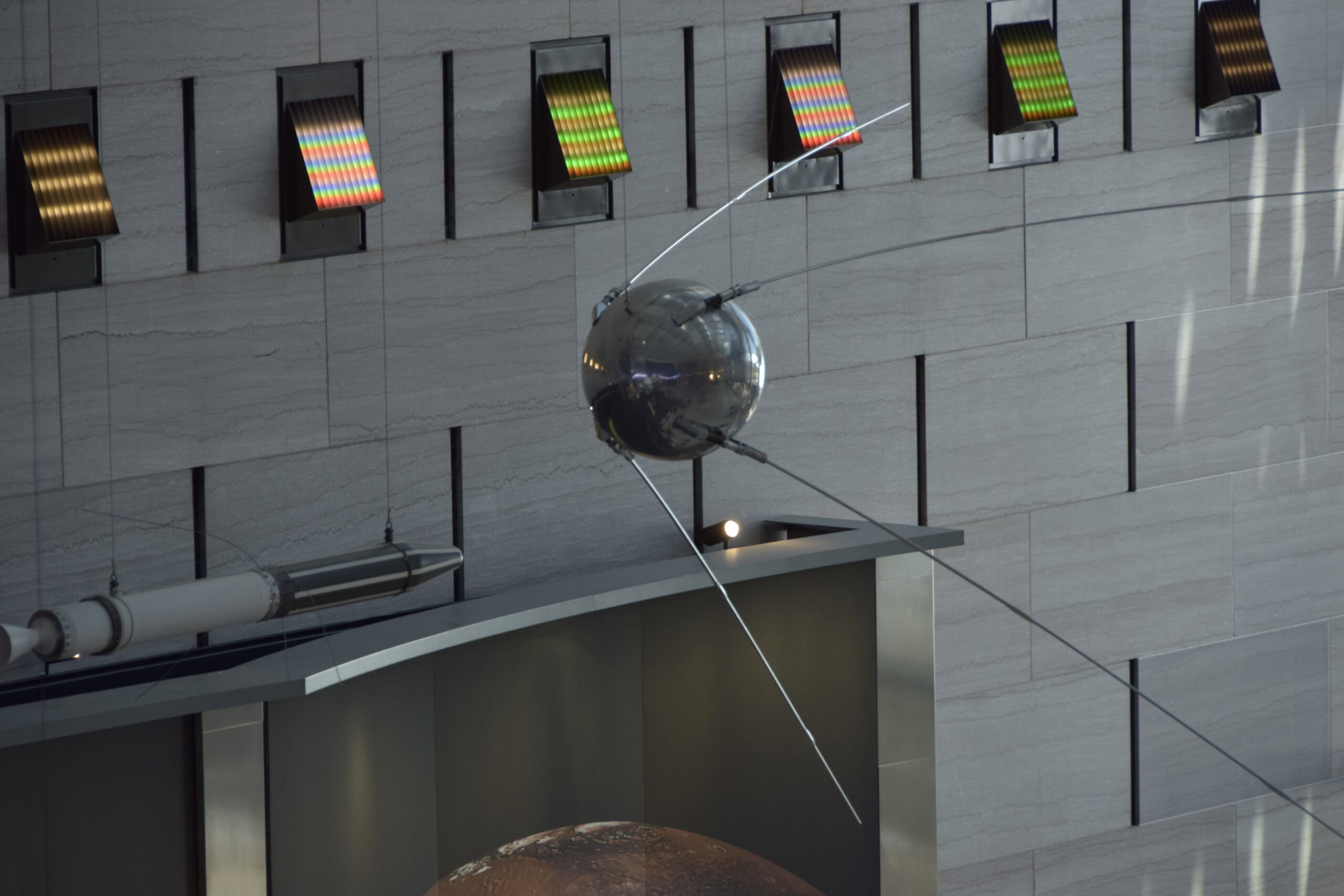
Sputnik Model at the Smithsonian. 19FortyFive.com Image Taken on June 24, 2026.
They then placed the world’s first human into Earth orbit. In the late 1950s and early 1960s, it looked like the Americans were going to lose the race to put men on the moon as well.
Thanks to an all-of-government effort spanning three presidencies (JFK, LBJ, and Nixon), Americans became the first to reach the Moon.
The Soviets, unhappy with that defeat, turned their attention to a more distant target. Not just a moon. The Reds wanted to be the first to the Red Planet.
Once the Americans beat the Soviets to the moon, the Soviet Union’s resources were diverted toward being the first to Mars.
Taking the lessons that the Soviet space program learned from their Luna unmanned probe missions to the moon, Moscow prepared to land unmanned probes on the Martian surface before the Americans were even thinking about it.
On November 27, 1971, the Soviet Mars 2 lander became the first human-made object ever to reach the surface of Mars.
It did so at enormous speed after its landing sequence failed, smashing into the planet rather than touching down safely.
The achievement was therefore both a triumph and a tragedy–the first arrival on Mars by an artificial object from Earth, but it was not a landing. It was a devastating crash for the probe.
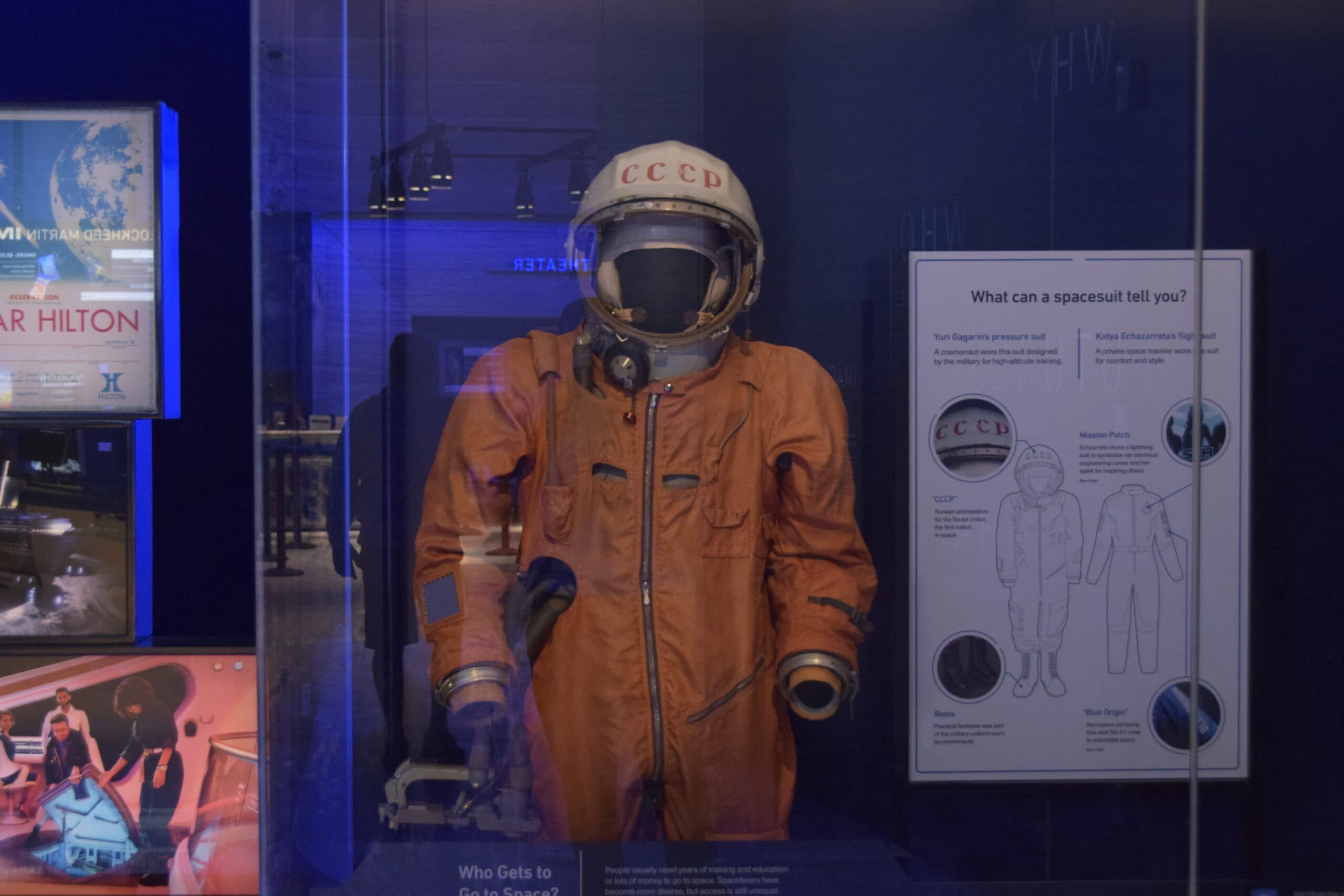
Soviet Space Suit. Image Credit: 19FortyFive Original Image Take at the Smithsonian on 6/24/2026.
The Soviets Were Going Big with a Mars Mission
Mars 2 represented a dramatic leap beyond the Soviet Union’s earlier Mars failure.
Rather than sending a simple flyby probe, Mars 2 was an integrated planetary exploration system consisting of an orbiter, a descent lander, and a tiny untethered rover called PrOP-M.
At roughly 4.6 metric tons, it was among the largest interplanetary spacecraft ever launched up to that point.
It rode atop the powerful Proton rocket and departed Earth on May 19, 1971, beginning a 192-day journey to Mars.
Soviet objectives with Mars 2 were ambitious.
They wanted the probe to map the Martian surface, analyze the atmosphere, measure temperatures, study magnetic fields, search for water vapor, and place a functioning scientific laboratory on Mars itself.
Had everything worked, Mars 2 would have rewritten the history of planetary exploration.
Not the First Time the Soviets Tried (and Failed) to Reach Mars
It should be noted here that Mars 2, as the name suggests, was not the first time the Soviets tried to send an unmanned mission to Mars. Around 1960, the Soviets attempted to send a spacecraft to Mars.
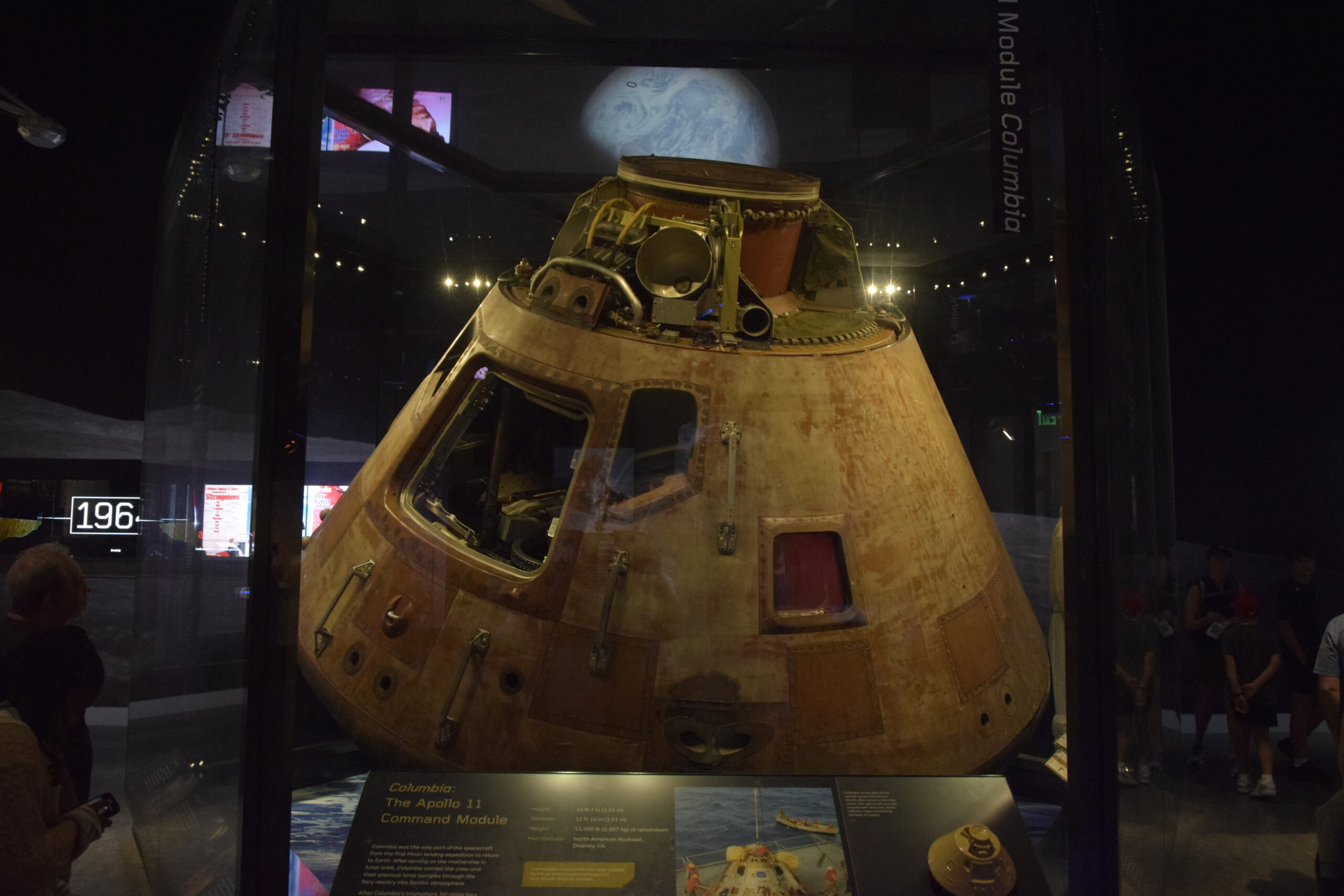
Apollo 11 Command Module. 19FortyFive.com Image Taken at the Smithsonian on 6/24/2026.
Those two attempts ended in complete failures.
Two years later, Mars 1 reached Mars before radio contact was lost a year later, failing to orbit Mars (although it did orbit Mars, proving that the Soviet Union could successfully send spacecraft deep into space).
In 1964, Zond 2 was another Mars flyby attempt that failed. In 1969, the same year the Americans landed on the Moon, the Soviets launched the M-69 missions, which consisted of two spacecraft that remained in Earth orbit.
Eventually, Mars 3 became the first spacecraft to achieve a soft landing on Mars. Although Mars 3 transmitted for only about 14.5-20 seconds after touchdown, it still achieved one of the greatest milestones in planetary exploration.
Why So Many Failures?
Early interplanetary exploration was extraordinarily difficult.
The Soviets were pushing the limits of rocket reliability, deep-space communications, autonomous navigation, onboard computers, and planetary entry systems.
Many failures occurred before the spacecraft even left Earth orbit because the heavy Proton launcher was still relatively new.
Once the spacecraft reached deep space, engineers encountered another challenge: they had no practical way to repair failures hundreds of millions of miles away.
An Underrated Achievement
The Soviet Mars program is often remembered for its failures, but that overlooks what it accomplished.
By 1971, Soviet engineers had developed spacecraft capable of navigating through interplanetary space, entering orbit around another planet, surviving atmospheric reentry, deploying landers, and attempting the world’s first planetary rover mission.
Many of the engineering lessons learned from these early missions directly assisted the remarkable Soviet Venera program, which ultimately achieved the first successful landing on another planet, the first images from another planetary surface, and the longest-lived surface operations on Venus.
In that sense, Mars 2 was not an isolated gamble. It was the product of more than a decade of increasingly sophisticated Soviet attempts to master interplanetary flight.
The Worst Possible Time to Arrive
Mars had other plans for the Soviet Mars 2 mission, though.
When Mars 2 arrived in late November 1971, the planet was engulfed by one of the largest global dust storms ever observed.
That storm had become so intense that even NASA’s Mariner 9, which had reached Mars first and entered orbit successfully, could barely see the surface beneath the swirling dust. Scientists initially thought they had lost the ability to map the planet because virtually everything was hidden beneath an orange haze.
The Soviet lander had to descend through exactly those conditions.
What Went Wrong?
The descent sequence appears to have gone disastrously wrong. Evidence suggests the spacecraft entered the atmosphere at a steeper angle and at a higher velocity than the Soviets had planned.
Whether due to the dust storm, navigation errors, or both, the parachute and landing systems failed to complete a proper landing sequence.
Rather than going gently onto the Martian plains, the capsule slammed into the surface. No radio transmissions were ever received.
So, Mars 2 became the first spacecraft both to reach and impact the Martian surface. It’s also one of history’s most famous “almost” achievements.
The Orbiter Still Succeeded
Although the lander was lost, the mission itself was far from a complete failure. The orbiter successfully entered Martian orbit and spent many months studying the planet.
That orbiter successfully mapped the Martian surface, measured atmospheric composition, studied water vapor and carbon dioxide, observed planetary temperatures, examined the Red Planet’s magnetic properties, and documented the enormous dust storm.
In fact, the Soviet orbiter completed 362 orbits around Mars before ending operations in 1972, returning valuable scientific data that helped shape later Mars exploration.
The Tiny Rover That Never Drove
One of the most fascinating aspects of Mars 2 is that it never had the chance to work: the miniature robotic rover called PrOP-M.
Unlike modern Mars rovers, PrOP-M was connected to the lander by a cable about 50 feet long.
It moved on small skis rather than wheels and was designed to hop across the surface while testing soil strength and mechanical properties.
Had it operated successfully, it would have become the first rover ever to move across another planet’s surface–more than 25 years before NASA’s Sojourner explored Mars in 1997.
But because the lander crashed, poor PrOP-M never had a chance.
Did NASA Ever Find the Crash Site?
Decades later, scientists revisited these forgotten Soviet missions during NASA’s Mars Reconnaissance Orbiter mission.
Using the powerful HiRISE camera, NASA photographed candidate locations for Soviet landing hardware, including detailed studies of the Mars 3 landing area.
While Mars 3 hardware candidates have generated the most attention, Mars 2’s impact location is believed to lie within the vast Hellas region.
Because Mars 2 struck the surface at high speed rather than landing intact, identifying the crash remains considerably more difficult than finding a soft-landed spacecraft.
The Legacy of Mars 2
Mars 2 occupies a unique place in the history of space exploration. While it failed in its primary mission, the craft still achieved a memorable milestone by becoming humanity’s first physical arrival on another planet beyond the moon.
Its orbiter returned critical scientific data, too. The engineers of this project pioneered technologies later used in subsequent Soviet missions.
The mission serves as a further reminder that the Space Race extended far beyond the Earth-Moon System.
While the United States won the race to land astronauts on the lunar surface, the Soviet Union remained a formidable planetary exploration power.
Mars 2 showed just how close Moscow came to claiming another historic first–this time on the Red Planet.
Had Mars 2’s landing sequence survived one of the worst Martian dust storms ever recorded, history might remember Mars 2 not as the first spacecraft to crash on Mars, but as the first to conquer it–truly putting the Red in “Red Planet.”
About the Author: Brandon J. Weichert
Brandon J. Weichert is the Senior National Security Editor at 19FortyFive.com. He also manages The Weichert Brief on Substack. Weichert also hosts “National Security Talk” on Rumble. He is the author of four bestselling national security books, the most recent of which is A Disaster of Our Own Making: How the West Lost Ukraine (Encounter Books). Follow him via Twitter/X @WeTheBrandon.