
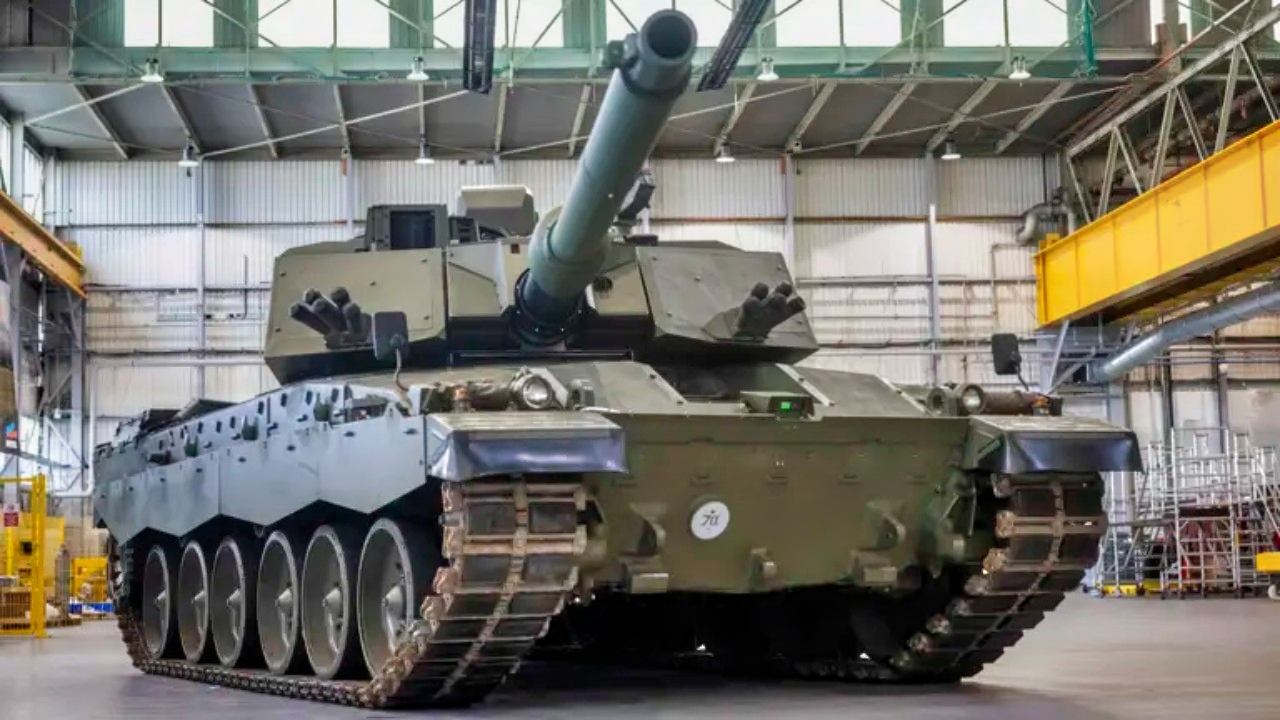
Summary and Key Points: In 1916, an agricultural machinery works in Lincoln built the first tanks in history and sent them to the Somme. In 2002, Britain delivered the last new tank it ever made. The factory that built it was demolished, and houses are going up on the site. That is the fact hiding underneath every argument about the Challenger 3, the 148 rebuilt tanks that will carry British armor into the 2040s: the debate is always about whether 148 is enough, and almost never about whether Britain could build number 149 if it wanted to. The honest answer is harder and more interesting than the obituary version — not today, not at scale, but for the first time in a generation, the pieces are being put back.
Britain Invented the Tank in 1916. Today, Houses Are Being Built on the Site of Its Last Tank Factory: An Introduction
Challenger 3 Tank. Image Credit: Creative Commons.
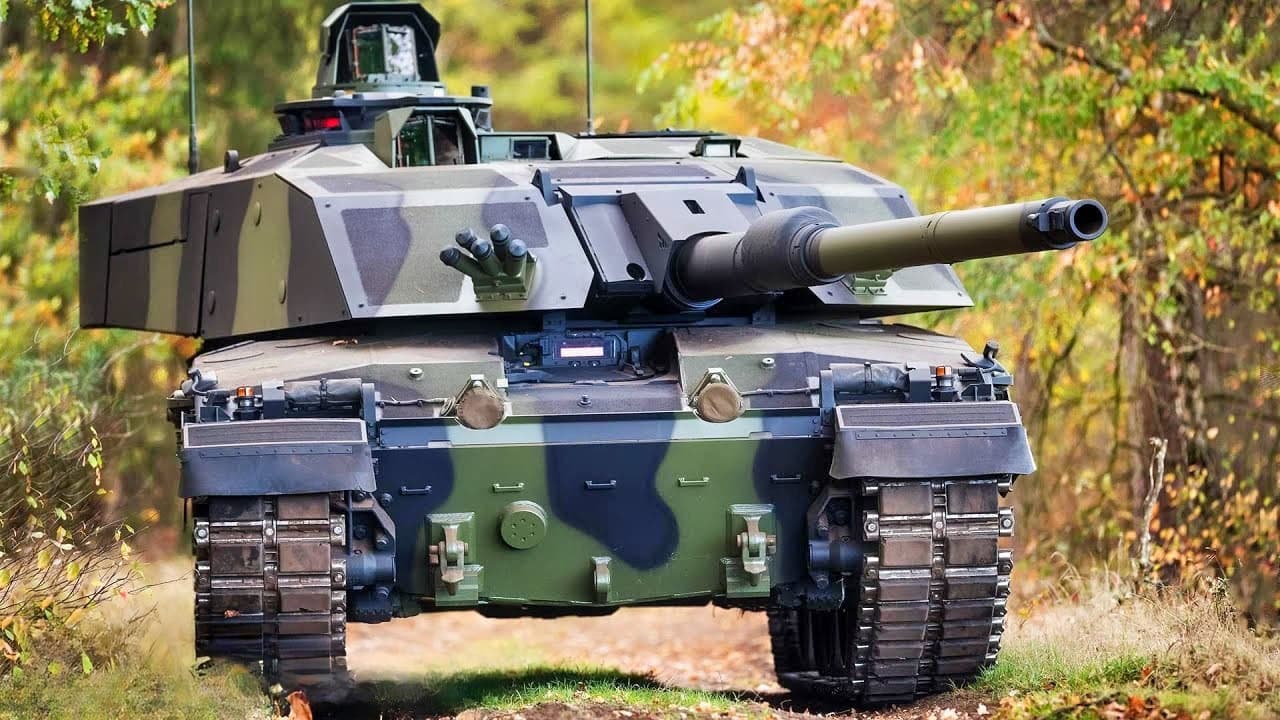
Challenger 3 Tank. Image Credit: Creative Commons.
Two facts, set side by side, frame everything about British armor. The first: the tank is a British invention, conceived in the First World War and built first by William Foster & Co., an agricultural engineering firm in Lincoln, before making its combat debut on the Somme in 1916. The second: the Vickers factory in Leeds that produced Britain’s current tanks was closed, demolished, and covered by a housing development now rising on the site. Between those two facts sits the Challenger 3 program, which is usually covered as a tank story, complete with a running debate about whether its 148 hulls are anywhere near enough. It is better understood as an industrial story: the visible edge of the question of whether a country that invented a weapon, built it for ninety years, and then let the capability die can grow it back.
Defense Industry: How the Line Went Cold
Britain’s last tank was the Challenger 2, and it was built at two places: the Barnbow works in Leeds, and the old Armstrong works at Elswick and Scotswood in Newcastle, with more than 250 subcontractors feeding the lines. The end came in stages, each one quiet. With the British Army’s order capped at 386 tanks and only a small Omani export order beyond it, Vickers announced in 1998 that the Leeds plant would close, consolidating what remained to Newcastle amid a contemporaneous row, angrily denied by the company, over whether politics had picked which factory survived. The last of the 386 Challenger 2s was delivered in April 2002, and no new British tank has been built since. The corporate name over the door kept changing, Vickers to Alvis Vickers to BAE Systems, and in time the Newcastle works went the way of Leeds: one defense reference records that the country which fielded the world’s first tanks at the Somme “lost its last armor assembly line” when the historic Newcastle plant shuttered.
The hulls were only half the loss. The guns died separately. The Royal Ordnance Factory at Nottingham was the sole producer of barrels for the Challenger 2 and the AS90 howitzer, and when it closed, Britain lost domestic large-calibre gun-barrel manufacture entirely, a gap that lasted roughly twenty years and went largely unnoticed until the war in Ukraine exposed it: the Challenger 2s and AS90s Britain donated wore out their barrels at combat rates, and the country that made them could not manufacture replacements. A nation can misplace an industry without ever deciding to do so, one closure at a time, and by the 2010s, Britain had done exactly that to the industry it had founded.
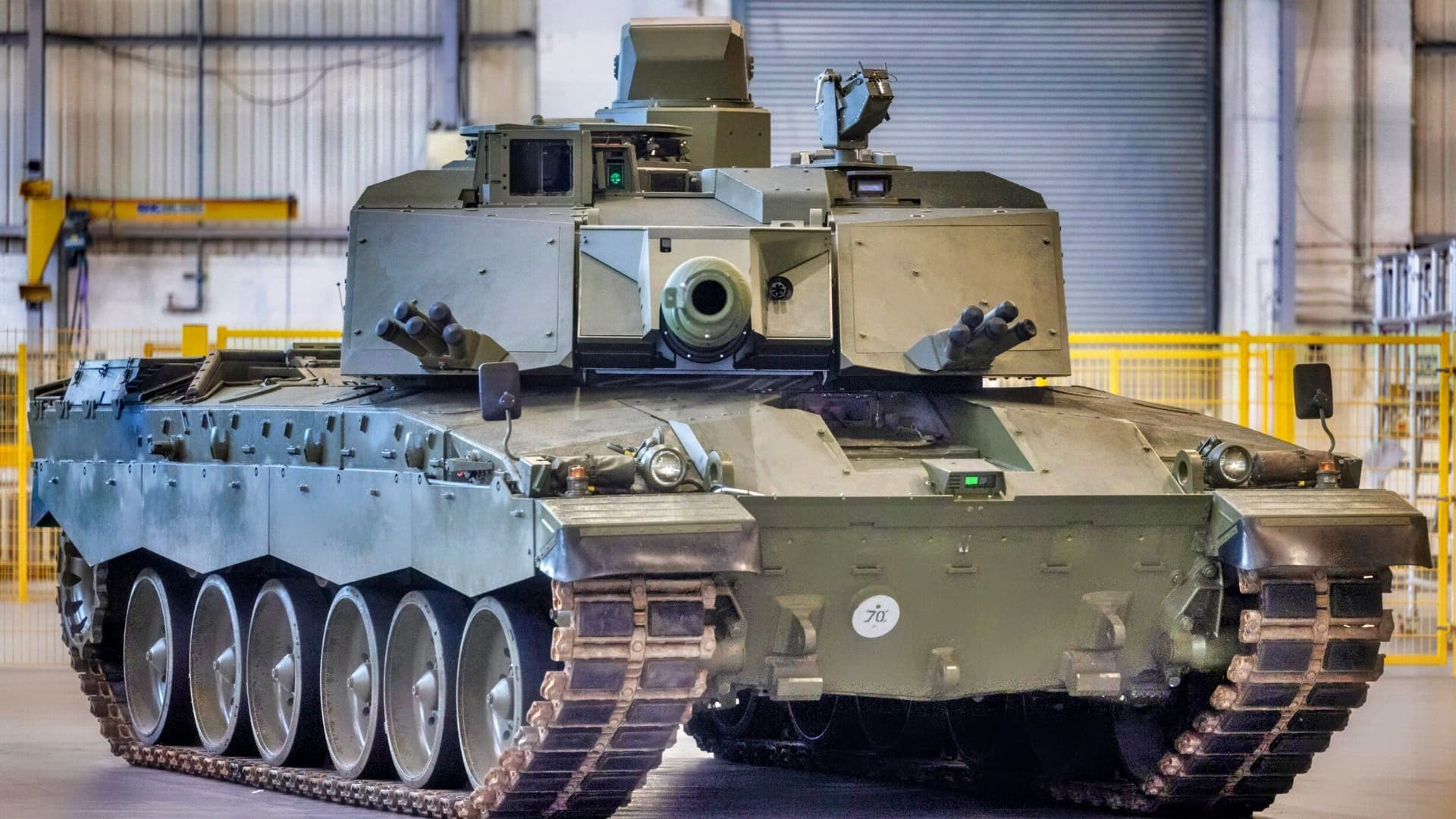
Challenger 3 Tank. Image Credit: British Government.
The Program: What Challenger 3 Actually Is
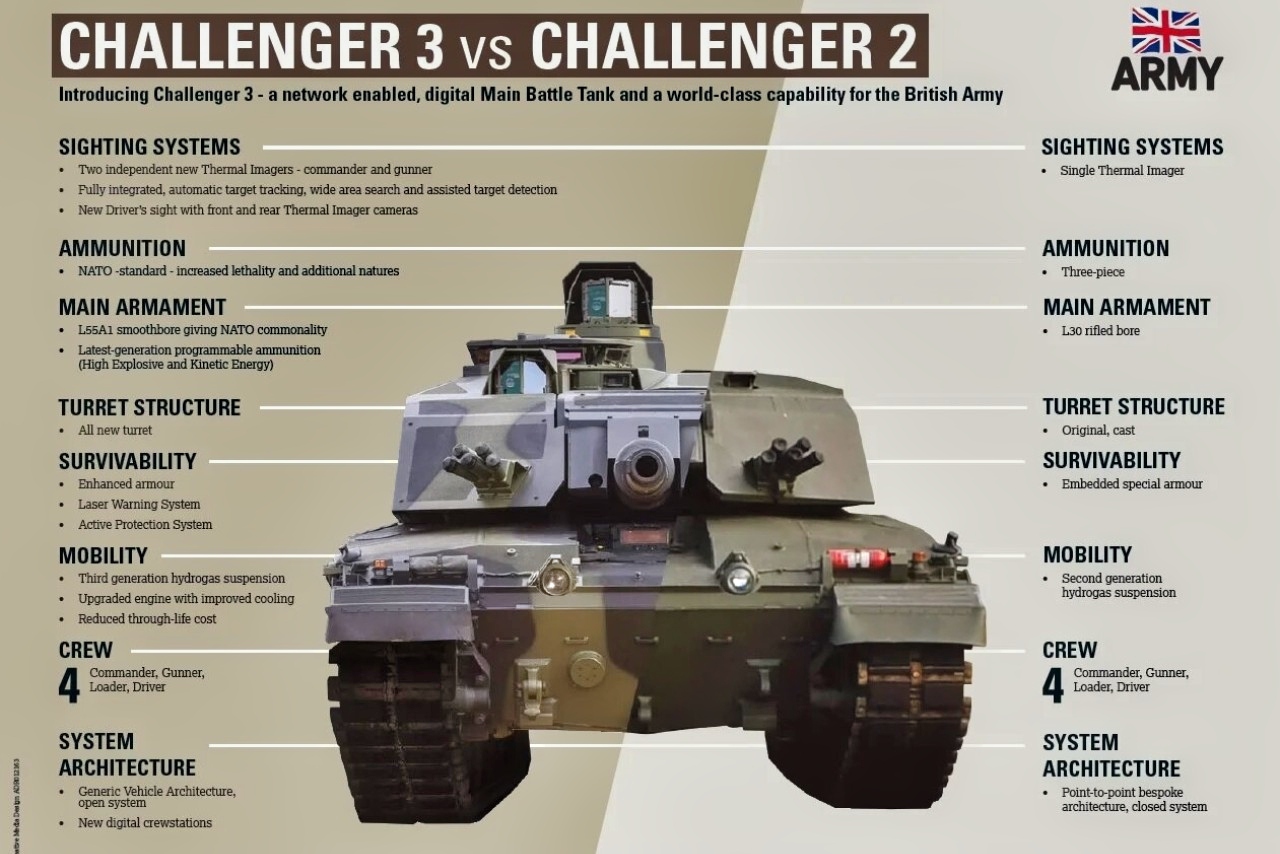
Seen against that background, the Challenger 3 decision reads differently. When Britain finally moved to modernize its armor, the options were famously three: buy a foreign tank, design a new one, or rebuild the Challenger 2 — and the middle option barely existed as an industrial fact, because the factories, the hull line, and the barrel plant were gone. The £800 million contract signed in May 2021 with Rheinmetall BAE Systems Land, the 2019 joint venture that inherited what remained of British tank-building, converts 148 Challenger 2s at Telford, supported by RBSL engineering sites in Washington and Bristol.
Calling it a refurbishment undersells what happens on the shop floor. Each tank is stripped to the hull; by RBSL’s own description, the turret ring stays, roughly half the internal units are traded, and everything else is new, crowned by a brand-new, fully digital turret carrying Rheinmetall’s 120mm L55A1 smoothbore, which is genuine tank manufacture by any definition. RBSL strategy director Rory Breen has gone further, saying it is “technically possible for RBSL to build new Challenger 3s if required”. The program sustains around 300 jobs at RBSL and another 450 across a supply chain, the Ministry of Defence says, providing about 60 percent of the tank’s value from UK firms, backed by a £40 million investment in Telford, including a purpose-built turret test rig. The honest asterisk belongs in the same paragraph: the gun, the turret’s core architecture, and the fire control are substantially German designs, which is what rebuilding from a joint venture with the industry leader looks like.
The Honest Ledger: Where the Program Stands This Month
The program’s current state cuts both ways, and both deserve stating. On January 20, the Challenger 3 conducted its first crewed live firing on British soil, the first time a newly developed British main battle tank had fired its gun at home in more than thirty years, followed by realistic battlefield-mission trials through the spring. The cost and schedule tell the harder half. The program’s whole-life cost has grown on the MoD’s own project data from roughly £1.3 billion to £1.99 billion, and in June, The Telegraph reported the program delayed, citing gearbox flaws, with the new turret’s weight adding engineering strain. The defense readiness minister, Luke Pollard, had already told Parliament in December that manufacturing would begin “once the tank’s performance is proven, rather than being tied to a specific deadline” — a sensible engineering posture that is also an admission that serial production has no start date. Initial operating capability is still targeted for 2027, with all 148 due by the end of 2030, and the eight prototypes, built in two batches of four, remain the only Challenger 3s in existence; the tank made its first public appearance at Tankfest just two weeks ago. Even the raw material is aging: Ukrainian analysts at Defense Express, surveying the program, note the donor Challenger 2 hulls are worn enough to slow the conversions, and render the blunter verdict that Britain cannot produce new main battle tanks even in the medium term.
The Rebuild: The Barrels Come Home First
This makes the least-noticed thread of this story the most important one. The gun-barrel capability, dead for two decades, is being deliberately regrown in three documented steps. In July 2024, the MoD announced it would regenerate barrel-forging capability in partnership with Sheffield Forgemasters, the historic steelmaker nationalized in 2021 and now owned outright by the ministry, whose chief executive confirmed the company would “reinstate gun barrels manufacture after a 20-year hiatus” on its 10,000-tonne press. In October 2024, the UK-Germany Trinity House Agreement committed Rheinmetall to opening a barrel factory in Britain, supporting more than 400 jobs, and Janes carried the detail that matters most here: the plant will produce 155mm artillery barrels and 120mm tank guns, including for the Challenger 3, with production scheduled to begin in 2027. And in May 2025, Rheinmetall announced the facility would be built in Telford, beside the tank line itself, explicitly reducing dependence on German supply for the L55A1. Read the timeline honestly and the rebuild is real, funded, and sited, and it is also future-tense: until the Telford plant turns its first barrels, the guns on Britain’s new tanks come from Germany.
The Counterpoints: The Case for the Obituary, and Against It
The skeptics’ case is strong and should be given straight. No British hull line exists, none is funded, and a company saying a new-build tank is “technically possible” is describing a capability, not a production rate; one bespoke hull is not an industry. The core intellectual property under the new turret is German. The program that is supposed to prove the rebuilt skills has doubled in whole-life cost and has just publicly slipped. And the contrast across the Channel is unflattering: Poland, starting from a smaller industrial base, is standing up licensed tank production, new factories, and a supply chain at speed, while Britain converts 148 hulls and debates the rest.
And yet the obituary overstates its case in three ways. Britain builds armored fighting vehicles at scale right now, with Ajax hulls manufactured in Wales and Boxer vehicles in Telford and Stockport, so the welding, machining, and integration skills are not extinct, merely pointed at lighter metal. The Challenger 3’s turret is a new-build tank manufactured today in Britain by a workforce of about 700, which did not exist as a tank enterprise a decade ago. And the single most strategic missing piece, the big gun, is the one with a factory already sited and a production date on the calendar.
The fair verdict on the question, could Britain build new tanks, is this: not this year, and not without choosing to. But for the first time since the last Challenger 2 rolled out in 2002, choosing to is becoming physically possible again.
That is the real stake hiding under the Challenger 3. In Leeds, the ground where Britain built its last tanks is being covered with houses, the final form a factory closure can take. In Telford, a turret line is running, a test rig is standing, and a barrel plant is rising from the ground beside them.
A century after Lincoln’s engineers sent the first tanks in history to the Somme, the question the Challenger 3 answers is not whether 148 tanks are enough but whether Britain intends to remain a country that could ever build the 149th — and for the moment, narrowly and expensively, the answer is being rebuilt in the West Midlands.
About the Author: Harry J. Kazianis
Harry J. Kazianis (@Grecianformula) was the former Senior Director of National Security Affairs at the Center for the National Interest (CFTNI), a foreign policy think tank founded by Richard Nixon based in Washington, DC. Harry has over a decade of experience in think tanks and national security publishing. His ideas have been published in the NY Times, The Washington Post, The Wall Street Journal, CNN, and many other outlets worldwide. He has held positions at CSIS, the Heritage Foundation, the University of Nottingham, and several other institutions related to national security research and studies. He is the former Executive Editor of the National Interest and the Diplomat. He holds a Master’s degree focusing on international affairs from Harvard University.

