
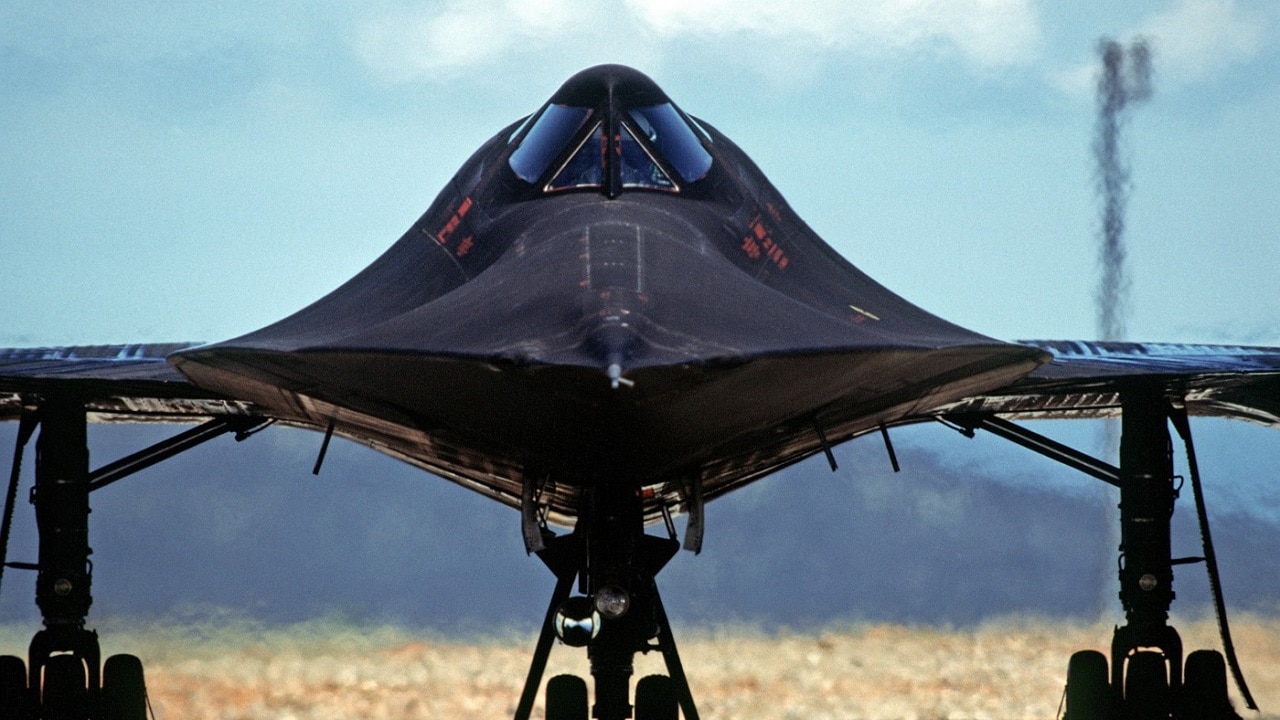
At the end of its life, the fastest aircraft ever built was converted into a truck. From 1997 to 1998, NASA flew an SR-71 Blackbird with a 41-foot, 14,300-pound pod bolted to its spine: a half-scale model of the X-33 spaceplane, fitted with a rocket engine unlike any that had ever flown. The plan was to light the rocket in flight. It never happened — liquid-oxygen leaks kept the engine dark, the X-33 died before flying, and the Space Shuttle’s replacement never existed. Then, on an October evening in 2024, a small German aircraft lifted off from Peenemünde and lit a linear aerospike in flight for the first time in history. It had a liquid-oxygen leak, too. It flew anyway.
The SR-71 Blackbird Story History Forgets
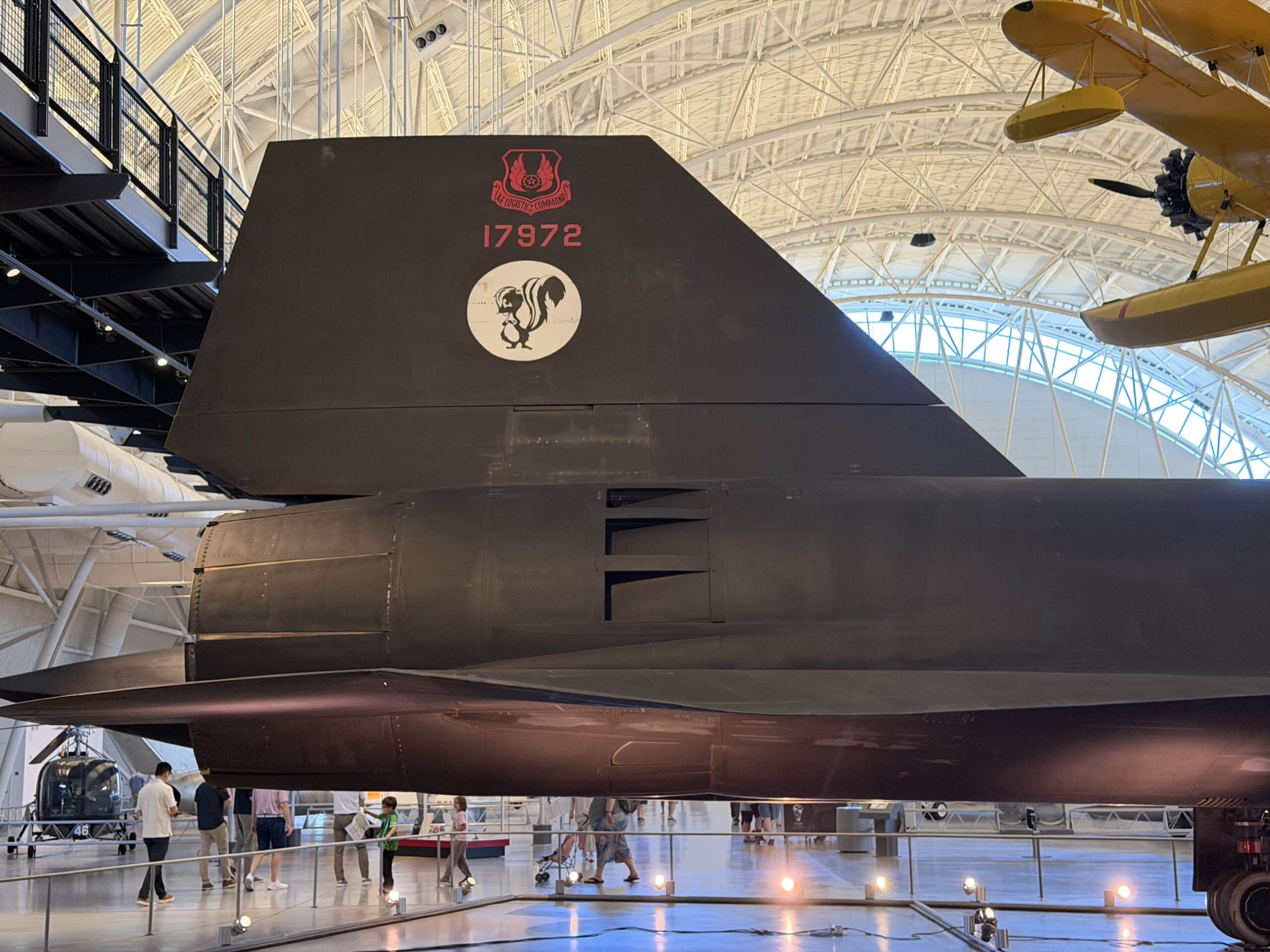
SR-71 Blackbird at the Smithsonian. 19FortyFive Image taken by Christian D. Orr.
On October 31, 1997, an SR-71 lifted off from Edwards Air Force Base, looking like no Blackbird before it. Riding its spine was a black hump the length of a school bus, and the jet famous for outrunning more than 4,000 missiles spent the flight loafing at Mach 1.2, a third of what it had touched over Libya a decade earlier. The mission was not reconnaissance.
In its final working years, the world’s fastest aircraft became a test rig for the rocket engine that was supposed to power the Space Shuttle’s replacement: the strangest chapter in the Blackbird’s life, and the one with the longest afterlife.
Space History: The Flying Wind Tunnel
The project was called LASRE, the Linear Aerospike SR-71 Experiment, and NASA’s own description of it was a “flying wind tunnel.” The pod on the Blackbird’s back held a half-span model of the X-33 at one-fifth scale, turned ninety degrees, and carrying eight thrust cells of a linear aerospike engine, all mounted on a housing engineers called the canoe.
The point was to learn, before the X-33 ever flew, how a rocket plume would interact with a lifting-body shape in real flight, the kind of aerodynamic question wind tunnels approximate and only flying can answer. Over seven research flights, the combination pushed out to Mach 1.8 while instruments mapped the airflow.
The engine itself was the exotic part. An aerospike has no bell nozzle; it fires its exhaust down the sides of a central ramp and lets the surrounding air act as the missing nozzle wall, which, in principle, keeps it efficient from sea level to the edge of space, where a fixed bell is only ever tuned for one altitude. The idea had been designed, ground-tested, and admired since the 1960s without once flying, and the X-33 was supposed to end that drought, with the SR-71 as its stepping stone.
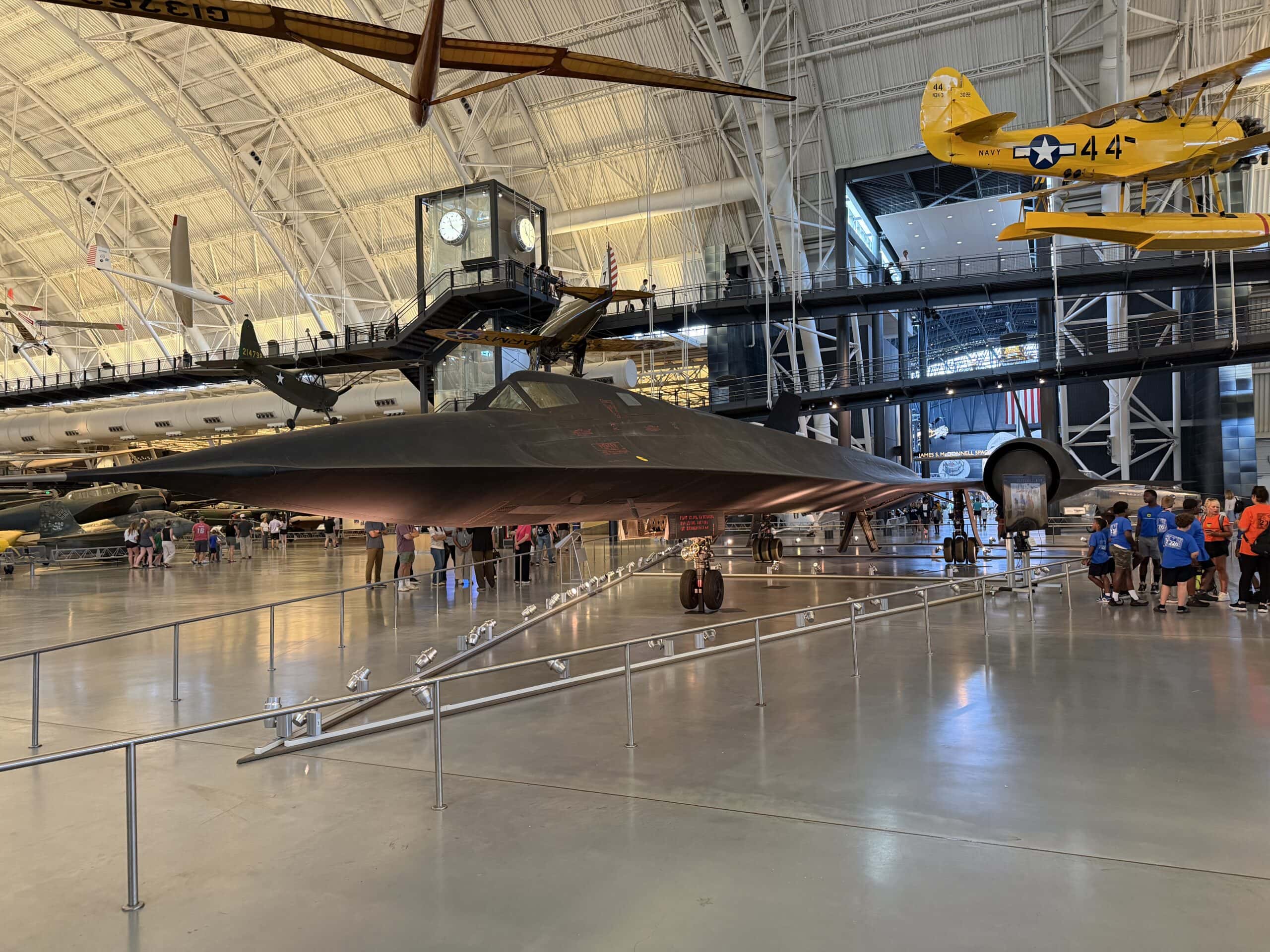
SR-71 Blackbird at the Smithsonian. 19FortyFive Image taken by Christian D. Orr.
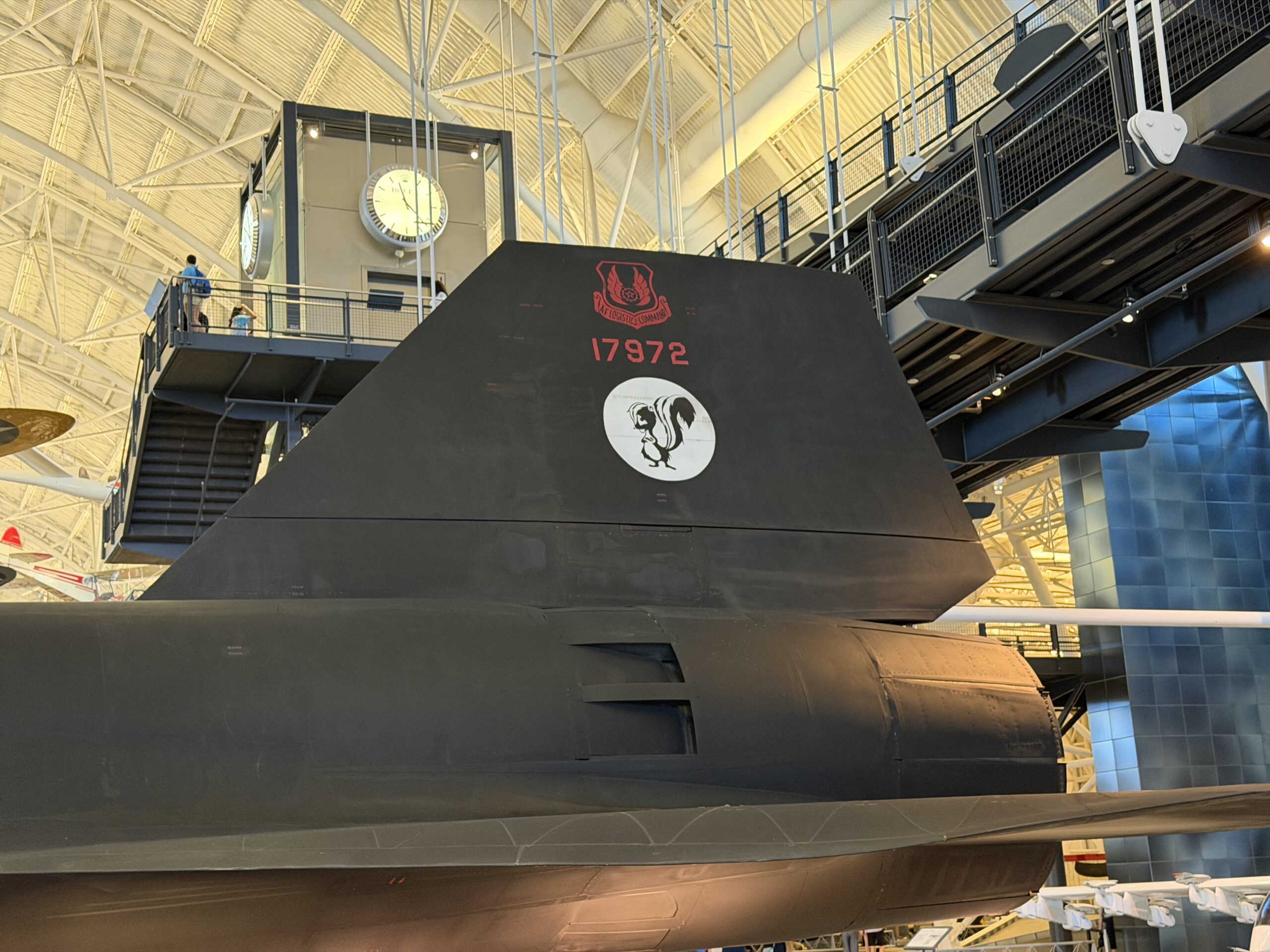
SR-71 Blackbird at the Smithsonian. 19FortyFive Image taken by Christian D. Orr.
The Hazard: A Rocket Riding a Crewed Jet
What LASRE asked of the Blackbird’s two-man crew deserves a moment of respect. The pod carried gaseous hydrogen and liquid oxygen, rocket propellants, on the back of a piloted jet, and the NASA technical report on the experiment’s safety systems reads like a bomb-disposal manual: oxygen monitors and hydrogen-sniffing algorithms, an inert gas purge for the pod, thermocouples watching for fire, even a water-misting system, all because a one-of-a-kind experiment “must be rated for piloted flight.” The caution was justified and, in the end, decisive.
Engineers hot-fired the engine twice on the ground, cycled helium, liquid nitrogen, and finally liquid oxygen through it in the air — and then scrubbed the in-flight firing altogether because of persistent liquid-oxygen leaks in the test apparatus. NASA concluded that the ground firings and airborne cryogenic flows were enough to predict the hot-gas effects, and flight operations ended in November 1998. The rocket that the Blackbird carried never lit in the air. The fastest aircraft in history flew its last research program, waiting for an ignition that never came.
The Spaceplane That Died Anyway
The X-33 followed its engine into the ground. The program was the centerpiece of NASA’s reusable-launch dream — administrator Dan Goldin’s pitch was to cut the cost of a pound to orbit from $10,000 to $1,000 — and it was meant to lead to VentureStar, a full-scale single-stage-to-orbit spaceplane with seven aerospikes, compared to the X-33’s two, replacing the Shuttle outright.
Then, in November 1999, the X-33’s composite liquid-hydrogen tank failed on the test stand, with the bitter engineering coda that the exotic multi-lobed tank’s joints had made it heavier than a plain aluminum one would have been.
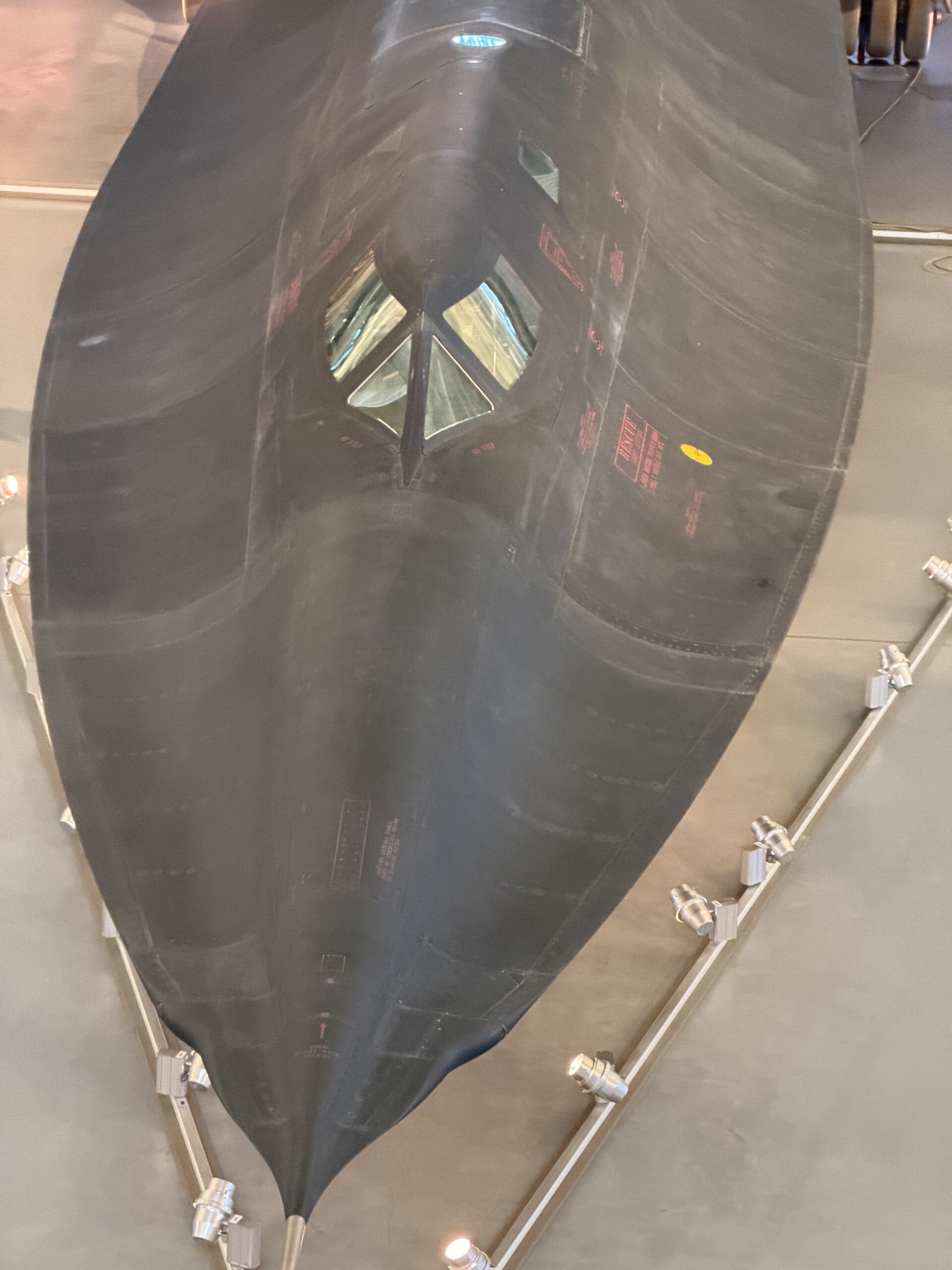
SR-71 Blackbird at the Smithsonian. 19FortyFive Image taken by Christian D. Orr.
On March 1, 2001, NASA declined to fund the program further, and the $1.3 billion effort ended ($912 million of it NASA’s, $357 million Lockheed Martin’s), with the prototype roughly 85 percent assembled, most parts delivered, and its Edwards launch facility standing complete. The Air Force reportedly tried more than once to adopt the vehicle and was refused. Four XRS-2200 aerospike engines had been built by then, and in a final irony, a twin-engine ground test ran successfully at Stennis Space Center in August 2001, months after the program was already dead. The engine outlived its own spaceplane on the test stand, then went to a museum display. So did the Blackbirds.
The Resurrection: Peenemünde, 2024
And there the story sat for a quarter century, the aerospike filled with the flying wing and the nuclear ramjet under ideas too elegant to die and too difficult to fly, terminated with the X-33 over cost and complexity. Then the startups arrived. On October 29, 2024, a five-meter, 240-kilogram-class demonstrator called MIRA II, built by the German company Polaris Spaceplanes, took off from Peenemünde, the Baltic airfield where the V-2 was born, flew out over the sea, and lit its linear aerospike in flight — by the company’s account, the first time that had ever been done: a three-second, roughly 900-newton burn on reduced propellant, after which the little aircraft came home and landed safely. One detail closes the circle. MIRA II’s onboard cameras caught a small leak in its liquid-oxygen tank bay on that historic flight, the exact gremlin that kept LASRE’s engine dark forever. Twenty-six years apart, the same problem; one program scrubbed, the other lit the engine and made history. The Germans have not slowed down since: 250 flights across seven demonstrators by late last year, and in January, the Bundeswehr contracted Polaris to build a hypersonic research vehicle around the same aerospike, the technology now a funded piece of European defense planning.
The honest caveats travel with the tale. A three-second burn on a 240-kilogram demonstrator is not the X-33’s 200,000-pound-thrust class, and the aerospike still has to prove the manufacturing, cooling, and weight case that killed it twice in the American system. The “first” belongs to a linear aerospike in flight, carefully worded, and it is the company’s claim, though the trade press has carried it without challenge. But the direction is not in dispute: the engine idea America carried on the back of its fastest jet, and then abandoned, is flying now, on someone else’s coastline, under someone else’s flag.
Which is a fitting last entry in the Blackbird’s ledger. The jet that could not be stopped by anything short of a nuclear airburst spent its final working years hauling the future around at half speed and never saw it ignite.
The future lit anyway — twenty-six years late, three seconds long, over the sea where rocketry began. Somewhere in a museum, an SR-71 sits a few steps from visitors who know it as the jet so fast it famously landed in California before it had taken off from Japan, and almost none of them know its last job was carrying a rocket that finally works.
About the Author: Harry J. Kazianis
Harry J. Kazianis (@Grecianformula) was the former Senior Director of National Security Affairs at the Center for the National Interest (CFTNI), a foreign policy think tank founded by Richard Nixon based in Washington, DC. Harry has over a decade of experience in think tanks and national security publishing. His ideas have been published in the NY Times, The Washington Post, The Wall Street Journal, CNN, and many other outlets worldwide. He has held positions at CSIS, the Heritage Foundation, the University of Nottingham, and several other institutions related to national security research and studies. He is the former Executive Editor of the National Interest and the Diplomat. He holds a Master’s degree focusing on international affairs from Harvard University.

