
This month, the Kremlin confirmed for the first time that it is in talks with Turkey over the fate of Ankara’s S-400 missile systems, the same weapons whose purchase got Turkey expelled from the F-35 program and sanctioned by Washington. That closing chapter is the right moment to tell the whole story, because the S-400’s two decades track the arc of Russian power itself: a system that was feared on reputation, bought as a geopolitical statement, punctured in combat over Ukraine, and now, possibly, traded away to undo the very rupture it caused.
The S-400 Has A History
The most consequential weapon Russia has sold in the twenty-first century has never shot down an American aircraft, never defended Moscow from a decisive attack, and spent the past four years being methodically hunted by drones. Yet the S-400 Triumf air defense system reordered alliances, triggered sanctions on three continents, ejected a NATO member from the West’s flagship fighter program, and became the single clearest symbol of what buying Russian meant in an American-led world. Now its story may be closing where it broke open: in Turkey. This July, at a NATO summit held in Ankara, President Trump said sanctions on Turkey would be lifted and, asked about readmitting the country to the F-35 program, answered, “Why wouldn’t we do that?”, while the Kremlin confirmed on the record, in spokesman Dmitry Peskov’s words a matter of extreme sensitivity, that Moscow and Ankara are discussing what becomes of Turkey’s S-400s. To understand why a surface-to-air missile system carries that much diplomatic weight, you have to go back twenty years.
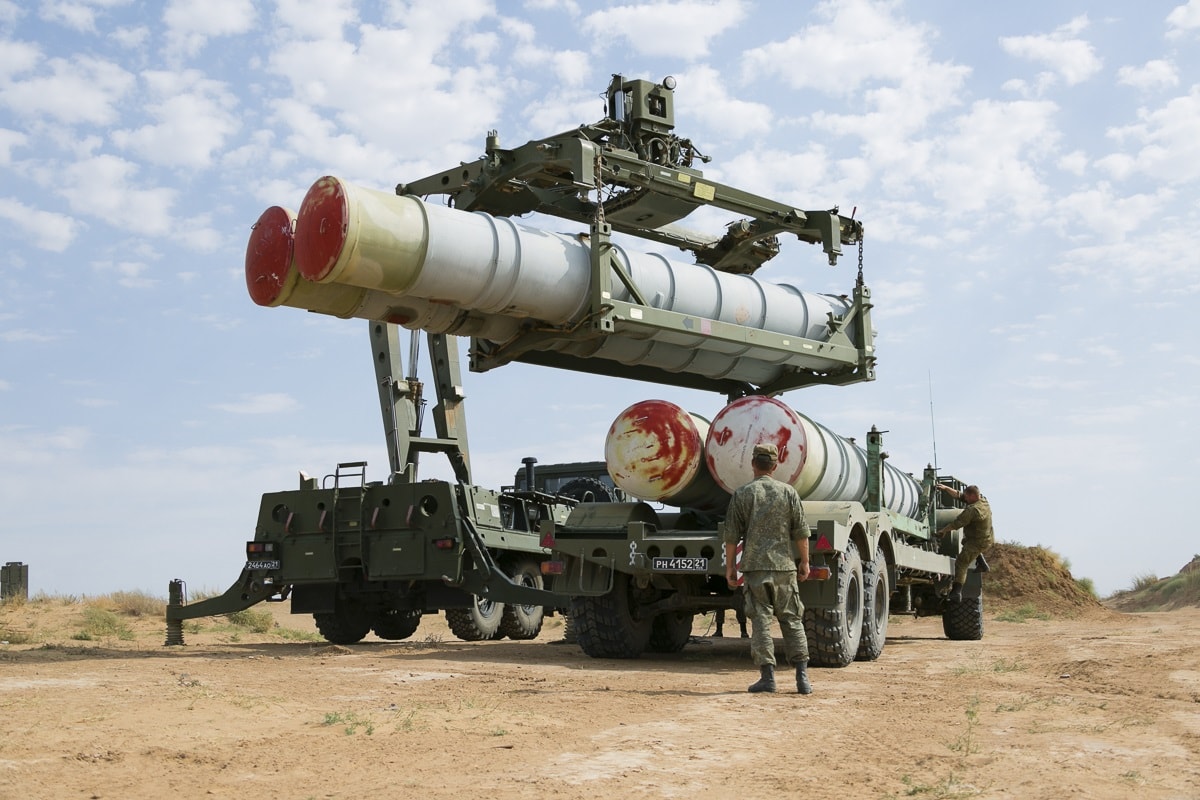
Russia’s S-400 Air Defense System. Image: Russian Military.
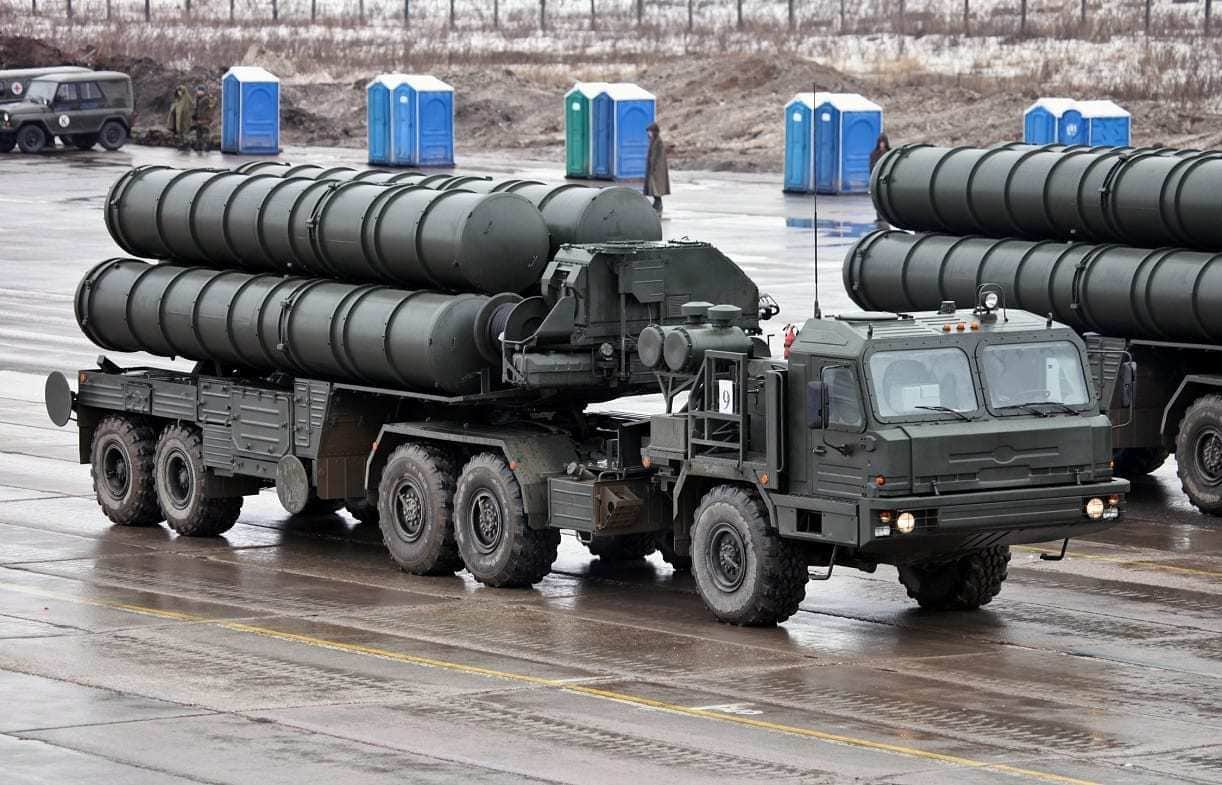
S-400. Image Credit: Creative Commons.
Act One: The Aura
The S-400 is the crown of the longest-running dynasty in air defense. Its designer, Almaz, built the S-25 rings that guarded Cold War Moscow, the S-75 that downed Gary Powers’ U-2 in 1960, and the S-300 family that became the Soviet standard. The S-400 began life in the 1990s as that family’s ultimate upgrade, known early on as the S-300PMU-3.
Approved for service in April 2007, with its first battalion on combat duty outside Moscow that August, it arrived with a set of claims that built its legend: radars tracking hundreds of targets at once, dozens engaged simultaneously, a layered family of interceptors topped by the 40N6 missile with a purported reach of 400 kilometers, and marketing that billed it as a threat to everything in Western inventories, stealth aircraft included. How much of that was demonstrated rather than asserted was always the open question, but deterrence runs on reputation, and the S-400’s reputation became formidable.
Its stage debut came in Syria. After Turkey shot down a Russian Su-24 in November 2015, Moscow deployed S-400s to its Khmeimim air base, instantly placing much of the eastern Mediterranean under a Russian air-defense umbrella and forcing every Western and Israeli planner to route around it. The Syrian record, though, was presence rather than combat: through years of Israeli strikes across Syria, the system produced no publicly confirmed intercepts of the aircraft attacking targets around it. As a weapon, it remained unproven. As an advertisement, it was priceless, and the customers began to line up.
Act Two: The Alliance-Breaker
What makes the S-400 historically singular is not its radar horizon but its geopolitical blast radius. Between 2014 and 2021, three of the largest militaries outside NATO’s core bought it, and each purchase detonated somewhere in Washington.
China came first, signing in 2014 as the system’s launch export customer and taking deliveries from 2018, for which the United States sanctioned China’s military procurement agency and its director under the new CAATSA law, the first use of that statute against an S-400 buyer. Beijing’s purchase, extending its coverage toward Taiwan and the East China Sea, was provocative but unsurprising between adversaries.
Turkey was the country affected by the earthquake. A NATO member since 1952, a manufacturing partner in the F-35 program with plans to buy around 100 of the jets, Ankara signed for the S-400 in December 2017 for roughly $2.5 billion, rejected repeated American offers of Patriot batteries instead, and took its first deliveries in July 2019.
The American response was without precedent inside the alliance: Turkey was expelled from the F-35 program that summer, and in December 2020, Washington sanctioned Turkey’s defense procurement agency under CAATSA, the first time the law had ever been used against a NATO ally. The stated logic, as the Observer Research Foundation summarized it, was that operating the Russian system alongside the F-35 would “endanger the security of US military technology and personnel” by letting the S-400’s radars gather data on the stealth fighter’s signature with Russian technicians nearby. Whatever the S-400 could or couldn’t shoot down, it had just done something no Russian weapon had managed in seventy years of Cold War and after: it split NATO’s second-largest army from the alliance’s most important program, without firing a shot.
India then walked the tightrope that Turkey fell from. New Delhi signed its own $5.43 billion deal for five S-400 regiments in October 2018, with Washington openly warning that the purchase could trigger the same sanctions, and Russia began deliveries anyway in late 2021, Indian analysts betting correctly that America’s need for India as a counterweight to China would keep the sanctions holstered. They never came. The same weapon that made Turkey an example made India an exception, which said less about the missile than about who Washington could afford to punish.
Act Three: The Reckoning
Then came the war that put the legend under fire. Ukraine has spent the past two years singling out the S-400 for destruction, and succeeding with weapons a fraction of its cost. In one February strike in occupied Crimea, Ukrainian special operations forces reported destroying an S-400 launcher, its 92N6E fire-control radar, and the Pantsir system guarding them, a battery Ukrainian officials value at roughly a billion dollars, taken apart by drones.
On the night of July 6 this year, Ukraine’s Unmanned Systems Forces claimed two more S-400 launchers in a single night, one in Russia’s Bryansk region and one hidden in a shelter in Crimea, part of a sustained campaign whose running tallies claim dozens of Russian air-defense systems and radars destroyed each season.
Those figures are Ukrainian claims, and Russia contests them, but the pattern is documented well beyond Kyiv’s own accounting: the system built to make airspace impenetrable has proven persistently killable by cheap drones and Western missiles that find its launchers, its radars, even its command posts.
Three honest qualifications keep the reckoning in proportion. First, Russia produces S-400 components at scale and steadily replaces lost launchers, which is why analysts note that attrition alone will not exhaust the system; the scarce, $60 million radars matter far more than the launch trucks. Second, the S-400 has spent much of the war doing a job its brochures never advertised, firing its missiles in a surface-to-surface role at Ukrainian ground targets, so the hunted system is also a shooter. And third, the aura has not died everywhere.
India says its S-400s fought their first battle in May 2025 against Pakistan, with the Indian Air Force chief publicly crediting the system with multiple kills including, per Indian reporting, a high-value surveillance aircraft downed at more than 300 kilometers, claims Pakistan disputes and no independent party has verified, Islamabad countering that it destroyed an S-400 site, which India rebutted with a prime-ministerial photo op at the intact battery. On the strength of its claimed performance, India took delivery of its fourth regiment weeks ago, expects the fifth by 2027 after years of war-driven slippage, and is reportedly moving to buy five more. The customer that risked sanctions for the S-400 is doubling its bet even as Ukraine burns the product, while Russia readies the S-500 as the dynasty’s next act.
The Frame Closes
Which returns the story to Ankara, where the endgame is being negotiated in public view this month. The sequence is extraordinary: Trump announced at the Ankara summit that the sanctions on Turkey would be lifted, American law requires that Turkey no longer possess the systems for that to happen, a government-connected Turkish columnist reported the S-400s sold to a Gulf state, with the announcement repeatedly expected and, as of this writing, never delivered, and the US ambassador told Bloomberg the whole issue could be resolved within four to six months, noting the systems sit in Turkey’s arsenal essentially unused.
Under the original contract, any transfer requires Moscow’s consent, and that consent is the last leverage Russia holds in a saga it once dominated. Nothing is consummated, and versions of this idea have died before. But the direction is unmistakable: the weapon Turkey bought in defiance of Washington, at the cost of the F-35 and its standing in the alliance, is now the asset Ankara appears ready to trade away to buy it all back.
What Twenty Years Adds Up To
Step back, and the S-400’s history reads like a biography of Russian power in miniature.
In its first act, it was feared largely on reputation, and the fear did real work, bending flight paths in Syria and commanding premium prices.
In its second, it was less a weapon than a statement, the purchase that announced a country’s willingness to defy Washington, and it broke more Western crockery than any Russian arms sale ever had.
In its third, actual combat arrived and delivered a split verdict: hunted relentlessly and killed repeatedly by a smaller neighbor’s drones, while its most important remaining customer credits it with victories and orders more.
And in what may be its final act in Turkey, it has become something no one predicted in 2007: a bargaining chip, valuable to Ankara chiefly as something to give up. Weapons usually earn their place in history by what they destroy.
The S-400 earned its place by what it fractured, and the measure of Russia’s changed position is that the fracture, twenty years on, is being repaired over Moscow’s head, with Moscow’s own missiles as the currency.
About the Author: Harry J. Kazianis
Harry J. Kazianis (@Grecianformula) was the former Senior Director of National Security Affairs at the Center for the National Interest (CFTNI), a foreign policy think tank founded by Richard Nixon based in Washington, DC. Harry has over a decade of experience in think tanks and national security publishing. His ideas have been published in the NY Times, The Washington Post, The Wall Street Journal, CNN, and many other outlets worldwide. He has held positions at CSIS, the Heritage Foundation, the University of Nottingham, and several other institutions related to national security research and studies. He is the former Executive Editor of the National Interest and the Diplomat. He holds a Master’s degree focusing on international affairs from Harvard University.

