
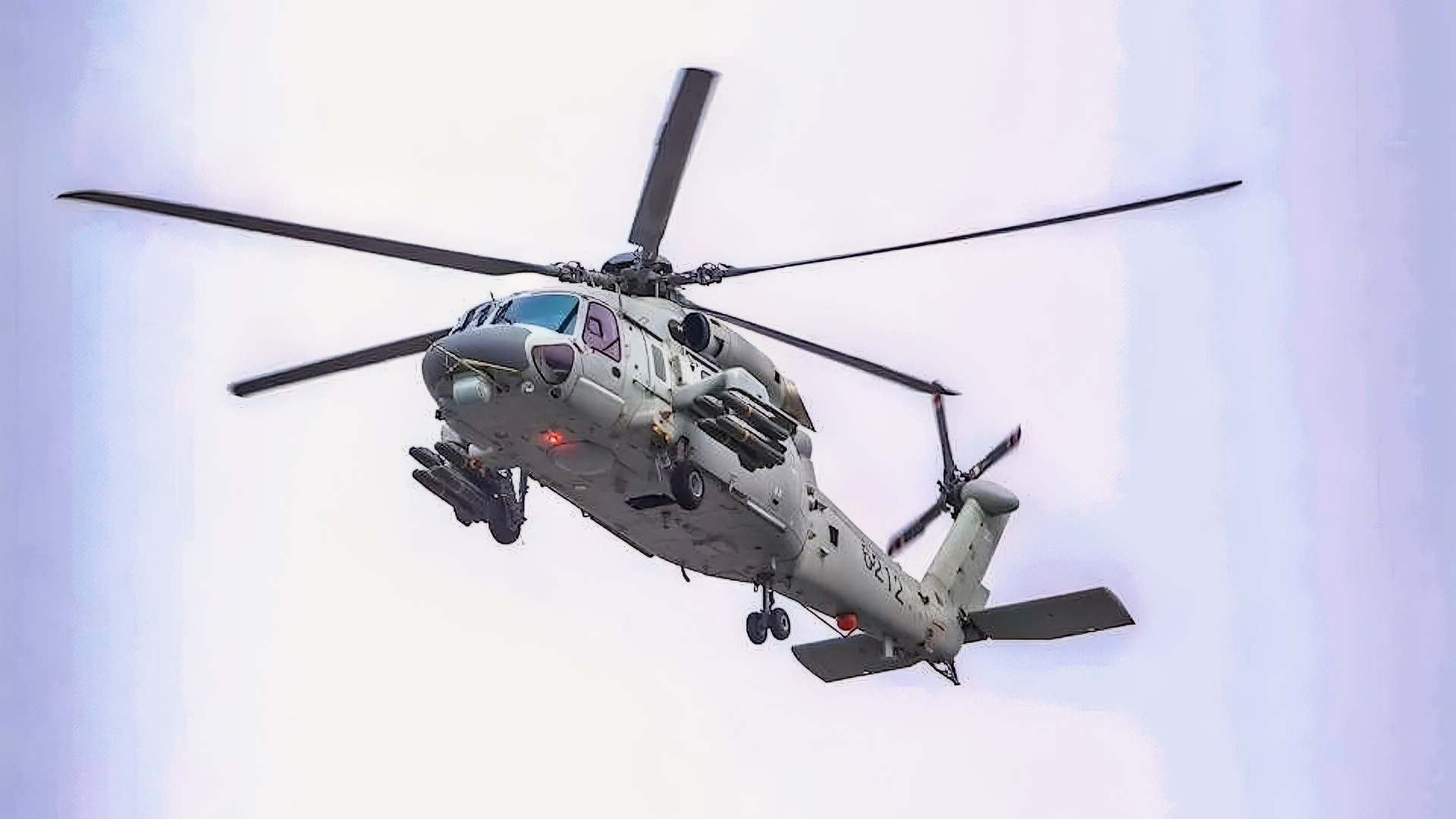
China’s Coast Guard has begun operating a naval version of the Z-20 medium-lift helicopter from the 165-meter Haijing 5901. Imagery released during a Malaysian maritime delegation’s 2025 visit showed the aircraft in Coast Guard colors taking off from the ship’s flight deck.
The helicopter’s configuration matters. Its naval tail-wheel position was visible, and the available photographs appeared to show a chin-mounted surface-search radar and an external fuel tank. More recent imagery has prompted claims that the aircraft is the Z-20F anti-submarine variant. Public evidence has not shown a dipping sonar, sonobuoy system, acoustic-processing station, or lightweight torpedoes.
China’s navy is developing the Z-20 family for several maritime missions. Reuters reported from the 2024 Zhuhai air show that the naval Z-20J was a step toward the dedicated Z-20F. The Pentagon has assessed that the Z-20F will provide a substantial anti-submarine improvement over China’s smaller Z-9 and imported Ka-28 helicopters.
The larger significance comes from the operator. China is expanding Coast Guard activity around Taiwan and integrating the service more closely with the People’s Liberation Army Navy. Taiwan recorded 55 Chinese government-vessel sightings around the island in June 2026, an 83 percent increase from May, including Coast Guard vessels with military-grade origins and capabilities.
Public Images Confirm a Coast Guard Z-20 but Leave Its ASW Fit Unclear
A maritime radar gives the Coast Guard a much larger search horizon than a cutter can obtain from its own bridge and mast sensors. The helicopter can examine distant ships, support boarding operations, move personnel and supplies, assist search-and-rescue missions, and maintain contact with vessels beyond the host ship’s line of sight.
Anti-submarine warfare requires another level of equipment and training. A dedicated helicopter normally needs acoustic sensors, sonobuoys or a dipping sonar, processors that can separate a submarine contact from background noise, secure data links, and crews trained to coordinate with ships and maritime-patrol aircraft. The Coast Guard aircraft seen publicly has not displayed that complete package.
The distinction matters because the Z-20F is central to China’s effort to expand airborne submarine hunting. A Coast Guard-specific Z-20 could share the same airframe, radar, endurance, and shipboard features without carrying every sensor or weapon fitted to the naval combat model.
China Is Trying to Close a Longstanding Undersea Gap
The Pentagon’s 2024 China military report says the Z-20F is intended for Type 055 cruisers, modified Type 052D destroyers, and newer Type 054 frigates. It compares the aircraft with the U.S. Navy’s SH-60 family and describes it as a major improvement over China’s older shipborne helicopters.
China is building the rest of the network around the aircraft. The navy operates Y-9 anti-submarine patrol aircraft, Z-18F helicopters, surface ships with hull and towed sonars, submarines, surveillance vessels, and growing numbers of unmanned systems. Beijing is also developing underwater drones and sensor networks rather than relying on one helicopter.
Industrial scale helps. China can modify new destroyers and frigates with larger hangars, build additional aviation-capable cutters, and produce helicopters while replacing older platforms. Its much larger shipbuilding base gives Beijing a path to field more sensor carriers across the First Island Chain even when individual systems remain less capable than their American equivalents.
The China Coast Guard Gives Beijing Another Maritime Sensor Layer
The Coast Guard has not operated as a conventional civilian agency since its transfer to the People’s Armed Police under Central Military Commission authority. The Pentagon’s 2025 assessment describes it as China’s front-line force for enforcing maritime claims, with the navy providing overwatch and an option for rapid military support.
The relationship extends into personnel and training. A U.S. Naval War College study of China’s maritime forces found that many naval officers have transferred into senior Coast Guard positions and that the navy has supported Coast Guard training and evaluation. China has also included Coast Guard units in major exercises around Taiwan.
A naval Z-20 can strengthen that integration without firing a weapon. Coast Guard crews can conduct surveillance, build experience operating from large cutters, collect environmental and traffic data, and pass surface tracks into a wider Chinese command network. During a crisis, helicopters and cutters could help monitor shipping, identify contacts, support a quarantine, and free naval aircraft for more demanding combat missions.
If the Coast Guard later receives acoustic sensors, its cutters could become additional launch points for limited anti-submarine searches. That would widen the number of platforms available to investigate a suspected contact and complicate planning for U.S. and allied submarines. The exact command relationship, data-sharing architecture, and wartime mission remain unknown.
China Still Faces a Difficult Anti-Submarine Warfare Problem
Submarine hunting remains one of the hardest military tasks. Water temperature, depth, seabed conditions, commercial traffic, biological noise, weather, and the submarine’s own tactics all affect detection. A helicopter has limited time on station and can search only a small portion of a large sea unless ships, fixed sensors, patrol aircraft, and other helicopters help narrow the area.
China also needs secure communications and commanders able to combine incomplete reports from many units. A surface-search radar can find ships and support maritime patrol, but it cannot replace acoustic sensors against a deeply submerged submarine. Airborne anti-submarine aircraft also need enough air control to operate safely during a conflict.
The United States has its own limitations, including reduced carrier-based fixed-wing anti-submarine capacity, but its submarines benefit from decades of operational practice, quieting technology, advanced weapons, and access to allied waters. China can raise the risk without making the surrounding seas transparent.
U.S. Submarines Remain China’s Hardest Pacific Target
American attack submarines are especially important in a Taiwan contingency because Chinese missiles place surface ships and large air bases under heavy pressure. Submarines can operate with less dependence on fixed infrastructure and threaten amphibious ships, escorts, logistics vessels, and other naval forces supporting an invasion or blockade.
A 2026 CSIS assessment concluded that China still has serious difficulty finding U.S. submarines. Earlier CSIS war games repeatedly found American submarines inflicting heavy losses on Chinese amphibious and escort forces. That undersea advantage is also why the shrinking American attack-submarine fleet has become a major planning concern.
Beijing does not have to eliminate the U.S. advantage completely. A larger anti-submarine network can force submarines to move more cautiously, spend time evading search patterns, launch from less favorable positions, or accept greater risk near Chinese forces. China’s own expanding nuclear-submarine program adds another demand on American and allied undersea forces.
The United States is responding through Virginia-class submarines, unmanned systems, Japanese and South Korean anti-submarine forces, and AUKUS cooperation with Australia and Britain.
China Has Not Yet Demonstrated a Coast Guard Z-20F
The Coast Guard Z-20 already gives China a larger shipborne surveillance aircraft. A confirmed anti-submarine role would require public evidence of dipping sonar, sonobuoy equipment, acoustic workstations, torpedoes, or exercises in which Coast Guard helicopters exchange submarine tracks with naval units.
As of July 23, the confirmed capability is a naval Z-20 operating from China’s largest Coast Guard cutter with equipment suited to maritime search. The full Z-20F anti-submarine configuration has not been demonstrated in Coast Guard service. The aircraft still shows how quickly China is connecting its law-enforcement fleet to the military system that would support a blockade or conflict around Taiwan.
About the Author: Harry J. Kazianis
Harry J. Kazianis (@Grecianformula) was the former Senior Director of National Security Affairs at the Center for the National Interest (CFTNI), a foreign policy think tank founded by Richard Nixon based in Washington, DC. Harry has over a decade of experience in think tanks and national security publishing. His ideas have been published in the NY Times, The Washington Post, The Wall Street Journal, CNN, and many other outlets worldwide. He has held positions at CSIS, the Heritage Foundation, the University of Nottingham, and several other institutions related to national security research and studies. He is the former Executive Editor of the National Interest and the Diplomat. He holds a Master’s degree focusing on international affairs from Harvard University.

