
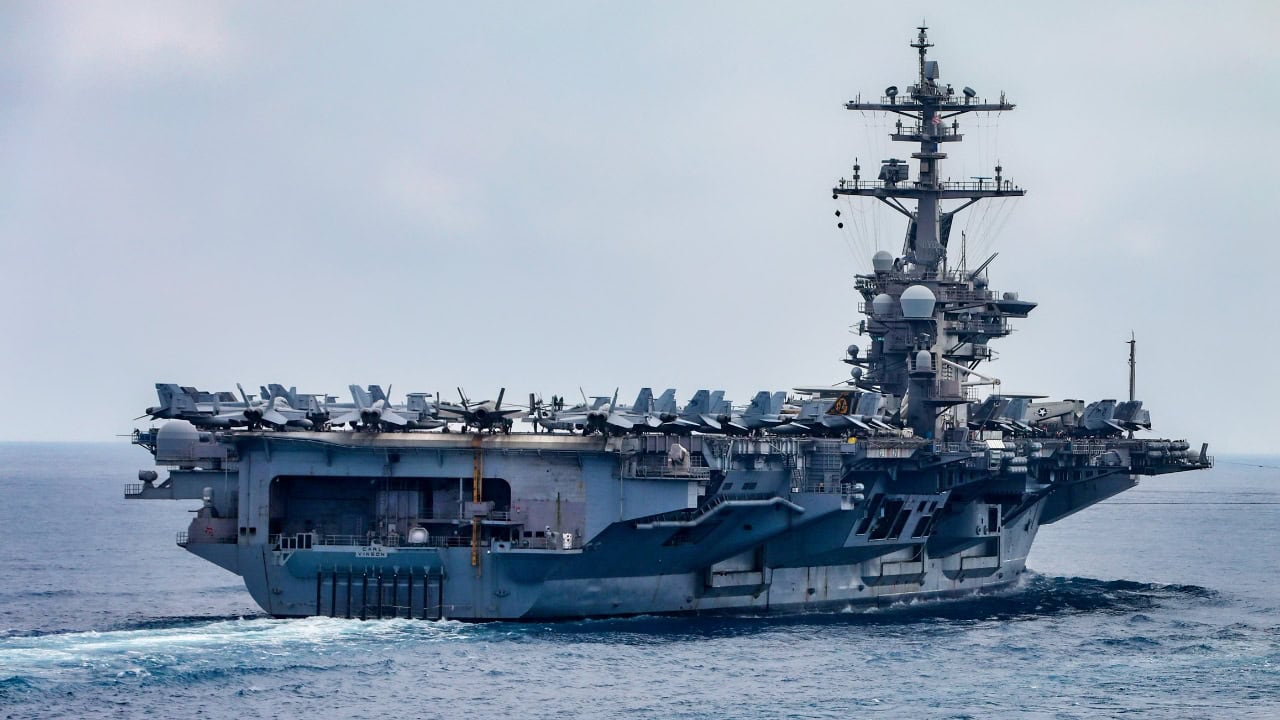
USS Carl Vinson Has Fought From Afghanistan to Yemen. The Pacific Is Why It Still Matters: USS Carl Vinson entered 2026 as a 44-year-old aircraft carrier with a fresh combat record and another maintenance period behind it. The ship completed a Planned Incremental Availability on June 12 after sailors and civilian workers logged more than 359,000 maintenance hours. Weeks earlier, the Navy named Vinson the winner of the 2025 aircraft carrier Battle Effectiveness award.
Commissioned on March 13, 1982, Carl Vinson is the third Nimitz-class carrier. The ship is homeported in San Diego, carries more than 60 aircraft with its air wing aboard and remains one of 11 operational U.S. carriers. Its official design life is 50 years, placing the nominal end of service around 2032.

Nimitz-class aircraft carrier USS Carl Vinson (CVN 70) transits the Bay of Bengal as part of Maritime Partnership Exercise (MPX), Oct. 16, 2021. MPX 2021 is a multilateral maritime exercise between the Royal Australian Navy, Japan Maritime Self-Defense Force, U.K. Royal Navy, and U.S. maritime forces, focused on naval cooperation, interoperability and regional security and stability in the Indo-Pacific and is an example of the enduring partnership between Australian, Japanese, U.K. and U.S. maritime forces, who routinely operate together in the Indo-Pacific, fostering a cooperative approach toward regional security and stability. (U.S. Navy photo by Mass Communication Specialist 2nd Class Russell Lindsey)
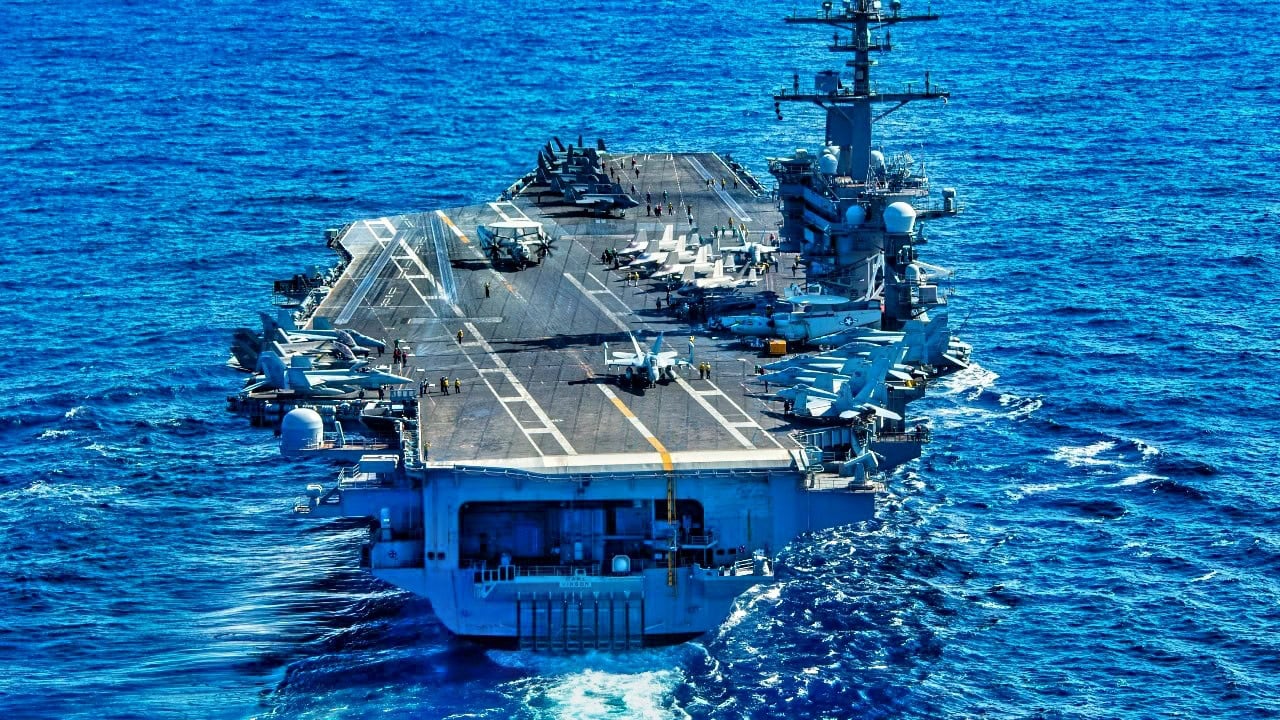
The Nimitz-class aircraft carrier USS Carl Vinson (CVN 70) transits the Philippine Sea with six additional F-35C Lightning II aircraft assigned to the “Argonauts” of Strike Fighter Squadron (VFA) 147, part of Carrier Air Wing FIVE, Dec. 13, 2024. VFA-147 operates from Marine Corps Air Station Iwakuni, Japan. U.S. Indo-Pacific Command forces perform operations in and around critical sea passages and trade thoroughfares to deter threats that create regional instability and impinge on the free flow of goods, people, and ideas. (U.S. Navy photo by Mass Communication Specialist Seaman Apprentice Pablo Chavez)
The carrier’s first major deployment began in 1983 with an around-the-world voyage to its new homeport at Alameda, California. During the Cold War, Vinson operated across the Pacific and Indian Ocean, entered the Bering Sea during winter operations and joined PACEX 89, one of the largest American fleet exercises since World War II, according to an official squadron history.
After the Soviet Union collapsed, the mission changed. Vinson supported Operation Southern Watch and Desert Strike in the mid-1990s, then Operation Desert Fox in 1998. The carrier moved from Cold War deterrence to enforcing no-fly zones and launching strikes against Iraqi targets.
USS Carl Vinson Opened the Afghanistan Air War
Carl Vinson was already deployed when al-Qaeda attacked the United States on Sept. 11, 2001. On Oct. 7, aircraft from Vinson and USS Enterprise launched the opening carrier strikes of Operation Enduring Freedom against Taliban and al-Qaeda targets in Afghanistan. The operation placed Vinson inside the Nimitz class’s long combat record.
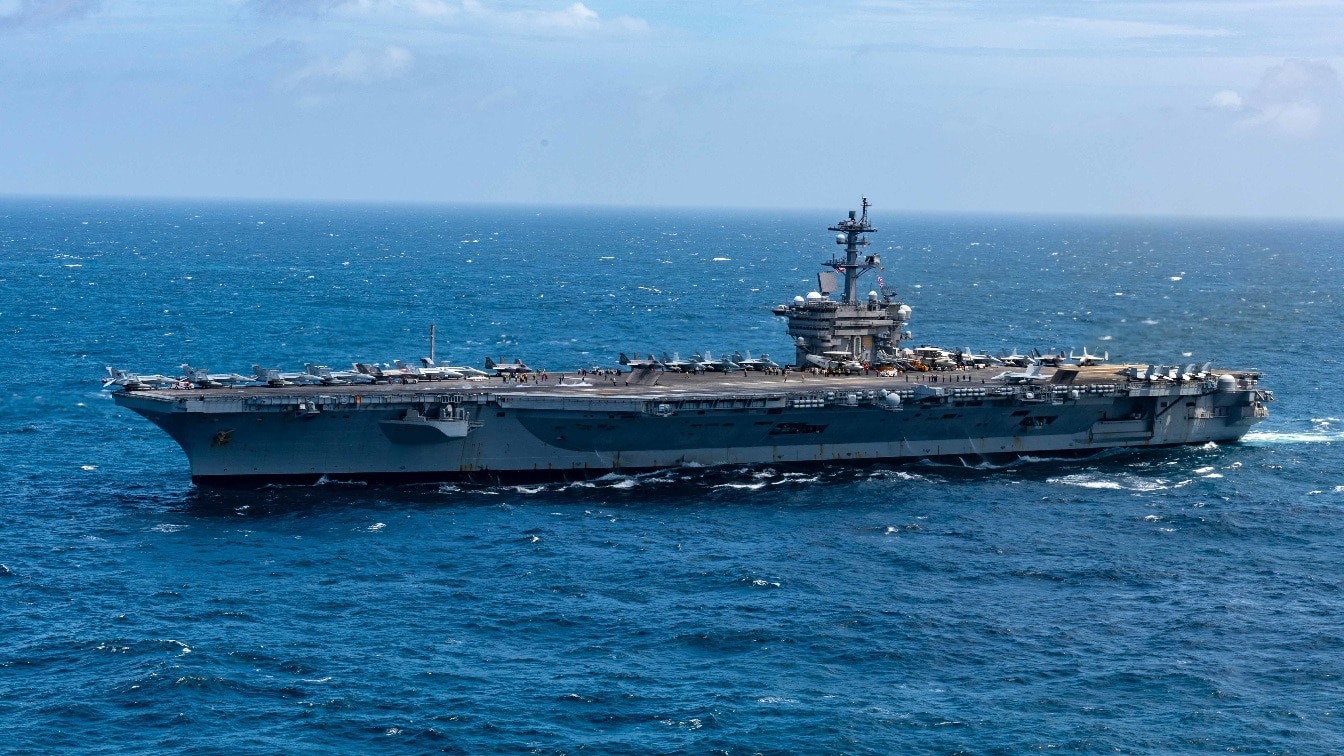
(Oct. 17, 2021) Nimitz-class aircraft carrier USS Carl Vinson (CVN 70) transits the Bay of Bengal as part of Maritime Partnership Exercise (MPX), Oct. 16, 2021. MPX 2021 is a multilateral maritime exercise between the Royal Australian Navy, Japan Maritime Self-Defense Force, U.K. Royal Navy, and U.S. maritime forces, focused on naval cooperation, interoperability and regional security and stability in the Indo-Pacific and is an example of the enduring partnership between Australian, Japanese, U.K. and U.S. maritime forces, who routinely operate together in the Indo-Pacific, fostering a cooperative approach toward regional security and stability. (U.S. Navy photo by Mass Communication Specialist 2nd Class Russell Lindsey)
Vinson returned to the region repeatedly. During a 2011 deployment, the ship and Carrier Air Wing 17 flew 1,656 combat sorties in support of Operations Enduring Freedom and New Dawn. The carrier returned again in early 2012 for another round of missions over Afghanistan.
The ship also became part of one of the most unusual episodes in modern naval history. On May 2, 2011, Osama bin Laden received a burial at sea from Carl Vinson in the North Arabian Sea after U.S. special operations forces killed him in Pakistan.
Haiti and the ISIS War Showed the Carrier’s Range
After Haiti’s January 2010 earthquake, helicopters operating from Carl Vinson moved relief supplies and evacuated injured people. One embarked squadron delivered more than 280,000 pounds of aid and completed 240 medical evacuations.
Four years later, Vinson returned to sustained wartime operations. From late 2014 into April 2015, Carrier Air Wing 17 flew 12,300 sorties, including 2,383 combat missions over Iraq and Syria during Operation Inherent Resolve. The air wing dropped 869 precision-guided weapons against ISIS targets.
USS Carl Vinson Introduced the F-35C Carrier Air Wing
Vinson underwent its midlife nuclear refueling and complex overhaul from 2005 through 2009.
Later modernization turned an early-1980s carrier into the Navy’s first operational home for a fifth-generation carrier air wing.
During the 2021-2022 Indo-Pacific deployment, Vinson became the first carrier to complete an operational cruise with the F-35C Lightning II and the CMV-22B Osprey. The air wing combined carrier-based stealth fighters, Super Hornets, EA-18G Growlers, E-2D Hawkeyes and helicopters.
The deployment mattered because China’s missile force has made carrier operations near the First Island Chain more demanding.
Vinson proved an older Nimitz-class hull remained compatible with the Navy’s newest carrier aircraft in the South China Sea and Philippine Sea.
USS Carl Vinson Returned to Combat Against the Houthis
Carl Vinson departed San Diego in November 2024 for a deployment centered first on the Indo-Pacific.
The strike group trained with French and Japanese forces during Pacific Steller 2025 and joined American and South Korean aircraft during Freedom Shield.
The Navy then sent the carrier to the Middle East. Vinson aircraft struck Iran-backed Houthi targets in Yemen during Operation Rough Rider.
Across the nine-month deployment, the strike group completed more than 10,000 sorties, logged 23,000 flight hours, conducted 45 replenishments at sea and sailed more than 275,000 nautical miles.
Why USS Carl Vinson Matters in 2026
Vinson matters because the Navy has little spare carrier capacity. USS Nimitz is entering retirement, USS Dwight D. Eisenhower is scheduled to follow in 2030 and Ford-class construction continues to run late.
The United States has the world’s largest carrier force, yet global demand and maintenance cycles leave fewer deployable decks than the headline total suggests.
The ship also brings more than a hull. Carl Vinson carries a trained crew, a modern air wing, escorts, logistics support and decades of operational practice. Those elements take years to build and are difficult to replace when a carrier sits in extended maintenance.
The June 2026 availability repaired and upgraded systems throughout the ship. Vinson returned to sea for local operations in July before coming back to San Diego.
On a flight deck commissioned during the Reagan administration, sailors were again testing arresting gear, running drills, and preparing aircraft for the next assignment.
More – China’s J-20 Stealth Fighter Could Take on the F-22 and F-35
About the Author: Harry J. Kazianis
Harry J. Kazianis (@Grecianformula) was the former Senior Director of National Security Affairs at the Center for the National Interest, a foreign policy think tank founded by Richard Nixon in Washington, D.C. Harry has more than a decade of experience in think tanks and national security publishing. His ideas have been published in The New York Times, The Washington Post, The Wall Street Journal, CNN and many other outlets worldwide. He has held positions at CSIS, the Heritage Foundation, the University of Nottingham and several other institutions related to national security research and studies. He is the former Executive Editor of The National Interest and The Diplomat. He holds a master’s degree focusing on international affairs from Harvard University.

