
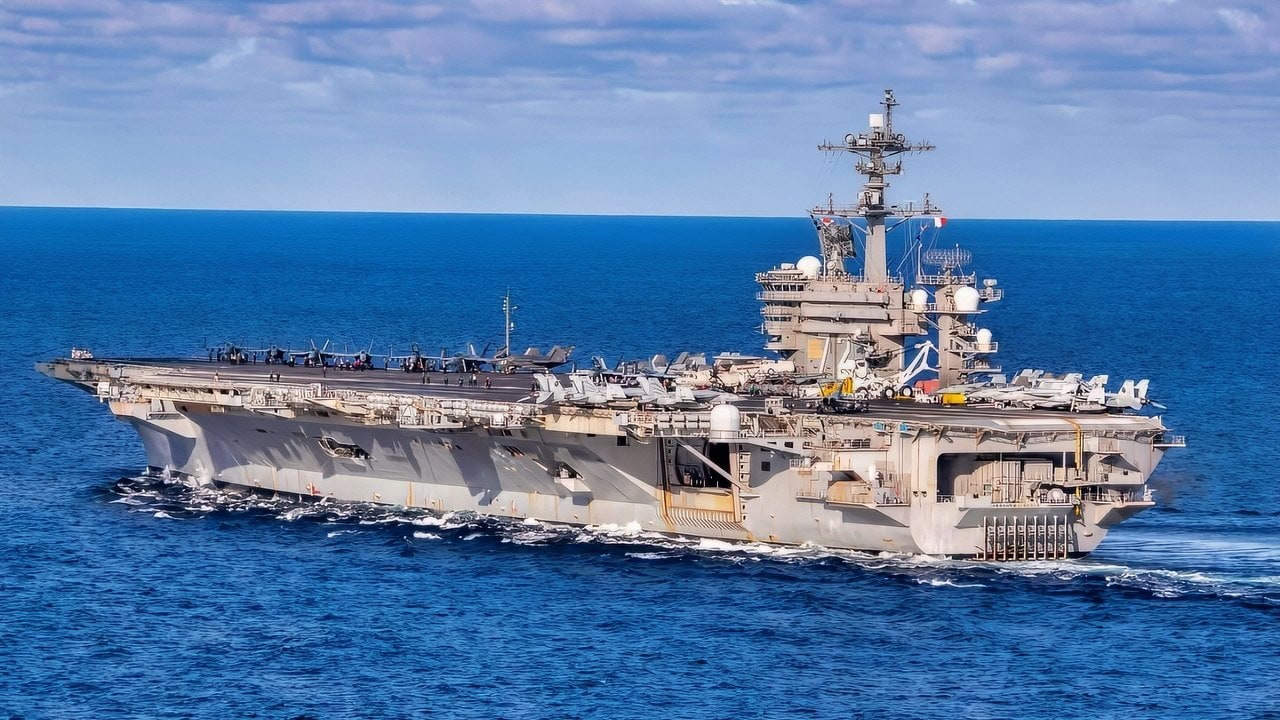
The Navy’s Next Three Ford-Class Aircraft Carriers Are Delayed Into 2027, 2031, and 2034: The U.S. Navy’s next three Ford-class aircraft carriers are all behind schedule. Under the latest budget timetable, the future USS John F. Kennedy is due in March 2027, the future USS Enterprise in March 2031, and the future USS Doris Miller in February 2034. The delays have become a fleet problem because every American nuclear carrier is assembled at Newport News Shipbuilding.
Kennedy completed builder’s sea trials on February 4, 2026, but Naval Sea Systems Command said the timing of acceptance trials remained under review. The Navy moved delivery from July 2025 to March 2027 to finish certification of the Advanced Arresting Gear and continue work on the ship’s Advanced Weapons Elevators, according to its fiscal 2026 shipbuilding request.
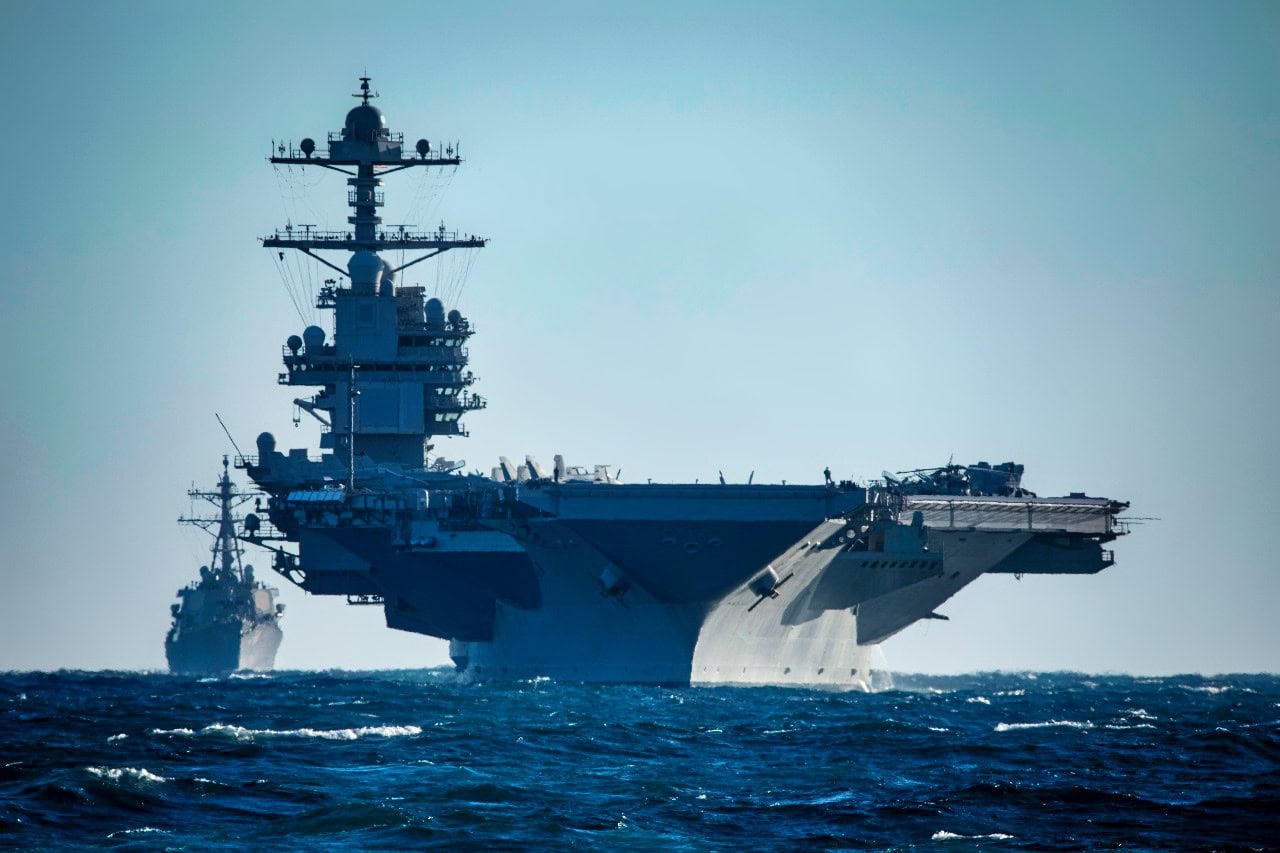
A view from the Ticonderoga-class guided missile cruiser USS Normandy (CG 60) of the first-in-class aircraft carrier USS Gerald R. Ford (CVN 78) and the Arleigh Burke-class guided missile destroyers USS Thomas Hudner (DDG 116), USS Ramage (DDG 61) and USS McFaul (DDG 74) as the ships steam in formation during a drill while underway as part of the Gerald R. Ford Carrier Strike Group March 5, 2023. Ford Carrier Strike Group is underway in the Atlantic Ocean executing its Composite Training Unit Exercise (COMPTUEX), an intense, multi-week exercise designed to fully integrate a carrier strike group as a cohesive, multi-mission fighting force and to test their ability to carry out sustained combat operations from the sea. As the first-in-class ship of Ford-class aircraft carriers, CVN 78 represents a generational leap in the U.S. Navy’s capacity to project power on a global scale. (U.S. Navy photo by Mass Communication Specialist 2nd Class Malachi Lakey)
Enterprise has a different immediate problem. Its delivery moved from July 2030 to March 2031 after critical-path work needed for launch fell behind. Newport News said large, sequence-sensitive pieces of equipment arrived late, disrupting the structural build in dry dock and forcing workers to complete tasks outside the preferred order.
The Enterprise delay then reached Doris Miller. The Navy moved that carrier from February 2032 to February 2034 because the yard lacked enough construction space to build its modules. Enterprise remained in the final assembly area served by the heavy-lift crane, preventing Doris Miller’s large units from moving through the yard as planned.
John F. Kennedy Is Still Paying for Ford-Class Technology Concurrency
The Ford class introduced electromagnetic catapults, new arresting gear, electromagnetic weapons elevators, a redesigned nuclear plant, new radars, and a more automated flight deck. The lead ship carried the development risk, but Kennedy did not escape it. Its delay is tied directly to two systems behind years of construction and certification work aboard Gerald R. Ford.
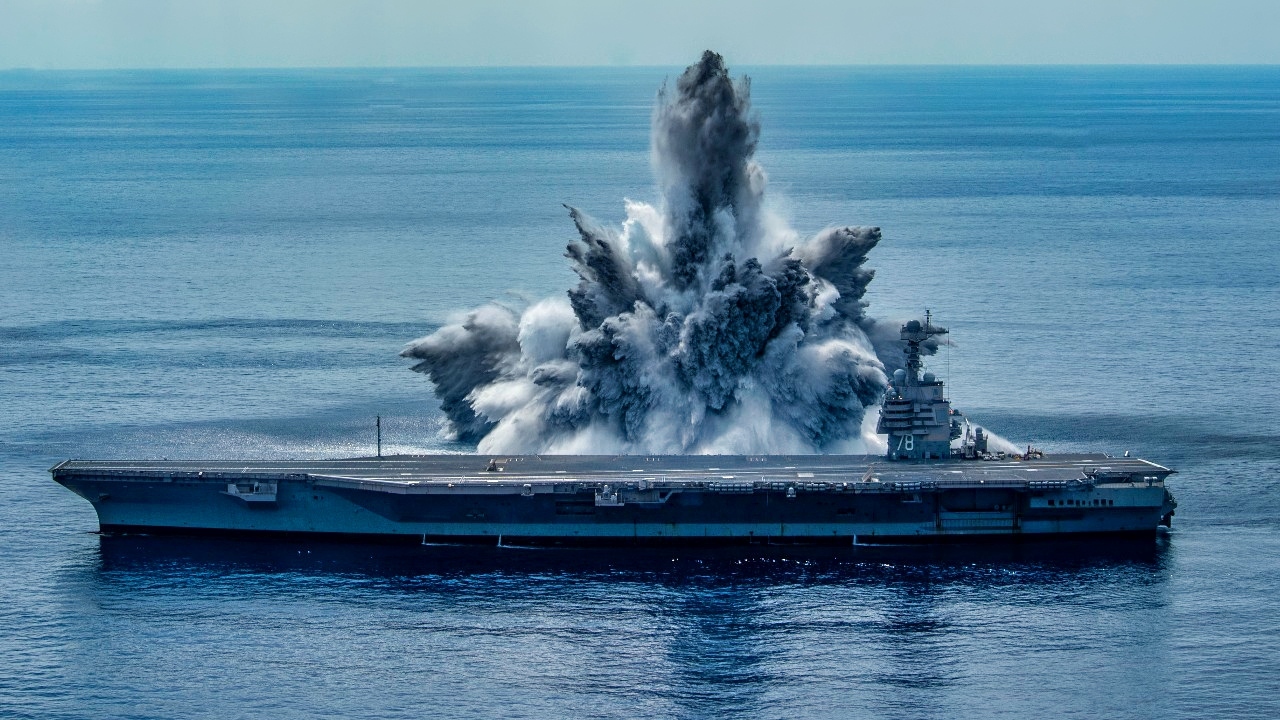
The aircraft carrier USS Gerald R. Ford (CVN 78) successfully completes the third and final scheduled explosive event of Full Ship Shock Trials while underway in the Atlantic Ocean, Aug. 8, 2021. The U.S. Navy conducts shock trials of new ship designs using live explosives to confirm that our warships can continue to meet demanding mission requirements under harsh conditions they might encounter in battle. (U.S. Navy photo by Mass Communication Specialist 3rd Class Novalee Manzella)
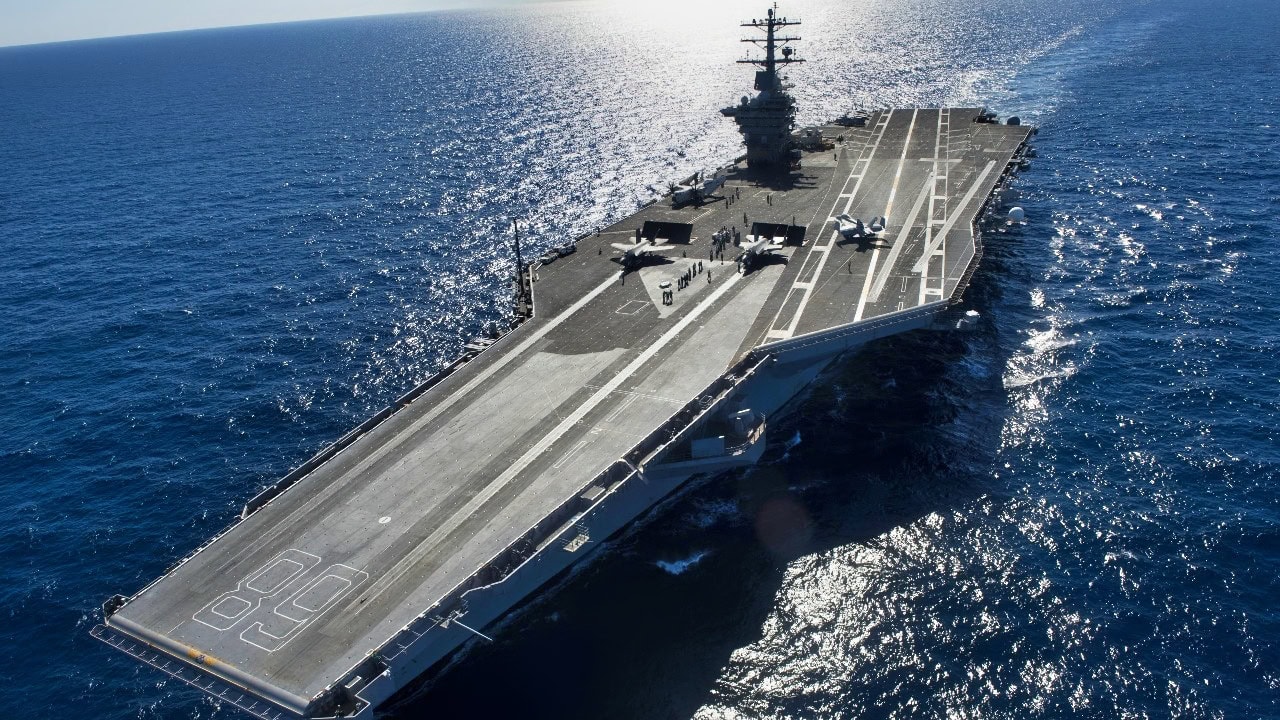
Ford-Class. Image Credit: Creative Commons.
The delivery plan changed while Kennedy was under construction. The Navy once intended to accept the carrier in two phases and install some combat capabilities later. Congress required the carrier to gain F-35C capability before completing its post-shakedown availability, and the service moved to a single-phase delivery. That removed the schedule margin. GAO found that Kennedy’s costs had risen by $1.3 billion by 2021, with an additional $200 million added later due to schedule and program changes.
Enterprise Turned a Supply Delay Into a Shipyard Bottleneck
Aircraft carriers are built from enormous pre-outfitted sections that must arrive in sequence. Missing equipment low in the hull blocks work above it. Continuing around the gap creates rework and crowded work zones. Enterprise reached 50 percent structural erection only after the remaining major components arrived, leaving the schedule vulnerable to a narrow set of suppliers.
The deeper constraint is physical. Newport News is the country’s only nuclear-carrier builder, and no second yard holds an equivalent dry dock, heavy-lift crane, trained nuclear workforce, and supplier network. GAO found that all 37 battle-force ships it examined that were under construction in September 2024 were delayed. The broader carrier construction problem is set within an industrial base constrained by workforce and infrastructure.
HII hired more than 6,600 shipbuilders in 2025, reported a 14 percent increase in throughput, and set a further 15 percent target for 2026. It is also sending more work to outside suppliers. Those improvements do not create another final assembly area. When Enterprise occupies the critical footprint longer, Doris Miller waits behind it.
The Navy Has Too Few Aircraft Carriers to Absorb Repeated Delays
Federal law requires at least 11 operational aircraft carriers. That number includes ships in training, maintenance, and lengthy midlife refueling overhauls, leaving far fewer available for deployment at any moment. A late replacement reduces the Navy’s ability to rotate carriers without stretching crews, maintenance schedules, and air wings.
The Navy extended USS Nimitz by 10 months, through March 2027, to align its departure with Kennedy’s expected delivery. Nimitz reached Norfolk on July 9 and is serving as a training carrier rather than a ship certified for national tasking. The extension keeps Nimitz in the 11-carrier inventory, but it does not provide the same deployable capacity as a new Ford-class carrier.
The longer problem appears in the Navy’s May 2026 shipbuilding plan. It projects the carrier inventory to fall to 10 in fiscal 2030, one year before Enterprise arrives, and again to 10 in fiscal 2033, before Doris Miller arrives. The Navy says it will consider extending older carriers, lengthening service after midlife refueling, or accelerating new construction to stay at 11. That places greater pressure on aging Nimitz-class hulls nearing the end of their planned service lives.
Accelerating CVN-82 Does Not Fix the Immediate Gap
The Navy moved procurement of CVN-82 forward from fiscal 2030 to fiscal 2029 and plans billions in advance funding for CVN-82 and CVN-83. Stable orders protect suppliers and preserve specialized labor, but a carrier authorized near the end of this decade will not solve a shortage at the start of the 2030s. The shipyard bottleneck remains in Newport News.
John F. Kennedy is the nearest relief. It has been to sea once, and work continues on issues found during builder’s trials. NAVSEA has not published the date for acceptance trials, while the budget still schedules delivery for March 2027.
MORE – The B-21 Raider Might Have a Flaw China Fixed
About the Author: Harry J. Kazianis
Harry J. Kazianis (@Grecianformula) was the former Senior Director of National Security Affairs at the Center for the National Interest (CFTNI), a foreign policy think tank founded by Richard Nixon based in Washington, DC. Harry has over a decade of experience in think tanks and national security publishing. His ideas have been published in the NY Times, The Washington Post, The Wall Street Journal, CNN, and many other outlets worldwide. He has held positions at CSIS, the Heritage Foundation, the University of Nottingham, and several other institutions related to national security research and studies. He is the former Executive Editor of the National Interest and the Diplomat. He holds a Master’s degree focusing on international affairs from Harvard University.

