
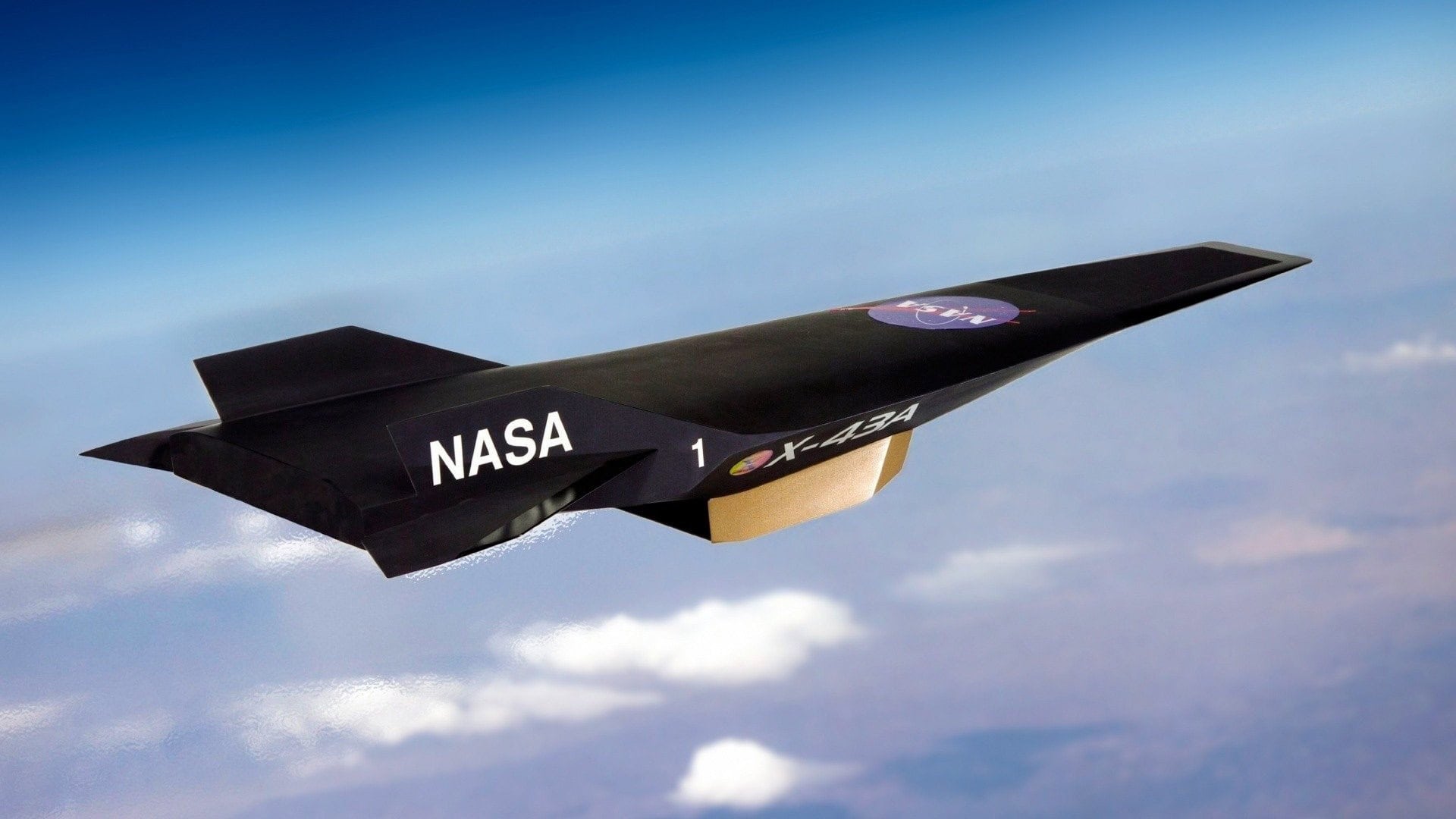
NASA’s X-43A Reached Mach 9.6. The Planned X-43 Follow-Ons Never Flew: On November 16, 2004, a 12-foot NASA research aircraft separated from a rocket booster at almost Mach 10 and roughly 109,000 feet over the Pacific Ocean. Its hydrogen-fueled scramjet burned for about 10 seconds, holding the vehicle near Mach 9.68. The X-43A entered the record books as the fastest aircraft powered by an air-breathing engine.
The X-43A often appears in accounts of American military hypersonics, but it was not an Air Force weapon prototype. NASA ran the Hyper-X program as an aeronautical research effort. Hypersonic missiles, military aircraft, and lower-cost space launch vehicles stood among the possible beneficiaries.
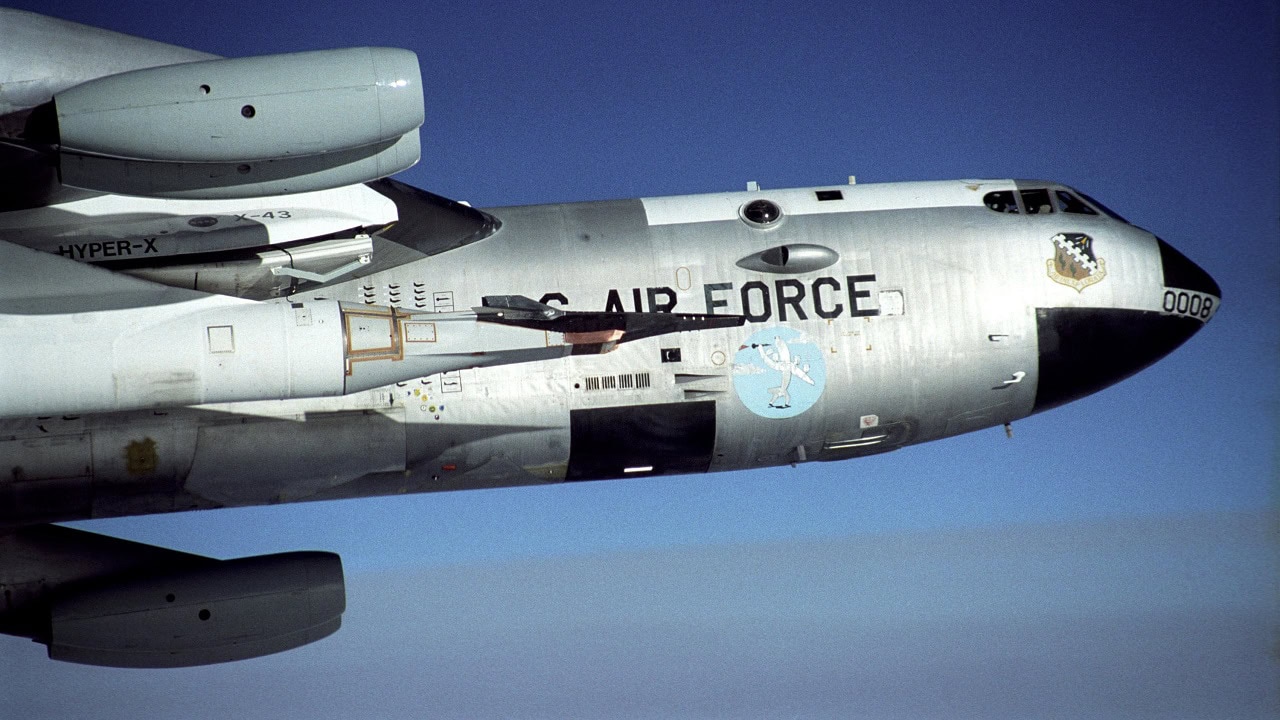
The X-43A was a small experimental research aircraft designed to flight-demonstrate the technology of airframe-integrated supersonic ramjet or “scramjet” propulsion at hypersonic speeds above Mach 5, or five times the speed of sound. Its scramjet engine is an air-breathing engine in which the airflow through the engine remains supersonic.
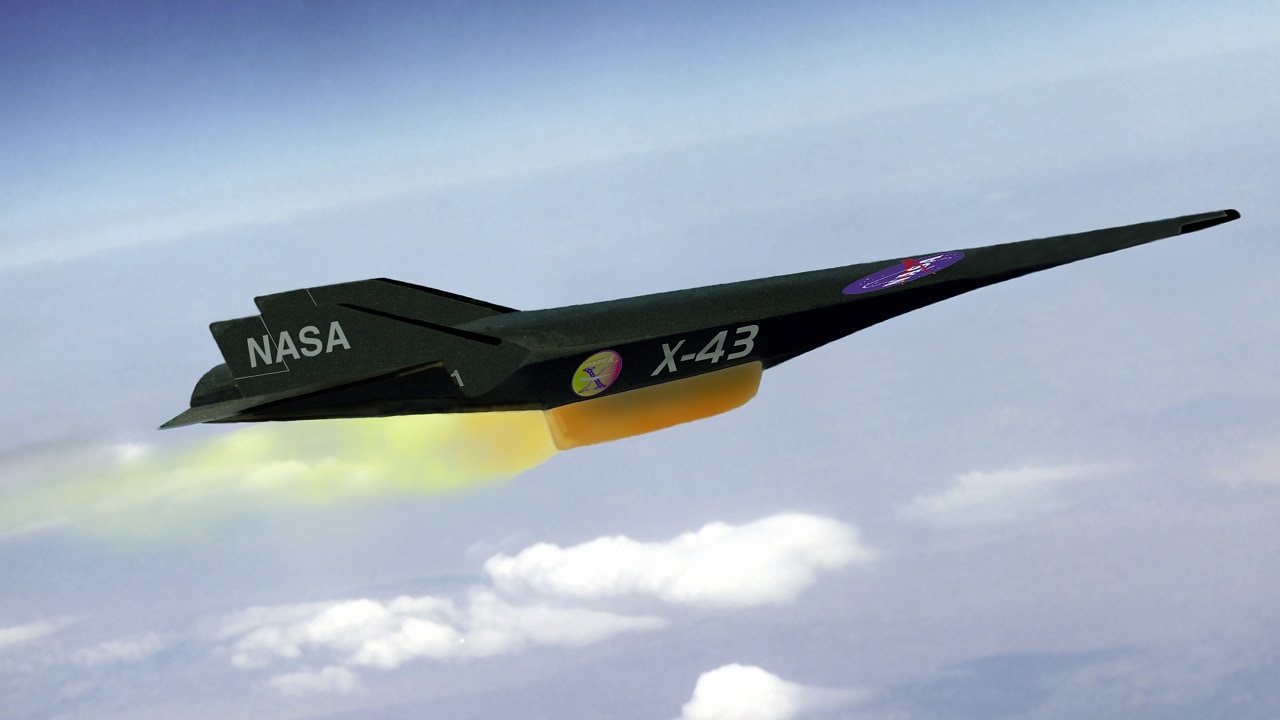
An artist’s conception of the X-43A Hypersonic Experimental Vehicle, or “Hyper-X” in flight. The X-43A was developed to flight test a dual-mode ramjet/scramjet propulsion system at speeds from Mach 7 up to Mach 10 (7 to 10 times the speed of sound, which varies with temperature and altitude).
NASA spent about $230 million over eight years to answer a focused question: would an airframe-integrated scramjet produce useful thrust in the real atmosphere at Mach 7 and Mach 10? Three expendable vehicles were built, each intended for one flight and a planned impact in the ocean. The program sought propulsion, aerodynamic, structural, thermal, and flight-control data rather than an aircraft ready for production.
The famous Mach 9.6 flight did not begin under scramjet power. A B-52B carried the X-43A and a modified Pegasus rocket to launch altitude, and the booster accelerated the stack into the narrow operating window for the engine. Hyper-X proved the propulsion physics while leaving takeoff, acceleration, long-duration cruise, payload, recovery, and repeated use for later programs.
Hyper-X Was Built to Move Scramjets Beyond Wind Tunnels
A turbojet compresses air through rotating machinery. A ramjet uses forward speed to compress incoming air and slows the flow below the speed of sound before combustion. A scramjet keeps airflow through the combustor supersonic, opening the possibility of far higher speed while leaving only milliseconds for fuel to mix, ignite, and release useful energy.
NASA had planned to fly a Hypersonic Research Engine on a modified X-15 during the 1960s, but the experiment ended with the X-15 program. The much larger National Aero-Space Plane later pursued reusable hypersonic flight and access to orbit before ending in the 1990s. Langley engineers then proposed a smaller, remotely controlled vehicle carried by a B-52 and pushed to test speed by an existing rocket.
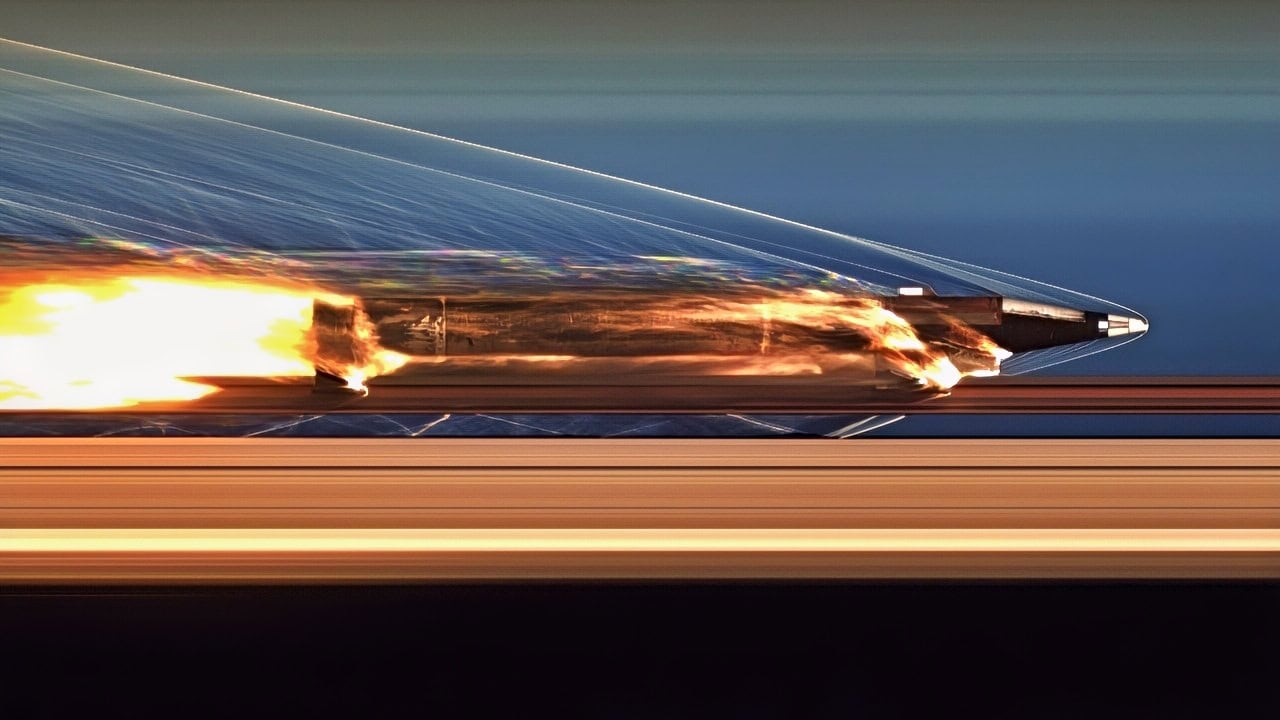
In late March of 2022, the 846th Test Squadron at Holloman Air Force Base, N.M., successfully stopped a reusable sled traveling at 6,400 feet per second on a monorail, making it a historic event for the team’s Hypersonic Sled Recovery, or HSR, effort.
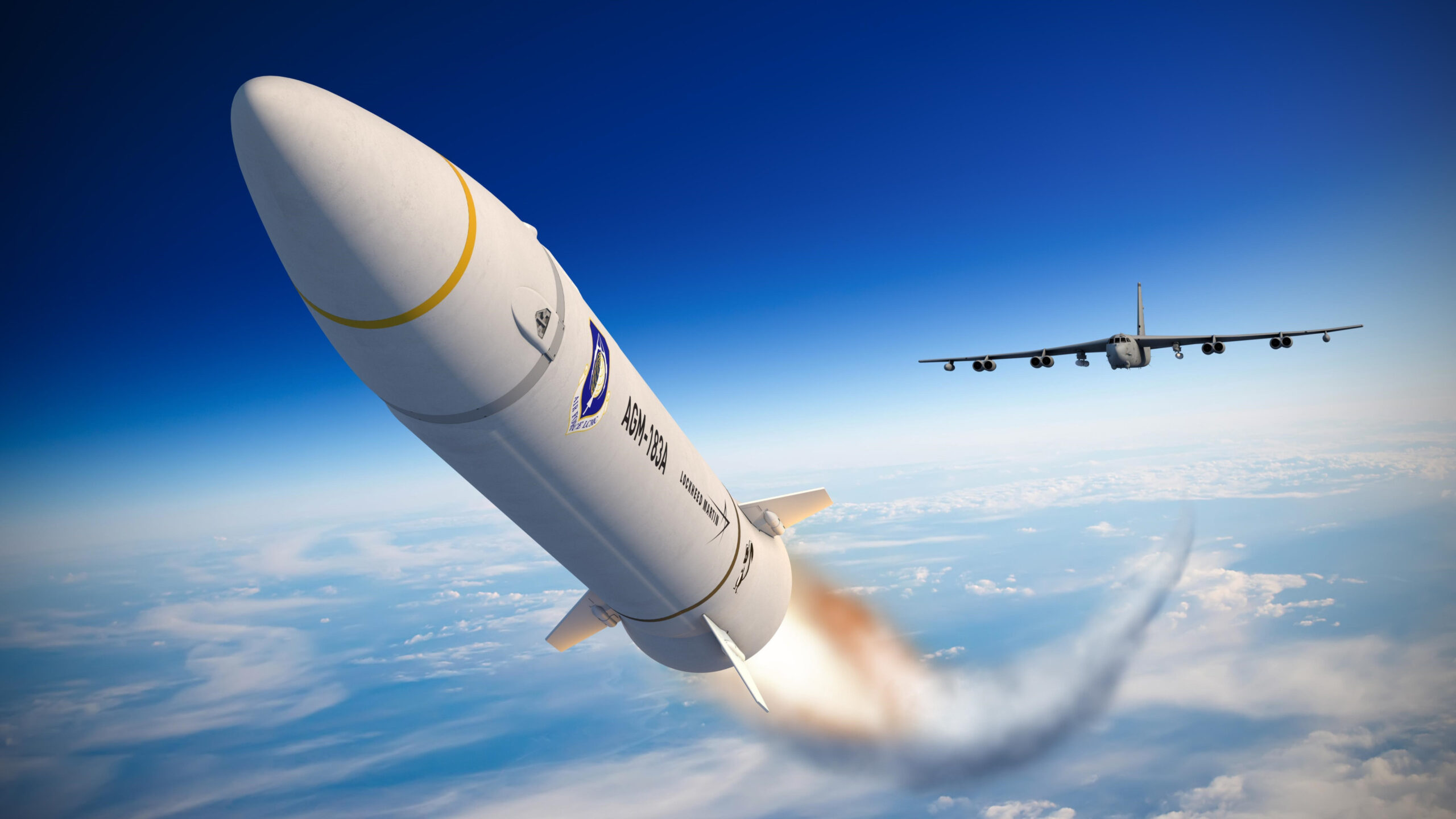
Hypersonic Missiles fired from B-52. Image Credit: Creative Commons.
NASA approved Hyper-X in 1996. An initial four-flight concept became three missions: two vehicles configured for approximately Mach 7 and a third for Mach 10. The result was a tightly defined flight-validation program rather than another attempt to build an operational spaceplane.
The attraction was mass. Rockets carry fuel and oxidizer. A scramjet draws oxygen from the atmosphere, reducing the oxidizer load during the usable portion of atmospheric flight. A future launch vehicle might carry more payload for the same mass, while a military aircraft or missile might gain range and speed without hauling a rocket’s full oxidizer supply.
The X-43A Used Its Fuselage as Part of the Engine
The X-43A measured about 12 feet long and five feet wide. Its compact lifting-body shape formed part of the propulsion system. The lower forebody compressed incoming air before it reached the combustor, while the aft section acted as part of the exhaust nozzle. The aircraft and engine functioned as one aerodynamic unit.
That integration reduced drag but tightened the margin for error. A change in the angle of attack altered inlet flow. Combustion changed pressures on the airframe. Propulsion, stability, structure and thermal protection had to remain aligned through a test window measured in seconds.
Gaseous hydrogen gave the experiment fast ignition and high energy per unit mass. It was less attractive for a compact operational missile because hydrogen occupies substantial volume and complicates storage. The later X-51A shifted to JP-7 hydrocarbon fuel, accepting harder combustion in exchange for greater military relevance.
Each mission followed the same relay. A B-52B released the booster and research vehicle over the Pacific. The modified Pegasus climbed and accelerated, then separated near the test point. The X-43A stabilized, opened its inlet, injected hydrogen, and ignited the scramjet under preprogrammed control. Telemetry sent the data to the ground before the aircraft glided into the sea.
The First Flight Failed Before the Scramjet Started
The first attempt on June 2, 2001, did not test the engine. About eight seconds after booster ignition, the combined launch vehicle lost control. Range safety destroyed it over the Pacific, with the X-43A still attached.
NASA’s investigation traced the failure to the booster flight-control system and the models used to design it. Engineers had overestimated the system’s ability to handle aerodynamic loads along the selected trajectory. Mounting the X-43A on the Pegasus changed the stack’s transonic behavior enough to invalidate assumptions inherited from the original launcher.
The loss supplied the first major lesson. The scramjet represented the headline technology, but the booster, actuators, separation mechanism, and aerodynamic database all determined whether the engine received a valid test. NASA conducted more wind-tunnel work, installed stronger fin actuators, removed some booster propellant, and raised the release altitude from about 23,000 feet to 40,000 feet to reduce loads. A later NASA lessons-learned review focused on the recovery from this failure.
The delay also increased the cost. GAO found the Hyper-X development estimate had grown by $60 million, or 35.9 percent, by 2004. NASA later placed the full ground-and-flight program at approximately $230 million.
The March 2004 Flight Produced More Thrust Than Drag
The second X-43A flew on March 27, 2004. The B-52 released the stack at 40,000 feet, and the booster carried the aircraft to about 95,000 feet before separation near Mach 6.95. The X-43A stabilized and lit its engine.
The scramjet burned for roughly 10 seconds, and the vehicle reached Mach 6.83. The important result was net thrust. The engine overcame total vehicle drag and accelerated the aircraft during powered flight, providing the first free-flight demonstration of an airframe-integrated scramjet-powered aircraft.
The X-43A then collected almost 10 minutes of aerodynamic and control data during a high-speed glide before entering the Pacific about 450 miles downrange. Postflight analysis placed engine performance within about 3 percent of predictions. Airframe drag ran higher than expected, showing that propulsion models had performed better than the full-vehicle drag estimate.
The Final X-43A Held Mach 9.68 Under Scramjet Power
The third vehicle faced roughly twice the heating expected during the Mach 7 mission. Engineers added thermal protection, including carbon-carbon material on the leading edges of the vertical fins, and tailored the propulsion geometry to the higher test point.
On November 16, 2004, the booster separated near Mach 9.74 and close to 110,000 feet. The scramjet ignited, and the X-43A reached a powered maximum near Mach 9.68. It did not accelerate sharply. The engine produced enough thrust to offset drag and maintain approximately constant speed, demonstrating cruise thrust at the planned condition.
Flight controls held the commanded angle of attack near one degree. After the engine test, the vehicle performed energy-management maneuvers and gathered nearly 10 minutes of aerodynamic data while traveling about 850 miles. Its planned ocean impact ended the final mission. NASA’s current hypersonics history says no later flight has surpassed Mach 9.6, leaving the air-breathing record intact.
The test validated far more than combustion. The stack survived ascent and separated in a complex shock environment at almost Mach 10. The free flyer established stable inlet flow, ignited, maintained control, and transmitted high-quality data without a pilot or recovery option.
The X-43A Exposed the Gap Between a Record and a Weapon
Hyper-X proved that an airframe-integrated scramjet worked under two widely separated flight conditions. It also gave engineers measurements linking wind tunnels and computational models to a complete vehicle in the atmosphere. Heating, aerodynamics, propulsion, structure, and control were observed as one coupled system.
The flights demonstrated why a scramjet cannot replace rockets or turbine engines on its own. The X-43A needed a B-52 and a large solid-fuel booster before its engine became useful. An operational aircraft needs an additional propulsion system for takeoff and acceleration, or it must be launched from a carrier aircraft. That requirement pushed later concepts toward turbine-based and rocket-based combined-cycle propulsion.
Fuel and endurance posed additional limits. Hydrogen supported a clean Mach 10 experiment, but military planners favored denser hydrocarbon fuel compatible with existing logistics. The proposed X-43C was intended to use an Air Force dual-mode hydrocarbon engine and accelerate from about Mach 5 to Mach 7, testing ignition, ramjet-to-scramjet transition, and a wider operating range.
The X-43A’s 10-second burn established viability but did not demonstrate minutes of powered cruise, throttle response, repeated starts, maneuvering under power, or a reusable hot structure. It carried no seeker, warhead, reconnaissance package, or orbital stage. Its military value came from reducing propulsion uncertainty, not from serving as a concealed operational system.
The X-43A Completed Its Plan While Hyper-X Lost Its Future
The claim that NASA shut down the X-43A needs qualification. The A-model effort was built around three expendable aircraft, and the third completed the final scheduled mission. No fourth X-43A waited for approval. Ending the flight series after November 2004 followed the test plan.
The broader Hyper-X effort ended abruptly. NASA engineers had worked on the X-43B, X-43C, and X-43D concepts, which involved combined-cycle propulsion, hydrocarbon fuel, and higher speeds. NASA announced an X-43C demonstrator effort in 2003. Its March 2004 operating plan removed $30 million, eliminated the X-43C flight vehicle, and reduced the work to in-house support and a single-engine Air Force demonstrator.
GAO later reported that NASA canceled Hyper-X funding in fiscal 2004. NASA’s aeronautics history says researchers expected support through at least March 2005, but the funding ended within weeks of the Mach 9.6 flight, before the team had finished publishing the results. The proposed Mach 15 X-43D never reached flight hardware.
NASA was redirecting resources toward the new exploration agenda and restructuring aeronautics to focus on fundamental research rather than narrowly defined flight demonstrators. GAO projected aeronautics funding would fall almost 30 percent in constant dollars from 2005 through 2011, while exploration systems gained resources. The X-43A had answered the least expensive question. Moving from proof of combustion to a longer-flying, hydrocarbon-fueled or reusable vehicle required another major commitment.
The Air Force Continued the Work With the X-51A
The Air Force Research Laboratory took the lead on the next major American scramjet flight vehicle, while NASA remained a technical participant. The X-51A Waverider traded the X-43A’s peak speed for endurance, a larger airframe, and operationally relevant fuel.
On May 1, 2013, the fourth X-51A reached Mach 5.1 and sustained scramjet power for 210 seconds until its JP-7 was exhausted. The Waverider never approached Mach 9.6, but it ran more than 20 times longer than the X-43A. Its flight came almost nine years after the final X-43A completed its planned Pacific impact.
About the Author: Harry J. Kazianis
Harry J. Kazianis (@Grecianformula) was the former Senior Director of National Security Affairs at the Center for the National Interest (CFTNI), a foreign policy think tank founded by Richard Nixon based in Washington, DC. Harry has over a decade of experience in think tanks and national security publishing. His ideas have been published in the NY Times, The Washington Post, The Wall Street Journal, CNN, and many other outlets worldwide. He has held positions at CSIS, the Heritage Foundation, the University of Nottingham, and several other institutions related to national security research and studies. He is the former Executive Editor of the National Interest and the Diplomat. He holds a Master’s degree focusing on international affairs from Harvard University.

