

“Leadership consists of picking good men and helping them do their best” was Chester W. Nimitz’s compact definition of command. In a January 1966 Boys’ Life article, published weeks before his death, Nimitz paired the line with a reciprocal obligation: subordinates owed loyalty, discipline and devotion to duty, while superiors owed patience, tolerance and understanding.
The words described the admiral who led the Pacific war. President Franklin D. Roosevelt selected Nimitz to command the U.S. Pacific Fleet on December 16, 1941, nine days after Pearl Harbor. He assumed command on December 31 with much of the battle line wrecked, morale damaged and Japan advancing across the Pacific.

A U.S. Sailor observes an F/A-18E Super Hornet, attached to Strike Fighter Squadron (VFA) 151, prepare for flight operations on the flight deck of Nimitz-class aircraft carrier USS Abraham Lincoln (CVN 72) during Operation Epic Fury, March 30, 2026. (U.S. Navy photo)

An F/A-18E Super Hornet, attached to Strike Fighter Squadron (VFA) 151, launches from the flight deck of Nimitz-class aircraft carrier USS Abraham Lincoln (CVN 72) during Operation Epic Fury, March 31, 2026. (U.S. Navy photo)
Nimitz possessed the technical background expected of a career naval officer. He had commanded submarines and surface ships, mastered diesel engineering and led the Bureau of Navigation, then the Navy’s personnel organization. His wartime advantage was judgment about people. He listened widely, protected capable officers and resisted the urge to direct every tactical move from headquarters.
His patience was grounded in experience. As a young officer commanding USS Decatur, Nimitz ran the destroyer aground in the Philippines in 1908. A court-martial issued a public reprimand, but the mistake did not end his career. He later extended the same opportunity to officers whose full records showed they still had value.
For Nimitz, helping meant concrete action: define the objective, move resources into place, remove needless interference and hold commanders accountable for results. He often refused staff suggestions to send tactical instructions to officers already at sea because they understood the immediate situation better. The approach required disciplined delegation.
Nimitz Kept the Pearl Harbor Team and Trusted Its Intelligence
Several Pearl Harbor staff officers expected to be removed after the attack. Nimitz instead asked them to remain. The decision preserved the experience of intelligence officer Edwin Layton and other planners who understood Japanese operations, communications and the geography of the Pacific. It also demonstrated the faith in subordinates behind Nimitz’s leadership philosophy.
That trust mattered before Midway. Commander Joseph Rochefort’s codebreakers and Layton concluded that the Japanese target identified as “AF” was Midway Atoll. Officials in Washington doubted the estimate. Nimitz backed his Pacific intelligence team and concentrated every available carrier northeast of the island.
He also helped his commanders reach the battle. USS Yorktown returned from Coral Sea with damage initially expected to require roughly three months of repair. Nimitz inspected the carrier and demanded it back in three days. More than 1,300 workers made temporary repairs. When William Halsey became too ill to command, Nimitz accepted his recommendation of Raymond Spruance, a cruiser officer with limited carrier-command experience and later namesake of the Spruance-class destroyers.
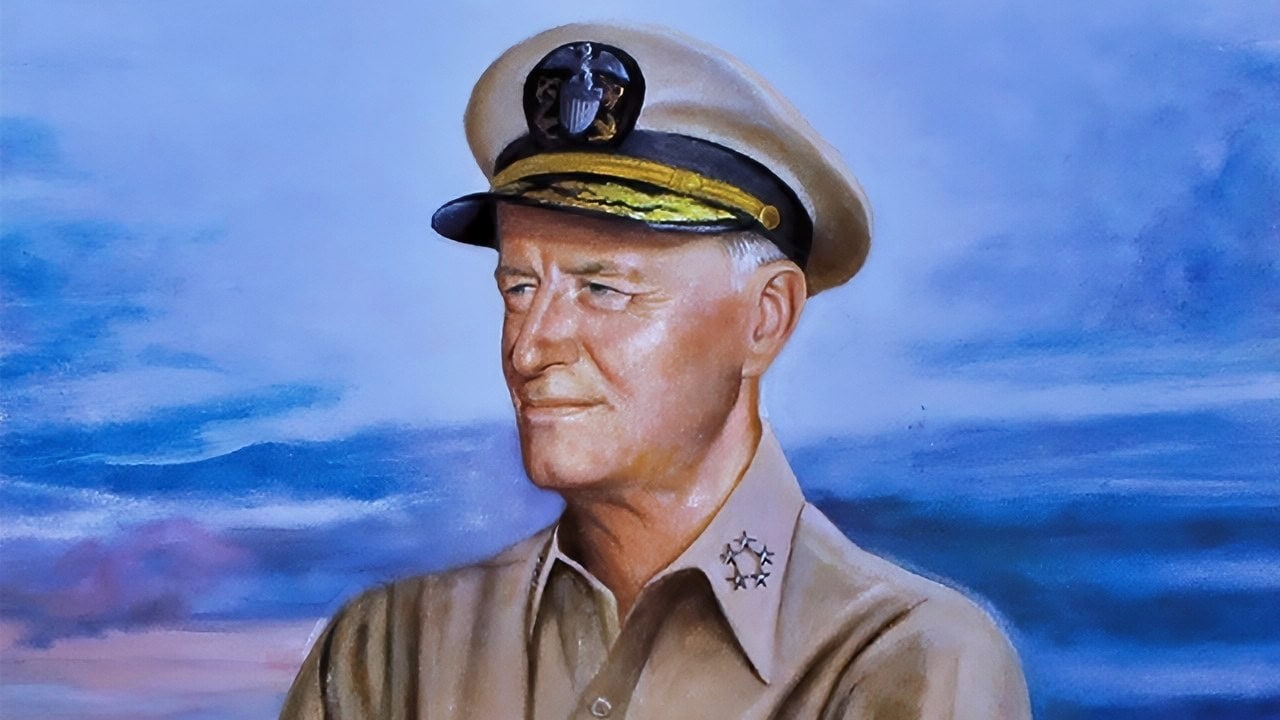
Chester Nimitz Navy Admiral. Image Credit: Creative Commons.
Nimitz gave Frank Jack Fletcher overall responsibility and allowed Fletcher and Spruance to fight from the information available at sea. American forces sank four Japanese fleet carriers, including Kaga, while losing Yorktown. The decisive attacks came from squadrons flying from USS Enterprise and Yorktown. Nimitz’s contribution came through the intelligence he trusted, the ship he restored and the commanders he placed in position.
Guadalcanal Showed That Trust Still Required Judgment
Nimitz’s philosophy did not require endless loyalty to an officer who no longer fit the assignment. By October 1942, the Guadalcanal campaign had reached a crisis. Vice Admiral Robert Ghormley appeared exhausted, immersed in detail and unable to restore confidence across the South Pacific command.
Nimitz visited the theater, saw conditions on Guadalcanal and relieved Ghormley on October 18. He replaced him with Halsey, whose energy immediately raised morale and sharpened cooperation among naval, air and ground forces. Nimitz later helped Ghormley become commandant of the 14th Naval District rather than publicly humiliating a longtime officer.
The decision revealed the harder meaning of “picking good men.” A leader has to judge fit as well as ability. Ghormley had served with distinction elsewhere. Halsey was the better choice for a desperate campaign demanding speed, confidence and visible aggression.
Spruance and Halsey Gave Nimitz Two Different Command Styles
Nimitz did not demand one command personality. Spruance was reserved, methodical and analytical. Halsey was emotional, aggressive and highly visible. Nimitz found uses for both. The same body of ships became the Fifth Fleet under Spruance and the Third Fleet under Halsey as the two headquarters alternated through the final Pacific offensives.
The arrangement reflected Nimitz’s willingness to match people to work rather than reward the loudest personality. He also relied on amphibious commander Richmond Kelly Turner, carrier commander Marc Mitscher and submarine leader Charles Lockwood. His belief that valuable advice came from junior officers and enlisted sailors kept information moving upward as authority moved downward.
Nimitz Signed for the United States in Tokyo Bay
The command team carried the war through the Central Pacific, the Philippine Sea, Iwo Jima and Okinawa. Nimitz received five-star rank on December 19, 1944. His authority expanded, but his public manner remained restrained and his commanders continued receiving the credit attached to their operations.
On September 2, 1945, Nimitz signed Japan’s Instrument of Surrender aboard USS Missouri on behalf of the United States. He did so nearly four years after taking command of the Pacific Fleet amid the wreckage at Pearl Harbor.
About the Author: Harry J. Kazianis
Harry J. Kazianis (@Grecianformula) was the former Senior Director of National Security Affairs at the Center for the National Interest (CFTNI), a foreign policy think tank founded by Richard Nixon based in Washington, DC. Harry has over a decade of experience in think tanks and national security publishing. His ideas have been published in the NY Times, The Washington Post, The Wall Street Journal, CNN, and many other outlets worldwide. He has held positions at CSIS, the Heritage Foundation, the University of Nottingham, and several other institutions related to national security research and studies. He is the former Executive Editor of the National Interest and the Diplomat. He holds a Master’s degree focusing on international affairs from Harvard University.

