
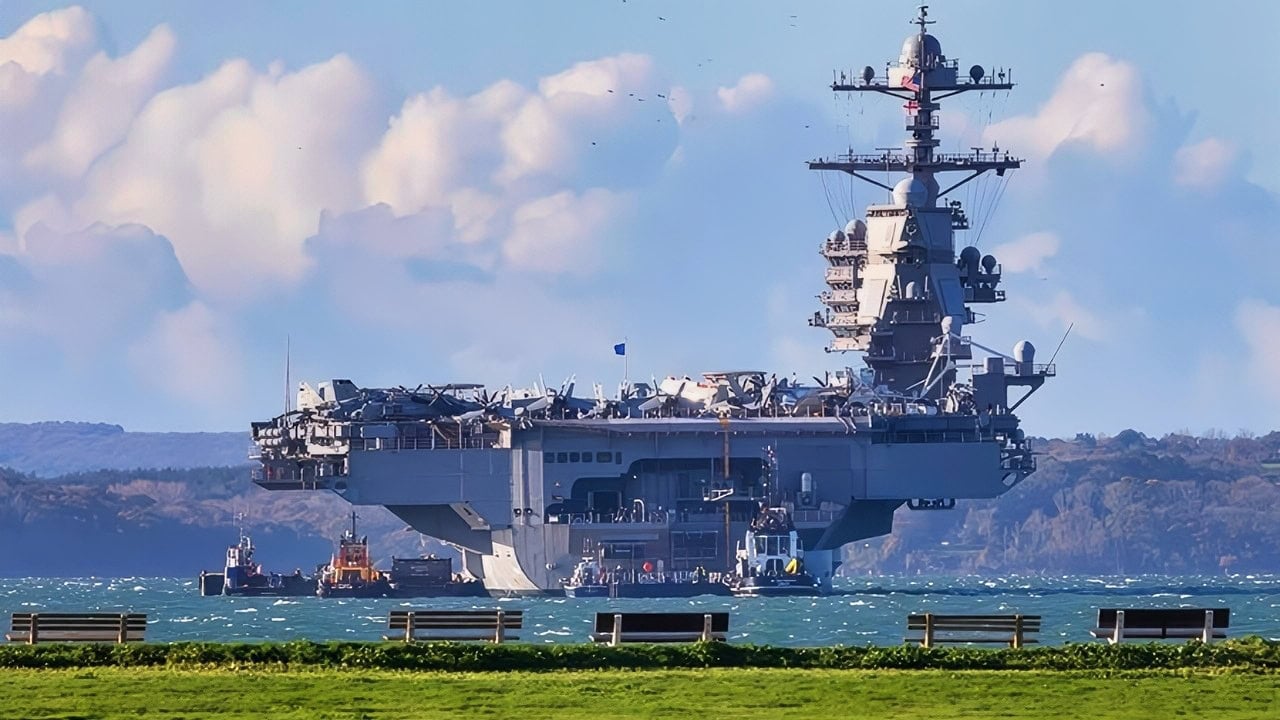
USS Gerald R. Ford by the Numbers: $13.3 Billion, 75 Aircraft and Two Nuclear Reactors: USS Gerald R. Ford cost $13.3165 billion in final procurement funding. That figure covers the construction of CVN-78 in then-year dollars. It does not include all research expenses associated with creating the class or the carrier’s operating costs over a planned 50-year service life.
At full load, Ford displaces 100,000 long tons, stretches roughly 1,100 feet, and has a flight deck 256 feet wide. A Navy class comparison places the flight deck at five acres and the design air wing at about 75 aircraft.
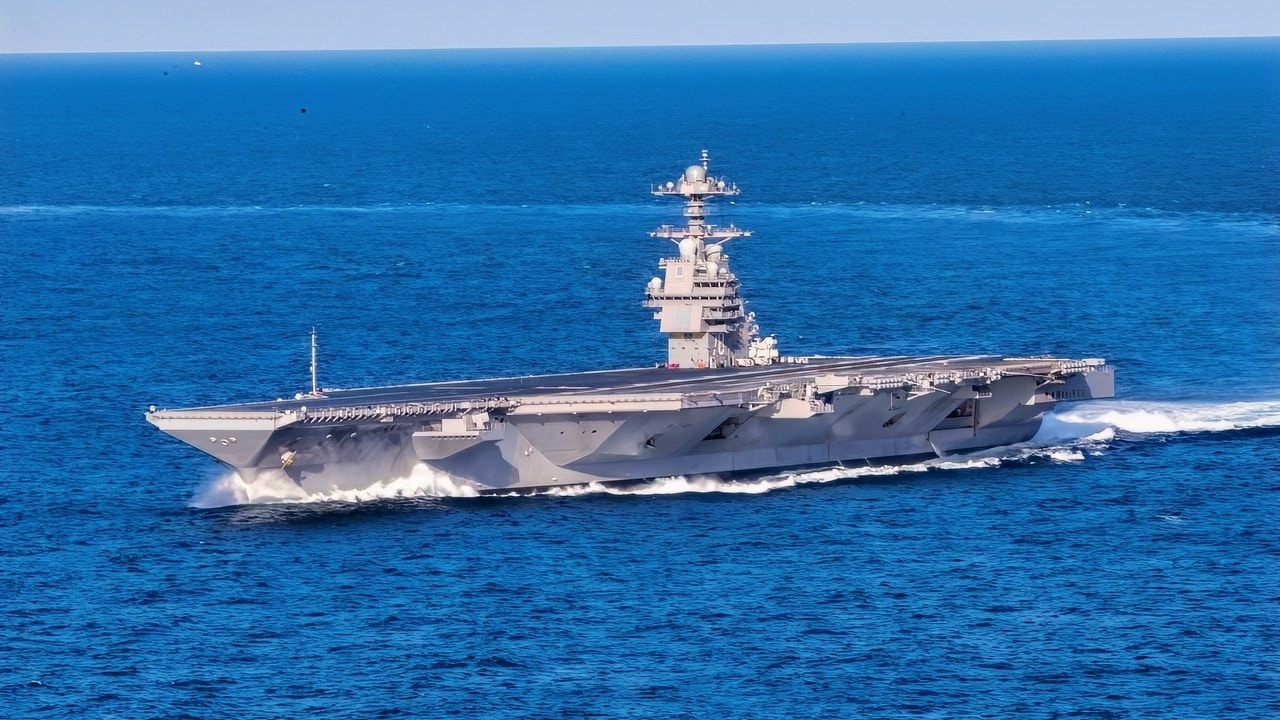
ATLANTIC OCEAN (Oct. 29, 2019) USS Gerald R. Ford (CVN 78) conducts high-speed turns in the Atlantic Ocean. Ford is at sea conducting sea trials following the in port portion of its 15 month post-shakedown availability. (U.S. Navy photo by Mass Communication Specialist 3rd Class Connor Loessin)
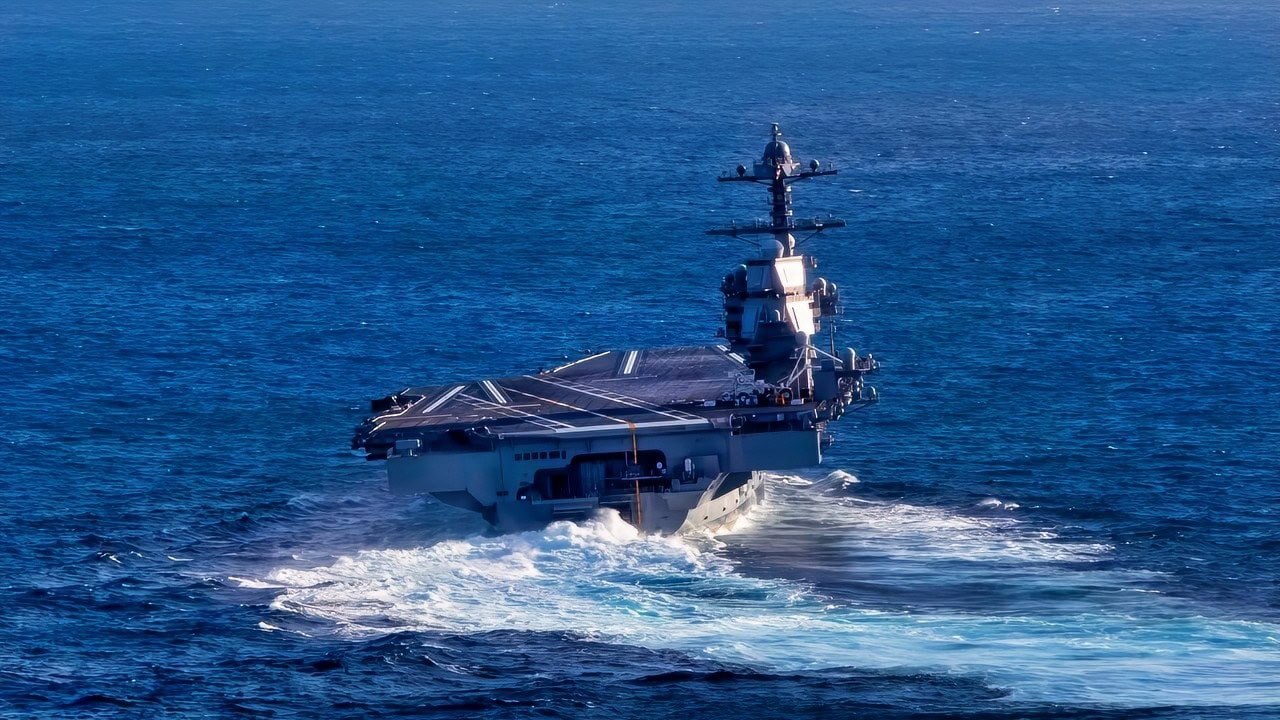
ATLANTIC OCEAN (Oct. 29, 2019) USS Gerald R. Ford (CVN 78) conducts high-speed turns in the Atlantic Ocean. Ford is at sea conducting sea trials following the in port portion of its 15 month post-shakedown availability.(U.S. Navy photo by Mass Communication Specialist 3rd Class Connor Loessin)
Two nuclear reactors drive four shafts and give the ship a published speed above 30 knots. Nuclear propulsion removes routine refueling of the main propulsion plant, giving the hull an effectively unrestricted steaming range. Aviation fuel, food, weapons, spare parts, and maintenance still determine how long the carrier and its air wing remain on station.
Ford’s installed weapons protect the ship at close and medium ranges. The Navy lists Rolling Airframe Missiles, Evolved SeaSparrow Missiles and Mk 15 Phalanx close-in guns.
Public Navy material does not give a complete loaded missile count for a deployment, and the carrier’s larger offensive arsenal sits in its magazines and aboard its aircraft.
$13.3 Billion Bought 23 New Technologies
The lead ship introduced 23 new technologies, including electromagnetic catapults, Advanced Arresting Gear, and Advanced Weapons Elevators. That breadth explains both the ship’s capability and the years spent correcting first-of-class problems.
It also separates the Ford design from the Nimitz class more than their similar length suggests.
NAVSEA lists accommodations for 4,660 sailors, aviators, and staff, compared with 5,922 in its Nimitz-class comparison. The class was designed for a smaller crew and roughly $4 billion less in lifecycle operating and support costs per ship.
Those are 50-year targets, not a discount on the $13.3 billion construction price. The Ford-class technology gamble depends on those savings appearing across decades of service.
The Navy Does Not Publish a Combined Horsepower Figure
The confirmed propulsion numbers are two reactors, four shafts, and more than 30 knots. No official Navy source reviewed for this article gives a combined shaft-horsepower figure for Ford’s reactor plant. Large numbers repeated online should therefore be treated as estimates rather than a published specification.

Aircraft Carrier USS Gerald R. Ford Diagram. Image Credit: Creative Commons.
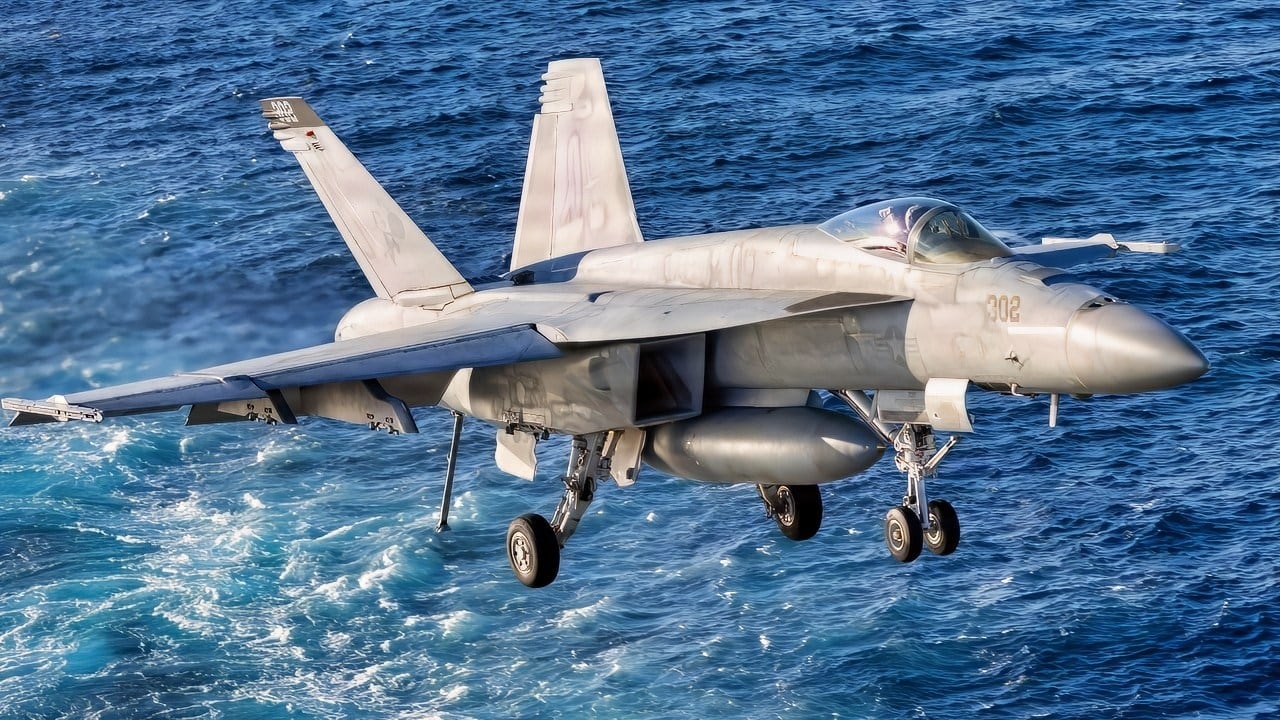
An F/A-18E Super Hornet aircraft approaches the flight deck of the world’s largest aircraft carrier, Ford-class aircraft carrier USS Gerald R. Ford (CVN 78), Nov. 17, 2025. U.S. military forces are deployed to the Caribbean in support of the U.S. Southern Command mission, Department of War-directed operations, and the president’s priorities to disrupt illicit drug trafficking and protect the homeland. (U.S. Navy photo)
The reactors provide approximately three times the electrical-generation capacity available aboard a Nimitz-class carrier. That reserve feeds the catapults, radar, elevators, workshops, and hotel services while leaving room for future sensors and weapons. It is one reason the A1B reactor plant matters beyond propulsion.
About 75 Aircraft Form the Carrier’s Main Battery
The published design figure is approximately 75 aircraft, not 75 fighters. Ford’s 2025–2026 air wing included nine squadrons flying F/A-18E/F Super Hornets, EA-18G Growlers, E-2D Advanced Hawkeyes, MH-60R and MH-60S helicopters, and C-2A Greyhounds.
The precise aircraft count changes with the mission.
Those aircraft deliver air-to-air missiles, anti-radiation weapons, anti-ship missiles, and precision-guided bombs.
The Navy does not publish Ford’s total magazine capacity or a fixed wartime load. That is why the 75-aircraft air wing matters more than an incomplete count of missiles mounted around the deck edge.
Four Catapults and 11 Weapons Elevators Set the Tempo
Ford has four electromagnetic catapults and three arresting wires supported by Advanced Arresting Gear. EMALS provides controlled acceleration across a wider range of aircraft weights and replaces the steam catapults used by theNimitz-class aircraft carriers.
The Navy set a sustained sortie-generation design rate of 160 sorties per day, compared with 120 for Nimitz. That number remains a design benchmark rather than a validated daily guarantee.
The Pentagon’s FY2025 test report said the live sustained-rate demonstration had moved to fiscal 2026, and operational testing was expected to continue into fiscal 2027. EMALS and arresting-gear reliability still affected flight operations, part of the class’s unfinished test program.
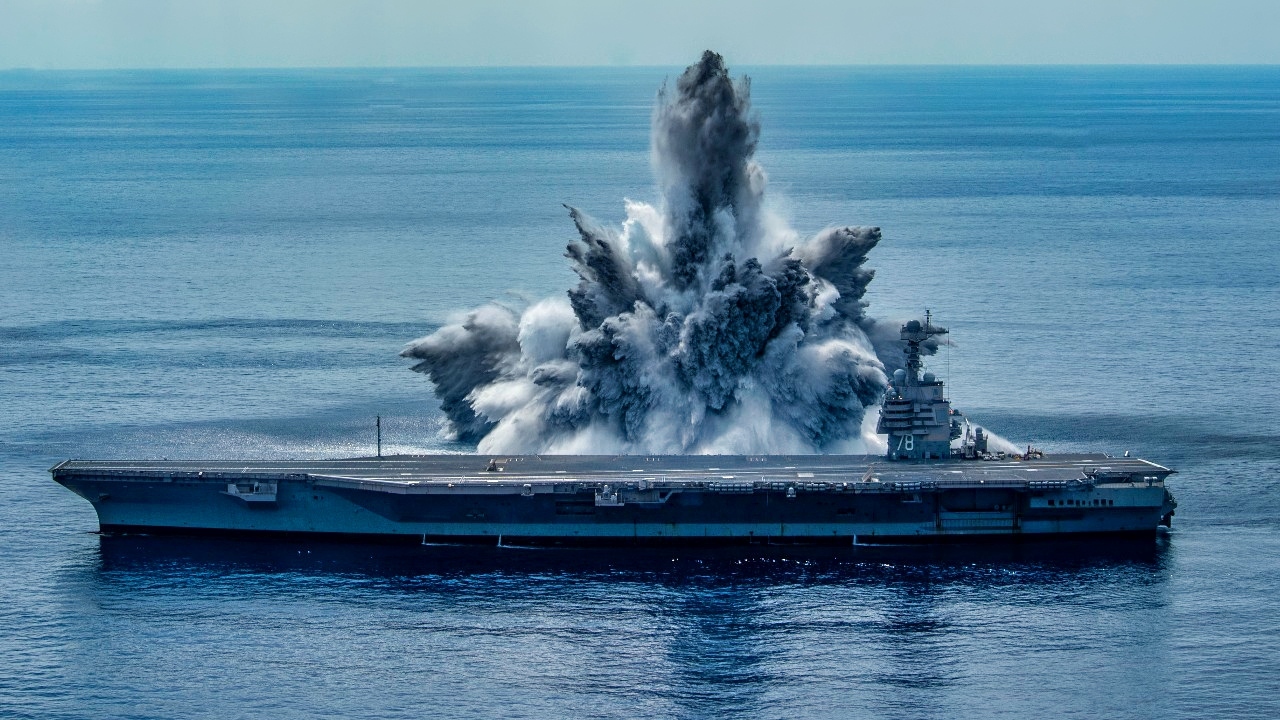
The aircraft carrier USS Gerald R. Ford (CVN 78) successfully completes the third and final scheduled explosive event of Full Ship Shock Trials while underway in the Atlantic Ocean, Aug. 8, 2021. The U.S. Navy conducts shock trials of new ship designs using live explosives to confirm that our warships can continue to meet demanding mission requirements under harsh conditions they might encounter in battle. (U.S. Navy photo by Mass Communication Specialist 3rd Class Novalee Manzella)
Three aircraft elevators are rated at 200,000 pounds each.
Eleven Advanced Weapons Elevators lift 24,000 pounds apiece, more than twice the 10,500-pound rating of the nine weapons elevators in NAVSEA’s Nimitz comparison.
The redesigned route cuts horizontal weapons movement from roughly 1,500 feet to about 390 feet.
Five Acres Support a City at Sea
Ten store elevators move food and supplies through the ship.
Ford’s freshwater plants are rated at 500,000 gallons per day, while nine air-conditioning plants provide 1,100 tons of cooling apiece.
The class was designed around 12-year docking intervals and a 43-month maintenance cycle. Supporting those numbers requires the shipyards and technical workforce behind a 100,000-ton nuclear carrier.
Ford returned to Norfolk on May 16, 2026, after 326 days, 57,713 nautical miles, 23 replenishments at sea, and more than 12,200 flight launches.
About the Author: Harry J. Kazianis
Harry J. Kazianis (@Grecianformula) was the former Senior Director of National Security Affairs at the Center for the National Interest (CFTNI), a foreign policy think tank founded by Richard Nixon based in Washington, DC. Harry has over a decade of experience in think tanks and national security publishing. His ideas have been published in the NY Times, The Washington Post, The Wall Street Journal, CNN, and many other outlets worldwide. He has held positions at CSIS, the Heritage Foundation, the University of Nottingham, and several other institutions related to national security research and studies. He is the former Executive Editor of the National Interest and the Diplomat. He holds a Master’s degree focusing on international affairs from Harvard University.

