

USS South Dakota by the Numbers: The $52,800,000 “Battleship X” With Nine 16-Inch Guns: One armor-piercing salvo from USS South Dakota placed 24,300 pounds of steel in the air. The rated firing cycle allowed the battleship to repeat that broadside twice per minute while 130,000 shaft horsepower drove more than 44,000 tons at nearly 28 knots.
South Dakota cost $52.8 million, making her one of the Navy’s most expensive ships when she entered the water in 1941. Using the 1941 Consumer Price Index and the June 2026 CPI-U, that equals roughly $1.2 billion in current purchasing power. The comparison measures inflation, not the price of a modern replacement.
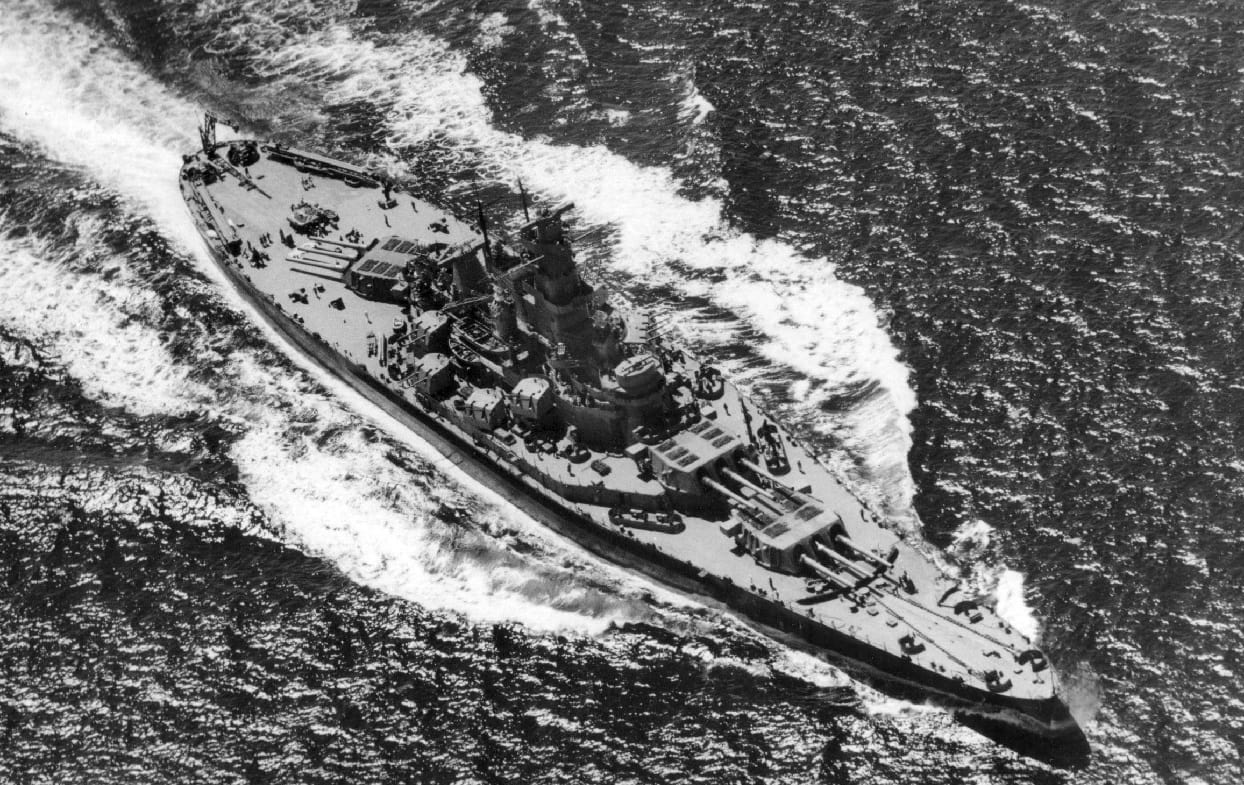
USS South Dakota. Image: Creative Commons.
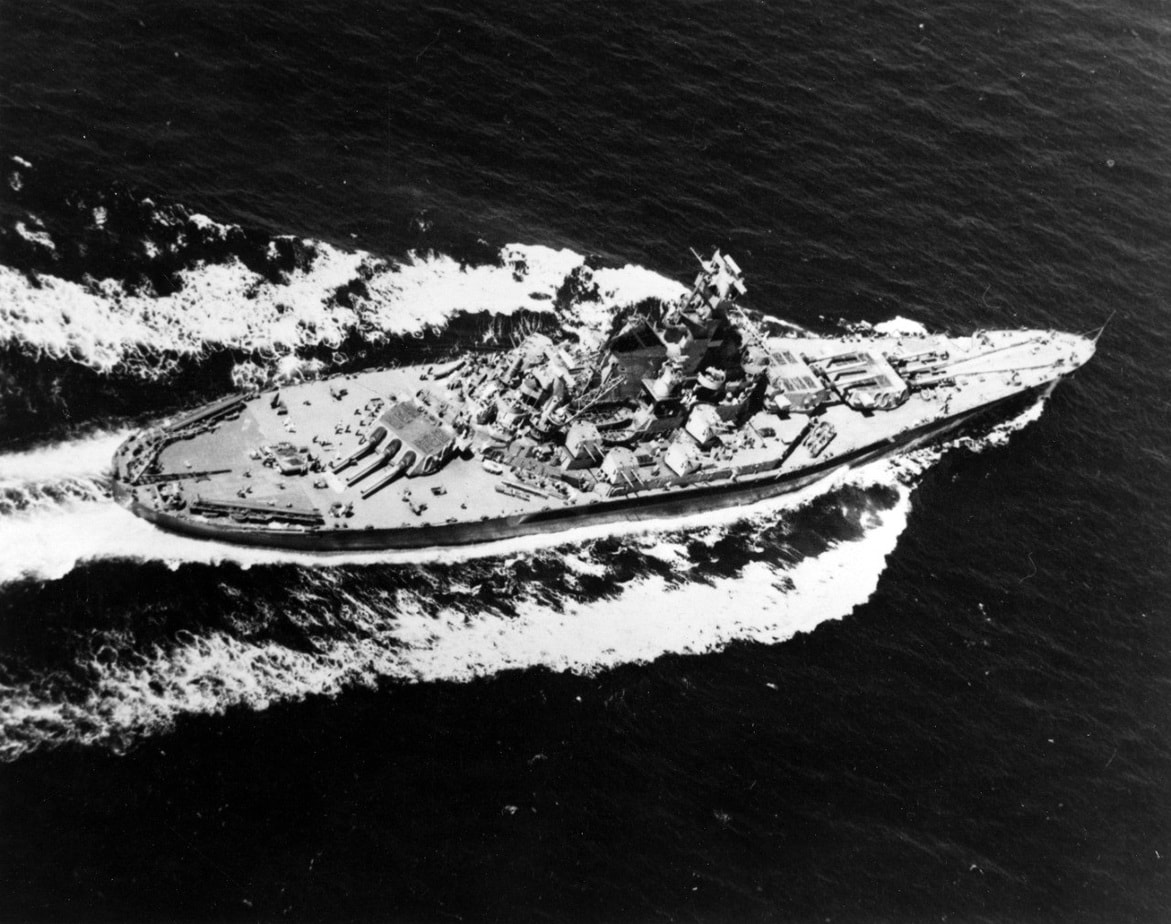
USS South Dakota-Class. Image: Creative Commons.
She was 680 feet long, 108 feet 2 inches wide, and displaced 44,519 long tons at full combat load in her early-war configuration. South Dakota is commissioned with 115 officers and 1,678 enlisted sailors, a total of 1,793. The Navy later listed a wartime complement of 2,354.
South Dakota fought in the Pacific and Atlantic, survived one of the most violent American battleship actions of World War II, and traveled 246,970 miles. Her Navy Unit Commendation and 13 battle stars helped make “Battleship X” one of the most decorated American capital ships of the war.
A $52.8 Million Flagship Fits 44,519 Tons Into 680 Feet
South Dakota was laid down at New York Shipbuilding in Camden, New Jersey, on July 5, 1939, launched on June 7, 1941, and commissioned on March 20, 1942. The design combined treaty-limited dimensions with heavy protection, high speed, and nine 16-inch guns, producing a short, densely packed fast battleship.
Eight Babcock & Wilcox boilers supplied four General Electric geared turbines turning four shafts. The machinery produced 130,000 shaft horsepower, a designed speed of 27.5 knots, and a range near 15,000 nautical miles at 15 knots. A 12.2-inch armored belt protected the hull; turret faces reached 18 inches.
The lead ship carried extra command spaces as a fleet flagship. Those quarters displaced two secondary mounts, leaving South Dakota with sixteen 5-inch/38 guns in eight twin turrets rather than the twenty aboard her sisters. It was one consequence of packing battleship firepower and armor into a 680-foot hull.
Nine Mark 6 Guns Fired a 24,300-Pound Broadside
The main battery consisted of nine 16-inch/45 Mark 6 guns in three triple turrets. Each gun weighed 192,310 pounds without its breech and fired a 2,700-pound armor-piercing shell using a 535-pound propellant charge. Muzzle velocity reached 2,300 feet per second, and maximum range approached 36,900 yards.
Nine shells produced a 24,300-pound, or 12.15-ton, broadside. At two rounds per minute per gun, the theoretical one-minute output reached 48,600 pounds. Those numbers explain why the class’s Mark 6 battery remained dangerous despite the compact hull.’
The sixteen 5-inch guns attacked aircraft and surface targets. The original 1.1-inch anti-aircraft weapons gave way to 40 mm Bofors guns, eventually reaching seventeen quadruple mounts, or 68 barrels. Two stern catapults launched Kingfisher floatplanes for reconnaissance and gunfire spotting.
Santa Cruz and Guadalcanal Made Her “Battleship X”
South Dakota entered combat while screening USS Enterprise at the Battle of the Santa Cruz Islands on October 26, 1942. A 500-pound bomb struck the forward turret. About 50 sailors were wounded, including Captain Thomas Gatch, and one later died.
Three weeks later, South Dakota and USS Washington confronted a Japanese force near Guadalcanal. An electrical failure disrupted South Dakota’s radars and communications before Japanese searchlights found her. The Navy’s damage report counted at least 26 projectile hits. Naval History and Heritage Command lists 39 men killed and 59 wounded.
The punishment damaged the radar, communications, and the superstructure without disabling the engines. Japanese fire concentrated on South Dakota, allowing Washington to close unseen and batter Kirishima at short range. The encounter became one of the war’s rare battleship duels.
Japan believed South Dakota had sunk, and the Navy protected her identity during repairs by calling her “Battleship X.” She returned to service after 62 days in the Brooklyn Navy Yard.
Carrier Escort Became South Dakota’s Main War
South Dakota crossed the Atlantic in 1943 and operated with the British Home Fleet against the threat from Tirpitz, taking her north of the Arctic Circle twice. She then returned to the Pacific, where fast battleships protected carrier forces and bombarded islands before amphibious landings.
She fought across the Gilberts, Marshalls, Carolines, and Marianas. During the Battle of the Philippine Sea on June 19, 1944, a 500-pound bomb struck her superstructure, killing 27 sailors and injuring 23. After repairs, South Dakota served around Leyte, Iwo Jima and Okinawa as part of the fast-battleship force built to keep pace with carriers.
A powder accident in a 16-inch turret on May 6, 1945, killed 11 men and injured 24. The ship remained in action and moved toward the Japanese home islands.
South Dakota Fired the Opening Battleship Salvo at Japan
On July 14, 1945, South Dakota joined Indiana and Massachusetts off Kamaishi. The memorial’s history credits South Dakota with firing the opening battleship salvo of the first heavy-warship bombardment of Japan’s home islands. She returned to Kamaishi on August 9 and also shelled Hamamatsu.
South Dakota entered Tokyo Bay as Fleet Admiral Chester Nimitz’s flagship before Japan’s surrender. By then, she had crossed the equator and the International Date Line 30 times each, traveled 246,970 miles, and earned 13 battle stars. She was decommissioned on January 31, 1947.
Local History: Sioux Falls Preserved the Outline After the Hull Was Scrapped
The Navy struck South Dakota from the register on June 1, 1962, and sold her for dismantling that October. South Dakotans formed a memorial foundation in 1963 and recovered the mast, anchor, and other equipment before the steel disappeared.
The memorial was dedicated in Sioux Falls on September 7, 1969. A concrete outline marks the ship’s dimensions, while the visitor center displays artifacts from South Dakota and its crew.
It remains at 2705 W. 12th Street, where admission is free, and the grounds display a propeller, gun, and radar equipment.
About the Author: Harry J. Kazianis
Harry J. Kazianis (@Grecianformula) was the former Senior Director of National Security Affairs at the Center for the National Interest (CFTNI), a foreign policy think tank founded by Richard Nixon based in Washington, DC. Harry has over a decade of experience in think tanks and national security publishing. His ideas have been published in the NY Times, The Washington Post, The Wall Street Journal, CNN, and many other outlets worldwide. He has held positions at CSIS, the Heritage Foundation, the University of Nottingham, and several other institutions related to national security research and studies. He is the former Executive Editor of the National Interest and the Diplomat. He holds a Master’s degree focusing on international affairs from Harvard University.

