
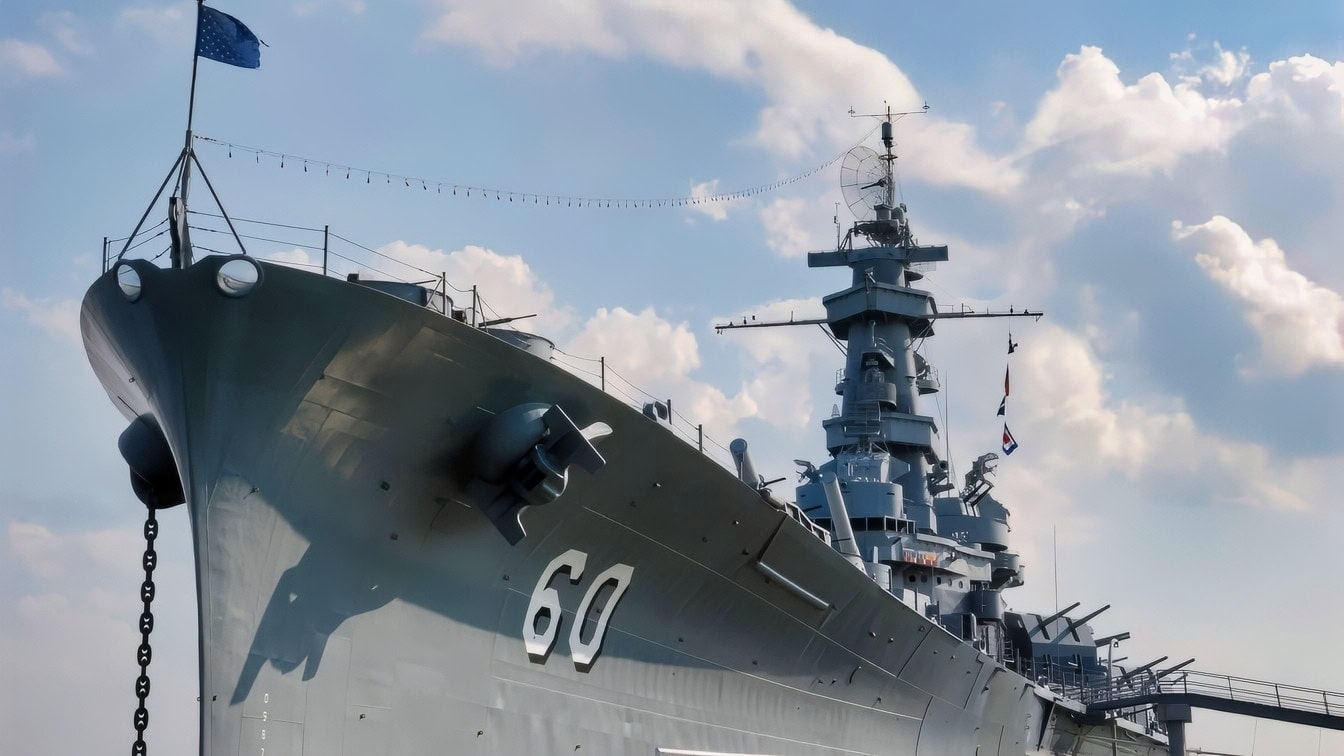
USS Alabama by the Numbers: $80 Million, 45,000 Tons and Nine 16-Inch Guns – USS Alabama cost about $80 million to build, displaced roughly 45,000 tons when loaded for war, and carried nine 16-inch guns. The South Dakota-class battleship traveled 218,000 miles during World War II, earned nine battle stars, and never fired those main guns at another battleship.
More than 3,000 workers completed BB-60 nine months ahead of schedule. The ship measured 680 feet long and 108 feet 2 inches across the beam. Eight boilers supplied four geared steam turbines producing 130,000 shaft horsepower, enough for 28 knots and a 15,000-nautical-mile range at 15 knots.
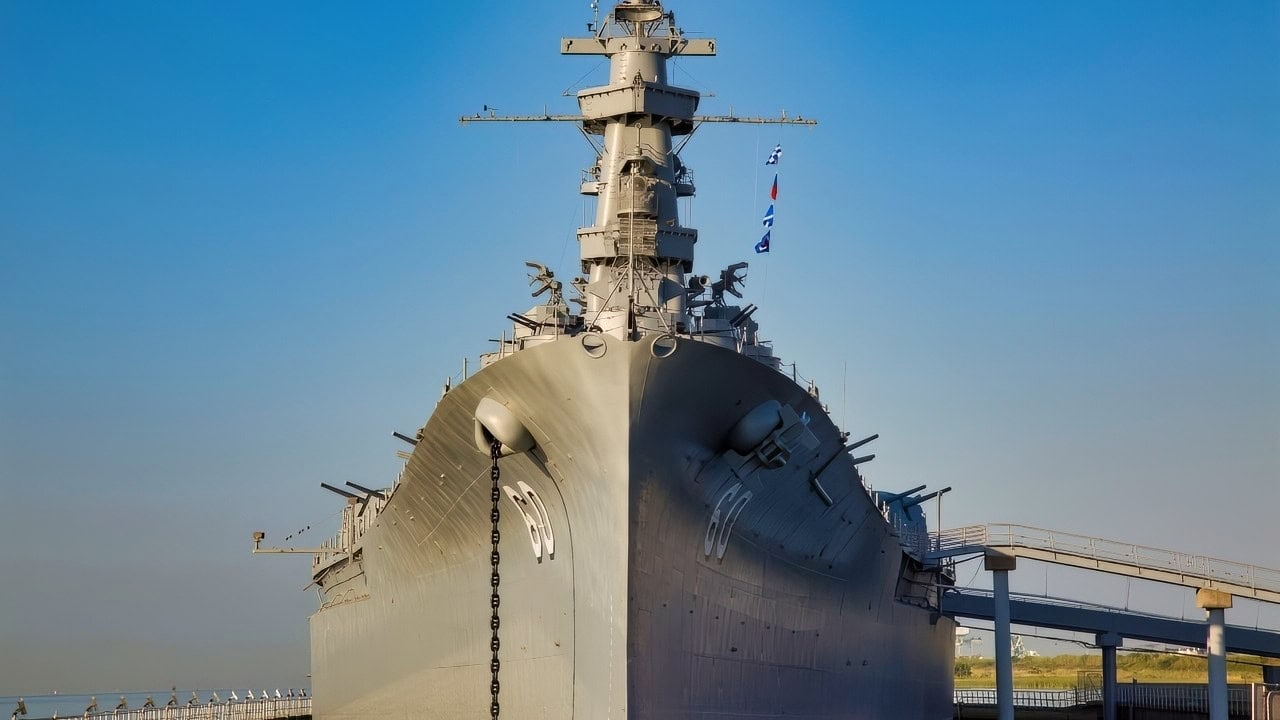
The USS Alabama Battleship Memorial Park in Mobile, Alabama. Creative Commons Image.
Alabama entered commission on August 16, 1942, and left active service on January 9, 1947. In those 53 months, she protected Arctic convoys, screened fast carriers, bombarded Japanese positions, and defended the fleet from air attack. Her wartime crew reached about 2,500 officers and sailors.
The Navy planned to scrap the ship in the early 1960s. Alabama residents instead launched a statewide preservation campaign and raised enough money to tow her from Washington State to Mobile, where the battleship has welcomed visitors since January 9, 1965.
$80 Million Bought a Compact 45,000-Ton Battleship
The South Dakota class grew from a difficult design order. Congress wanted the Navy to remain near the 35,000-ton treaty limit while adding nine 16-inch guns and armor able to resist heavy shellfire. Alabama therefore packed exceptional firepower into a hull shorter than the later Iowa class, a compromise behind the reputation of the South Dakota-class battleships.
The nominal standard figure was 35,000 tons, while wartime loads pushed Alabama toward 44,500 tons. Her side belt reached 12.2 inches, the conning tower had 16 inches of protection, and the faces of the main turrets were 18 inches thick. The treaty-limited design still produced a fast ship able to remain with carrier task forces.
Nine 16-Inch Guns Fired a 24,300-Pound Broadside
Alabama’s main battery consisted of nine 16-inch/45-caliber Mark 6 guns arranged in three triple turrets. Each gun fired a 2,700-pound armor-piercing projectile more than 20 miles. One full broadside placed 24,300 pounds of steel in the air, the central number behind the destructive power of Alabama’s main battery.
The battleship carried 20 dual-purpose 5-inch guns in ten twin mounts, 48 40mm Bofors barrels and 52 20mm Oerlikons in its late-war configuration. Added to the main battery, the ship displayed 129 gun barrels. Three Kingfisher floatplanes and two stern catapults supported reconnaissance and gunfire spotting.

16-Inch Guns of USS Iowa 19FortyFive Image taken By Harry J. Kazianis on the Deck of the Battleship USS Iowa.
Alabama’s Main Mission Was Protecting Aircraft Carriers
Alabama’s first deployment sent her to the British Home Fleet in 1943. She helped protect the Arctic supply route to the Soviet Union and participated in an effort intended partly to draw the German battleship Tirpitz into action. Tirpitz stayed in port, denying Alabama her first possible battleship engagement.
The ship moved to the Pacific in August 1943. Her wartime assignments included the Gilberts, Marshalls, Truk, New Guinea, the Marianas, Guam, the Philippines, Okinawa, and strikes against Japan. Alabama bombarded Nauru, Saipan, Minami Daito Jima, and industrial targets on Honshu while spending much of the war inside the anti-aircraft screen around fast carriers.
At the Battle of the Philippine Sea in June 1944, Alabama’s radar supplied early warning of approaching Japanese aircraft. The ship’s task group destroyed nine planes during the battle. The larger carrier engagement destroyed much of Japan’s remaining naval air strength before the opposing battleships came within gun range.
USS Alabama Never Fought Another Battleship
The answer is direct: Alabama never exchanged fire with an enemy battleship. American forces tried to catch the retreating Japanese fleet after the Philippine Sea battle, but no surface contact followed. During Leyte Gulf, Alabama went north with Admiral William Halsey’s force for the Battle off Cape Engaño and again saw no ship-to-ship action.
Massachusetts exchanged heavy gunfire with the French battleship Jean Bart off Casablanca, while South Dakota fought near Guadalcanal as Washington destroyed Kirishima. Alabama’s 16-inch guns were used against shore installations rather than enemy armor, reflecting how carrier aviation had displaced the battleship duel.
218,000 Miles Produced Nine Battle Stars
Alabama finished the war credited with 22 enemy aircraft destroyed and nine battle stars. No crew member died from enemy action, helping produce the nickname “Lucky A.” The record was not free of loss: an accidental discharge from one 5-inch mount into another on February 21, 1944, killed five sailors and wounded 11.
The battleship survived Japanese air attacks and two major Pacific typhoons without serious combat damage.
After Japan surrendered, Alabama supported occupation duties and returned personnel to the United States before joining the reserve fleet.
The ship remained there until the Navy struck her from the register in 1962.
$800,000 Saved Alabama From the Scrapyard: You Can Visit This Battleship in Mobile, Alabama Right Now
The state preservation campaign raised about $800,000, with Alabama schoolchildren supplying nearly $100,000.
Tugboats then pulled the ship about 5,600 nautical miles through the Panama Canal to Mobile.
The 108-foot-wide hull passed through the original locks with approximately 11 inches of clearance on each side.
USS Alabama now anchors Battleship Memorial Park at 2703 Battleship Parkway in Mobile.
The museum is open from 8 a.m. to 5 p.m. every day except Christmas, with the final ticket sold at 4 p.m.
About the Author: Harry J. Kazianis
Harry J. Kazianis (@Grecianformula) was the former Senior Director of National Security Affairs at the Center for the National Interest (CFTNI), a foreign policy think tank founded by Richard Nixon based in Washington, DC. Harry has over a decade of experience in think tanks and national security publishing. His ideas have been published in the NY Times, The Washington Post, The Wall Street Journal, CNN, and many other outlets worldwide. He has held positions at CSIS, the Heritage Foundation, the University of Nottingham, and several other institutions related to national security research and studies. He is the former Executive Editor of the National Interest and the Diplomat. He holds a Master’s degree focusing on international affairs from Harvard University.

