
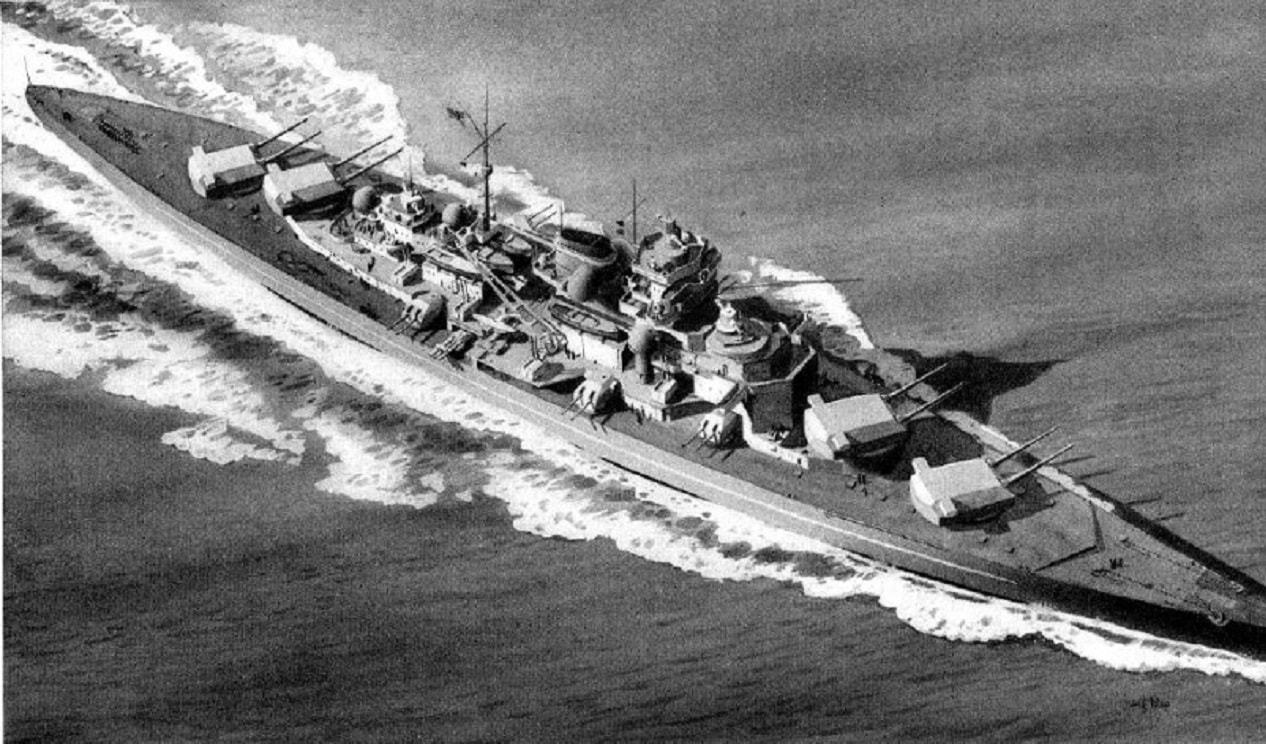
Germany’s H-Class Battleship Was a 62,600-Ton Super-Bismarck That Never Left the Slipway: Nazi Germany laid down two H-class battleships in 1939, then stopped almost as soon as the war began. Battleship H went onto the slipway at Blohm & Voss in Hamburg in July. Battleship J followed at Deschimag’s AG Weser yard in Bremen in September. Neither reached the water.
The H-39 design was not the 140,000-ton fantasy associated with the later H-44 study. It was a serious Plan Z project: a 62,600-long-ton battleship intended to cross the Atlantic, operate for long periods without refueling, and challenge the heavy escorts protecting British convoys.
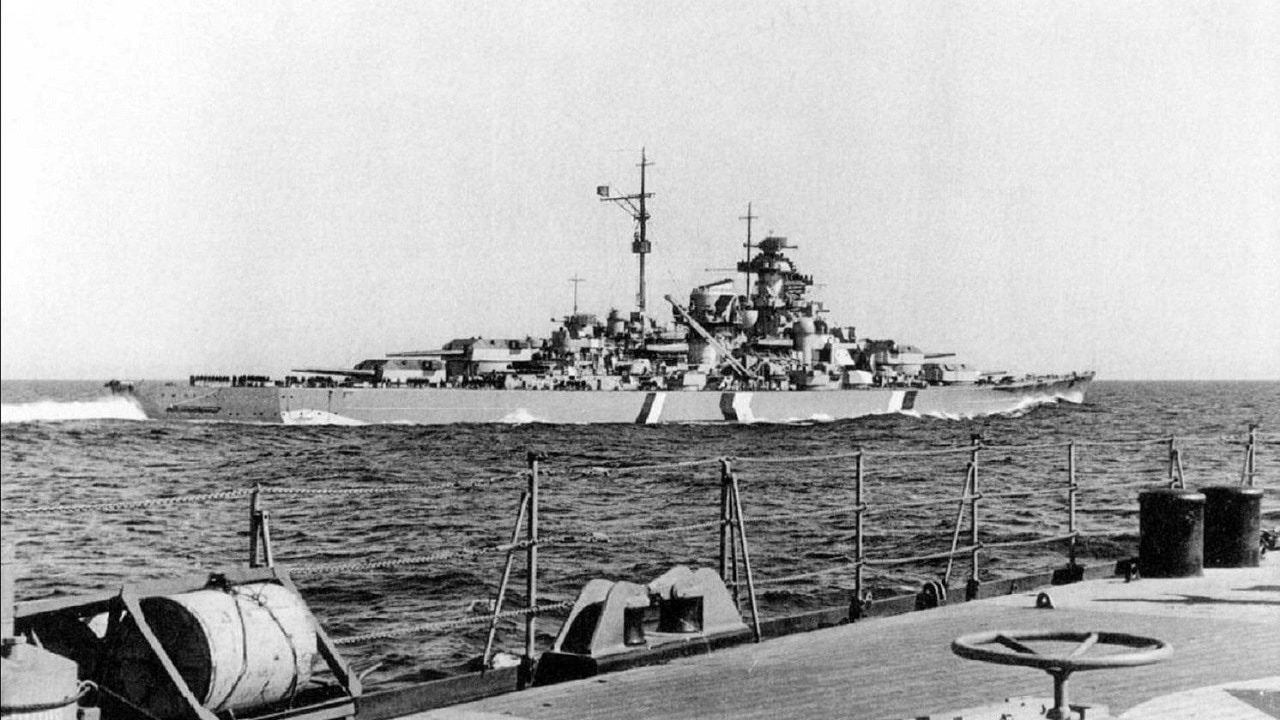
Battleship Bismarck. Image Credit: Creative Commons.
Published German warship-cost compilations estimate 240.85 million Reichsmarks for Battleship H and 237.6 million for Battleship J. Those were planning figures rather than final completed-ship bills. Bismarck was recorded at 196.8 million Reichsmarks. One H-class ship represented roughly the construction cost of 51 Type VII C U-boats.
That comparison explains the class’s fate. Germany approved a fleet intended for the late 1940s, then went to war with Britain in September 1939. The Kriegsmarine needed submarines and smaller vessels immediately, a mismatch built into Germany’s prewar naval strategy. A battleship requiring more than four years to finish would not affect the conflict Germany had already started.
The H-39 Was the Real H-Class Battleship
Plan Z called for six H-class battleships as the center of a much larger surface fleet. H-39 would have measured 911 feet overall, with a beam of about 121 feet and a full-load draft near 37 feet. Standard displacement was approximately 52,600 long tons, rising toward 62,600 at full load. Crew size was projected at about 2,600.
Twelve MAN diesel engines would have driven three shafts with 165,000 horsepower. Intended speed was 30 knots, but range was the standout figure: roughly 19,200 nautical miles at 19 knots. The diesels reflected Admiral Erich Raeder’s plan to use the ships for extended commerce warfare in the Atlantic.
That endurance would have made H-39 a serious raider, fitting Germany’s surface commerce-war strategy. It would have forced the Royal Navy to assign battleships, carriers, and cruisers to hunting groups.
Eight 16-Inch Guns Gave H-39 a Nine-Ton Broadside
The main battery consisted of eight 40.6-centimeter, or 16-inch, SK C/34 guns in four twin turrets. Each armor-piercing shell weighed about 2,271 pounds. Firing all eight guns would have produced an 18,168-pound broadside, a little more than nine short tons.
The guns were designed for roughly 2,657 feet per second, about two rounds per minute, and a maximum range near 40,000 yards. Their high velocity favored belt penetration over plunging deck fire.
The supporting battery included twelve 5.9-inch guns, sixteen 4.1-inch dual-purpose guns, lighter anti-aircraft weapons, and six submerged torpedo tubes. The 1939 antiaircraft fit would have required major wartime expansion.
H-39 vs. Iowa and Yamato
H-39 would have sat between the Iowa and Yamato classes in loaded displacement. Its full-load displacement of about 62,600 long tons exceeded the roughly 58,000-ton Iowa figure, while Yamato approached 71,700 long tons. H-39 was also longer than both: about 911 feet, compared with Iowa’s 887 feet and Yamato’s 863 feet.

Iowa-Class Battleship. Image: Creative Commons.
Iowa held the speed advantage. Its 212,000-horsepower machinery drove the American battleship near 33 knots. H-39 was designed for 30, while Yamato made about 27. The German ship’s diesel range would have been its strongest numerical advantage.
Firepower favored the American and Japanese ships. Iowa’s nine 16-inch guns fired 2,700-pound armor-piercing shells for a 24,300-pound broadside. Yamato’s nine 18.1-inch guns fired 3,219-pound shells for 28,971 pounds. H-39 had one fewer gun than either ship and a much lighter shell. The comparison helps explain why shell design mattered as much as bore diameter.
H-39’s planned 11.8-inch belt was close to Iowa’s but well below Yamato’s 16.1 inches. America’s planned Montana class would also have carried twelve 16-inch guns.
War Ended the H-Class Before It Began
The Navy expected about 50 months to complete each ship. War destroyed the assumptions behind that schedule. The first two hulls would not affect the immediate struggle with Britain, and the remaining four never reached the slipway.
The Bundesarchiv identifies construction capacity, raw materials and financing as problems even before war. After September 1939, work stopped so shipyards and steel went to U-boat production and urgent programs. Battleship H had only hundreds of tons incorporated into the keel, although several thousand tons had been delivered or machined. J was even less advanced.
U-boats were already attacking the trade routes Plan Z was supposed to threaten years later with battleships and carriers. A submarine cost a fraction of H-39, required a far smaller crew and entered service much sooner. Germany also never completed the carriers and escorts needed to make Raeder’s surface groups work.
The later H-41 through H-44 studies grew beyond the capacity of German ports and yards. H-39 was different: it was buildable, ordered and started.
The H-Class Ended as Scrap and Coastal Artillery
The incomplete keels were eventually dismantled and their steel reused. By late 1941, the physical beginning of Plan Z’s battleship force was being broken apart on the same slips where it had started.
Some 40.6-centimeter guns built for the program survived. Germany installed them in coastal batteries in France and Norway rather than battleship turrets. Several remained at Trondenes after the war, and one is preserved there as a museum weapon. The gun entered service. The 62,600-ton ship designed to carry it never moved beyond sections of steel in Hamburg and Bremen.
About the Author: Harry J. Kazianis
Harry J. Kazianis (@Grecianformula) was the former Senior Director of National Security Affairs at the Center for the National Interest, a foreign policy think tank founded by Richard Nixon in Washington, D.C. Harry has more than a decade of experience in think tanks and national security publishing. His ideas have been published in The New York Times, The Washington Post, The Wall Street Journal, CNN and many other outlets worldwide. He has held positions at CSIS, the Heritage Foundation, the University of Nottingham and several other institutions related to national security research and studies. He is the former Executive Editor of The National Interest and The Diplomat. He holds a master’s degree focusing on international affairs from Harvard University.

