
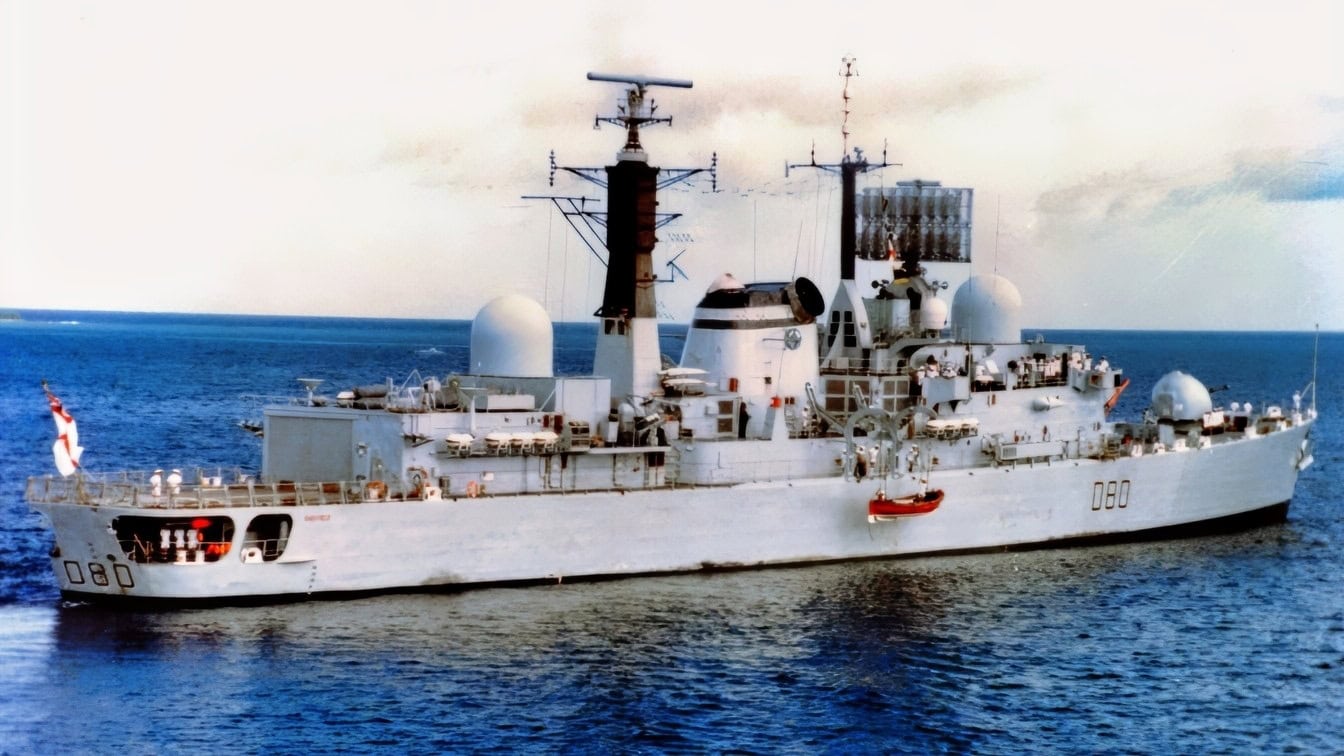
The UK and Argentina went to war over British territory in the Falkland Islands off Argentina’s coast in the spring of 1982. The ten-week conflict began when Argentina invaded and occupied the Falkland Islands on April 2, 1982, followed by the occupation of South Georgia Island the next day.
The UK shortly thereafter dispatched a naval force to engage Argentine ground and naval forces and retake the disputed islands.
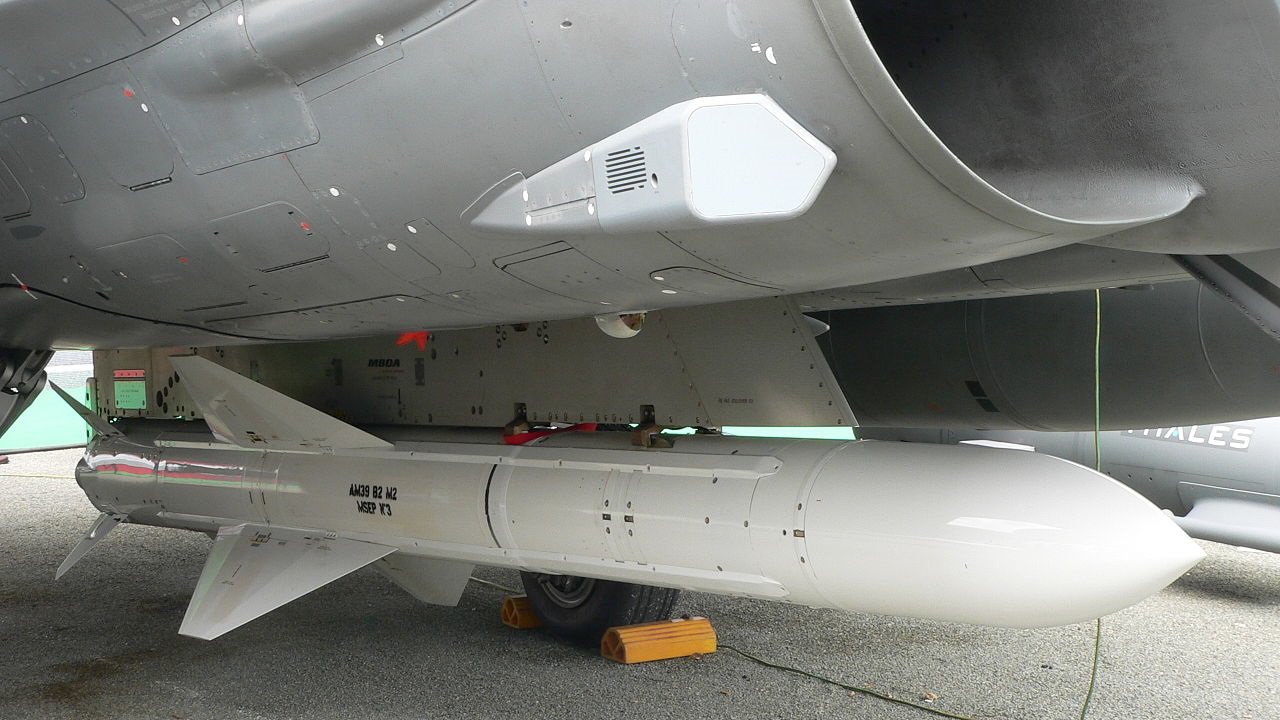
Exocet AM-39 anti-ship missile (from MBDA) under a Dassault Rafale.
On May 4, 1982, two Argentine Super Étendard fighters launched Exocet anti-ship missiles at the British fleet. One missile hit the destroyer, HMS Sheffield (D80), on deck level 2, penetrating the galley and causing a massive explosion and fire.
A total of 20 sailors died, mostly from smoke inhalation, and another 26 were wounded in the attack. The ship lost power, and the firefighting water main was knocked out. She was placed under tow, but eventually sank six days later on May 10.
It was the first Royal Navy ship sunk in combat since World War II.
Background On The Falklands War
The Falkland Islands had been a British colony for over 150 years.
The Argentinians called them the Islas Malvinas.
However, the British government considered the colony somewhat of a nuisance and an impediment to trade in South America.
During the mid-1960s, they were prepared to cede control of the islands, including South Georgia Island and the South Sandwich Islands, to Argentina.
However, the residents of the colonies considered themselves British citizens and sought parliamentary favor to remain so.
They steadfastly refused to become Argentine citizens and refused to accept Argentine control of the region.
In December 1981, a new military junta led by General Leopoldo Galtieri (acting president), Basilio Lami Dozo, and Admiral Jorge Anaya sought a way for Argentine citizens to rally around national sovereignty and divert public attention from the country’s dire economic situation since the junta took control.
Anaya was the main architect for the invasion, believing that the UK, which had been trying to cede the territory back to Argentina for more than a decade and a half, wouldn’t respond militarily.
It was a terrible mistake on his part.
How The Argentine Attack On The Sheffield Unfolded
On May 4, HMS Sheffield had been ordered forward with two other Type 42 destroyers to provide long-range radar and medium-high-altitude missile picket far from the British carriers.
She was attacked by Argentine fighters from the 2nd Naval Air Fighter/Attack Squadron. At 0750 hours, a Neptune patrol aircraft picked up the Sheffield and HMS Yarmouth.
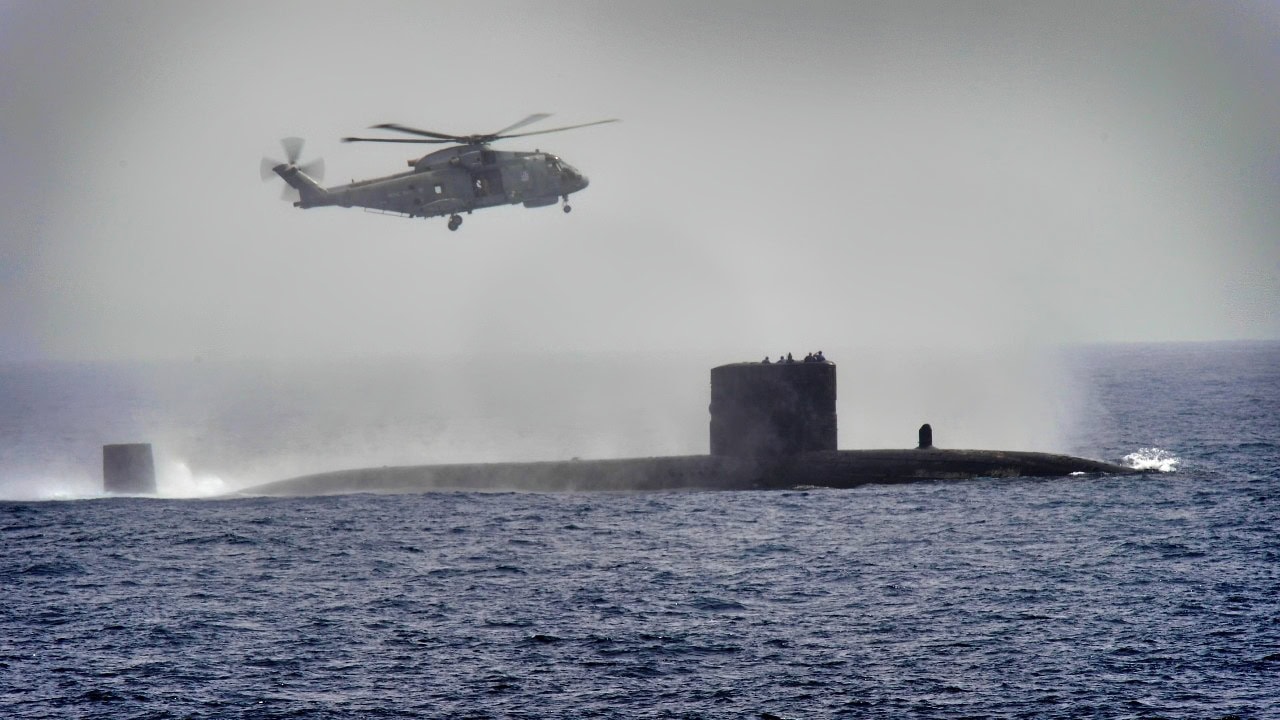
Trafalgar Class Fleet Submarine HMS Turbulent is pictured with the Merlin helicopter from Type 23 frigate HMS St Albans, during an anti-submarine exercise in the Gulf of Oman. The ship tested sonar ranges, radar ranges and lookouts during the exercise also involving HMS Turbulent and a small number of foreign vessels. Organization: ROYAL NAVY Object Name: FK110085048 Category: MOD Supplemental Categories: Equipment, Submarines, Fleet, Trafalgar Class, Aircraft, Helicopters, Merlin Keywords: Royal Navy, Equipment, Submarine, Nuclear, Fleet Submarines, Ship Submersible Nuclear, SSN, Trafalgar Class, HMS Turbulent, Aircraft, Helicopter, Merlin , HM Mk1 Country: Middle East.
Two Argentine pilots flying Super Étendard fighters rendezvoused with aerial tanker support and pressed on with an attack.
The Argentine Navy also had Type 42 destroyers, so the pilots knew the vessels’ strengths and weaknesses, especially the ship’s radar horizon, detection distances, and reaction times, as well as the optimal procedure for programming the Exocet missiles for a successful attack profile.
They launched the Exocets from a range of 20 to 30 miles at 1104 hours.
This is when several breakdowns occurred in the Royal Navy. Lookouts on the Sheffield saw the smoke from the incoming missiles.
However, the anti-air warfare officer had left the ship’s operations room and was drinking coffee in the wardroom when the Argentinian Navy launched the attack, while his assistant had left “to visit the head” (bathroom break).
So, there was no air defense officer at his post in a war zone.
Because of this breakdown, the ship didn’t perform evasive maneuvers, fire chaff, go to “action stations” (battle stations on USN ships), or even call the ship’s captain to the bridge.
The second Exocet fired at the Yarmouth missed, but the first one slammed into the Sheffield’s starboard side at deck level 2, traveling through the junior ratings’ scullery and breaching the Forward Auxiliary Machinery Room/Forward Engine Room bulkhead 8 feet above the waterline, creating a hole in the hull roughly 4 feet by 10 feet.
Although the missile apparently failed to explode, it disabled the ship’s electrical distribution systems and breached the pressurized seawater fire main.
The after-action report found that the firefighting efforts “lacked cohesion” and were “uncoordinated”, and that although the crew attempted to tackle the blazes, “it was not clear where the command of the ship was located.”
The damage to the fire system severely hampered any firefighting response and eventually doomed the ship to be consumed by the fire.
Fire Fighting And Damage Control Measures Failed
With the main firefighting water main knocked out, the damage control teams lacked the capacity to fight the fires, and their efforts were uncoordinated.
After four hours with the fires raging out of control, Captain James Salt ordered the crew to abandon ship.
Sheffield was taken under tow by the Yarmouth, but heavy seas began to leak seawater through the hole in the hull. On May 10, she rolled over and sank in 6,000 feet of water.
The Exocets Were Game Changers Despite Their Few Numbers
At the time of the conflict, Argentina had only five air-launched Exocet missiles in its inventory.
The Argentinians had purchased a handful of AM39 variants, along with a few Super Étendard strike fighters from France, only a few months prior to the conflict.
They also had a pair of shipboard MM-38 Exocets that they removed and loaded on ground launchers.
They launched all seven Exocet missiles at the British fleet; three ships were hit, and two of those sank: HMS Sheffield and the 15,000-ton container ship Atlantic Conveyor.
A third ship was hit, the County-class destroyer HMS Glamorgan, but she was maneuvering at the time of the missile strike and was able to contain the damage, continued the fight, and sailed home under her own power.
Those seven Exocets caused hundreds of millions of dollars in damage to the Royal Navy, with two ships sunk, one damaged, as well as the loss of three Chinook, six Wessex, and one Lynx helicopters, ammunition, and other war supplies, and the lives of 46 sailors.
The cost ratio alone for HMS Sheffield was more than 250-to-1, as the Exocet cost only $200,000 in 1982, against the cost of the Sheffield (about $40.55 million), but it highlighted how a cheap, sea-skimming missile could influence a battle against a fleet of warships.
While the British were successful in retaking the Falkland Islands, the cost was very steep. They lost 2 Type 42 destroyers, 2 Type 21 frigates, 1 landing ship,1 landing craft, 1 container ship, 1 light tank, 24 helicopters, and 10 fighters.
And the presence of just seven cheap Exocet missiles had a profound effect on the conflict. Had Argentina had more of those, the outcome may have been vastly different.
The status of the islands remains a sore spot with Argentinians. Following Argentina’s semi-final victory over England in Atlanta, some players brandished a banner declaring “Las Malvinas Son Argentinas” (The Falklands Are Argentine).
About the Author: Steve Balestrieri
Steve Balestrieri is a National Security Columnist. He served as a US Army Special Forces NCO and Warrant Officer. In addition to writing on defense, he covers the NFL for PatsFans.com and is a member of the Pro Football Writers of America (PFWA). His work was regularly featured in many military publications.