
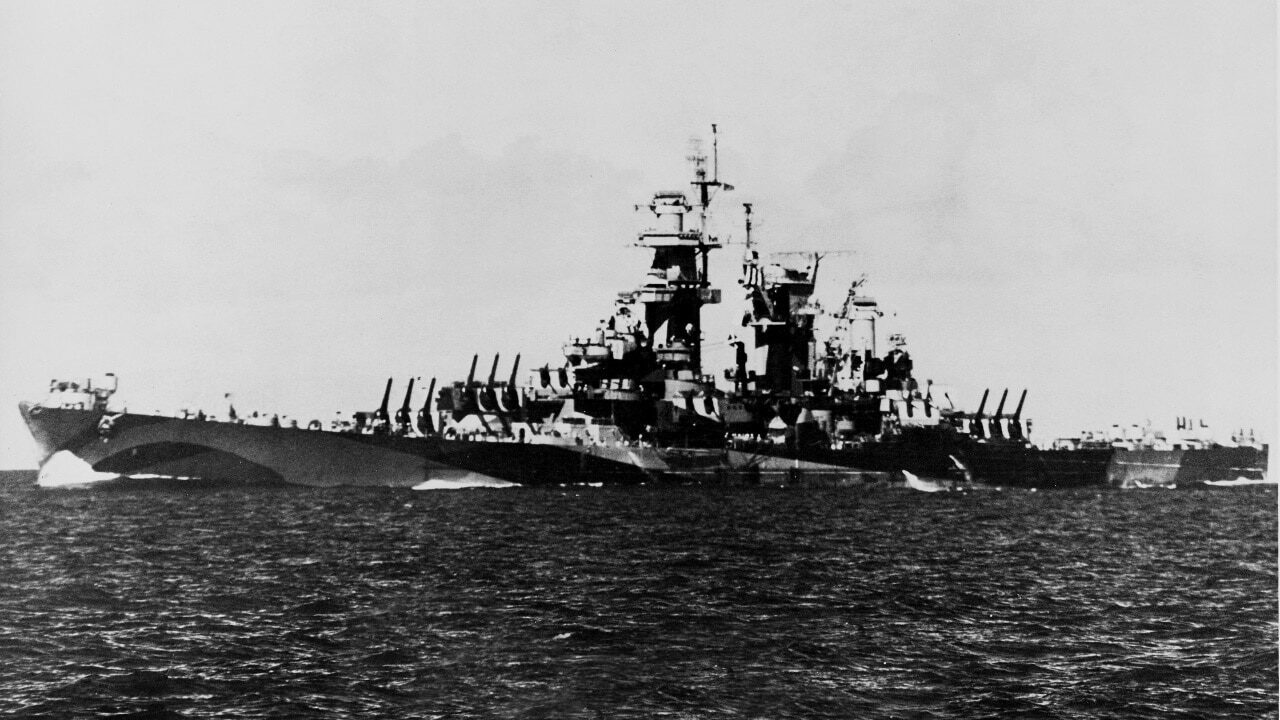
USS Hawaii Was About 84 Percent Complete When the Navy Abandoned Its Third Alaska-Class Cruiser – Hawaii (CB-3), what many have called a min-battleship of sorts, was close to becoming a warship when the Navy stopped construction. Most summaries round their progress to 84 percent. An official Navy photograph gives the more precise figure of 82.4 percent when work was formally suspended on February 17, 1947. All three 12-inch turrets had been installed, but the ship never received a commission, so “USS Hawaii” is a familiar name rather than its formal service identity.
The Alaska-Class Cruiser That Never Was Finished
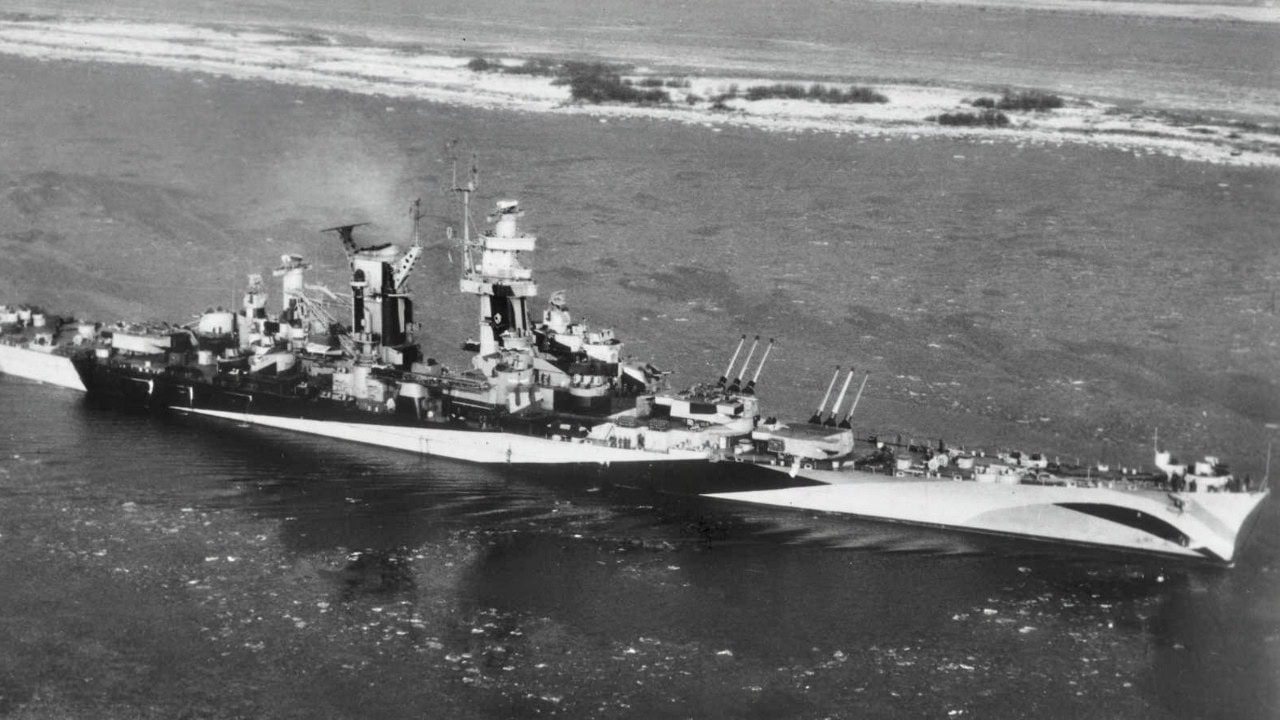
Alaska-Class U.S. Navy Cruiser
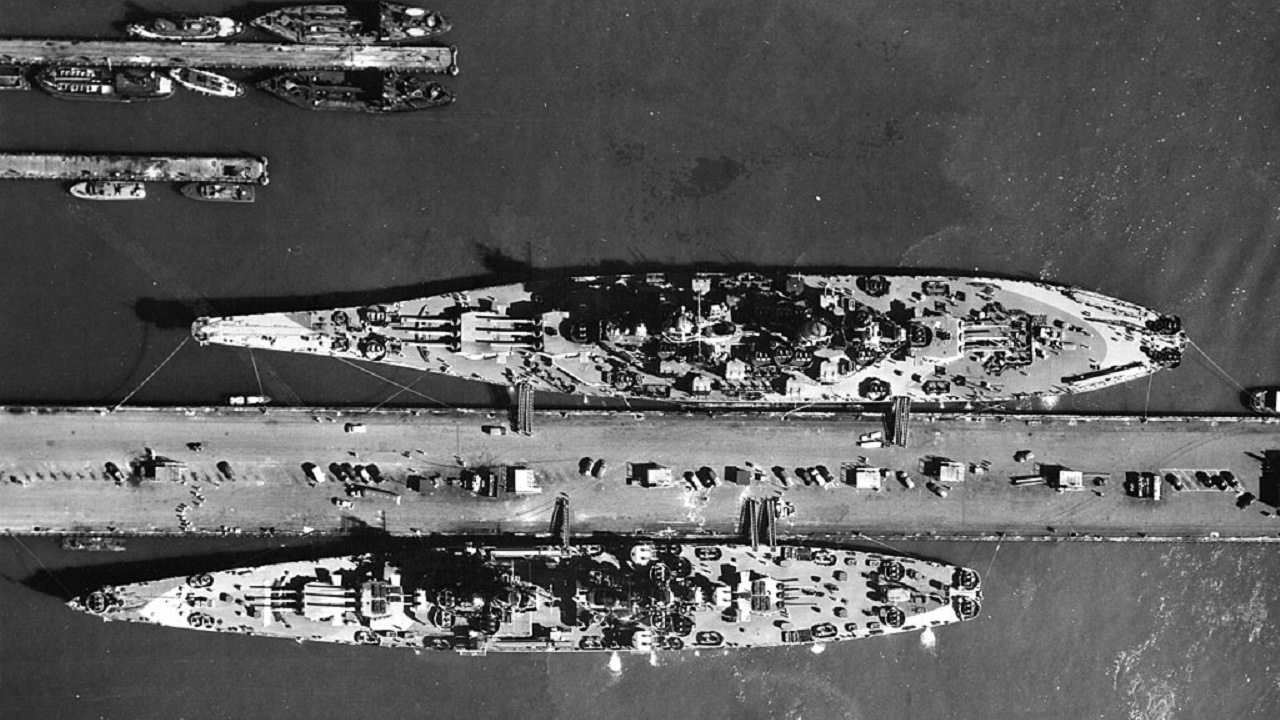
Aerial view of warships at the base piers of Norfolk Naval Base, Virginia (USA), circa August 1944. Among them are: the battleship USS Missouri (BB-63), the largest ship; the battlecruiser USS Alaska (CB-1), on the other side of the pier; the escort carrier USS Croatan (CVE-25), and two destroyers, a Fletcher-class destroyer at the pier and a Clemson/Wilkes-class-destroyer moored outboard.
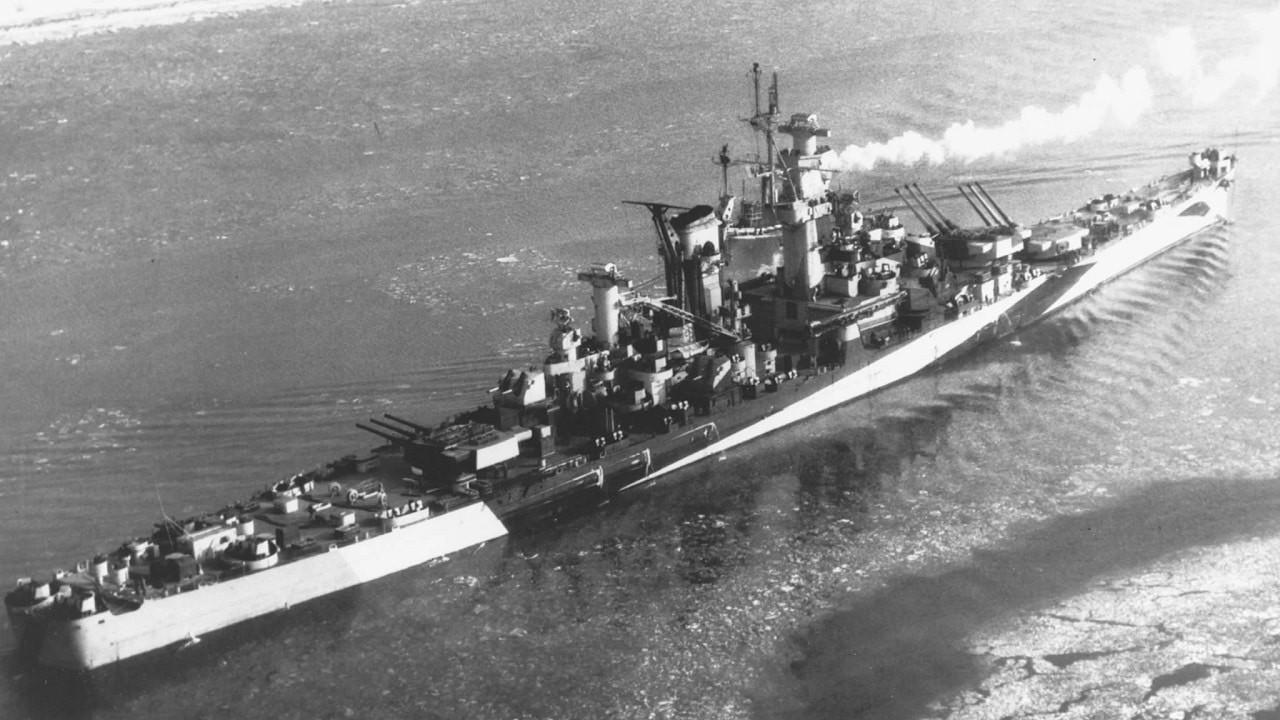
Alaska-Class. Image Credit: Creative Commons.
New York Shipbuilding Corporation in Camden, New Jersey, laid the keel in December 1943. Hawaii entered the war on November 3, 1945, two months after Japan signed the surrender documents in Tokyo Bay. It was an 808-foot cruiser killer launched after the war it had been designed to fight was already over.
The class was rated at 27,000 long tons standard and 35,264 tons on trials. Eight boilers supplied four General Electric geared turbines producing 150,000 shaft horsepower. The completed ships reached 31.4 knots on trials, while published design figures commonly rounded the maximum to 33 knots.
Hawaii’s intended armament contained nine 12-inch guns, twelve 5-inch guns, fifty-six 40 mm Bofors barrels, and thirty-four 20 mm Oerlikons, plus four floatplanes. That amounted to 111 gun barrels on a hull able to accommodate 140 officers and 2,111 enlisted sailors under Bureau of Ships planning figures.
Hawaii Was Built to Hunt Cruisers That Never Appeared
The Navy officially classified the Alaska class as “large cruisers,” assigning the unusual CB designation. Their size, 12-inch battery, and capital-ship price led generations of writers to call them battlecruisers or mini-battleships. The distinction mattered because the design carried cruiser-style protection rather than the armor and underwater defense expected from a true battleship.
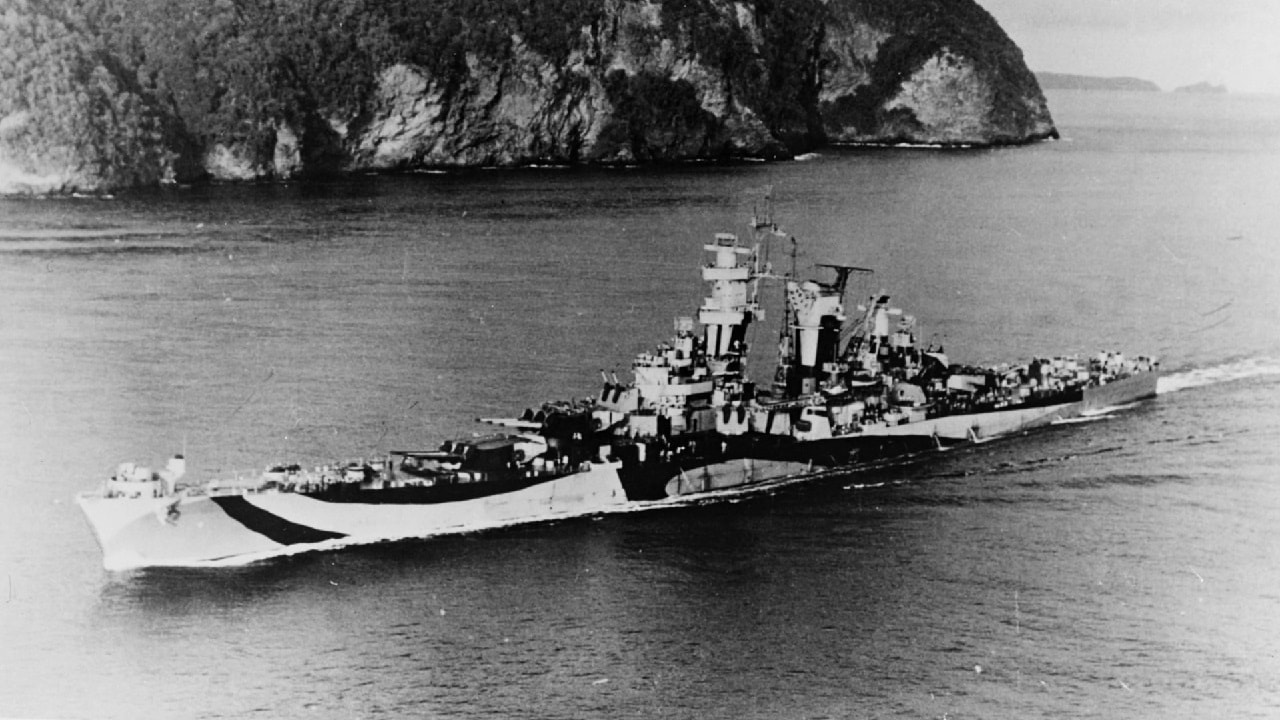
The U.S. Navy large cruiser USS Guam (CB-2) underway off Trinidad on 13 November 1944 during shakedown training.
The requirement grew from late-1930s anxiety about German commerce raiders and reports that Japan might build “super-cruisers” capable of overpowering American heavy cruisers. The Navy wanted a fast hunter that would catch those ships, defeat them with larger guns, and still operate with carrier task forces. That mission produced the peculiar middle ground behind the Alaska-class large-cruiser design.
Six ships were ordered. Alaska and Guam entered service in 1944. Hawaii became the third hull, while the Philippines, Puerto Rico, and Samoa were canceled before construction began. Japan studied its own B-65 large cruiser, but never ordered one. The enemy class used to justify the American ships remained a design study.
Hawaii also lacked the protection needed to fight modern battleships. Its belt was about nine inches thick, and the underwater defense system followed cruiser practice. The ship was meant to dominate 8-inch-gun cruisers, not trade salvos with 14-, 15-, or 16-inch battleships.
Nine 12-Inch Guns Would Have Fired a 10,260-Pound Broadside
The Mark 8 gun was developed for the Alaska class. Each weapon weighed 121,856 pounds with its breech and fired a 1,140-pound armor-piercing shell at 2,500 feet per second. Nine shells created a 10,260-pound broadside, slightly more than five short tons of steel.
The guns were rated at 2.4 to three rounds per minute. At the upper rate, the complete battery theoretically launched 30,780 pounds of armor-piercing projectiles in 60 seconds. Ammunition spaces provided 166 rounds for each barrel, and the maximum range for the armor-piercing shell reached 36,774 yards, nearly 21 miles.
The twelve 5-inch/38 guns supplied dual-purpose fire against aircraft and surface targets. Fourteen quadruple Bofors mounts accounted for the 56 medium antiaircraft barrels, with 34 Oerlikons defending the closest zone. The completed sisters used those smaller weapons far more than their 12-inch batteries during carrier-screening operations in 1945.
Official photographs show Hawaii fitting out in July 1946 with the after 12-inch turret and three aft 5-inch mounts already in position. Later images show the full set of three main turrets removed after the unfinished ship moved to the Philadelphia Reserve Fleet.
The War Ended Before Hawaii Left Camden
Alaska and Guam were not defective ships. They screened fast carriers, helped defend formations from aircraft, escorted the damaged USS Franklin, and bombarded Japanese-held islands. Neither fired its main battery at an enemy surface warship. Japan’s cruiser force had already suffered devastating losses by the time the two large cruisers reached combat.
Hawaii faced an even harsher timing problem. It launched after victory, when the Navy possessed a huge surplus of carriers, battleships, cruisers, and destroyers. The Bureau of Ships recorded a construction cost of $45.616 million for each completed sister. No comparable completed cost exists for Hawaii because the Navy never accepted the ship.
Finishing Hawaii meant spending more money, assigning more than 2,000 sailors, and supporting another specialized hull for a mission that had largely disappeared. Carrier aircraft reached hundreds of miles beyond the ship’s guns. Iowa-class battleships offered heavier armor and 16-inch firepower while remaining fast enough to escort carriers. Heavy cruisers provided air defense and bombardment with smaller crews and lower operating costs.
Hawaii occupied the same expensive middle position examined in the wider Alaska-class failure. The Navy suspended work rather than pay for completion, trials, ammunition, crew training, and years of operation. By 1947, it no longer had a requirement strong enough to justify the remaining work.
Missile and Command-Ship Plans Could Not Save the Hull
The Navy did not immediately give up on the nearly finished ship. One proposal would have converted Hawaii into an experimental guided-missile vessel with full combat capability. Plans included seven twin 3-inch/70 mounts and new missile-related equipment. Shrinking budgets and the cost of modernizing Essex-class aircraft carriers killed the project.
A second plan advanced further. Congress authorized $58.772 million in fiscal 1952 to finish Hawaii as a large tactical command ship, including $30 million for the conversion. The Navy reclassified it as CBC-1 on February 26, 1952. No conversion contract was awarded, and rising costs elsewhere ended the program in 1954.
The failed conversions showed both the attraction and burden of the hull. Its size offered room for command spaces, sensors, and weapons, but completing and operating an 808-foot ship remained expensive. The experience became part of the case against preserving a specialized capital ship without a settled mission.
Later histories have revisited why the Alaska-class mini-battleships arrived too late, used the ships as a warning for new battleship proposals, and detailed how their 111-barrel batteries never fought the surface action envisioned for them. The broader debate over bringing battleships back returns to whether one large hull provides enough unique value to justify its cost.
Boston Metals Took Hawaii to Baltimore
Hawaii reverted to CB-3 in October 1954. The Navy struck the unfinished ship from the register on June 9, 1958, and sold it to Boston Metals Company of Baltimore, Maryland, in 1959. The three 12-inch turrets had already been removed.
A Navy photograph from June 20, 1959, shows the 808-foot hull being towed away for scrapping, with empty circular barbettes marking where its main battery once stood.
About the Author: Harry J. Kazianis
Harry J. Kazianis (@Grecianformula) is the former Senior Director of National Security Affairs at the Center for the National Interest (CFTNI), a foreign policy think tank founded by Richard Nixon based in Washington, DC. Harry has over a decade of experience in think tanks and national security publishing. His ideas have been published in the NY Times, The Washington Post, The Wall Street Journal, CNN, and many other outlets worldwide. He has held positions at CSIS, the Heritage Foundation, the University of Nottingham, and several other institutions related to national security research and studies. He is the former Executive Editor of the National Interest and the Diplomat. He holds a Master’s degree focusing on international affairs from Harvard University.

