
Operation Praying Mantis: One Day, Half of Iran’s Navy, and the Only Missile Duel the US Navy Has Ever Fought – On 18 April 1988, the United States Navy fought a battle that lasted a single day and cost Iran roughly half its operational surface fleet. The frigate Sahand was sunk, the missile boat Joshan was sunk, the frigate Sabalan was crippled and left burning, two militarized oil platforms were destroyed, three armed speedboats were killed, and a pair of Iranian F-4 Phantoms was chased off with a damaged wing between them. The only Americans dead were two Marine aviators whose helicopter went into the Gulf after dark. The Naval History and Heritage Command records the day as the largest of five major US Navy surface actions fought since 1945, the only occasion on which American warships have traded surface-to-surface missile fire with an enemy, and the action that produced the largest warship the Navy has sunk since the Second World War.
The Iran War of 1988: Operation Praying Mantis
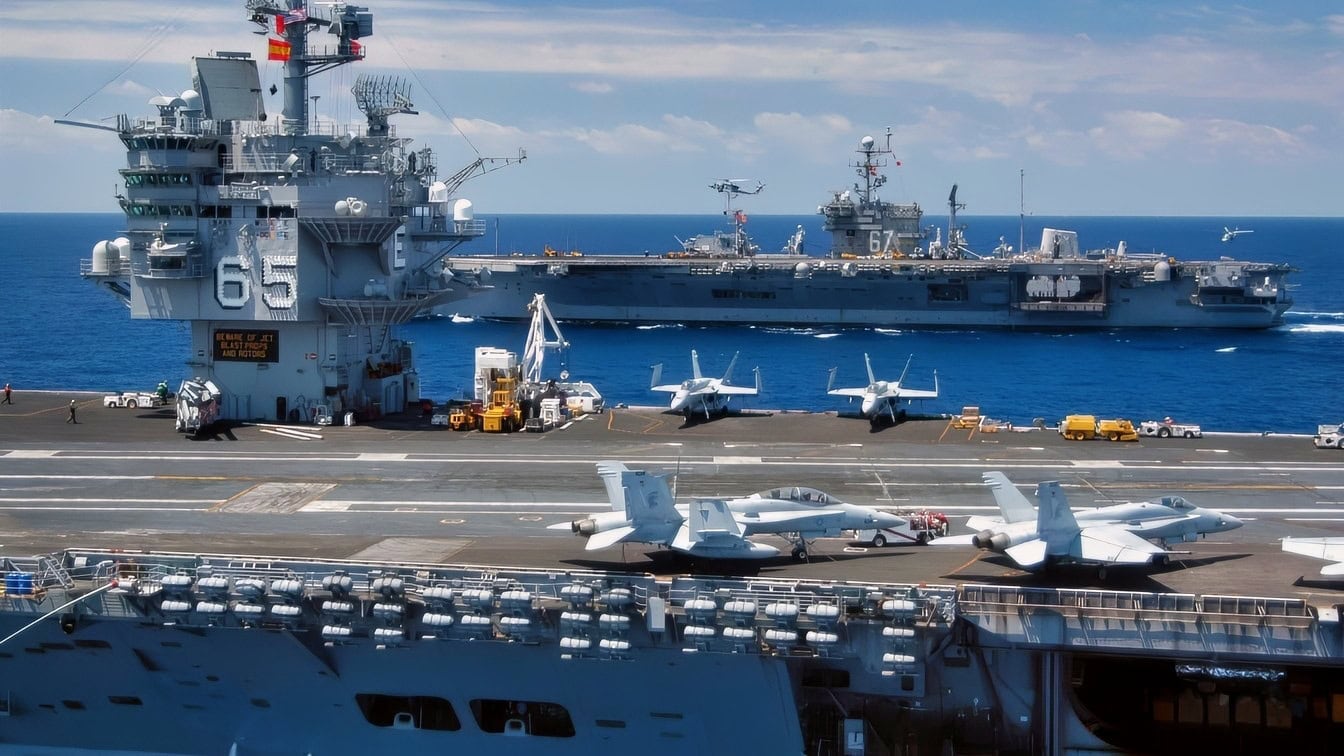
040423-N-8704K-011 Atlantic Ocean April 23, 2004 The USS Enterprise (CVN65) and the USS John F. Kennedy (CV67) steam along side each other while transferring ammunitionin in the Atlantic Ocean on April 23,2004. The Kennedy received ordnance from from the USS Enterprise (CVN65) and the USS Seattle (AOE3) in preperation of an upcoming deployment.
US Navy photo by: Photographers Mate Third Class (AW/SW) Joshua Karsten
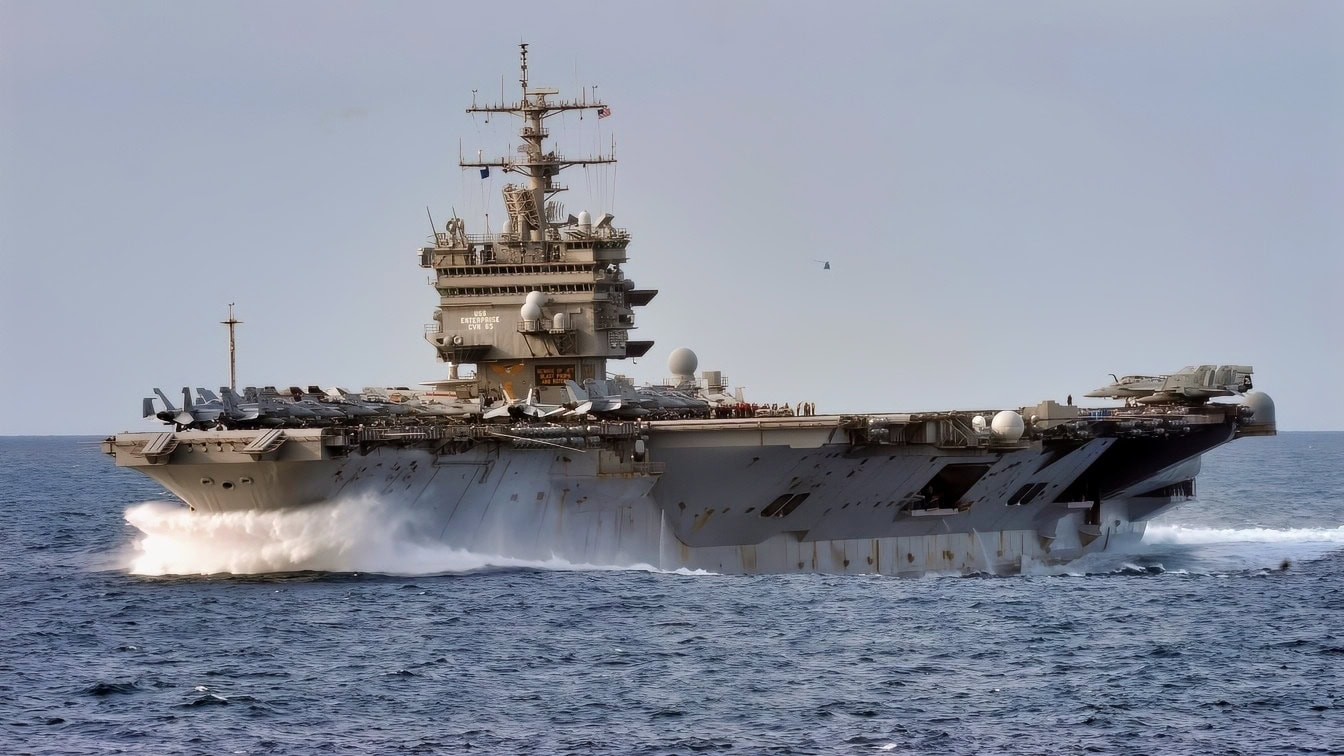
ATLANTIC OCEAN (Feb 04, 2012) Aircraft carrier USS Enterprise (CVN 65). Enterprise is underway participating in exercise Bold Alligator 2012. Bold Alligator 2012, the largest naval amphibious exercise in the past 10 years, represents the Navy and Marine Corps’ revitalization of the full range of amphibious operations. The exercise focuses on today’s fight with today’s forces, while showcasing the advantages of seabasing. This exercise will take place 30 Jan – 12 Feb, 2012 afloat and ashore in and around Virginia and North Carolina. (US Navy photo by Mass Communication Specialist 3rd Class Nick C. Scott)
The trigger came four days earlier, when the guided-missile frigate USS Samuel B. Roberts struck an Iranian mine while escorting reflagged tankers under Operation Earnest Will.
The explosion tore open the hull and broke the ship’s keel; ten sailors were injured and four badly burned, and only a damage-control effort that has since been taught in the fleet as a model kept her afloat. Navy divers then recovered other mines from the same field whose serial numbers matched those taken from an Iranian minelayer the previous September, which removed any question of attribution and set the retaliation in motion.
Three surface action groups of three warships each went in at dawn against two oil platforms that Iran had fitted out as surveillance and command posts.
Naval gunfire from the destroyers preceded a Marine assault on the Sassan complex, where an AH-1 Cobra put a TOW missile into the main building before Marines boarded to collect intelligence and set demolition charges. At Sirri, gunfire from US Navy warships Wainwright, Bagley, and Simpson set the platform ablaze so thoroughly that the planned boarding was abandoned as unnecessary.
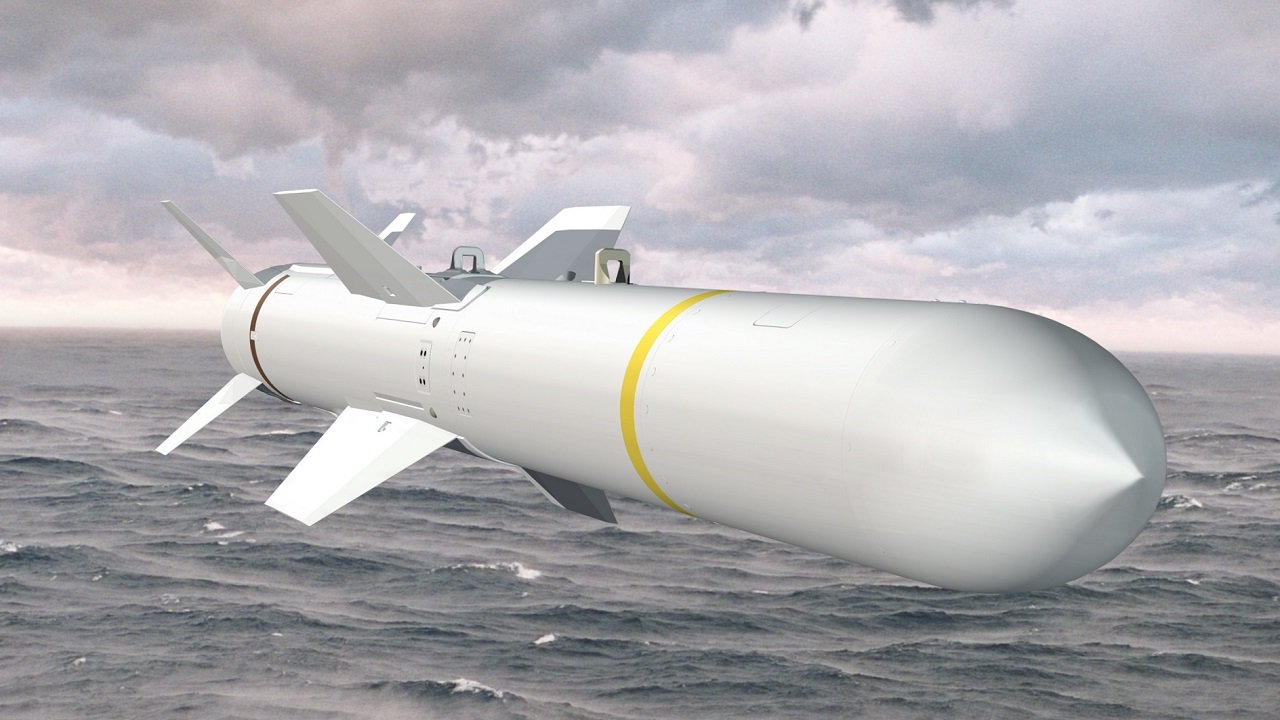
The engagement that made the day historic began around midday when the Kaman-class missile boat Joshan closed on that same group. Warned off and refusing to turn, her captain fired the boat’s remaining American-made Harpoon, a weapon sold to the Shah a decade earlier, and the missile ran down Wainwright’s side without guidance, decoyed by chaff.
The response was measured in seconds and in ordnance: four Standard missiles from Simpson and one from Wainwright, all of which struck, followed by a Harpoon from Bagley that failed to acquire, followed by gunfire that finished the wreck. When two Iranian F-4s pressed toward the group afterward, USS Wainwright fired two extended-range Standards, one of which detonated close enough to shear part of a wing, and the damaged Phantom recovered at Bandar Abbas.
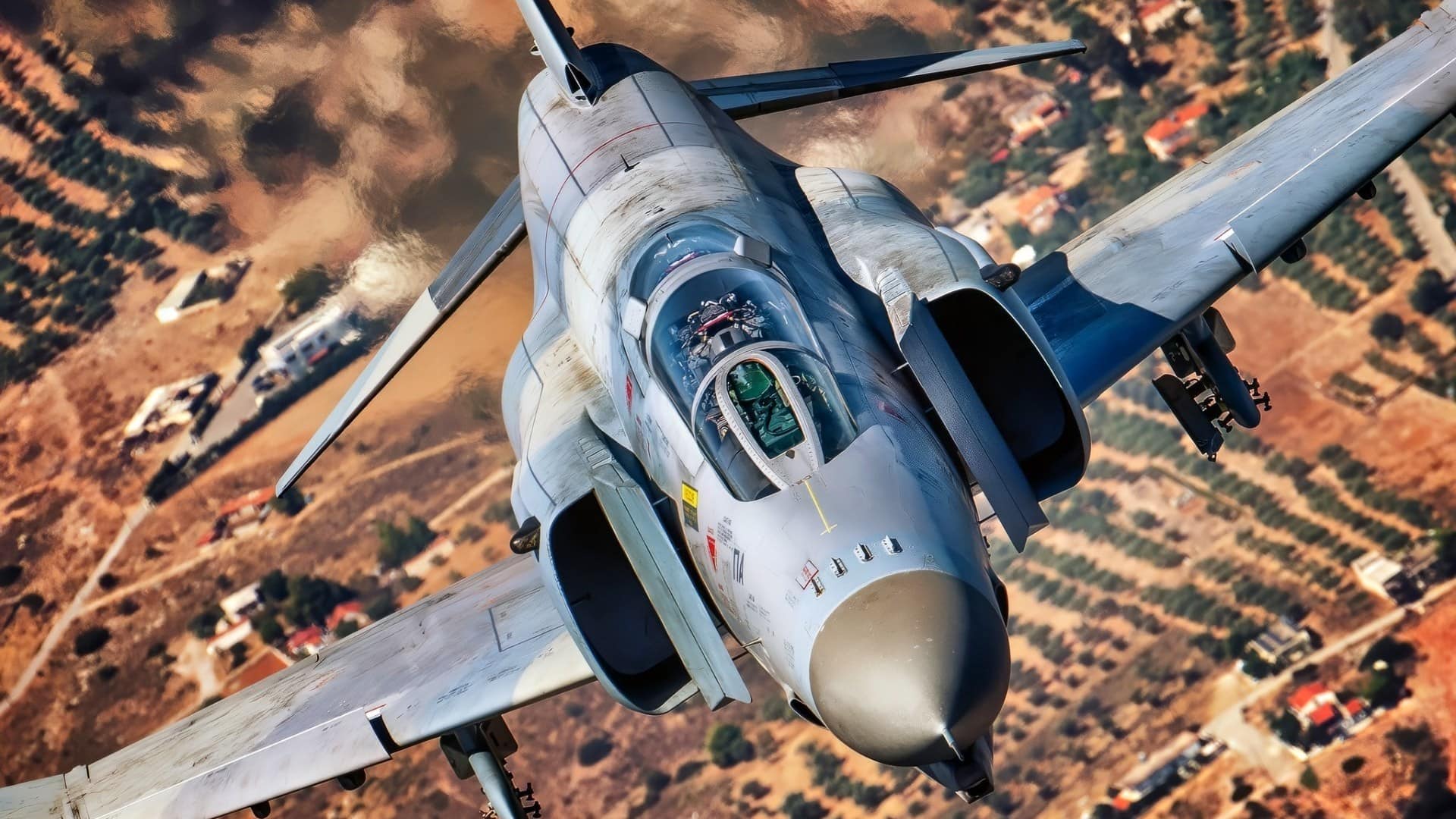
F-4 Phantom Fighter Flying High. Image Credit: Creative Commons.
How the US Navy Fought Iran
The afternoon belonged to A-6E Intruders from the nuclear aircraft carrier USS Enterprise. Sahand sortied from Bandar Abbas, fired on the aircraft, and absorbed what the record shows as three Harpoons, four Skipper laser-guided weapons, a Walleye, and several 1,000-pound bombs, with one of the Harpoons coming from the destroyer Joseph Strauss.
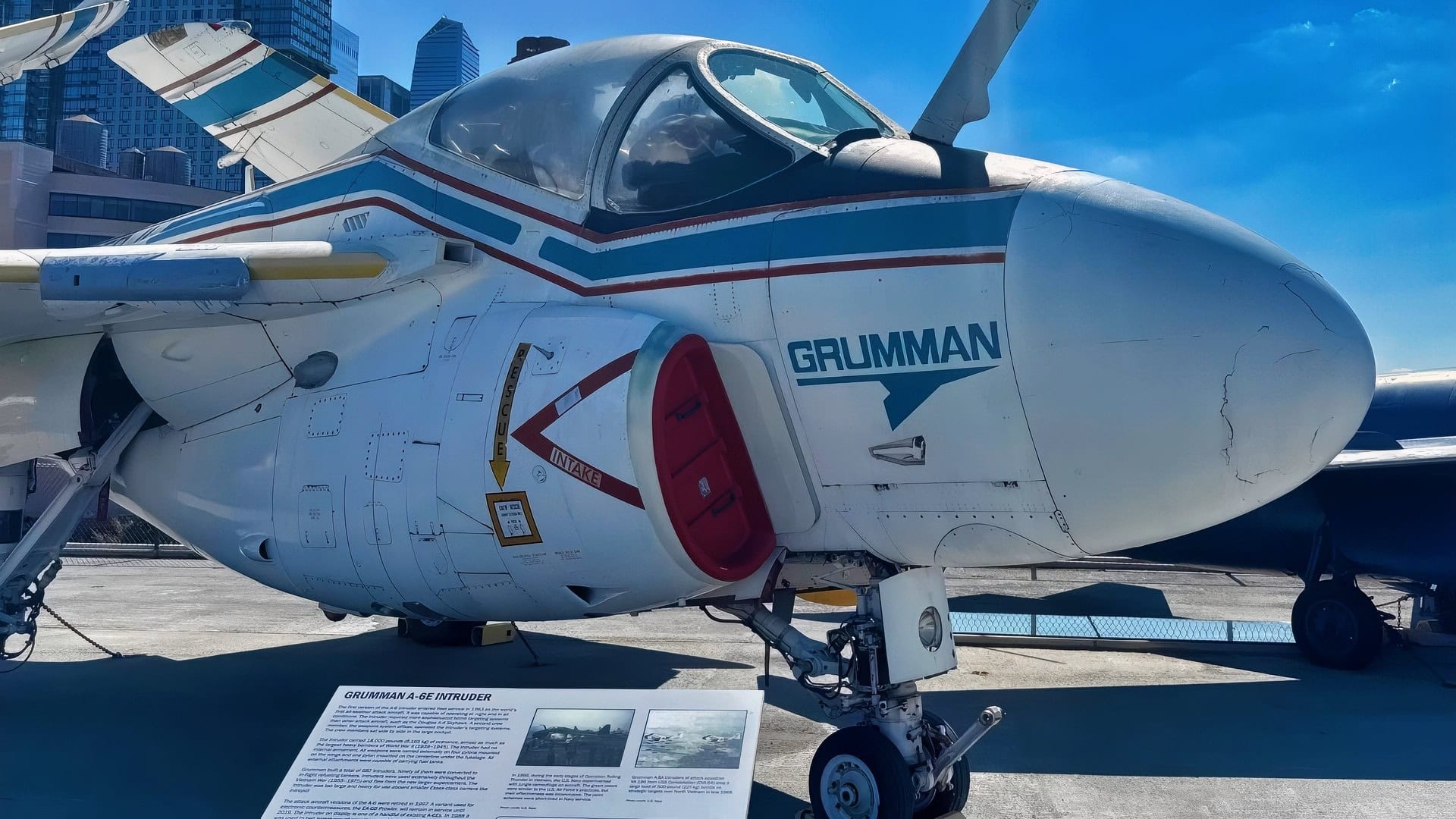
A-6 Intruder Original 19FortyFive.com Image Taken in July 2025.
She burned for hours before the fire reached her magazines and the explosion put her under.
Her sister Sabalan came out at about 1700, fired surface-to-air missiles at the Intruders, and took a single 500-pound laser-guided bomb down her stack, which stopped her dead in the water.
Defense Secretary Frank Carlucci and Admiral William Crowe decided that enough had been destroyed, and the order went out to leave her alone. Iranian tugs towed her home.
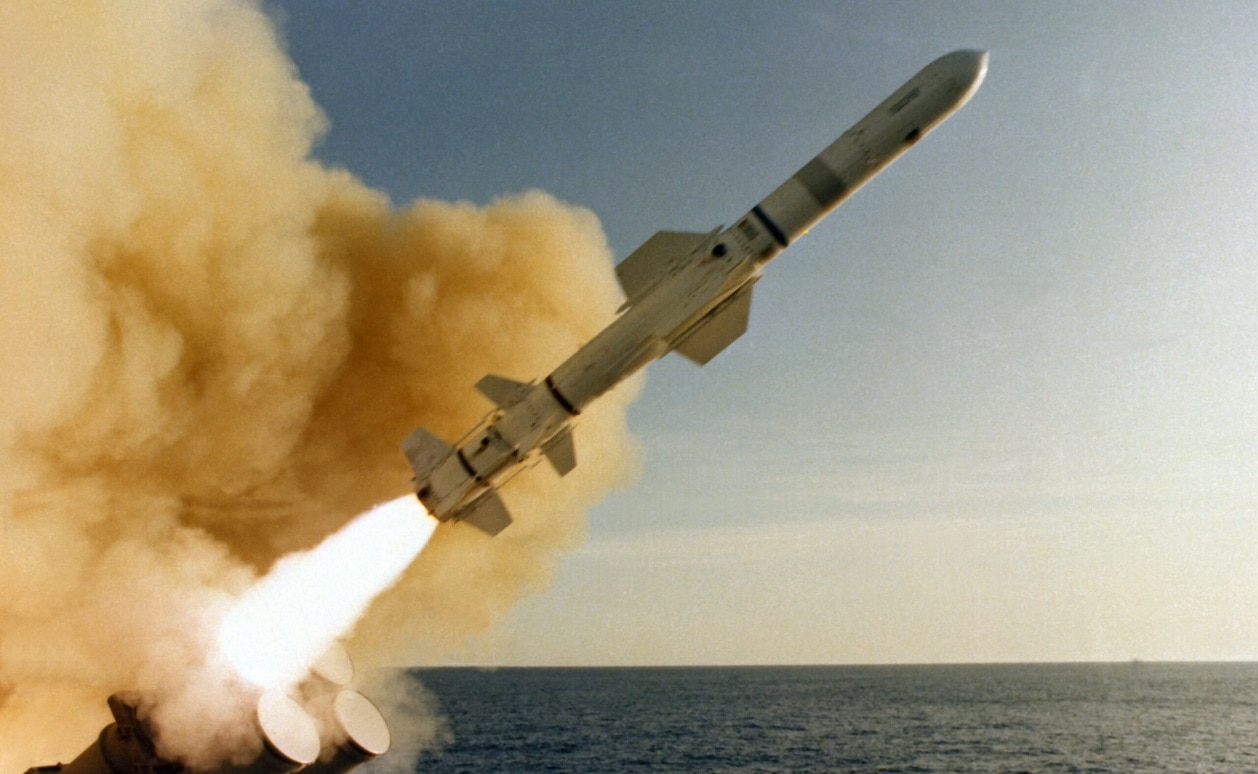
A view of an RGM-84 surface-to-surface Harpoon missile, immediately after leaving a canister launcher aboard the cruiser USS LEAHY (CG-16), near the Pacific Missile Test Center, Calif.
The American cost came after dark, when an AH-1T Sea Cobra flying reconnaissance for USS Wainwright reported evading a missile before disappearing from radar about 15 miles southwest of Abu Musa. Marine Captains Stephen Leslie and Kenneth Hill were killed.
Divers recovered their bodies the following month, and the wreckage showed no battle damage, leaving investigators to conclude they may have crashed while maneuvering away from fire. Iranian casualties were never fully published, though accounts put the dead aboard Sahand alone at several dozen.
Tehran Was Not Happy and Tried to Learn from Combat
What Tehran took from the day shaped the next thirty-eight years. Having lost half a conventional fleet in an afternoon, Iran concluded that symmetrical naval warfare against a superpower was unwinnable and rebuilt around mines, coastal anti-ship missiles, midget submarines, and swarms of fast attack craft, institutionalizing the split between a conventional navy and the Revolutionary Guard’s asymmetric one.
That bet is being settled now. American and Israeli forces have sunk something on the order of 60 Iranian warships in the current war, and the Strait of Hormuz has stayed closed anyway, because denying the waterway never required the ships the Navy is good at sinking.
Enterprise, which launched the strikes that killed Sahand, was retired in 2012 and is being cut apart in Mobile, Alabama, under a contract that runs to 2030. Sabalan, the ship Carlucci spared, was repaired at Bandar Abbas and served in the Iranian Navy for another thirty-seven years. She was destroyed earlier this year.
About the Author: Harry J. Kazianis
Harry J. Kazianis (@Grecianformula) was the former Senior Director of National Security Affairs at the Center for the National Interest (CFTNI), a foreign policy think tank founded by Richard Nixon based in Washington, DC. Harry has over a decade of experience in think tanks and national security publishing. His ideas have been published in the NY Times, The Washington Post, The Wall Street Journal, CNN, and many other outlets worldwide. He has held positions at CSIS, the Heritage Foundation, the University of Nottingham, and several other institutions related to national security research and studies. He is the former Executive Editor of the National Interest and the Diplomat. He holds a Master’s degree focusing on international affairs from Harvard University.

