
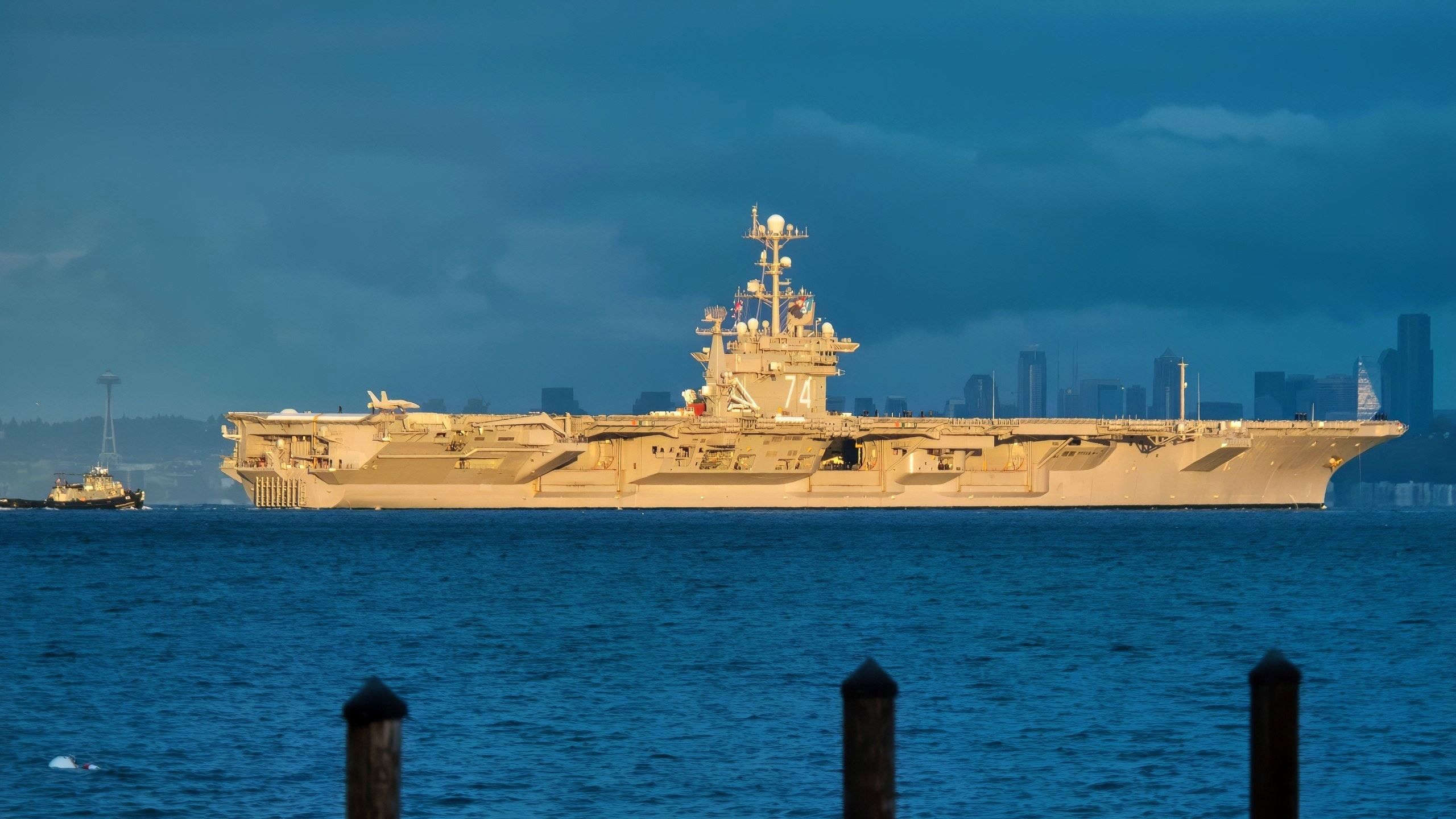
USS Nimitz Took 1,129 Days to Rebuild. George Washington Needed 2,120 – USS Nimitz spent about 1,129 days in its midlife Refueling and Complex Overhaul, or RCOH, between May 1998 and June 2001. USS George Washington entered the same once-in-a-lifetime process on August 4, 2017, and did not return to the Navy until May 25, 2023. That was 2,120 days, an increase of almost 88 percent.
USS John C. Stennis entered Newport News Shipbuilding on May 6, 2021, under a $3 billion execution contract. The Navy moved its planned redelivery from August 2025 to October 2026, a delay of nearly 14 months. An early-October handover would place Stennis near 1,979 days in the yard, while the fiscal 2026 budget requested about $483 million in cost-to-complete funding tied to schedule growth, contract changes, and added equipment.
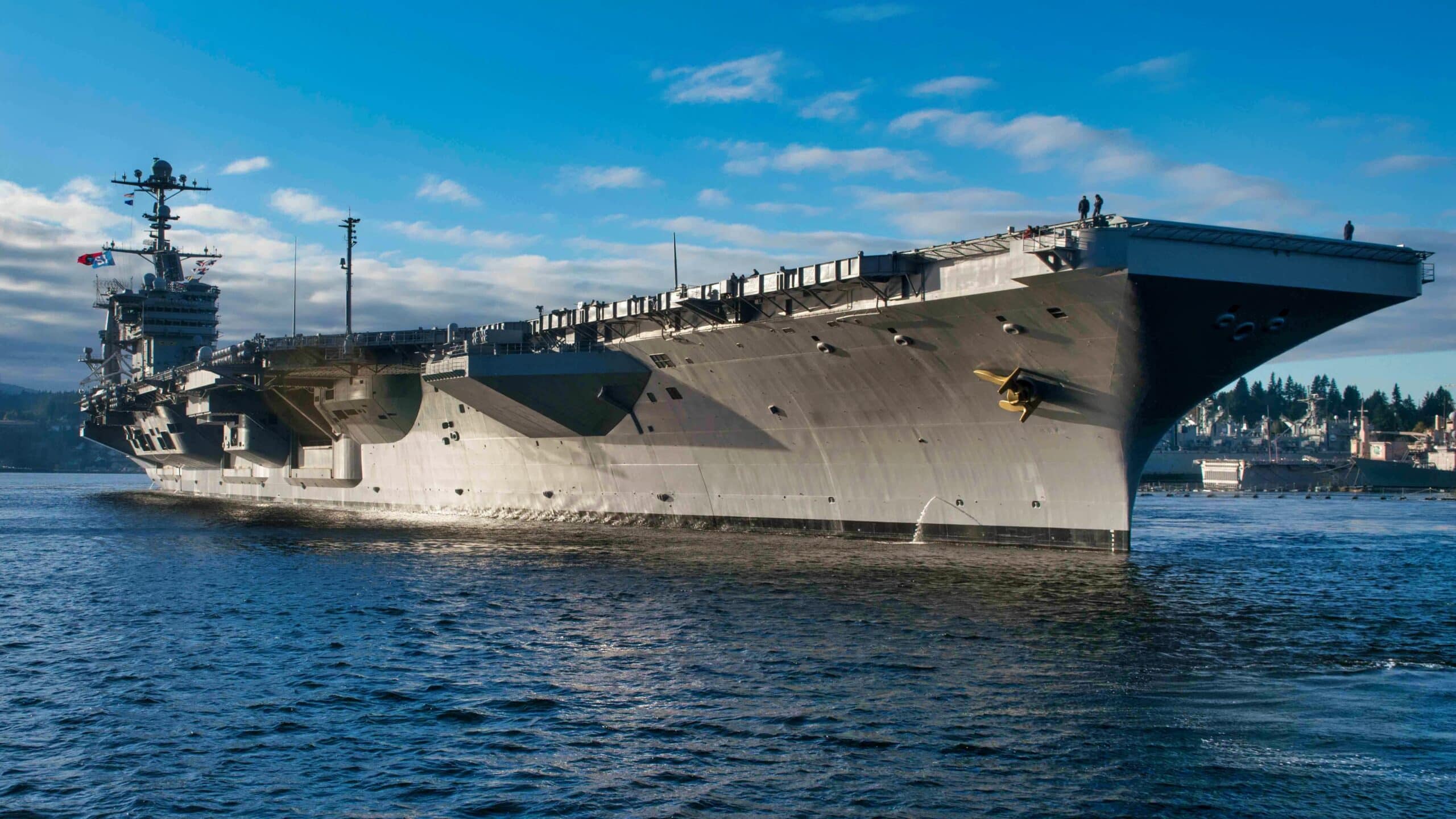
USS John C. Stennis Aircraft Carrier. Image Credit: Creative Commons.
The question is simple: Why does an aircraft carrier mid-life update take so long?
Those numbers matter because federal law requires the Navy to maintain at least 11 operational aircraft carriers. One carrier in RCOH has been unavailable for deployment, surge operations, or pilot training for years. Another may be in shorter maintenance, while others are preparing for or recovering from deployments. A delay at Newport News therefore reaches far beyond one ship.
The same class name does not make every overhaul identical. Each carrier arrives after more than two decades of deployments, repairs, deferred work, and earlier upgrades. The Navy must refuel two reactors, inspect systems hidden inside a 100,000-ton hull, replace worn machinery, and install technology that did not exist when the ship was built.
The schedule begins as a plan. Opening the ship reveals the actual job.
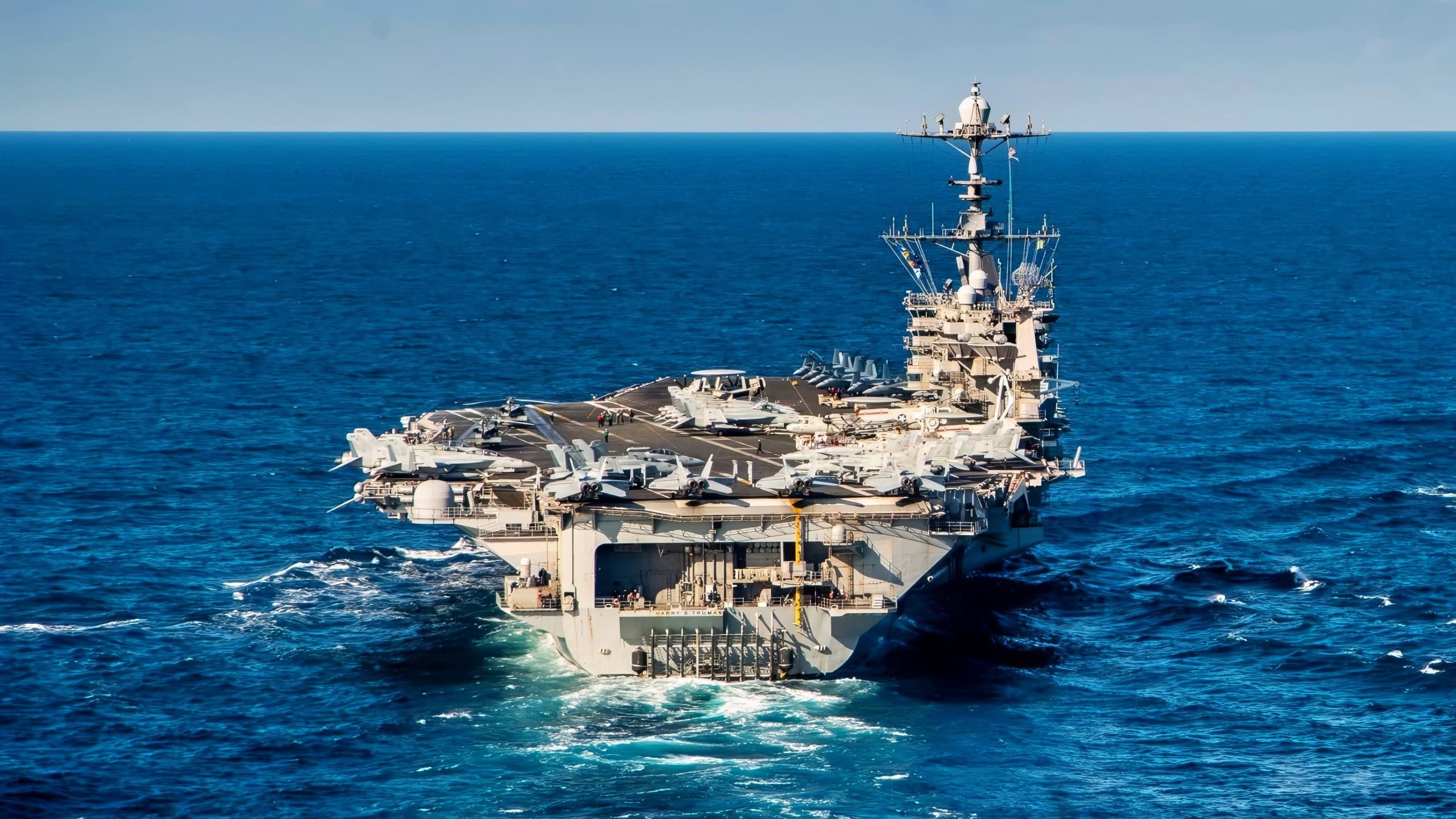
MEDITERRANEAN SEA (Jan. 22, 2021 The Arleigh Burke-class guided-missile destroyer USS Gravely (DDG 107) breaks away from the Nimitz-class aircraft carrier USS Harry S. Truman (CVN 75) following a replenishment-at-sea exercise, Jan. 22, 2022. The Harry S. Truman Carrier Strike Group is on a scheduled deployment in the U.S. Sixth Fleet area of operations in support of naval operations to maintain maritime stability and security, and defend U.S., allied and partner interests in Europe and Africa. (U.S. Navy photo by Mass Communication Specialist 3rd Class Bela Chambers)

The USS George H.W. Bush Carrier Strike Group sails in formation during a strait transit exercise in the Atlantic Ocean, Feb. 8, 2026. The George H.W. Bush Carrier Strike Group is at sea as an integrated warfighting team. Composite Training Unit Exercise (COMPTUEX) is the Joint Force’s most complex integrated training event and prepares naval task forces for sustained high-end Joint and combined combat. Integrated naval training provides combatant commanders and America’s civilian leaders highly capable forces that deter adversaries, underpin American security and economic prosperity, and reassure Allies and partners. (U.S. Navy photo by Mass Communication Specialist 3rd Class John R. Farren)
RCOH Rebuilds 35 Percent of a Carrier’s Lifetime Maintenance
An RCOH occurs near the midpoint of a Nimitz-class carrier’s planned 50-year life. HII says the project represents 35 percent of all maintenance and modernization performed during those five decades. It also removes one hull during a period of tight aircraft carrier availability.
The work includes defueling and refueling both reactors, overhauling the propulsion plant, and renewing systems across more than 2,300 compartments. Shipbuilders repair or replace shafts, propellers, rudders, sea chests, pumps, valves, piping, ventilation, and electrical equipment.
The flight deck, catapults, arresting gear, combat systems, communications equipment, aviation-support spaces, and island also receive major work. Hundreds of tanks must be opened, inspected, preserved, and closed again.
This is why an RCOH cannot be compared with a long automobile service or even a conventional shipyard availability. RAND called it one of the most challenging engineering and industrial tasks undertaken anywhere. Much of the work takes place inside a nuclear-powered airfield whose systems were installed in a strict sequence decades earlier.
Nimitz Created the Baseline in 1,129 Days
Nimitz was the first ship in the class to undergo an RCOH, and only the fourth nuclear carrier ever refueled. RAND found that the execution contract grew from roughly $1.25 billion to about $1.5 billion. The project had been scheduled for 33 months but ran several months longer.
The reasons already looked familiar. The Navy had to plan while Nimitz remained operational, limiting how much equipment could be dismantled for inspection. Work requirements shifted, budgets changed, and a four-month labor strike disrupted execution. More than one million man-hours of unplanned work were authorized only eight months before delivery.
The first overhaul still took roughly three years rather than six. It did not face a global pandemic, the same supplier disruptions, or the expanding set of digital, communications, and aviation-support modifications placed aboard later ships. Nimitz was difficult enough to show that the Navy needed better planning, more reliable estimates, and a stronger working relationship with Newport News.
George Washington Became the 2,120-Day Warning
George Washington entered RCOH under a $2.8 billion contract. The Navy officially described the completed project as a 69-month availability involving 26 million man-hours. The work touched nearly every space and system, including more than 600 tanks, thousands of valves and pumps, the shafts, propellers, main mast, combat systems, and aircraft launch and recovery equipment.
The overhaul also added technology needed to support the F-35C. That increased the carrier’s value after redelivery, but integration requires design work, testing, and sequencing. A new system cannot simply be carried aboard and connected to electrical, cooling, and data networks designed decades earlier.
COVID-19 restrictions hit a project dependent on thousands of workers operating in confined spaces. Supplier interruptions slowed material deliveries. Competing demands for skilled labor placed more pressure on the schedule.
Inspections also found significant damage in one of the ship’s eight steam turbine generators. The discovery produced work that had not been fully priced or sequenced at the contract’s outset. Repairing a turbine generator affected access, propulsion-plant testing, and jobs planned around the damaged machinery.
The 2,120-day overhaul became the clearest warning that the RCOH schedule had lost its margin. It also demonstrated what the Navy receives upon completion of the work. George Washington returned to Japan as the forward-deployed carrier, able to operate the F-35C with Carrier Air Wing 5 and place American naval aviation near the Western Pacific every day.
Stennis Inherited the Same Industrial Problems
Stennis arrived before Newport News had fully recovered from George Washington. The original plan called for work through August 2025. Navy budget documents shifted redelivery to October 2026 after mandatory growth work, workforce pressure, and material shortages upset the sequence.
The turbine problem followed the class into another overhaul. NAVSEA said inspections found major damage in one of the eight steam turbine generators aboard both George Washington and Stennis. A turbine repair is not a stand-alone task. It affects testing, electrical work, propulsion-plant sequencing and the people assigned to connected jobs.
More than 25 million man-hours are expected to be invested in Stennis. The carrier is receiving a new square and tapered mast, updated defense and communications systems, refurbished propellers, shaft work and modernized launch and recovery equipment. Added months also increase crew support, berthing, and shipyard expenses.
The prolonged work has become part of the wider USS John C. Stennis overhaul problem. Redelivery will not make the ship immediately combat-ready. Sea trials, certifications, crew training, and air-wing workups still follow before another operational deployment.
One Shipyard Must Refuel Every Nuclear Aircraft Carrier
Newport News Shipbuilding is the only American yard with the workforce and facilities required to perform a carrier RCOH. That protects rare nuclear expertise, but it also creates a national single point of failure.
The same company builds Ford-class carriers, supports Virginia-class submarine construction, completes carrier overhauls, and prepares older nuclear carriers for inactivation. Each program competes for nuclear-qualified engineers, welders, electricians, planners, inspectors, cranes, waterfront space, and supplier capacity.
Carrier work depends on hundreds of vendors spread across the country. A late valve, turbine component, electrical assembly, or nuclear-qualified part may block several tasks behind it. The Navy cannot move an RCOH to another builder when the sequence slips because no second yard can refuel a Nimitz-class carrier.
That bottleneck sits behind the warning that America has one nuclear-carrier refueling yard. It also collides with a separate problem: Ford-class construction has stretched beyond a decade, leaving the Navy unable to replace an unavailable carrier quickly.
Hidden Damage Makes Early Estimates Unreliable
Every RCOH begins years before the ship reaches dry dock. Planners inspect what they can, order long-lead material, and build a detailed work package. The carrier continues operating through much of that planning period, so some tanks, piping, machinery, and structural areas cannot be opened until execution begins.
GAO found the same pattern across Navy carrier and submarine maintenance. Unplanned work identified after schedules were finalized contributed to more than 4,100 days of delay from fiscal 2015 through 2019. Workforce performance and capacity contributed to more than 4,000 days of work. The Navy underestimated required personnel resources by 36 percent.
Older ships create more opportunities for surprises. Corrosion may extend beyond the visible area. A pump replacement may reveal damaged piping. One cable route may conflict with a new system. The added job then needs engineering approval, materials, certified labor, inspection, and testing.
Several hundred small changes can disrupt a schedule as effectively as one major machinery casualty. Once one task moves, another team may lose access to the same compartment or wait for testing before beginning its work.
The Navy Is Changing the Model for Harry S. Truman
The next RCOH belongs to the USS Harry S. Truman. The Navy is using commercial contracts to remove routine, supplementary work from carrier sailors, including painting, insulation, transportation, and preservation duties.
The change could return as many as one million man-hours to the crew for technical training and operational preparation. Five contracts had already returned approximately 690,000 labor hours by June 2026.
The approach will not create another dry dock or eliminate hidden damage. It should give managers a clearer division of labor while reducing the burden on sailors living through a multiyear industrial period.
The Navy also has better digital planning tools and the lessons from George Washington. The challenge is converting those lessons into a stable workforce, reliable supplier deliveries, and realistic estimates before Truman’s work package expands.
The Fleet Gets Back a New Carrier Inside an Old Hull
The delays should not obscure the reason the Navy continues to perform RCOHs. A refueled Nimitz-class carrier returns with another 25 years of nuclear endurance, renewed propulsion machinery, modernized flight-deck systems, and updated defenses.
Its air wing supports strike, air defense, electronic warfare, surveillance, and airborne command missions without depending on a foreign runway. The carrier can move between theaters, remain at sea through repeated replenishment, and place dozens of combat aircraft near a crisis.
George Washington now demonstrates that payoff in the Western Pacific. Its overhaul produced an F-35C-capable carrier assigned to the most demanding forward-deployed naval position in the fleet.
No other navy currently fields the same combination of nuclear endurance, large tactical air wings, global logistics, airborne early warning and decades of continuous carrier experience. The Navy’s published target still calls for Stennis to return in October 2026, and HII says it will be the most technologically advanced Nimitz-class carrier in the fleet.
About the Author: Harry J. Kazianis
Harry J. Kazianis (@Grecianformula) was the former Senior Director of National Security Affairs at the Center for the National Interest (CFTNI), a foreign policy think tank founded by Richard Nixon based in Washington, DC. Harry has over a decade of experience in think tanks and national security publishing. His ideas have been published in the NY Times, The Washington Post, The Wall Street Journal, CNN, and many other outlets worldwide. He has held positions at CSIS, the Heritage Foundation, the University of Nottingham, and several other institutions related to national security research and studies. He is the former Executive Editor of the National Interest and the Diplomat. He holds a Master’s degree focusing on international affairs from Harvard University.

