
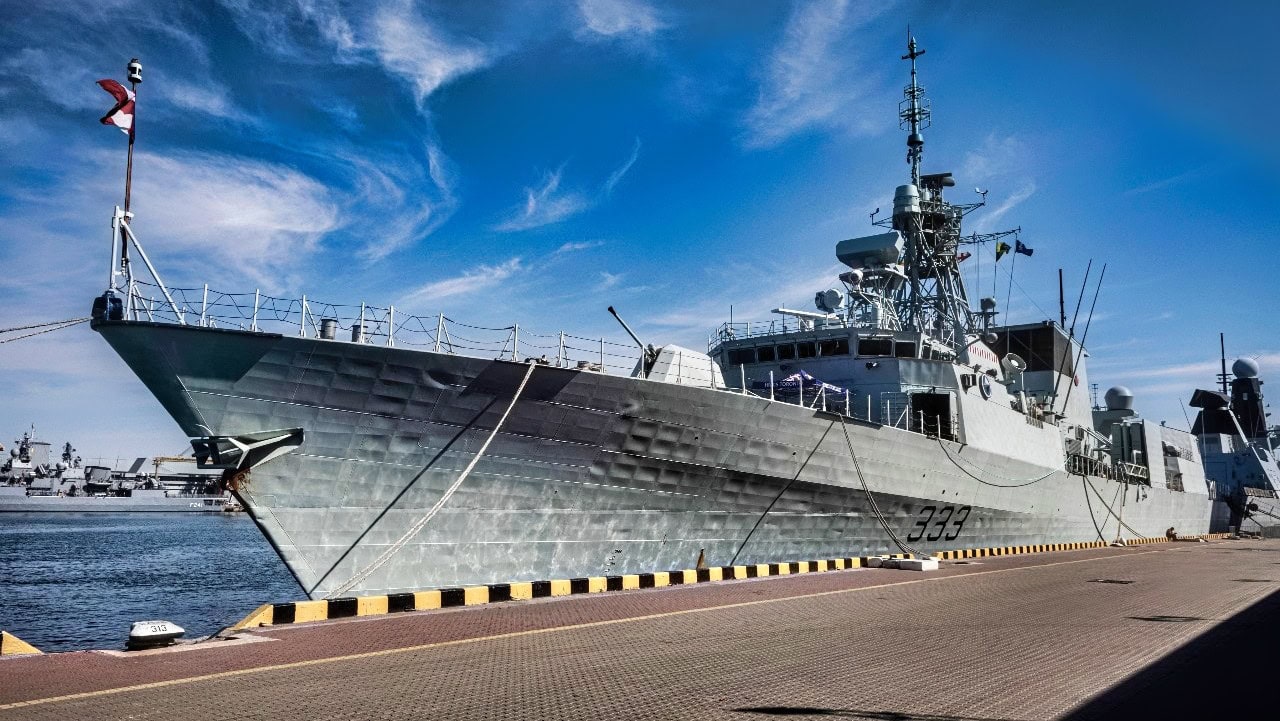
Canada’s navy is finally getting the fleet Ottawa promised it two decades ago, and the timing could hardly be worse. Six Arctic and Offshore Patrol Ships have now been delivered in full, and the first of fifteen planned River-class destroyers is now under construction at Irving’s Halifax shipyard, while Prime Minister Mark Carney’s government says it has pushed defence spending to two percent of GDP for the first time since before the Berlin Wall fell. Taken together, it looks like the recapitalization the Navy has needed since the 1990s. What it shows instead is a fleet architecture built for a world that stopped existing sometime around 2014, and a navy racing to design the program that might fix it before the world changes again.
A Fleet Built for a World That’s Gone
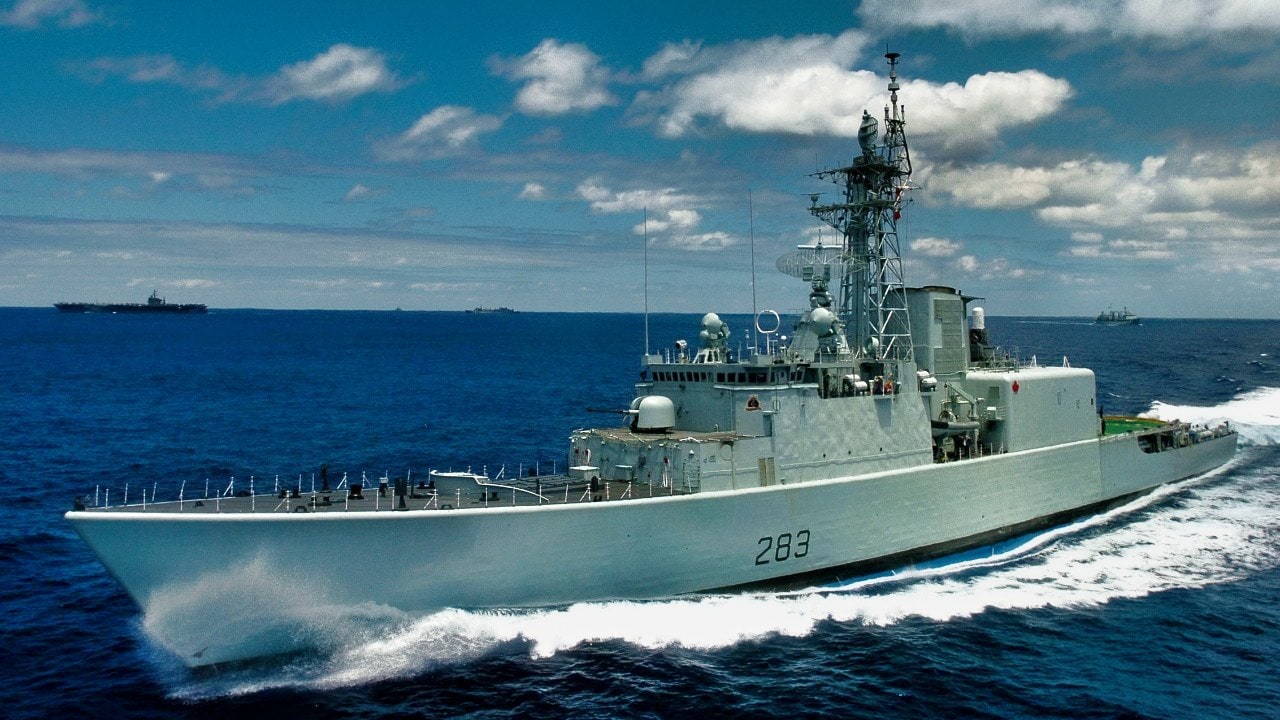
Pacific Ocean (June 25, 2004) – The Canadian destroyer HMCS Algonquin (DDG 283) is shown underway in close formation with the Nimitz-class aircraft carrier USS John C. Stennis (CVN 74). Algonquin just completed an eight-ship photo exercise with Stennis just prior to participation in Rim of the Pacific Exercise (RIMPAC) 2004. RIMPAC is the largest international maritime exercise in the waters around the Hawaiian Islands. This years exercise will include seven participating nations; Australia, Canada, Chile, Japan, South Korea, Britain and the United States. RIMPAC is intended to enhance the tactical proficiency of participating units in a wide array of combined operations at sea, while enhancing stability in the Pacific Rim region. U.S. Navy photo by Photographer’s Mate 2nd Class Jayme Pastoric (RELEASED)
The Harry DeWolf-class patrol ships were announced in 2007, and the Canadian Surface Combatant project, since rebranded the River-class destroyer program, received government approval the year after, within the framework of the 2008 Canada First Defence Strategy, which did list defending North America among the Canadian Forces’ core roles. Ottawa’s planners did not ignore continental defence. They named it, then built a fleet organized mainly around something else.
That something else assumed American maritime dominance was durable enough to take for granted, and that persistent defence of Canada’s own maritime approaches against a peer competitor was not the problem the fleet had to be organized around. Fifteen high-end combatants would operate with allied task groups, and six lightly armed patrol ships would handle the Arctic and the coasts. It was a defensible division of labor in 2008. Russian submarines are active again in the North Atlantic, and gray-zone attacks on undersea cables have become a live European problem. Ottawa’s own defence policy describes Arctic warming at nearly three times the global rate. None of that made the 2008 plan wrong at the time. It just isn’t current anymore.
The destroyer itself isn’t a weak link here. Its combat system, built around Aegis and Lockheed Martin’s SPY-7 radar, was selected in 2018 and 2019, squarely inside the period when great-power competition returned to Washington’s vocabulary. What hasn’t kept pace with that shift is the fleet architecture the ship sits inside.
The Missing Middle
Most coverage of Canada’s shipbuilding progress skips over this part. A River-class destroyer can handle a serious, high-end maritime fight, submarine warfare included, without much trouble.
Canada is going to have exactly fifteen of them, though, arriving from the early 2030s through roughly 2050, and it cannot afford to risk one of a fleet that small chasing every suspicious survey vessel near a fiber-optic cable off Nova Scotia. The AOPS fleet was built for sovereign presence and search and rescue, not for persistent anti-submarine work or contested surveillance.
What’s missing sits between those two tiers. A River is too scarce and too expensive to devote routinely to that kind of work, and an AOPS lacks the combat systems for some of it.
What Canada needs is a class of ships, not a single vessel, numerous enough to hold a persistent presence and handle mine countermeasures across three ocean approaches at once, something fifteen destroyers were not sized to provide, no matter how capable their radar.
Ottawa Can Move Fast When It Wants To
This summer gave Canada a useful demonstration of what urgency looks like in defence procurement. Announcing a preferred bidder for the Canadian Patrol Submarine Project, the largest defence acquisition in Canadian history, Secretary of State for Defence Procurement Stephen Fuhr said the government had run the decisive competitive phase in roughly eight months and could move at “the speed of relevance.”
The full process, from the request for information in September 2024 to the announcement in July, took closer to two years. Even so, compressing a submarine competition that large into anything resembling that timeline was a real institutional achievement, proof Ottawa can set its own pace when a file is judged important enough.
The Continental Defence Corvette has not gotten that treatment. The two programs aren’t strictly comparable: the submarine competition is selecting from existing foreign designs, while the corvette still has to become a shipbuilding program, with considerably more design and industrial work ahead.
That difference doesn’t explain a schedule stretching to 2039, though.
As of this summer, the program had not yet issued a request for information, with industry told to expect a contract around 2030 and the first ship operational, on current planning, around 2039. Eight months got a submarine deal went through its hardest phase.
The corvette meant to plug the most urgent gap in the surface fleet, by contrast, is not expected to reach contract signature before 2030, let alone deliver a ship.
The Corvette Nobody Has Ordered Yet
That timeline changes what the requirements process happening right now means. The Navy is shaping the specifications for a ship it may not field until 2039, against a threat environment that no one currently serving can specify with confidence.
What matters more than locking in a hull count early is whether the design leaves room to grow, enough power and space margin to take on sensors and weapons nobody has built yet. A corvette designed too tightly around 2026’s understanding of gray-zone warfare risks becoming obsolete on arrival, the same trap that produced the fleet it’s supposed to fix.
The ships now being retired were themselves intended as a short-term solution. The Kingston class entered service in the 1990s as modest reserve-training and coastal-patrol vessels, never meant to still be the navy’s principal coastal presence three decades later.
Canada has a long habit of letting interim platforms cover for institutional delay, and the corvette now risks joining that list.
What Continental Defence Should Mean
There is a version of this program that does more than fill a gap in the order of battle. Canada provides greater value to the United States and its allies by taking on more responsibility for the maritime approaches to North America than by concentrating its scarce naval capacity on expeditionary deployments alongside them.
That means making the Arctic, the North Atlantic, and the North Pacific genuinely hard for an adversary to survey or disrupt, with sensor and data-sharing architecture built into NORAD and NORTHCOM planning from the outset.
Few of Canada’s allies can own that mission the same way. The corvette program could deliver it, if Ottawa treats the requirements stage now underway as the decisive moment it is.
Canada’s last two Kingston-class coastal vessels, HMC Ships Moncton and Nanaimo, are scheduled to be paid off in 2028.
The class intended to replace them, according to the Navy’s current plans, won’t be fully operational until 2039. AOPS, allied ships, and unmanned systems will absorb pieces of what the Kingstons did in the meantime, but none of it is quite the same as a vessel built for persistent, credible work in Canada’s own maritime approaches.
That leaves eleven years after the Kingstons retire without the surface combatant meant to succeed them. The requirements now being shaped will determine whether that gap closes on schedule or just becomes the next Kingston.
About the Author: Dr. Andrew Latham
Andrew Latham is a professor of international relations and political theory at Macalester College in Saint Paul, MN. You can follow him on X: @aakatham.