
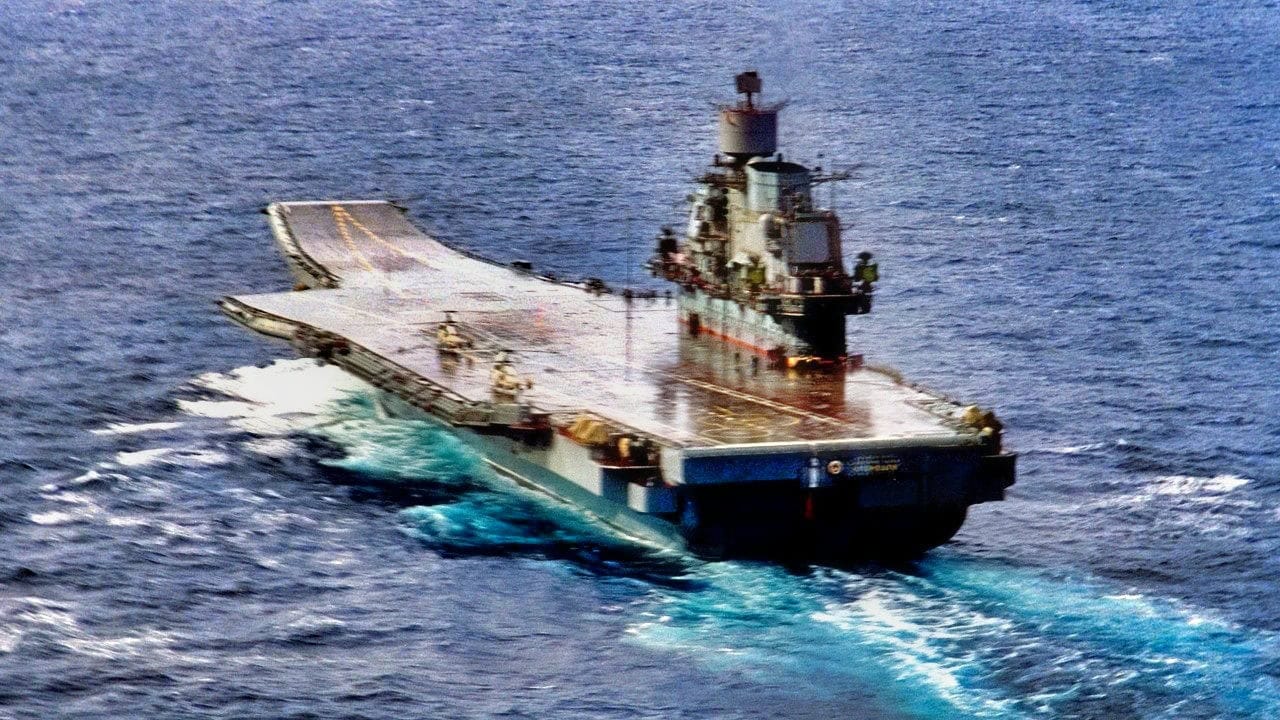
A 70-Ton Crane Tore a 215-Square-Foot Hole in Admiral Kuznetsov. Russia Never Saved Its Aircraft Carrier: Admiral Kuznetsov was a 1,000-foot, 58,600-ton heavy aircraft-carrying cruiser designed to reach 29 knots and operate Su-33 and MiG-29K fighters from a ski-jump flight deck. The conventionally powered warship was also designed with 12 P-700 Granit anti-ship missiles, giving it far more offensive armament than a Western aircraft carrier.
On October 30, 2018, the floating drydock beneath Russia’s only carrier sank during an undocking operation near Murmansk. One of the dock’s 70-ton cranes crashed onto Kuznetsov and tore an opening measuring roughly four by five meters, or about 215 square feet, through the flight deck.
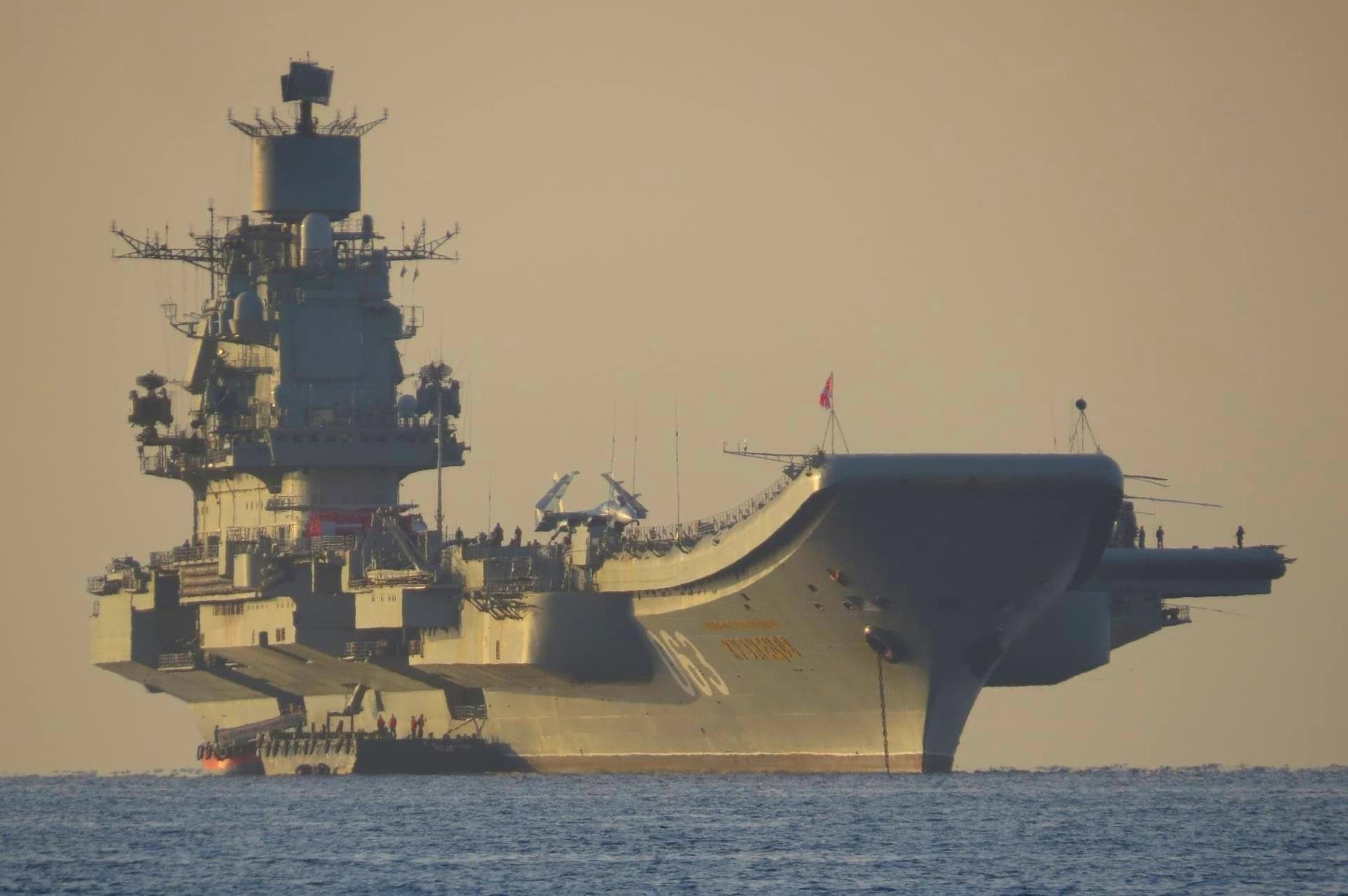
Aircraft Carrier Admiral Kuznetsov. Image Credit: Creative Commons.
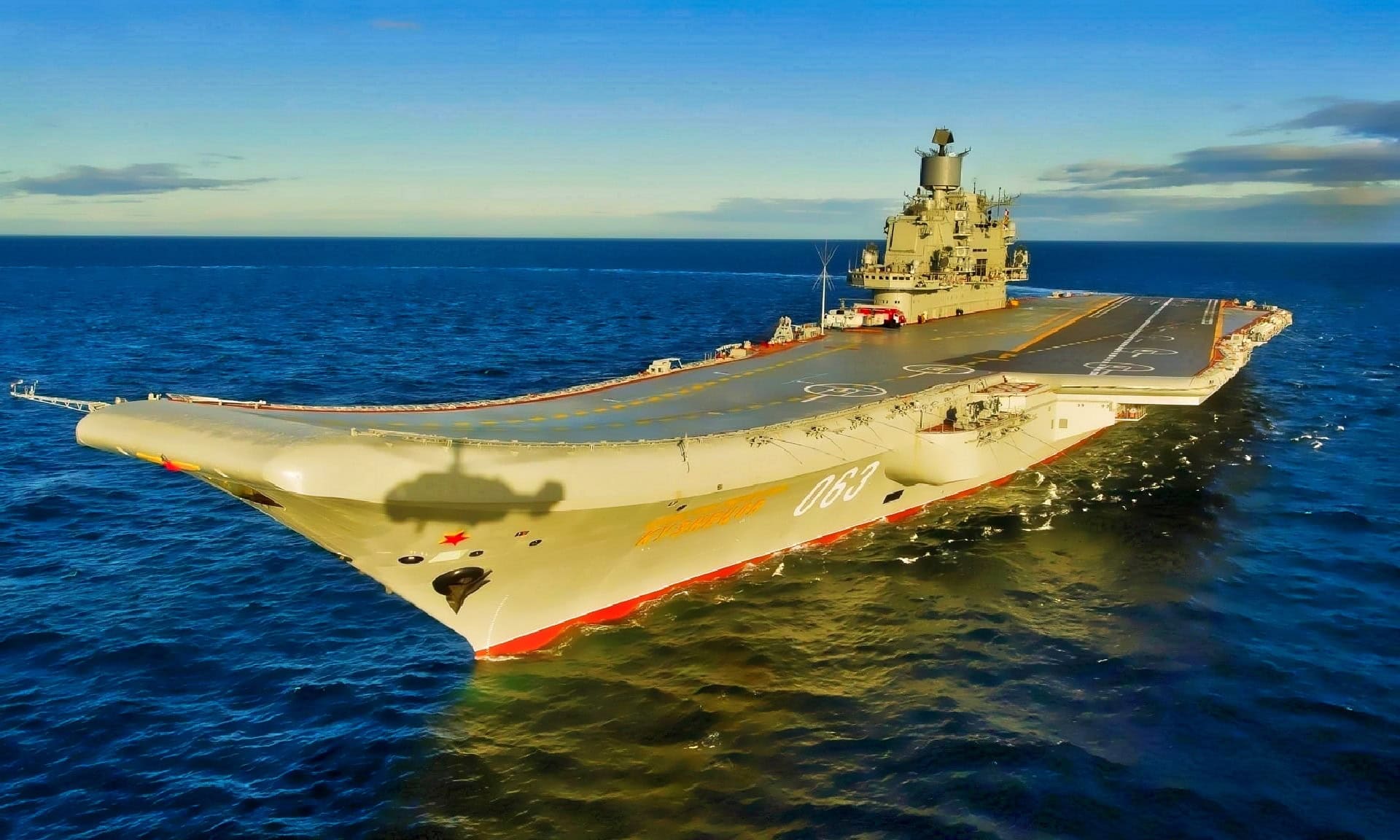
Admiral Kuznetsov Aircraft Carrier. Image Credit: Creative Commons.
Four workers were hospitalized, and one later died. A fifth worker remained missing after the dock disappeared beneath the water. The carrier survived, but Russia lost the only drydock in the north capable of handling a warship of Kuznetsov’s size.
Fourteen months later, welding work started a major fire aboard the carrier. The blaze burned for more than 24 hours, killed two people, and sent 14 to hospitals. Russia had begun the overhaul as an attempt to preserve its only carrier. The drydock sinking and fire turned the project into a test of whether the country still possessed the industrial base to restore it.
By July 2025, repair and modernization work had been suspended. Andrei Kostin, chairman of Russia’s state-owned United Shipbuilding Corporation, said there was no point spending more money on the 40-year-old vessel and expected it to be sold or disposed of. As of August 2026, Moscow had not published a final disposal order, but Admiral Kuznetsov looked far closer to the scrapyard than to a return to sea.
The Syria Deployment Sent Kuznetsov Into the Yard
The Soviet Union launched the Admiral Kuznetsov in 1985 at the Black Sea Shipyard in Nikolayev, now Mykolaiv, Ukraine. It was the first Soviet carrier capable of launching conventional fixed-wing fighters from a full-length flight deck and recovering them on arresting wires.
The design carried serious compromises. Kuznetsov used oil-fired boilers rather than nuclear power. Its ski jump removed the need for catapults but restricted the fuel and weapons that aircraft could carry on some missions. Boiler and propulsion problems repeatedly reduced its time at sea.
A U.S. Naval Institute review calculated that the carrier averaged about 15 days at sea per year across much of its Russian service.
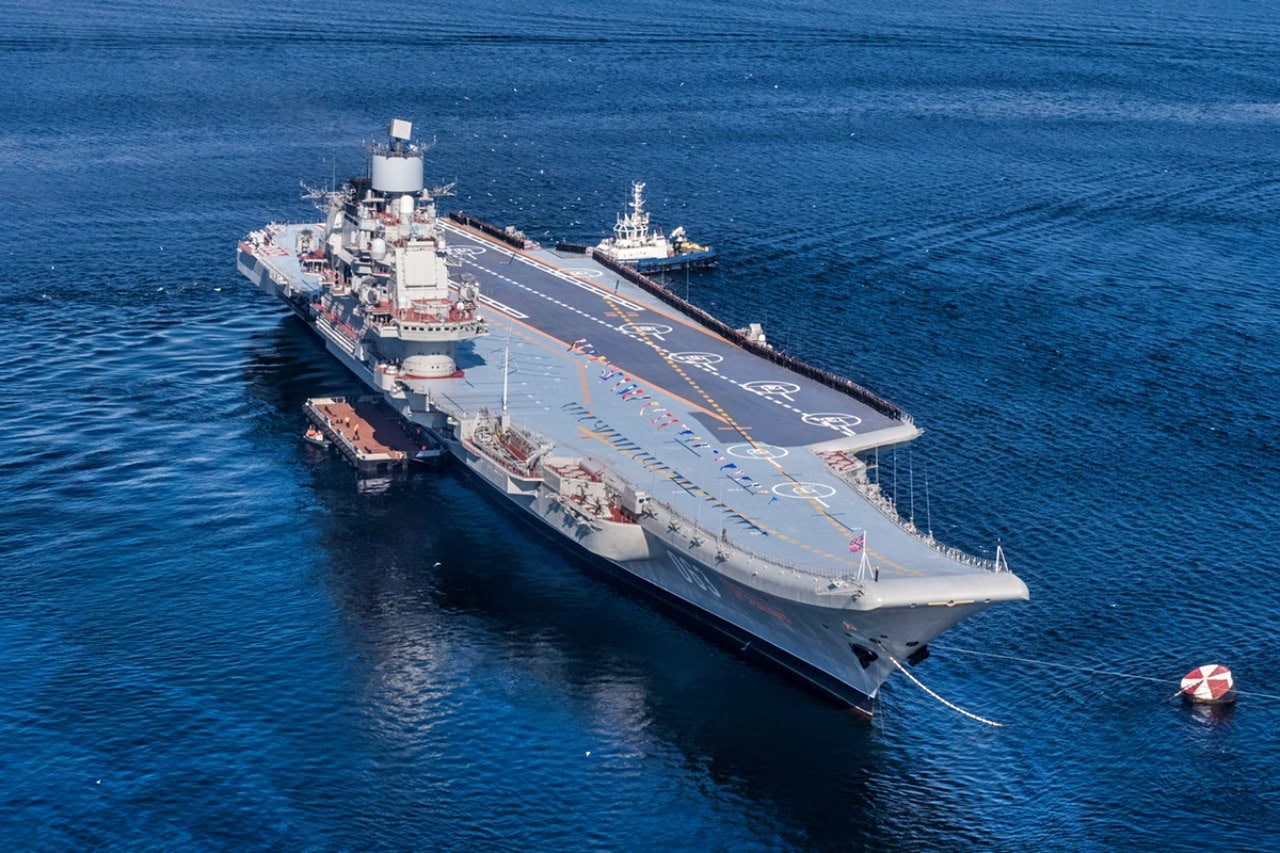
Aircraft Carrier Admiral Kuznetsov from Russian Navy.
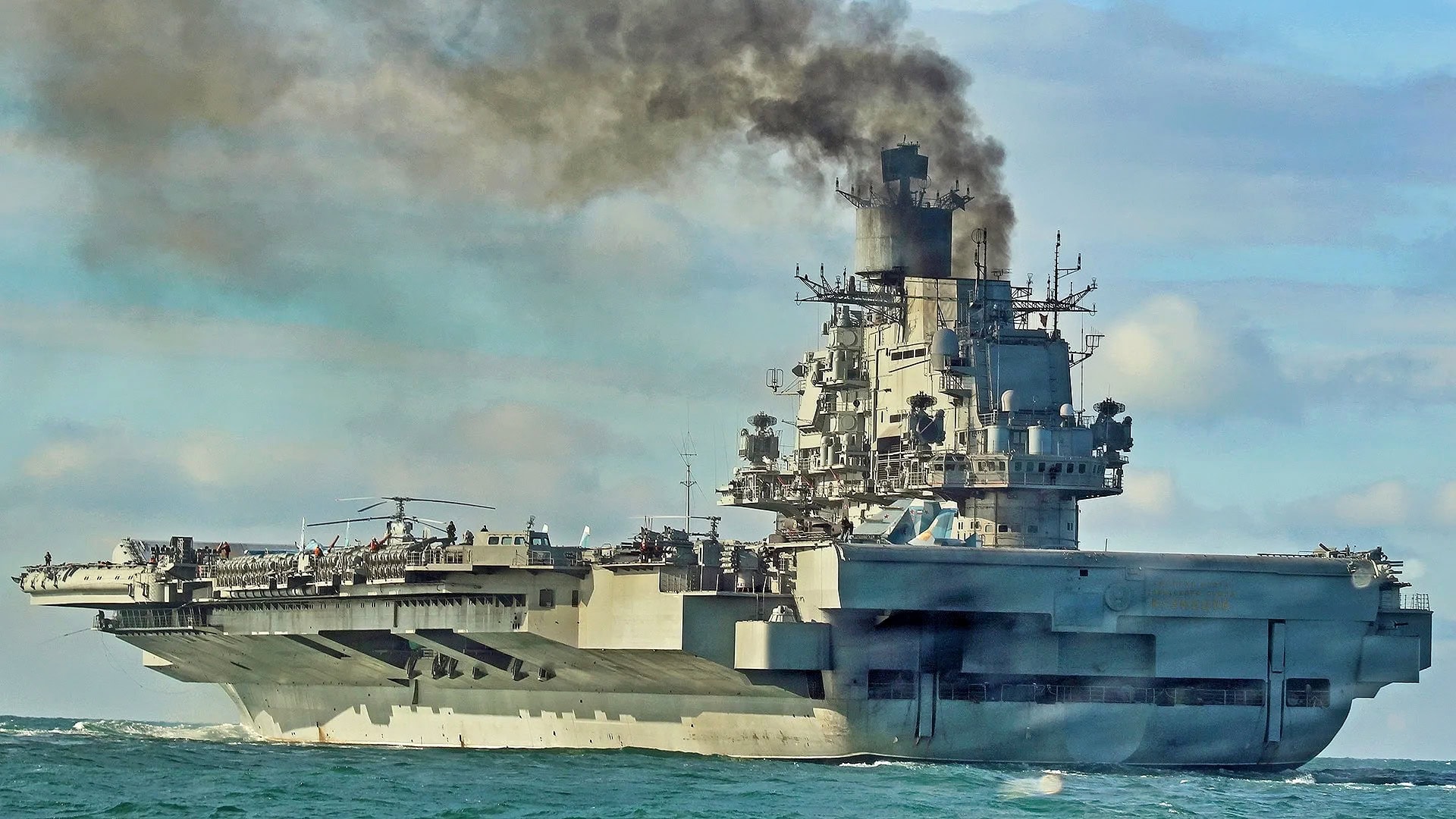
Aircraft Carrier Admiral Kuznetsov Russian Navy. Image Credit: Creative Commons.
Its only combat deployment came in late 2016, when Russia sent the carrier to the eastern Mediterranean to support operations in Syria. The Russian Defense Ministry reported 420 flights, including 117 at night, although American reporting noted Moscow did not separate carrier launches from missions flown after aircraft moved ashore.
The deployment exposed the landing system. A MiG-29K crashed after arresting-gear trouble delayed recovery, and the aircraft ran out of fuel. A Su-33 went into the sea weeks later after an arresting cable failed. Both pilots survived.
Russia then shifted much of the air wing to Khmeimim Air Base in Syria. The carrier remained offshore, but land-based runways had taken over much of the combat workload.
Kuznetsov returned north in early 2017 after a voyage remembered for thick black exhaust and the presence of an ocean-going tug. The two lost fighters and limited military effect exposed the gap between possessing a carrier and operating an effective carrier air wing.
The ship needed work on its boilers, propulsion plant, electrical equipment, and flight-deck systems before another serious deployment.
Russia Planned a Three-Year, $700 Million Rescue
A 2017 plan reported by TASS placed the proposed modernization at almost 40 billion rubles, then about $700 million. Work was supposed to finish in the fourth quarter of 2020.
The program covered the ship’s electromechanical systems, propulsion machinery, and runway complex. Russian officials presented it as a path back to useful service, not a temporary patch. The overhaul was intended to preserve fixed-wing carrier aviation while Moscow debated a future replacement.
The industrial problem sat behind the ship. Kuznetsov was built in Soviet Ukraine. Russia inherited the carrier but not the original shipyard or the larger shipbuilding network that built it.
Northern repair facilities had experience with submarines and surface warships, yet only one local dock was large enough to lift the carrier clear of the water.
It was PD-50.
PD-50 Sank During an Undocking Operation
PD-50 was a 330-meter floating drydock built in Sweden for the Soviet Union and rated to lift about 80,000 tons. It serviced the Northern Fleet’s largest surface ships and nuclear submarines.
During the night of October 29-30, 2018, Kuznetsov was being moved out of the dock when a power-supply disruption affected the pumping system. PD-50 lost stability, listed and sank into Kola Bay.
The carrier floated free, but one of the dock’s cranes fell across its flight deck. United Shipbuilding Corporation chief Alexei Rakhmanov placed the opening at four by five meters and initially argued the damaged structure was straightforward to replace.
Direct repairs to the carrier were later estimated at about 70 million rubles, roughly $1 million at the time. The number disguised the greater loss. Russia still possessed the carrier, but no northern drydock could complete its underwater hull, propeller, and rudder work.
Rakhmanov soon acknowledged that Russia had alternatives for other major warships, but not for Admiral Kuznetsov.
Russia Had to Build a Dock Before Finishing the Carrier
The solution required combining two smaller graving docks at Shipyard No. 35 in Murmansk. Workers had to remove the wall between them, extend the chamber, and create a dock roughly 400 meters long and 70 meters wide.
This became a separate construction program attached to the carrier overhaul. Contract disputes, changing contractors, and delays slowed the work. In 2021, the director of a shipyard involved in the refit was arrested on suspicion of embezzling about 45 million rubles allocated to the project.
Kuznetsov did not enter the rebuilt dock until May 2022. Russia had spent almost four years creating the infrastructure required to resume basic work below the carrier’s waterline.
The loss of PD-50 showed that the carrier’s problems extended beyond a single unreliable warship. A navy operating a large carrier also needs drydocks, trained yard workers, heavy cranes, replacement machinery, test facilities, pilots, and a steady maintenance budget.
Russia was trying to preserve the flight deck while rebuilding part of the support system underneath it.
The Carrier Burned for More Than 24 Hours
On December 12, 2019, workers were welding near the first power compartment when hot material fell into a lower space where fuel was being handled. Fire and toxic smoke spread through internal compartments.
About 400 military and civilian personnel were aboard when the fire began. Firefighters used foam and fought the blaze into the next day. Two people died, while many of the injured suffered from smoke inhalation.
Early public damage estimates varied wildly. An unofficial figure reached 95 billion rubles, while United Shipbuilding Corporation later placed the direct repair work at 300 million to 350 million rubles, which is equal to about $4.7 million.
The lower corporate estimate did not capture the lost time, investigation, and disruption imposed on a carrier already waiting for a replacement drydock.
The fire followed the PD-50 sinking by less than 14 months. It also fit the carrier’s long record of boiler trouble, tug escorts, and smoke.
A smaller fire broke out aboard the Kuznetsov in December 2022 while the ship remained under repair. Russian officials reported no casualties or significant damage. Even a minor event carried symbolic weight after years of missed deadlines.
Every Return-to-Service Date Slipped
The original schedule pointed to completion in 2020 and a return to the fleet in 2021. Later announcements moved delivery to 2022, then 2023.
In June 2022, Russian reporting acknowledged defects in completed work and pushed the expected return to 2024 at the earliest.
A revised 2023 plan called for sea trials in spring 2024, with handover at the end of that year. The schedule already contained another escape clause: delivery would move to 2025 if testing uncovered further trouble.
Kuznetsov left the rebuilt drydock in February 2023, but it did not begin the promised sea trials. The carrier remained inside the Murmansk repair system while the war in Ukraine imposed competing demands on Russia’s military budget and industrial base.
The ship’s heavy aircraft-carrying cruiser designation reflected its missile battery and the legal history surrounding passage through the Turkish Straits.
The title did nothing to solve the central problem. Russia had preserved a carrier on paper without returning a functioning carrier air group to sea.
Russia Said the Repair Was No Longer Worth It
Russian newspaper Izvestia reported in July 2025 that work on Admiral Kuznetsov had been suspended while the Navy and United Shipbuilding Corporation assessed whether restoration still made sense.
Two weeks later, Kostin gave the clearest public signal from Russia’s shipbuilding establishment. He described further work as extremely expensive and expected the issue to end with sale or disposal.
The 70-ton crane did not doom Kuznetsov by itself. The 2019 fire did not settle the ship’s fate by itself. Together, the accidents consumed time, exposed weak infrastructure, and raised the price of restoring a carrier with a poor operational record.
The overhaul also became harder to defend after Russia spent years without carrier operations. Rebuilding the flight-deck crew, air wing, pilot-training cycle, and escort group represented another bill beyond the cost of repairing the hull.
By 2026, the nine-year repair effort had become an even greater indictment of Russian naval maintenance. Russia had saved the hull from the sinking drydock, removed the fallen crane, and built a dock around the stranded carrier. None of it returned Kuznetsov to sea.
The contrast with the unfinished sister hull is severe. Ukraine sold Varyag to China, which completed it as Liaoning. In June 2026, Liaoning returned from more than 40 days of drills in the South China Sea and western Pacific.
Admiral Kuznetsov had not sailed under its own power since returning from Syria in 2017. It remained at Murmansk in August 2026, its repair work suspended, and every announced return-to-service date had expired.
About the Author: Harry J. Kazianis
Harry J. Kazianis (@Grecianformula) was the former Senior Director of National Security Affairs at the Center for the National Interest (CFTNI), a foreign policy think tank founded by Richard Nixon based in Washington, DC. Harry has over a decade of experience in think tanks and national security publishing. His ideas have been published in the NY Times, The Washington Post, The Wall Street Journal, CNN, and many other outlets worldwide. He has held positions at CSIS, the Heritage Foundation, the University of Nottingham, and several other institutions related to national security research and studies. He is the former Executive Editor of the National Interest and the Diplomat. He holds a Master’s degree focusing on international affairs from Harvard University.