
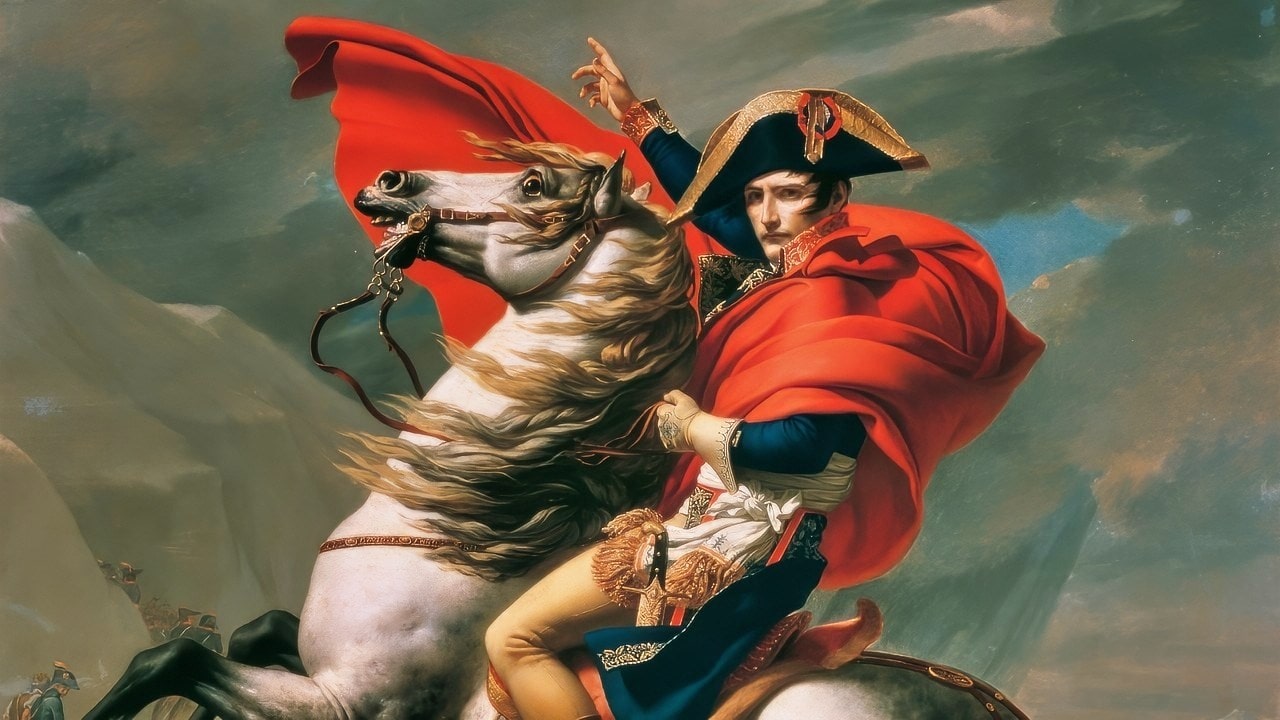
“You become strong by defying defeat and by turning loss and failure into success.” The line is widely attributed to Napoleon Bonaparte, though its source is uncertain. The searchable text of the 1916 aphorism collection Napoleon in His Own Words does not contain the phrase. The sentiment still fits a career built around recovery.
Napoleon lost his homeland, his army, his empire, and his throne. More than once, he answered collapse with a faster and more audacious return.
Napoleon Movie Poster Image. Image Credit: Industry Handout.

Napoleon with the Crown. Image Credit: Creative Commons.
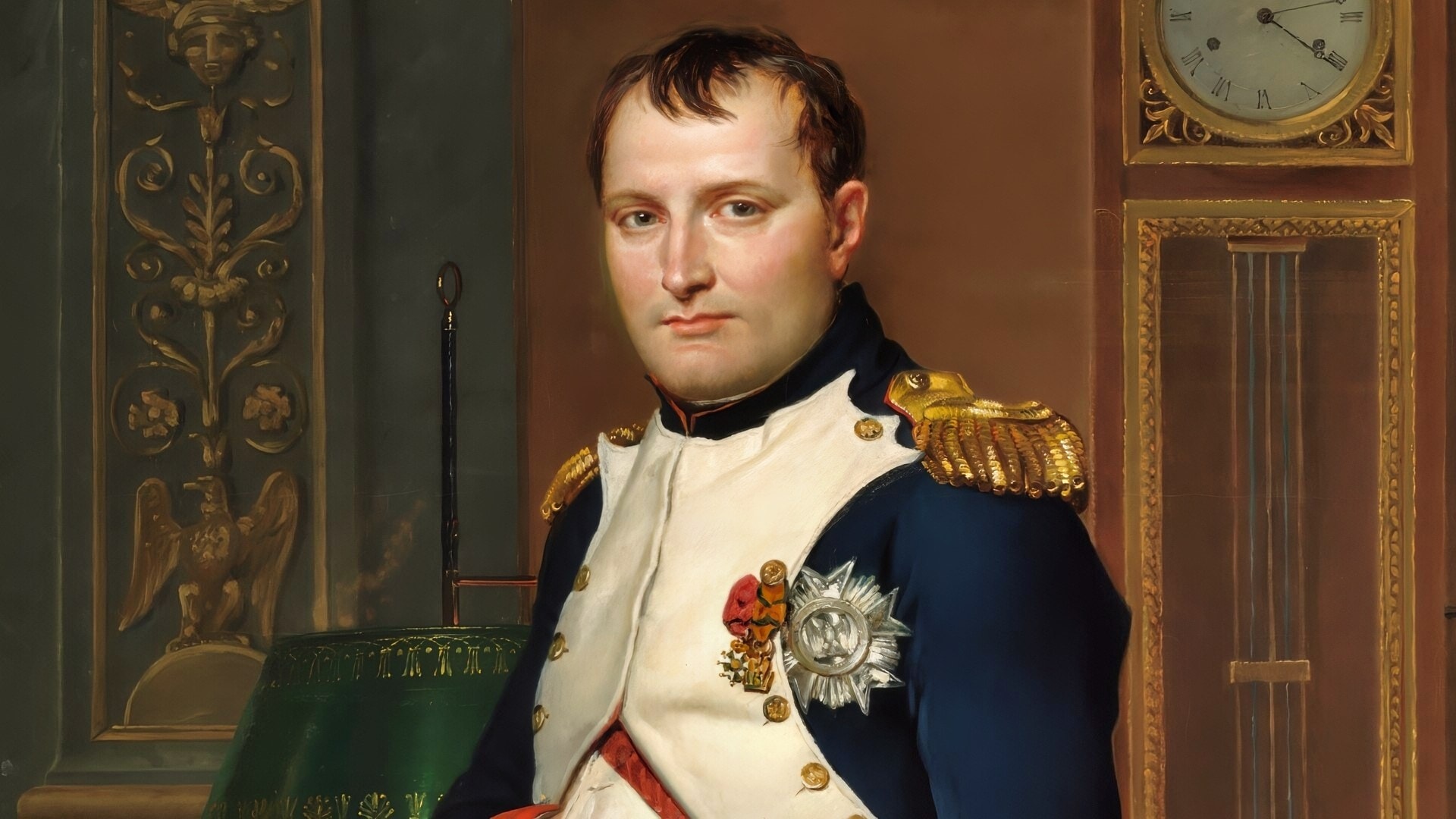
Napoleon Painting Creative Commons Image
Napoleon Knew Failure
Napoleon was born in Ajaccio, Corsica, on August 15, 1769, and entered the French artillery.
His first great defeat was political rather than military.
He backed the French Revolution while Corsican leader Pasquale Paoli moved toward separation from France. The Bonaparte family fled the island in 1793, losing their home and local standing. Napoleon reached Toulon on June 13 and never saw Corsica again.
Mainland France gave the displaced officer his opening. At the Siege of Toulon, Napoleon helped direct the artillery plan that seized the heights commanding the harbor, forcing British and allied forces to evacuate.
He became a brigadier general at 24. The fall of Maximilien Robespierre then brought arrest and temporary disgrace. In October 1795, Napoleon used artillery to crush a royalist rising in Paris. Months later, he received command of the Army of Italy.
The 1796-1797 Italian campaign made his reputation. Napoleon moved faster than larger enemy forces, separated Austrian and Piedmontese armies, and won at Montenotte, Lodi, Arcole, and Rivoli.
His method rested on concentration, speed, and the confidence to attack before an opponent completed its own plan. It also established a political habit: Napoleon presented battlefield recovery as proof of personal destiny.
Egypt Turned Military Failure Into Political Power
The Egyptian expedition of 1798 achieved victories at Malta and the Pyramids, but was followed by disaster.
Adm. Horatio Nelson destroyed the French fleet at the Battle of the Nile, trapping Napoleon’s army in the eastern Mediterranean. Napoleon then invaded Ottoman Syria. The siege of Acre ran from March to May 1799 and ended in failure after stubborn defense, British naval support, and disease stopped repeated French assaults.
Napoleon returned to Egypt, defeated an Ottoman landing at Aboukir, and left for France in August 1799. The army he abandoned surrendered in 1801. In Paris, he transformed a failed expedition into a political opening. The Directory was weak, and the coup of 18 Brumaire made him First Consul. Egypt did not become a military success. Napoleon escaped the consequences before they destroyed his career.
Marengo provided a cleaner battlefield recovery. On June 14, 1800, Austrian forces pushed the French army back across northern Italy. By midafternoon, defeat looked near.
Austrian commander Michael von Melas left the field believing victory secure. Gen. Louis Desaix arrived with reinforcements, and François Étienne de Kellermann’s cavalry charge broke the advancing Austrian column. The Fondation Napoléon describes Marengo as a battle where victory came exceptionally close to defeat. Napoleon gained the political benefit, though Desaix, Kellermann, and the soldiers supplied the turnaround.
Aspern-Essling Forced Napoleon to Correct His Own Plan
Napoleon’s victories at Austerlitz, Jena-Auerstedt, and Friedland created an aura of invincibility. Austria broke it at Aspern-Essling on May 21-22, 1809. Napoleon tried to cross the Danube east of Vienna while Archduke Charles attacked the French bridgehead. Austrian forces damaged the fragile bridges, slowing the flow of reinforcements and ammunition.
Napoleon withdrew to Lobau Island after two days of fighting. Marshal Jean Lannes suffered a mortal wound.
Six weeks later, Napoleon returned with a rebuilt crossing system, fortified bridgeheads, heavier artillery, and a larger force. At Wagram on July 5-6, he defeated Austria and ended the War of the Fifth Coalition. The combined losses exceeded 80,000. Recovery came through engineering, logistics, and concentration of force. Wagram restored his military position while showing how expensive each new victory had become.
Russia Destroyed an Army Napoleon Never Fully Replaced
The invasion of Russia in 1812 tested resilience beyond its limits. Roughly 600,000 men crossed the Neman. Napoleon won the blood-soaked battle of Borodino and entered Moscow, but Russia refused peace.
Fire, distance, and a collapsing supply system forced retreat. The Musée de l’Armée estimates fewer than 80,000 men remained fit to fight when the remnants reached the western edge of the empire.
Napoleon rebuilt an army within months and won at Lützen, Bautzen, and Dresden in 1813. Those victories recalled the operational skill behind Austerlitz, Jena-Auerstedt, and Friedland. The replacements lacked the experience, cavalry, and cohesion lost in Russia. Coalition commanders avoided his preferred decisive engagement, combined their armies, and defeated him at Leipzig in October.
Leipzig cost Napoleon control of Germany and opened France to invasion. A retreating column suffered another disaster when a bridge over the Elster was demolished too early, trapping thousands.
A later 19FortyFive examination of Russia, Leipzig, and Waterloo captures the widening gap between Napoleon’s tactical skill and the strategic weight aligned against him.
He still produced one final run of battlefield recoveries in 1814. With about 60,000 young troops, Napoleon won at Brienne, Champaubert, Montmirail and Montereau. The victories delayed the coalition but did not save Paris. Allied troops entered the capital on March 31. His marshals refused another campaign, and Napoleon abdicated on April 6 before leaving for Elba.
The Hundred Days Was Napoleon’s Greatest Comeback
Napoleon spent ten months governing Elba. On February 26, 1815, he sailed with about 1,000 men and landed in France on March 1. Royal troops sent to stop him joined instead. He reached Paris on March 20 after Louis XVIII fled. The return required no major battle. It relied on memory, charisma and the army’s resentment of the restored Bourbon monarchy. Few political comebacks have moved so quickly.
Europe refused to accept his return. Napoleon struck into Belgium before the coalition completed its mobilization. He defeated the Prussians at Ligny on June 16, his last battlefield victory, while Marshal Michel Ney fought Wellington at Quatre Bras. The French failed to destroy either army or keep them apart.
The comeback restored Napoleon’s throne but not the seasoned command system examined in 19FortyFive’s account of his final campaigns.
Waterloo followed on June 18. Rain delayed the French attack, repeated assaults failed to break Wellington’s position and Prussian forces arrived on Napoleon’s right.
The National Army Museum describes the battle as the event which destroyed Napoleon’s imperial power for good.
The lost time and converging coalition armies also explain why control of battlefield chaos deserted the French at Waterloo.
Napoleon abdicated again on June 22 and surrendered to the British in July.
They sent him to Saint Helena, far beyond the route of another return. He died at Longwood House at 5:49 p.m. on May 5, 1821, aged 51.
His second exile lasted almost six years.
About the Author: Harry J. Kazianis
Harry J. Kazianis (@Grecianformula) was the former Senior Director of National Security Affairs at the Center for the National Interest (CFTNI), a foreign policy think tank founded by Richard Nixon based in Washington, DC. Harry has over a decade of experience in think tanks and national security publishing. His ideas have been published in the NY Times, The Washington Post, The Wall Street Journal, CNN, and many other outlets worldwide. He has held positions at CSIS, the Heritage Foundation, the University of Nottingham, and several other institutions related to national security research and studies. He is the former Executive Editor of the National Interest and the Diplomat. He holds a Master’s degree focusing on international affairs from Harvard University.