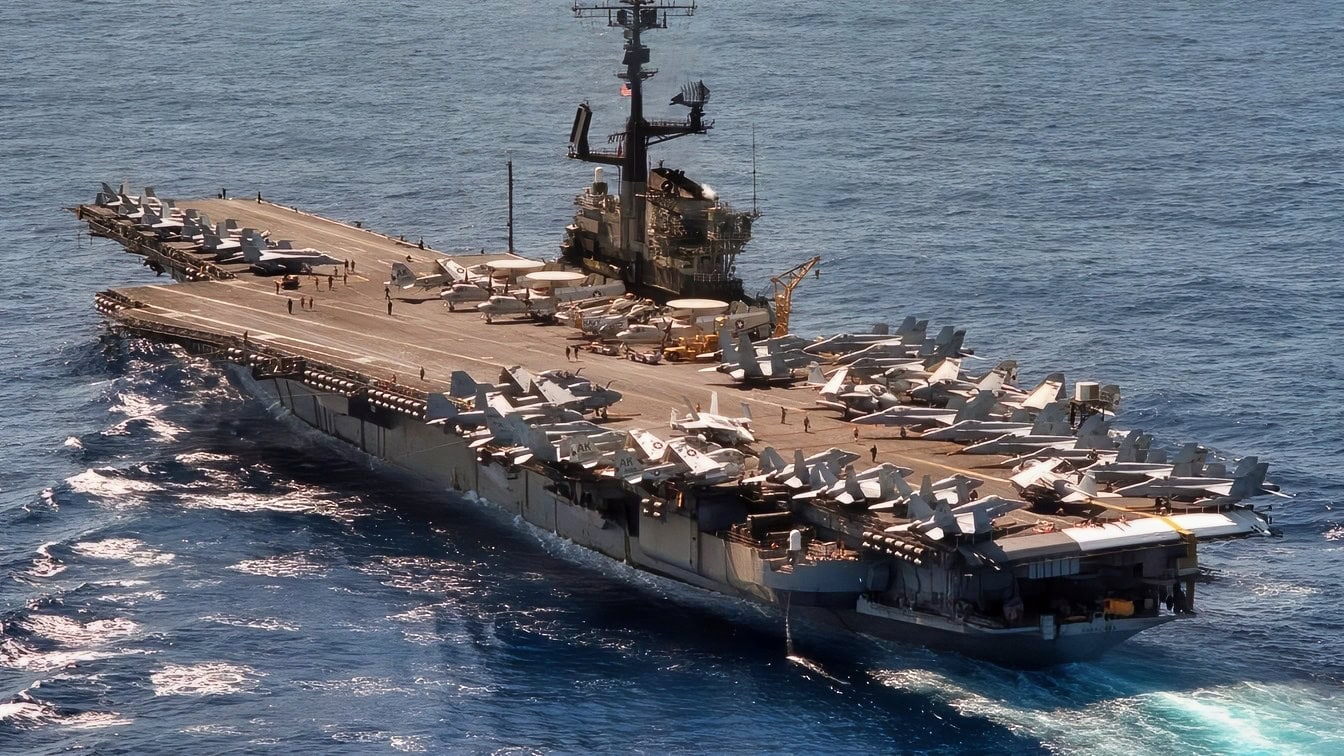
One of the most interesting periods for the American aircraft carrier fleet came when the force transitioned from its World War II-era designs to Cold War-era designs intended to handle the heavier, larger, and more demanding jet-powered planes that populate the Navy’s aviation fleet today. Contrary to what some may believe, the Navy did not abandon the carriers it was building when World War II ended. Instead, the Navy upgraded many of those carriers to accommodate the new jet-powered aircraft the maritime branch was procuring.
The Ageless Warrior
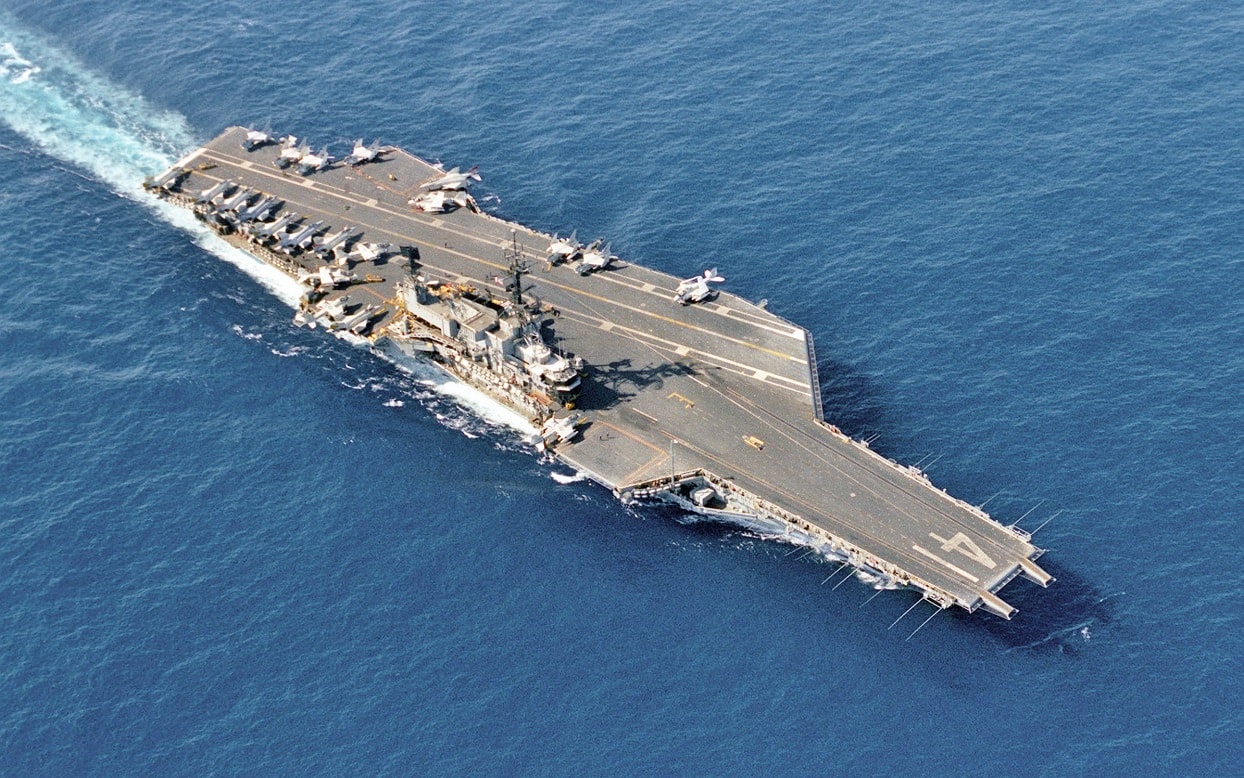
An elevated starboard bow view of the aircraft carrier USS MIDWAY (CV 41) underway off the coast of Okinawa, Japan.
Midway-Class Aircraft Carriers. Image: Creative Commons.
The USS Coral Sea (CV-43) entered service when WWII-era propeller-driven fighters were the primary aircraft employed by the naval aviation force. The Navy eventually retired this carrier when the F/A-18 Hornets entered service. Thus, the Coral Sea is a prime example of the transition that occurred in the mid-to-late twentieth century for the Navy’s surface warfare fleet.
Some even called the Coral Sea the “Ageless Warrior,” since the carrier had served through so many different eras of military technology.
When the ship was first commissioned, she displaced 45,000 tons and measured 968 feet long. The leviathan could achieve speeds of 33 knots. Originally, the carrier was designed to carry 4,000 sailors. She even carried 18 five-inch guns, 84 40mm Bofors guns, and 68 20mm cannons.
One key element of the Midway-class aircraft carriers (of which the Coral Sea was a part) was their armored flight decks.
This development stemmed from hard-won experience in the Pacific Theater of World War II.
Japanese kamikaze and bombing attacks against US aircraft carriers could be especially damaging for the carriers if the attacks went through the undefended flight decks of those carriers. The British Royal Navy had long employed armored flight decks.
But their weight meant smaller air wings.
The Americans prized mass over protection in the early phases of WWII.
The Americans quickly embraced the British concept of armored flight decks–and didn’t have to reduce their air wing because the US just made the Midway-class bigger.
Another interesting tidbit about this class of carrier was that in their original massive design, they could not pass through the Panama Canal.
Coral Sea was the last American aircraft carrier made with a straight flight deck.
An Evolving Carrier
To highlight the evolution of the carrier’s vast air wing, in 1948 the carrier operated F4U Corsairs, F6F Hellcats, and AD-1 Skyraiders.
These propeller-driven planes were top-of-the-line, WWII-era planes.
By the time the Coral Sea did its shakedown cruise in 1948, the Navy was already working to move away from these planes. That meant the Coral Sea had to adapt to the newer jet-powered birds coming online at the time.
At the same time, the Navy was using the Coral Sea to test its nascent strategic nuclear-strike capability. Lockheed P2V Neptune patrol bombers conducted jet-assisted takeoffs from this carrier.
Later, the AJ Savage was introduced on this carrier.
That was an early carrier-based plane that was designed to deliver nuclear bombs.
By the late 1950s, though, jet-powered planes were effectively rendering the WWII-era Coral Sea obsolete.
The Navy temporarily decommissioned the Coral Sea in 1957 for a 33-month SCB-110 modernization at Puget Sound Naval Shipyard.
The carrier underwent partial reconstruction.
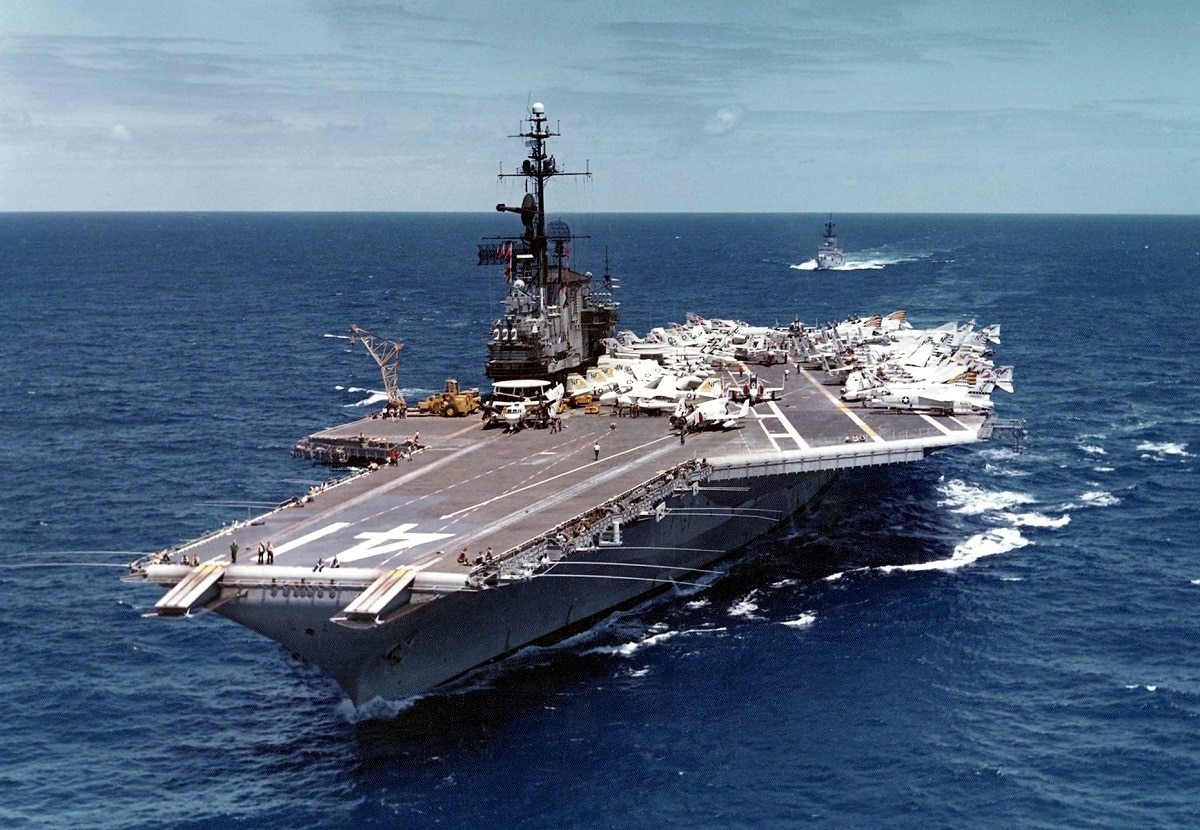
At Puget Sound in 1957, Coral Sea received an angled flight deck, three steam catapults, new arresting gear, an enclosed hurricane bow, and even deck-edge elevators to give more space for jet aircraft operating from the WWII-era carrier.
Coral Sea returned to service in January 1960.
And by the Vietnam War, the Coral Sea was flying F-4 Phantom II, F-8 Crusader, A-4 Skyhawk, A-6 Intruder, and A-7 Corsair II jet planes.
She also carried a variety of reconnaissance, electronic warfare (EW), and airborne early warning detachments. The Coral Sea possessed a sizable helicopter detachment, too.
Her Vietnam War Service
The Coral Sea’s best years were during the Vietnam War. Warplanes from the carrier participated in Operation Rolling Thunder, striking key targets in North Vietnam.
In fact, the carrier accumulated 10,000 combat sorties during one cruise. That deployment set the record for a carrier operating one air wing during a single combat deployment.
Coral Sea was involved with the US Navy’s response to the Iran Hostage Crisis and the subsequent, failed hostage rescue attempt known as Operation Eagle Claw.
Flying F/A-18 Hornets
During the 1980s, the Coral Sea was upgraded to accommodate the F/A-18 Hornet.
In 1986, the Coral Sea’s air wing, which carried multiple warplanes, notably the F/A-18, participated in combat operations against Libya under Gaddafi, including Operation El Dorado Canyon in April 1986.
By 1989, the Coral Sea completed its final deployment.
She was decommissioned on April 26, 1990, after more than 42 years, three wars, and the deployment of everything from propeller-driven WWII-era warplanes to jet-powered fighters from her flight deck.
Coral Sea was sold for scrap in 1993 (although environmental and legal complications delayed dismantlement until 2000).
This carrier evolved with the nation from WWII until the bitter end of the Cold War. It experienced almost every conflict within that time and fielded all manner of aircraft. It truly was the “Ageless Warrior.”
About the Author: Brandon J. Weichert
Brandon J. Weichert is the Senior National Security Editor at 19FortyFive.com. He also manages The Weichert Brief on Substack. Weichert also hosts “National Security Talk” on Rumble. He is the author of four bestselling national security books, the most recent of which is A Disaster of Our Own Making: How the West Lost Ukraine (Encounter Books). Follow him via Twitter/X @WeTheBrandon.