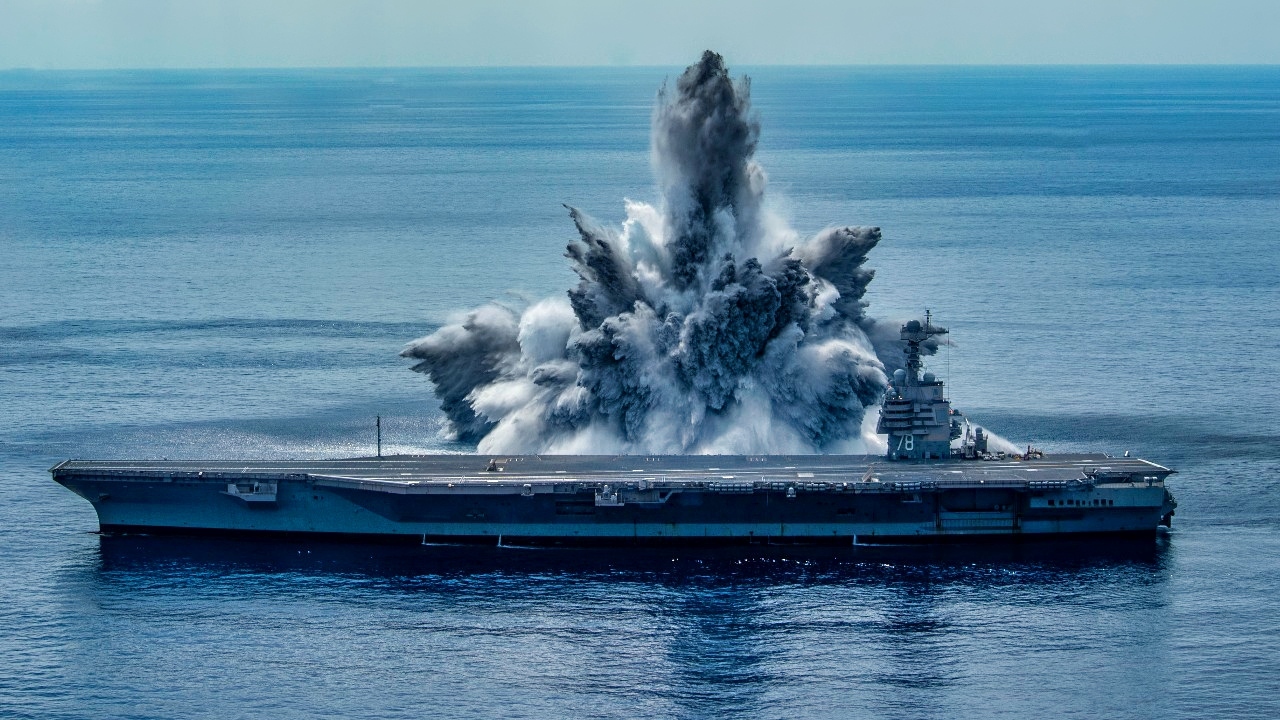
The U.S. Navy’s Ford-class aircraft carriers are projected to enter service on much-delayed, protracted timelines, driven by several converging factors.
First, the massive supercarriers are nuclear-powered, a far greater engineering challenge than conventionally powered vessels.
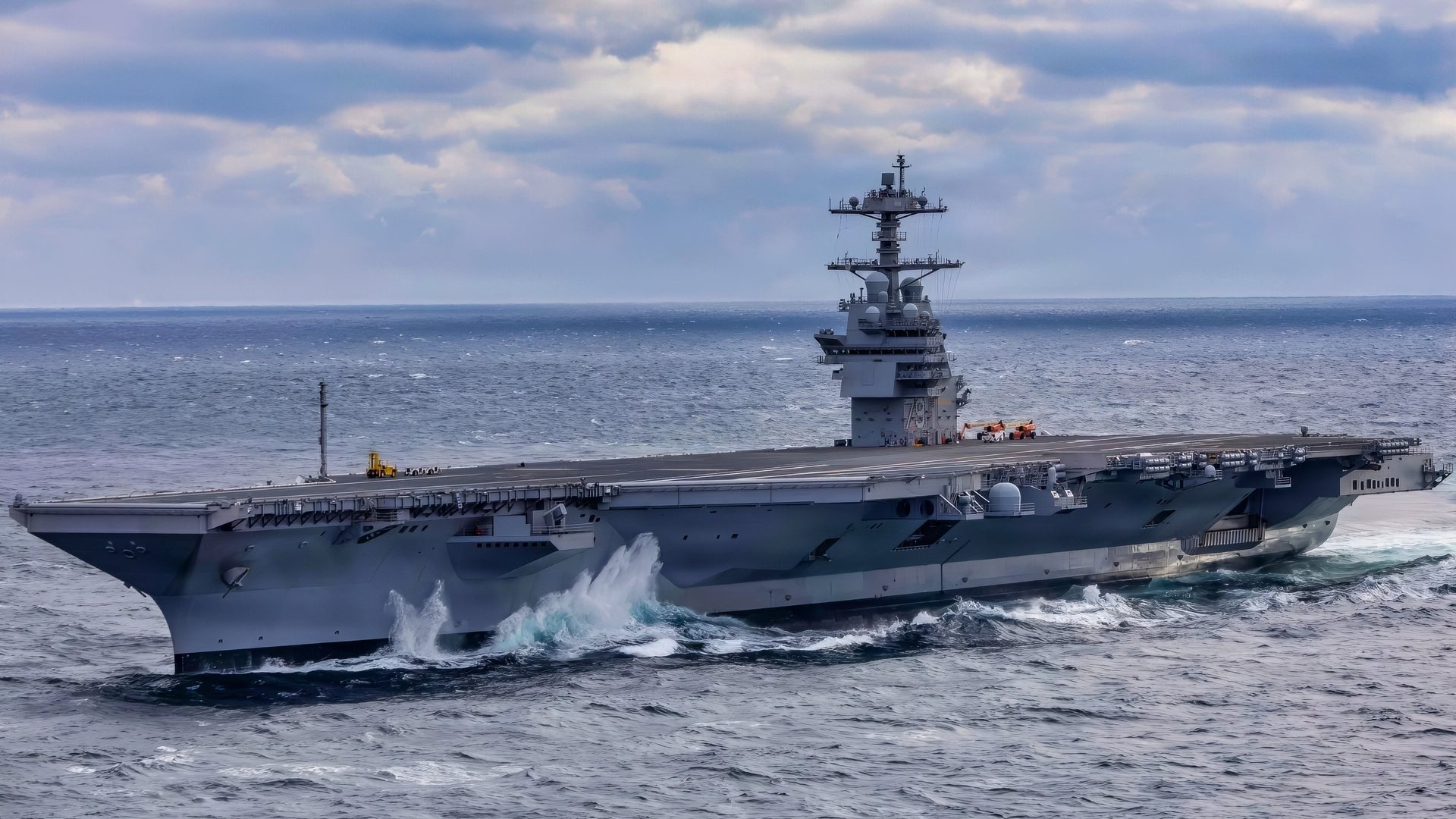
Pre-Commissioning Unit John F. Kennedy (CVN 79) transits the Atlantic Ocean during Builder’s Sea Trials, Jan. 28, 2026. Builder’s Trials provide an opportunity to test ship systems and components at sea for the first time, and make required adjustments prior to additional underway testing. (U.S. Navy photo by Mass Communication Specialist 2nd Class Kaitlin Young)
But at the same time, the Ford-class sports several brand-new, redesigned subsystems that have not been integrated into an aircraft carrier before.
Concurrently, however, America has lost much of the industrial muscle that made the rapid construction of warships possible.
The lead ship of the class, the USS Gerald R. Ford, illustrates this problem.
Construction formally began with a keel-laying ceremony in November 2009.
The ship was ultimately delivered to the U.S. Navy in May 2017 — roughly seven and a half years after it was ordered, but about two years behind schedule.
The subsequent Ford-class carriers have been anything but paragons of speed themselves.
The USS John F. Kennedy, originally slated for September 2022, is now anticipated in March 2027, a delay of four and a half years.
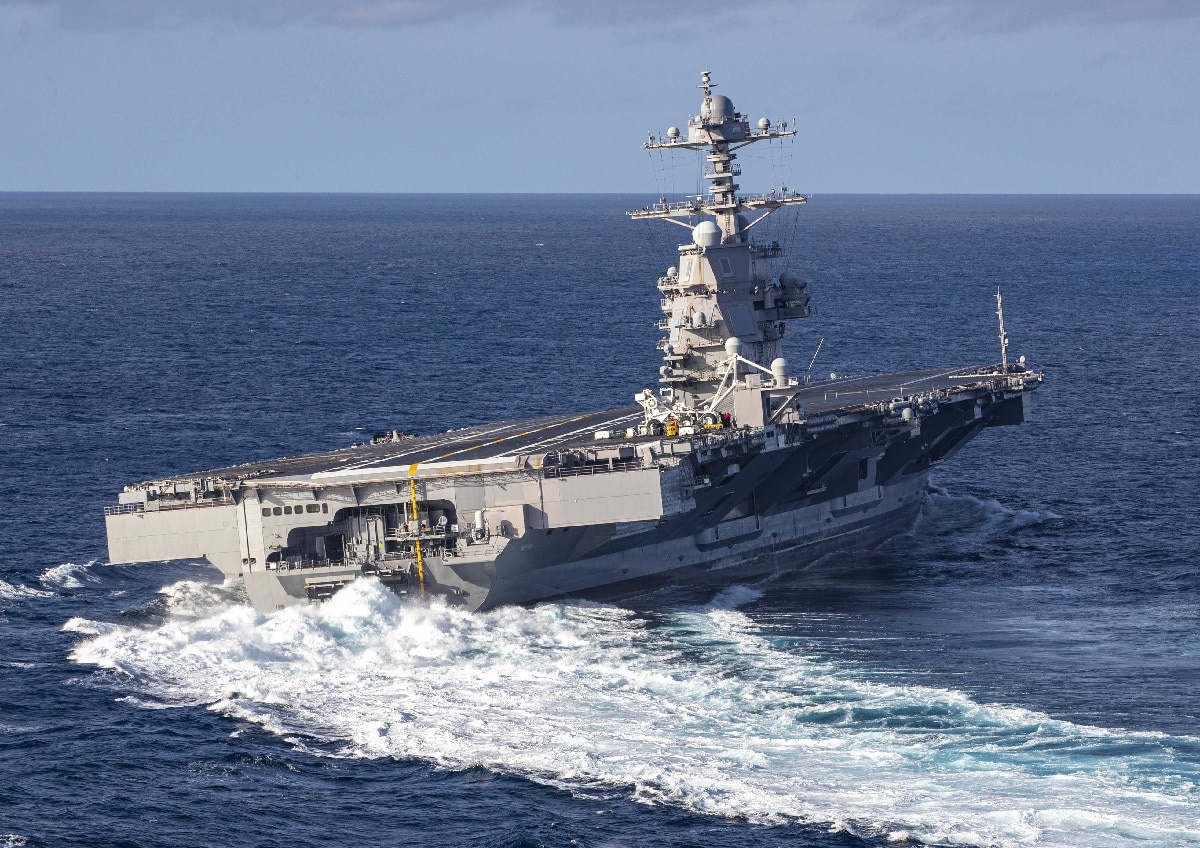
Gerald R. Ford-class. Image: Creative Commons.
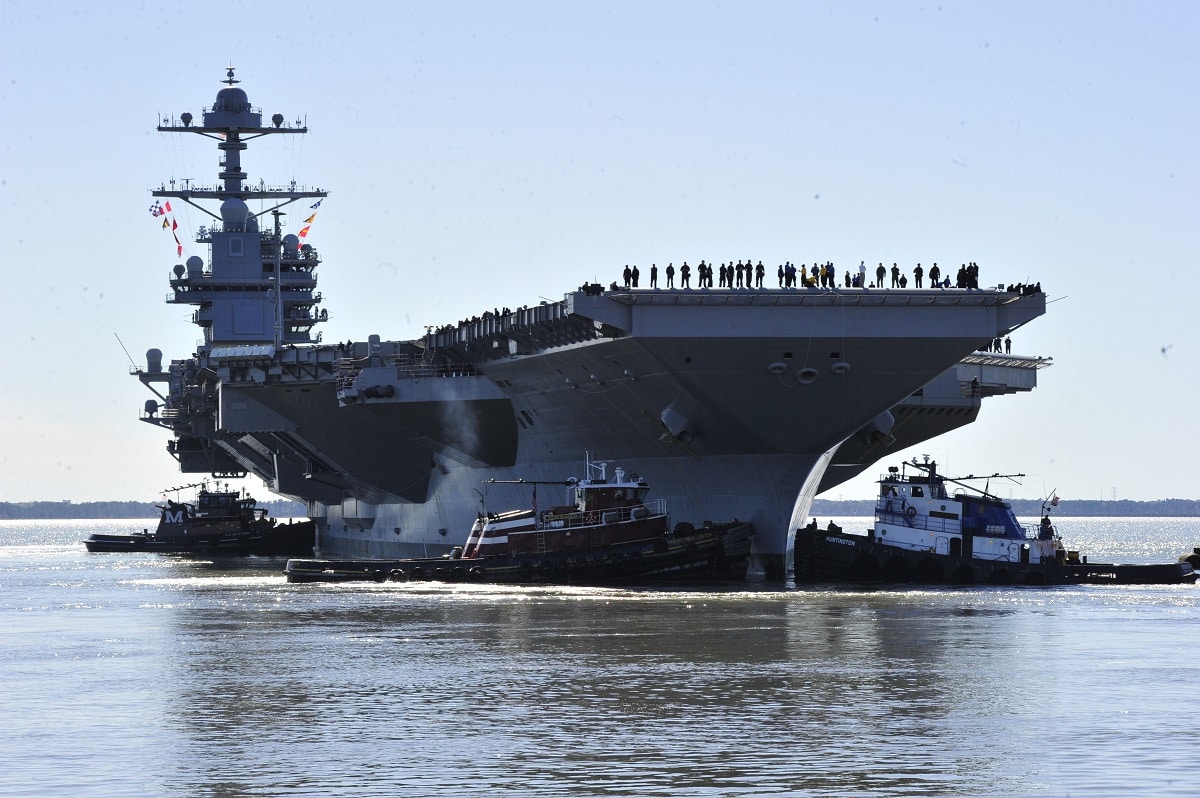
Gerald R. Ford (CVN 78) Sailors man the rails as the ship departs Huntington Ingalls Industries Newport News Shipbuilding for builder’s sea trials off the coast. The first- of-class ship—the first new U.S. aircraft carrier design in 40 years—will spend several days conducting builder’s sea trials, a comprehensive test of many of the ship’s key systems and technologies. (U.S. Navy photo by Chief Mass Communication Specialist Christopher Delano)
The USS Enterprise, the following ship of the class, has also slipped behind its originally projected build schedule and is expected to enter service around 2030.
Based on available data, the average time from contract award to delivery was 101 months — or 8.4 years.
However, they note that future varies significantly between ships.
Some took more than nine years. Still, a Ford-class trend is clear: the class suffered significant delays on top of an already lengthy construction period.
American Industrial Might During World War Two
The situation was markedly different during World War Two. Take the USS Essex, for example, the lead ship of the Essex-class.
That ship, from keel laying to commissioning, took just 20 months, a pace of construction that can be explained by the fact that the circumstances then were almost the opposite of today’s.
America was engaged in a total war against Imperial Japan and Nazi Germany, and shipyards were tasked with building many copies of the same ships.
Furthermore, the vessels of that era were conventionally powered, and the intricacies and challenges of nuclear propulsion were necessarily not yet to be grappled with.
The New Complexities of Carrier Building
The Ford-class is the first new American carrier design in four decades and integrates several new features at once.
EMALS, the ship’s electromagnetic catapult that launches aircraft from the carrier’s flight deck and into the air, replaces legacy steam catapults.
It offers more precise, finely-tuned launches, reducing strain on aircraft and maintenance burden while also enabling a wider variety of aircraft to be launched, from relatively light unmanned aircraft to heavy fighters.
The ship’s Advanced Arresting Gear is also new to the class. It receives aircraft on landing, replacing the Nimitz-class’ hydraulic system with a digitally controlled system capable of handling a wider variety of aircraft.
But the Ford-class also has Advanced Weapons Elevators. These use electromagnetic motors instead of conventional machinery to move substantially heavier loads more quickly.
The U.S. Navy maintains that these elevators can support a 33 percent increase in sortie generation by the Nimitz-class carriers.
Lastly, the Ford-class has much greater electrical power-generation capacity, a necessity for supporting these energy-intensive systems as well as future sensors and weapons.
In theory, the strategy should reduce lifetime operating costs, but in practice, making these systems work together for the first time was difficult.
Challenges
The carrier’s weapons elevators are perhaps one of the clearer examples.
They were developed concurrently with the ship and integrated into the hull before full testing and validation.
Problems uncovered during installation and testing caused delays, and the ship’s elevators remain troublesome long after delivery.
EMALS and AAG likewise suffered development and reliability problems. The U.S. Navy had, in essence, allowed immature technologies to enter production, leaving preciously little leeway for design changes without expensive rework.
Meanwhile, Newport News is the only shipyard in the United States capable of building these carriers, so it has little spare build capacity.
The shipyard has struggled to recruit and retain skilled workers, while the retirement of experienced employees during and after Covid has left a smaller, less experienced workforce.
Supply-chain bottlenecks have also compounded the problem. So while the Ford-class was intended to make carriers more efficient at sea, getting that class to be more efficient has been, ironically, anything but.
About the Author: Caleb Larson
Caleb Larson is an American multiformat journalist based in Berlin, Germany. His work covers the intersection of conflict and society, focusing on American foreign policy and European security. He has reported from Germany, Russia, and the United States. Most recently, he covered the war in Ukraine, reporting extensively on the war’s shifting battle lines in the Donbas and writing on its civilian and humanitarian toll. Previously, he worked as a Defense Reporter for POLITICO Europe. You can follow his latest work on X.