
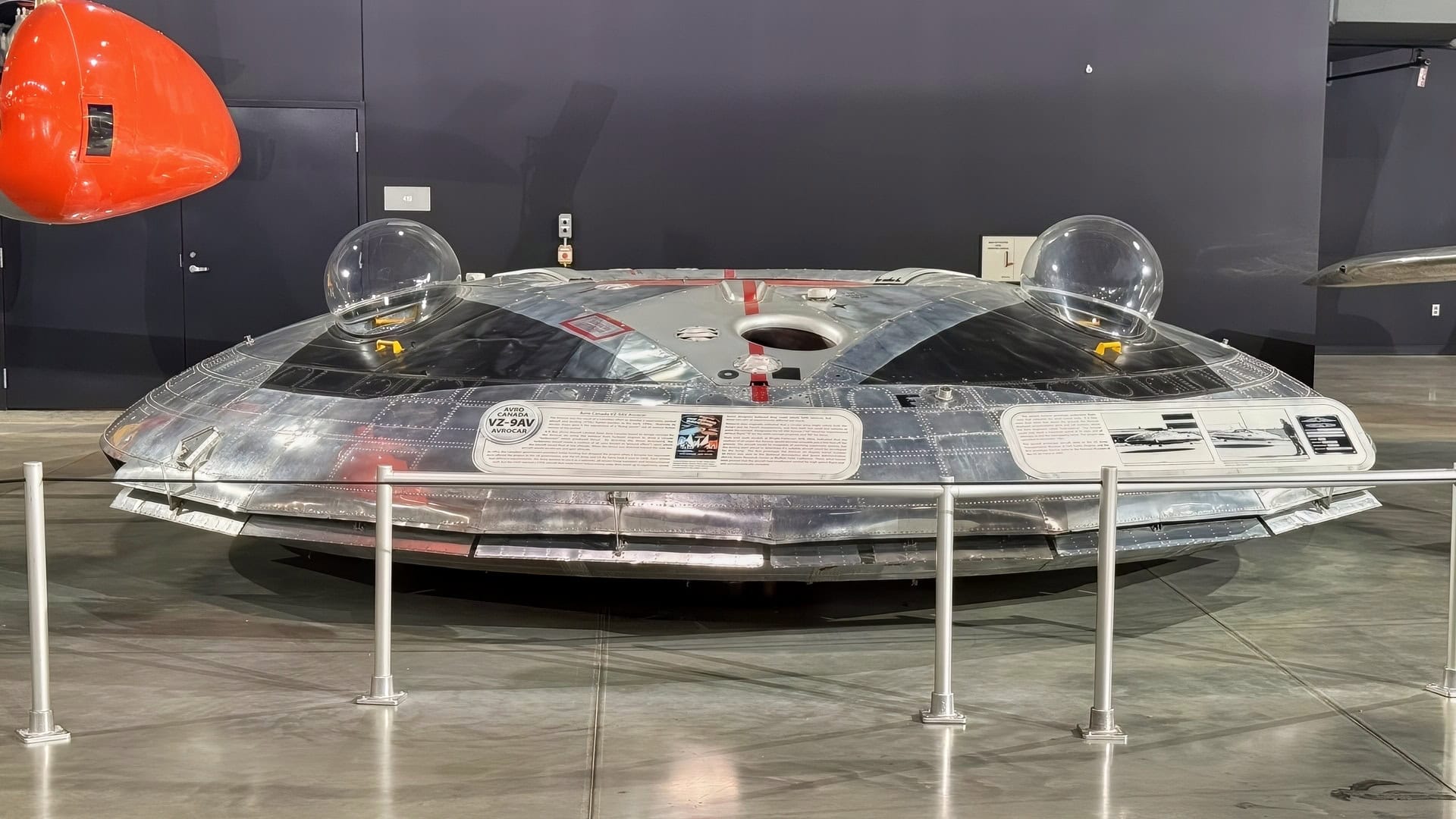
Avro Canada VZ-9: We got as close as they would let us at the National Museum of the US Air Force – When it comes to alleged alien spacecraft visiting Planet Earth from outer space, the term “flying saucer” is no longer in vogue.
For that matter, even the longstanding acronym “UFO (Unidentified Flying Object)” is becoming less prevalent, being replaced by “UAP (“Unidentified Anomalous/Aerial Phenomena“).
Avrocar Flying Saucer Up Close 19FortyFive.com Image
Avrocar Flying Saucer Up Close 19FortyFive.com Image
Semantic shifts aside, back in the day, U.S. government officials and other skeptics typically pooh-poohed alleged flying saucer sightings, attributing them to Mother Nature, weather balloons, or experimental military aircraft.
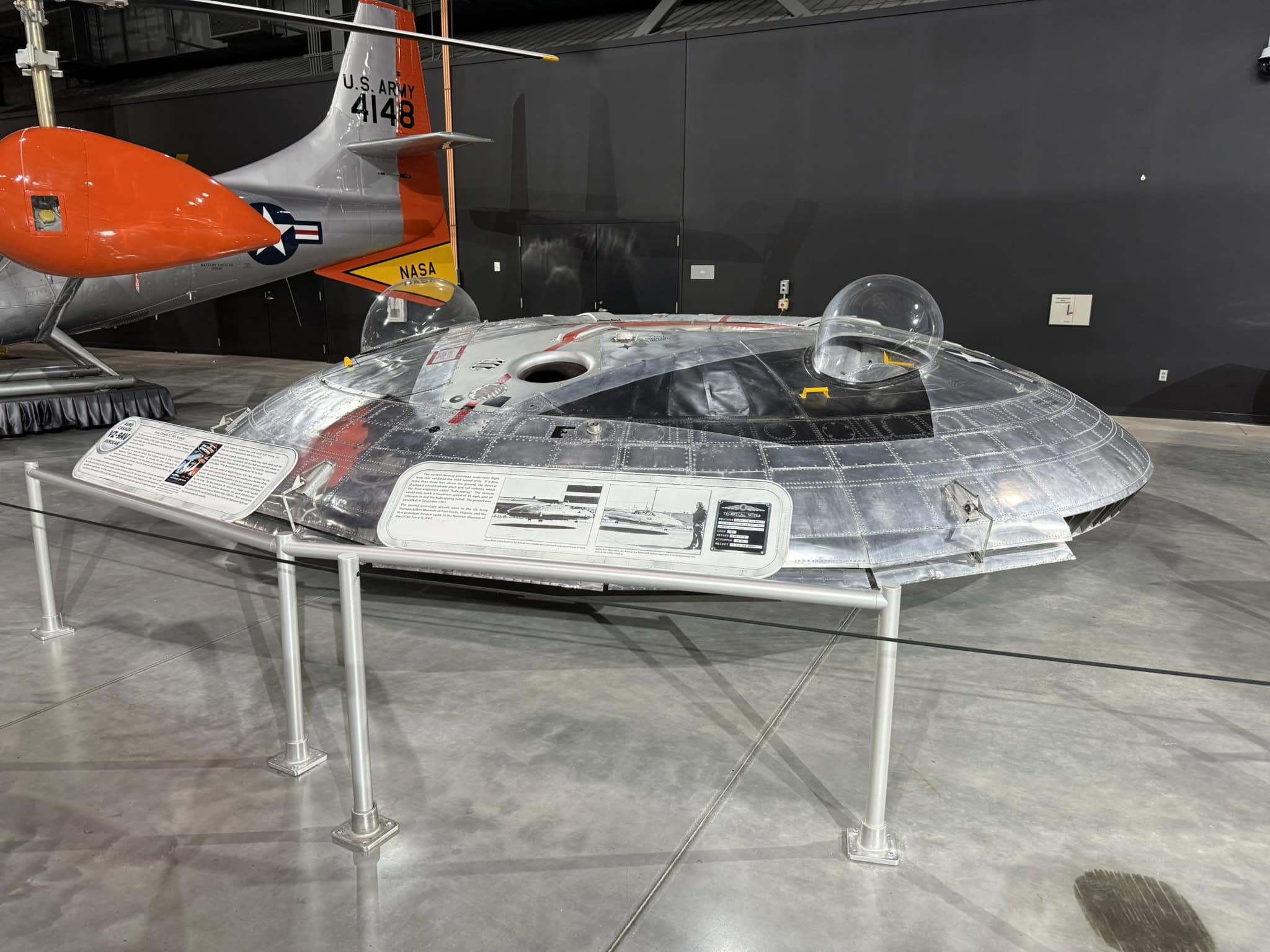
Although these explanations are unconvincing to true believers in the paranormal, at least one experimental military aviation project was indeed saucer-shaped. Say hello to the Avro Canada VZ-9AV Avrocar.
Avro Canada VZ-9 Initial History and Premise
Although the VZ-9 was ultimately intended for the U.S. Armed Forces, it originated in Canada, as you astute readers have undoubtedly already deduced from the Avro Canada manufacturing nexus.
This reflected the solidity of Can-Am military relations through both NATO and the North American Aerospace Defense Command (NORAD) during the Cold War. Avro Canada was also famous for building the CF-100 Canuck— the only Canadian-designed fighter plane to go into mass production—and the star-crossed CF-105 Arrow.
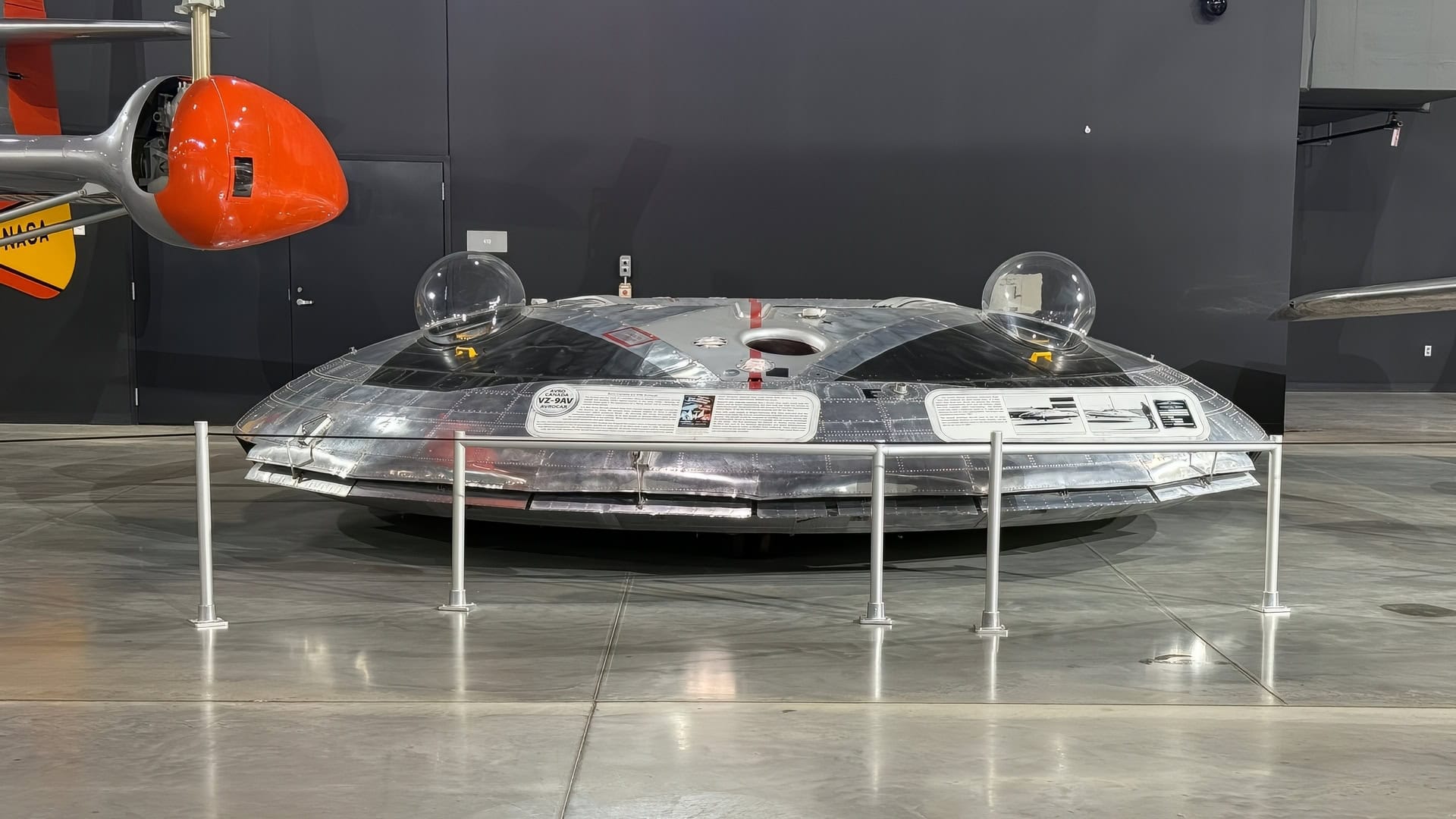
Avrocar Flying Saucer. Image Credit: 19FortyFive.com

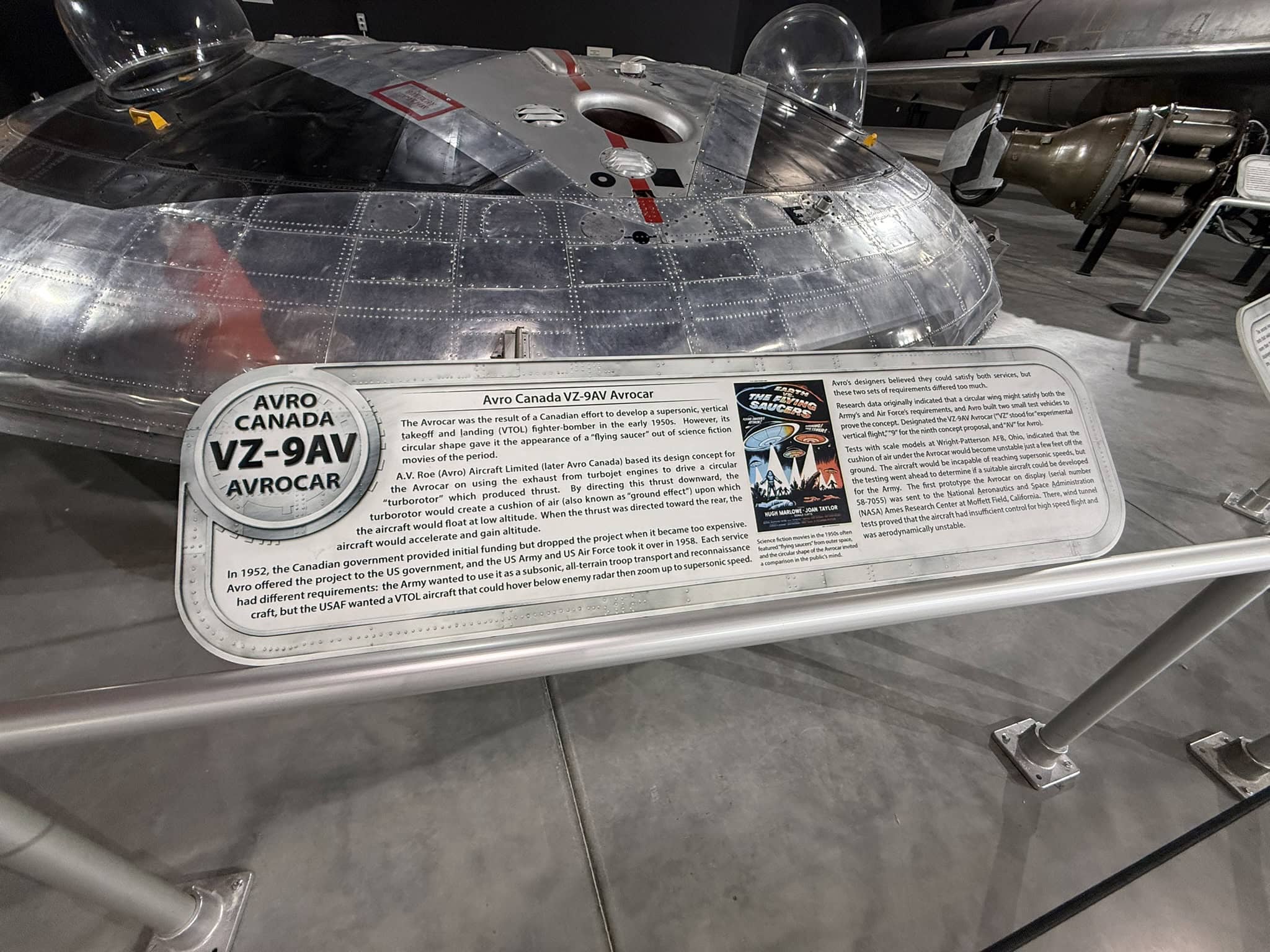
The Avrocar was the result of a Canadian effort to develop a supersonic, vertical takeoff and landing (VTOL) fighter-bomber in the early 1950s. However, its circular shape gave it the appearance of a “flying saucer” out of science fiction movies of the period.
You could say the Avrocar was built on a rumor. In 1953—six years after *after* the infamous Roswell Incident, mind you—British Intelligence and Royal Canadian Air Force (RCAF) personnel, along with Avro Canada chief designer John Frost, met in West Germany with a German engineer who claimed to have worked on a flying saucer for the Nazi-era Luftwaffe between 1944 and 1945.
Mr. Frost cross-examined the German engineer, who elaborated upon his initial claim with an assertion that this covert flying saucer achieved flight by generating a cushion of thrust between itself and the ground, but after this successful test, the saucer was destroyed, along with the drawings and blueprints, to avoid capture by the Allies.
Well, for all of the wild Wunderwaffen (“wonder weapons”) that the Luftwaffe actually did build during WWII, these saucer claims could never be proven, but nonetheless, John Frost now had inspiration to build his own experimental saucer-shaped craft.
The Canadian government provided the initial funding but pulled out when the project proved too expensive.
However, Avro pitched the project to Canada’s neighbors to the south, and both the U.S. Army and U.S. Air Force alike perked their eyebrows & ears up, and they decided to take over funding for the project, whereupon it was officially designated the VZ-9AV Avrocar; “VZ” stood for “experimental vertical flight,” “9” for the ninth concept proposal, and “AV” for Avro.
As a result, John Frost built two prototypes between 1958 and 1959. They had a crew capacity of two, a wingspan/diameter of 18 feet, a height of 4 feet, 10 inches, and an empty weight of 4,620 lbs.
The powerplant consisted of three Continental J69-T9 turbojet engines generating 927 lbs. of thrust each; this was the same engine that would power the Cessna T-37 Tweet, which served for 5.5 decades as the U.S. Air Force’s training craft for future fighter and bomber pilots.
The Avrocar would use exhaust from those J69-T9 turbojet engines to drive a circular “turborotor” that produced thrust.
By directing this thrust downward, the turborotor would create an air cushion upon which the aircraft would float at low altitude; when the thrust was redirected rearward, the aircraft would accelerate and gain altitude.
Performance and What Went Wrong
Part of the problem was that the Army and Air Force, unsurprisingly, had different requirements: the former wanted to use it as a subsonic, all-terrain troop transport and reconnaissance craft; the latter wanted a VTOL (Vertical Takeoff & Landing) warbird that could hover below enemy radar then zoom up to supersonic speed. Nonetheless, initial research data indicated that a circular wing might satisfy both services’ requirements.
Alas, tests with both scale models and the prototypes themselves would demonstrate otherwise.
For starters, scale-model tests at Wright-Patterson AFB, Ohio, showed that the cushion of air under the Avrocar became unstable just a few feet off the ground.
Despite this bad omen, the first prototype was sent to the NASA Ames Research Center at Moffett Field, California, where wind tunnel tests showed the aircraft had insufficient control for high-speed flight and was aerodynamically unstable.
Jack Frost and his Avro Canada team weren’t quite ready to throw in the towel just yet, so his second Avrocar prototype underwent its own flight tests.
These results were no happier than the previous ones: if the saucer flew more than three feet above the ground, it displayed uncontrollable pitch and roll motions, which the Avro engineers called “hubcapping.” The alien-looking craft could only reach a maximum speed of 35 mph—a piddly 0.04 Mach—and the project was canceled in December 1961.
Frost would have much greater success with the aforementioned CF-100 Canuck. And the Avrocar legacy lives on in modern ground-cushion vehicles and hovercraft.
Where Are They Now?
“The Truth Is Out There,” as FBI Special Agent Fox Mulder from the long-running X-Files sci-fi franchise was fond of saying. Well, luckily for the sake of posterity, the Avrocars are also still out there, and not secretly stashed away, but rather publicly accessible at museums:
-The first specimen, S/N 58-7055, aka AV-7055, is displayed at the Research and Development Gallery of the National Museum of the United States Air Force at the aforementioned Wright-Patterson AFB, which is in the vicinity of Dayton. In fact, most of the pictures above are from our 2025 visit to that amazing museum.
-The second specimen, S/N 59-4975, is currently under restoration at the U.S. Army Transportation Museum in Fort Eustis, Virginia.
Not to be outdone, Canada—the craft’s country of origin, after all— has a full-sized replica exhibited at the Royal Aviation Museum of Western Canada, Winnipeg, Manitoba, Canada. It was built for the 2002 production Avrocar: Saucer Secrets from the Past, narrated by LeVar Burton.
Christian D. Orr
Christian D. Orr is a Senior Defense Editor. He is a former Air Force Security Forces officer, Federal law enforcement officer, and private military contractor (with assignments worked in Iraq, the United Arab Emirates, Kosovo, Japan, Germany, and the Pentagon). Chris holds a B.A. in International Relations from the University of Southern California (USC) and an M.A. in Intelligence Studies (with a concentration in Terrorism Studies) from American Military University (AMU). He is also the author of the book “Five Decades of a Fabulous Firearm: Celebrating the 50th Anniversary of the Beretta 92 Pistol Series,” the second edition of which was recently published.