
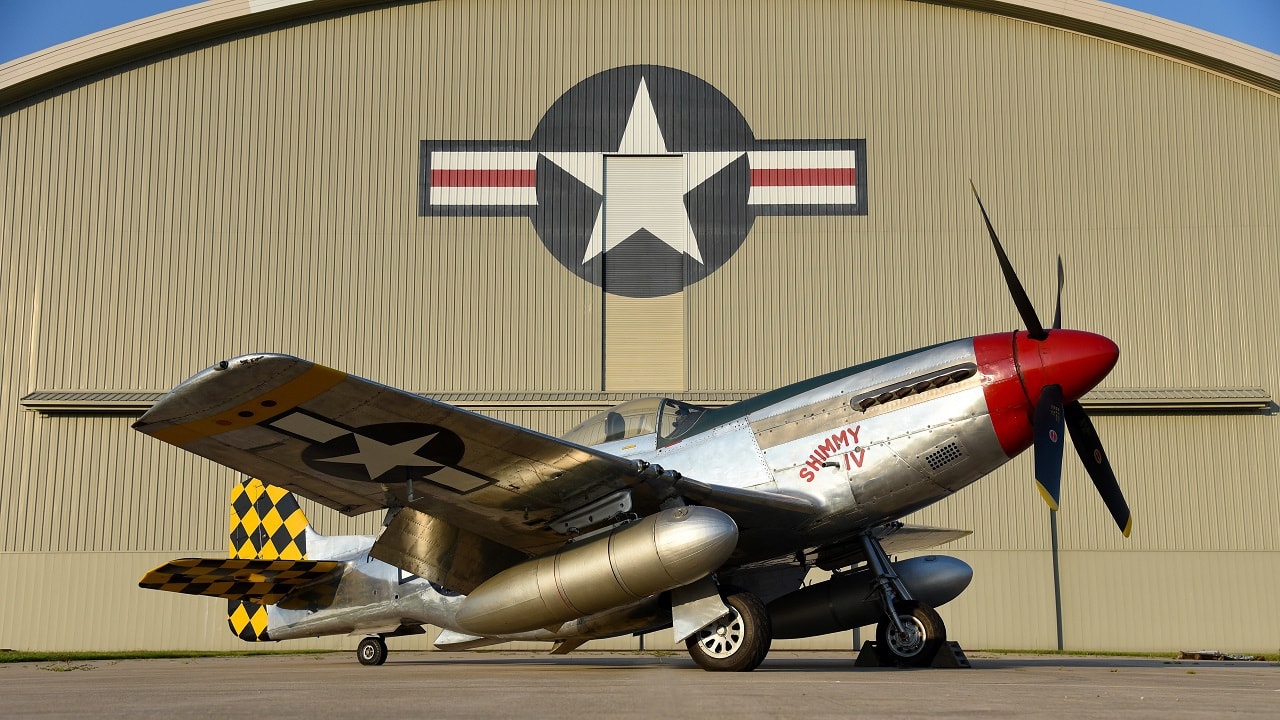
Summary and Key Points: The best-fighter argument usually drowns in specifications, but the Mustang’s case is three numbers: it escorted bombers to Berlin and back when nothing else could (1,650-mile range with tanks and 1,000 with no tanks), its pilots were credited with roughly 4,950 aerial kills in Europe, and it cost about $51,000 against $83,000 for a P-38 Thunderbolt. Born in 102 days because North American refused to license-build P-40s, transformed by a British engine, it broke the Luftwaffe in six months, fought on through Korea and a 1969 border war, and has never stopped flying.
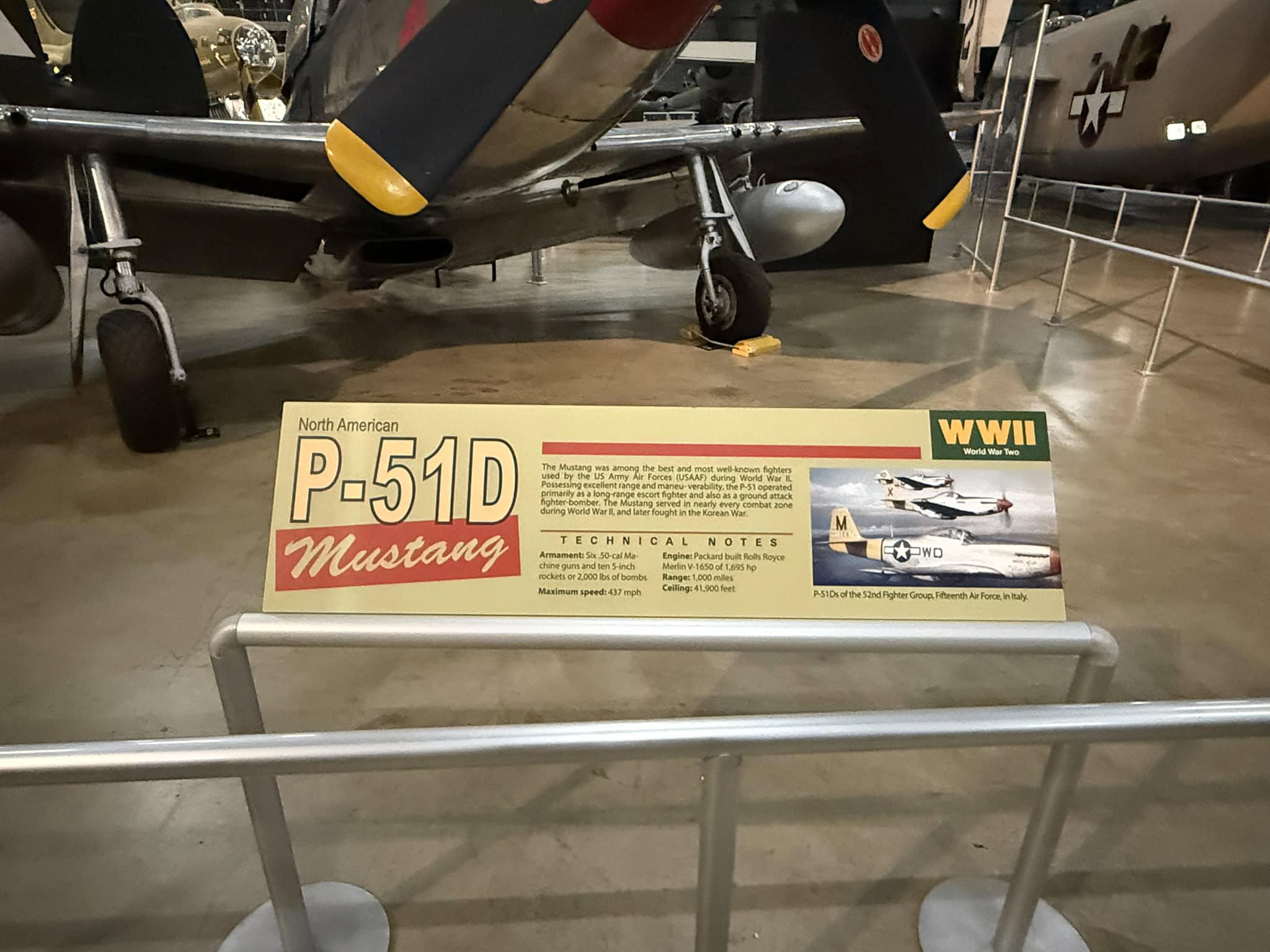
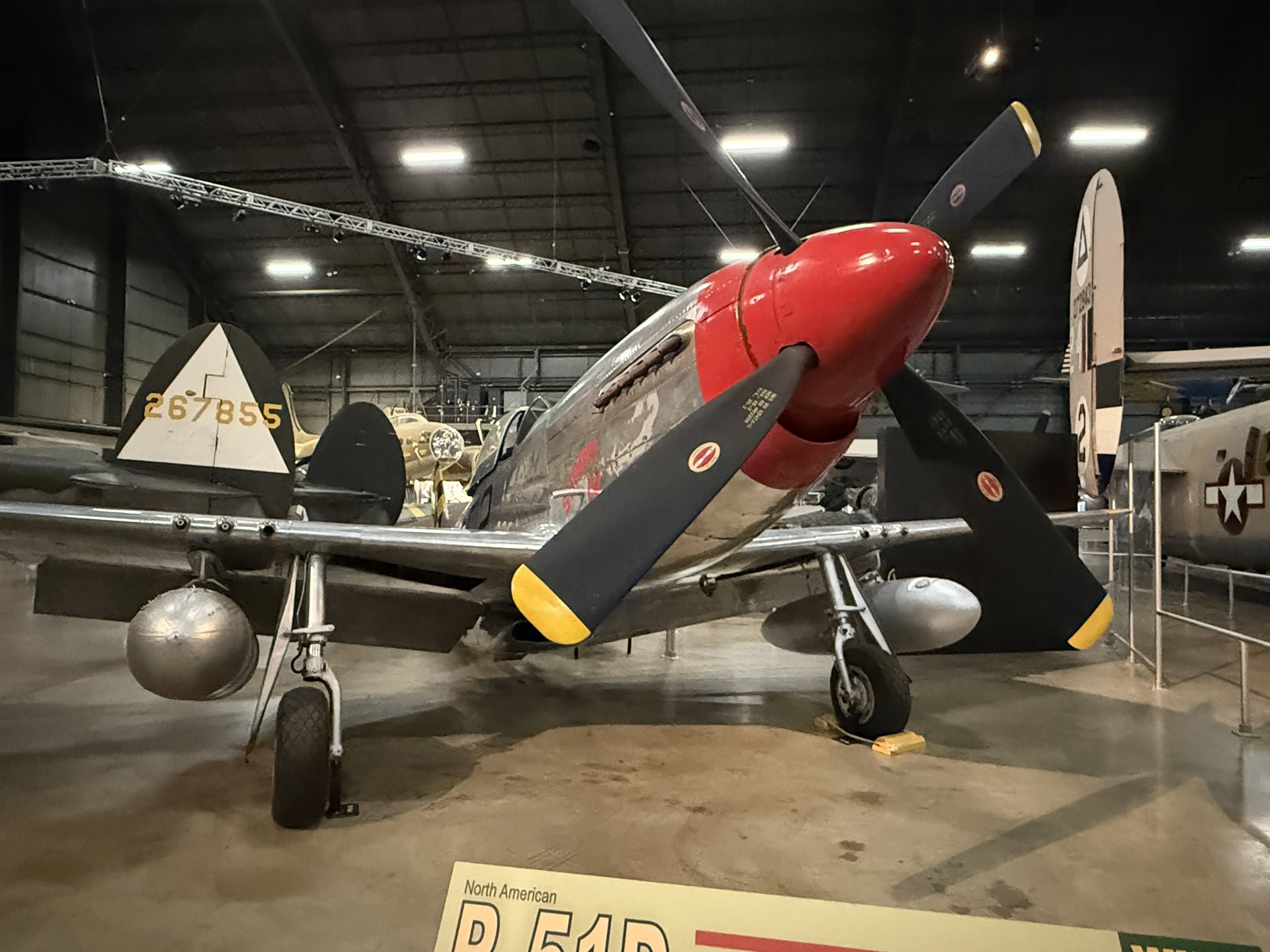
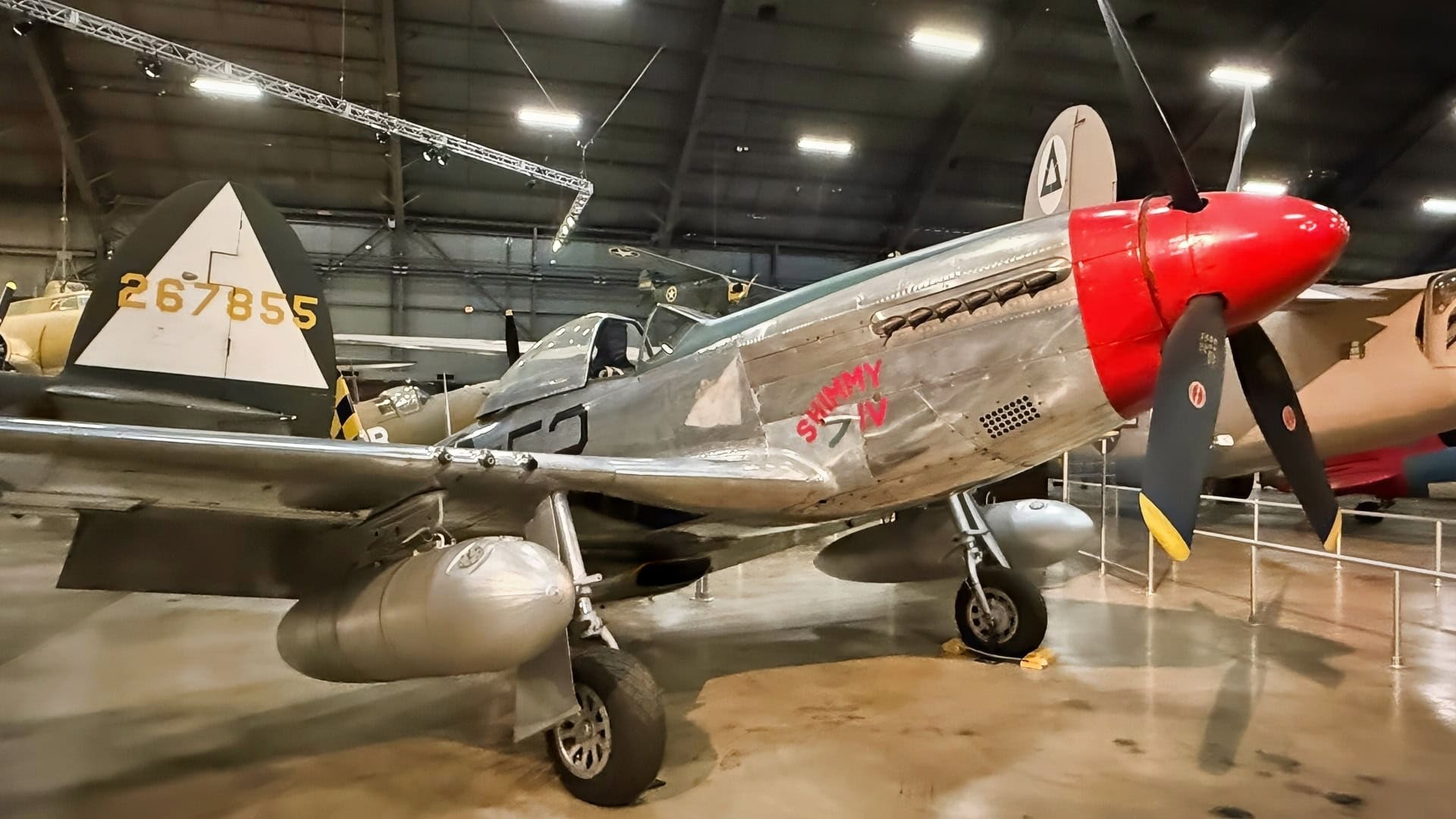
NOTE: I saw the P-51D Mustang last year on a visit to the National Museum of the U.S. Air Force. I have a few photos below that could be of interest.
The P-51 Mustang: Simply the Best?
P-51D Mustang 19FortyFive.com Image
P-51D Mustang 19FortyFive.com Image
P-51D Mustang 19FortyFive.com Image
The case that the P-51 Mustang was the best fighter of the Second World War rests on three numbers.
It could fly to Berlin and back, which no other Allied fighter could do when it mattered.
Its pilots were credited with roughly 4,950 enemy aircraft destroyed in the air in Europe, more than any other American fighter in that theater.
And it cost the taxpayer about $ 51,000 per copy in 1945, cheaper than the P-47 Thunderbolt at roughly $ 83,000 and barely half the price of a P-38 Lightning.
The airplane that broke the Luftwaffe was also the bargain of the American arsenal, and that combination of performance, reach, and price is why the argument has never ended.
Why This Plane Was Born
The Mustang exists because a company refused an order.
In early 1940, the British Purchasing Commission asked North American Aviation to build Curtiss P-40s under license for the Royal Air Force. Company president James “Dutch” Kindelberger and his chief designer, Edgar Schmued, answered that they could design a better fighter around the same Allison engine faster than they could tool up for someone else’s, and the British, desperate for aircraft, took the extraordinary bet.
The prototype NA-73X rolled out 102 days after the order was signed, famously still without an engine, and flew on October 26, 1940. The airframe was advanced from the first drawing: a laminar-flow wing for low drag, and a belly radiator ducted so cleverly that its exhaust returned a measure of thrust.
What the airframe lacked was breathing. The Allison engine faded above 15,000 feet, so the RAF flew its early Mustangs low, as reconnaissance aircraft and ground attackers, while the design’s potential sat untapped. The turn came in 1942, when Rolls-Royce test pilot Ronald Harker flew one and pushed to refit it with the two-stage supercharged Merlin, the Spitfire’s engine.
The marriage was everything: with the Merlin, built under license in America as the Packard V-1650, the P-51B could fight at 30,000 feet and still fly farther than anything in Europe. The definitive P-51D added the bubble canopy and six .50-caliber machine guns fed by 1,840 rounds, about half a minute of continuous fire, and North American’s plants at Inglewood and Dallas ultimately turned out more than 15,500 Mustangs of all versions, one of the largest fighter runs in American history, at that famously modest unit price.
The Six Months That Broke the Luftwaffe
Through 1943, unescorted American daylight bombing was bleeding toward failure; on the worst raids that autumn, more than a fifth of the bombers dispatched did not come back.
The first Merlin Mustangs reached Europe with the 354th Fighter Group in December 1943, and in January 1944, the Eighth Air Force’s new commander, Jimmy Doolittle, changed the escort doctrine from staying with the bombers to hunting the Luftwaffe wherever it could be found. The results came at once. During Big Week in February 1944, by the National WWII Museum’s accounting, Mustang pilots destroyed 17 percent of the Luftwaffe’s experienced fighter pilots in air-to-air combat. In March, Mustangs appeared over Berlin itself, escorting the first American daylight raids on the capital, and among the pilots who flew the type to fame were the Tuskegee Airmen of the 332nd Fighter Group, whose red-tailed Mustangs became one of the war’s most recognized symbols.
By the end of 1944 the P-51 equipped all but one of the Eighth Air Force’s fighter groups, and the Luftwaffe’s day-fighter arm was functionally destroyed, its veteran pilots dying faster than Germany could train replacements.
History Has Spoken
The men on both sides said what the numbers say. Hermann Goering, interrogated after the surrender, blamed the Luftwaffe’s failure on “the success of the American Air Forces in putting out a long-range escort fighter,” the airplane that let the bombers go deep with cover the whole way. The often-quoted line about seeing Mustangs over Berlin and knowing the jig was up is likely an embellishment; the documented interrogation is damning enough. And Clarence “Bud” Anderson, who flew 116 escort missions in Mustangs named Old Crow and shot down 16.25 German aircraft, delivered his verdict plainly: “probably the best all around fighter” developed during the war.
The claim needs its honest limits: the Spitfire turned and climbed better, the P-47 absorbed damage the liquid-cooled Mustang could not, and the German jets were faster. But no other fighter combined the Mustang’s speed, range, and numbers in the theater that decided the air war, which is the job description the “best” argument is about.
Korea, and the Wars After the War
The Mustang’s second career started almost immediately. Redesignated F-51 in 1948, it was the fighter America still had in numbers when North Korea attacked in 1950, and Mustangs pulled from storage, and Air National Guard squadrons carried much of the ground-attack load through the war’s first years. The work was brutal and the airplane imperfect for it; the same belly radiator that made the Mustang fast made it mortally vulnerable to a single rifle-caliber hit from the ground, and losses were heavy. The type left the American inventory through the 1950s, the last Guard Mustang retiring in 1957, but it kept fighting elsewhere: more than 25 nations flew it after 1945, from Sweden and Switzerland to Israel, which used Mustangs in 1948 and again at Suez in 1956.
Its last battle was the strangest. In July 1969, El Salvador and Honduras fought the hundred-hour Football War, and on July 17 a Honduran F4U Corsair flown by Captain Fernando Soto shot down a Salvadoran Mustang in what remains the last aerial combat between piston-engine fighters ever fought. The Mustang lost its final dogfight, then outlived the winner anyway: the Dominican Republic, the type’s last military operator, flew Mustangs until 1984, and nine of its final ten airframes were sold to American collectors in 1988, the last warplanes of the breed rolling straight from active service into the warbird market.
The P-51 Mustang Legacy
That market is where the Mustang’s legacy lives in the open. The type that once filled Eighth Air Force fields by the hundred survives in three figures worldwide, with more than a hundred still airworthy, a fixture of every major airshow season and the backbone of unlimited-class air racing for seventy years. The engine-swap story became the textbook case of how one decision transforms a weapon, taught wherever aircraft development is studied, and the fighter’s name was reused by the Air Force itself and by Ford. The men are nearly gone now.
Bud Anderson, the last living American triple ace, died at 102 on May 17, 2024, having outlived his friend Chuck Yeager and nearly every man he flew with; his 357th Fighter Group had produced a record 42 aces and downed 17 of Germany’s Me-262 jets with propeller-driven Mustangs.
The airplanes outlived them all.
Somewhere this weekend, at an airshow in America or England or Australia, a Merlin will light off with that unmistakable crackle, eighty-six years after a company bet the British it could do better than a P-40 in four months, and won.
MORE – The F-22 Raptor Almost Became A Bomber
About the Author: Harry J. Kazianis
Harry J. Kazianis (@Grecianformula) was the former Senior Director of National Security Affairs at the Center for the National Interest (CFTNI), a foreign policy think tank founded by Richard Nixon based in Washington, DC. Harry has over a decade of experience in think tanks and national security publishing. His ideas have been published in the NY Times, The Washington Post, The Wall Street Journal, CNN, and many other outlets. He has held positions at CSIS, the Heritage Foundation, the University of Nottingham, and several other institutions related to national security research and studies. He is the former Executive Editor of the National Interest and the Diplomat. He holds a Master’s degree focusing on international affairs from Harvard University.

