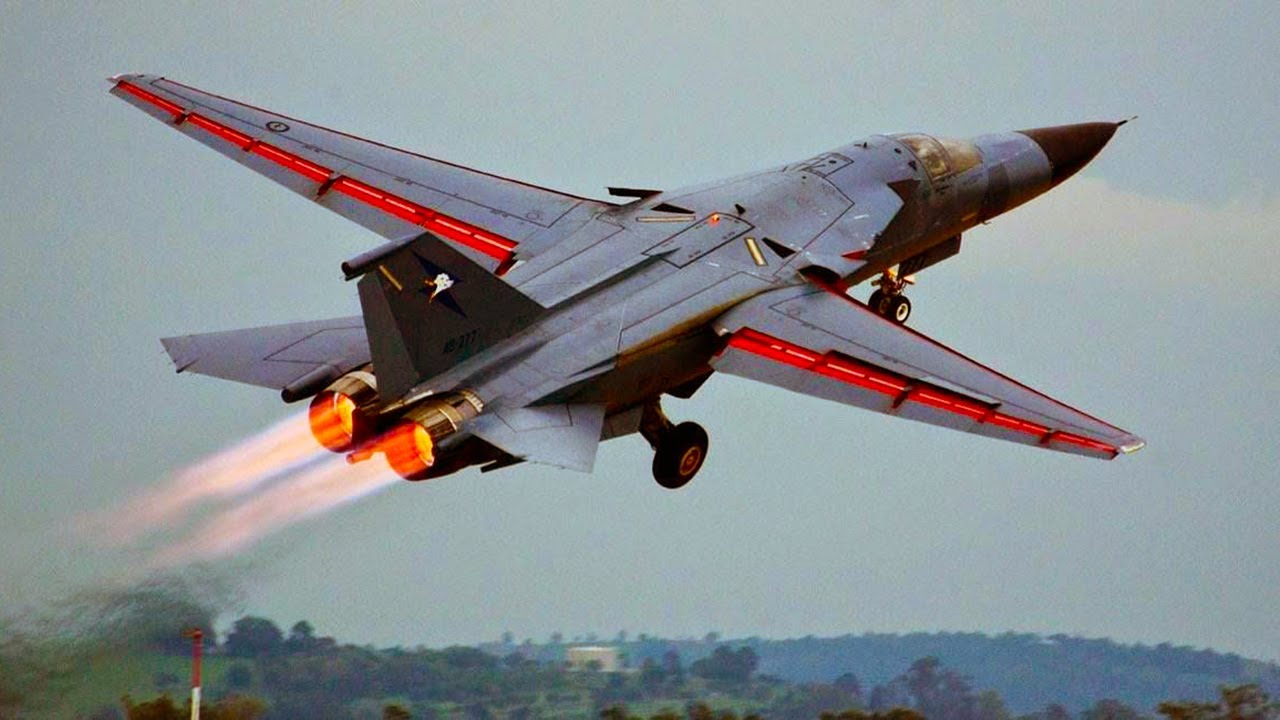
Before Tom Cruise and the Navy “felt the need for speed” with the F-14 Tomcat, the United States Navy wanted a different kind of plane altogether for its carrier force.
During the Cold War, the Navy wanted the plane that the Air Force loved: the F-111 Aardvark.
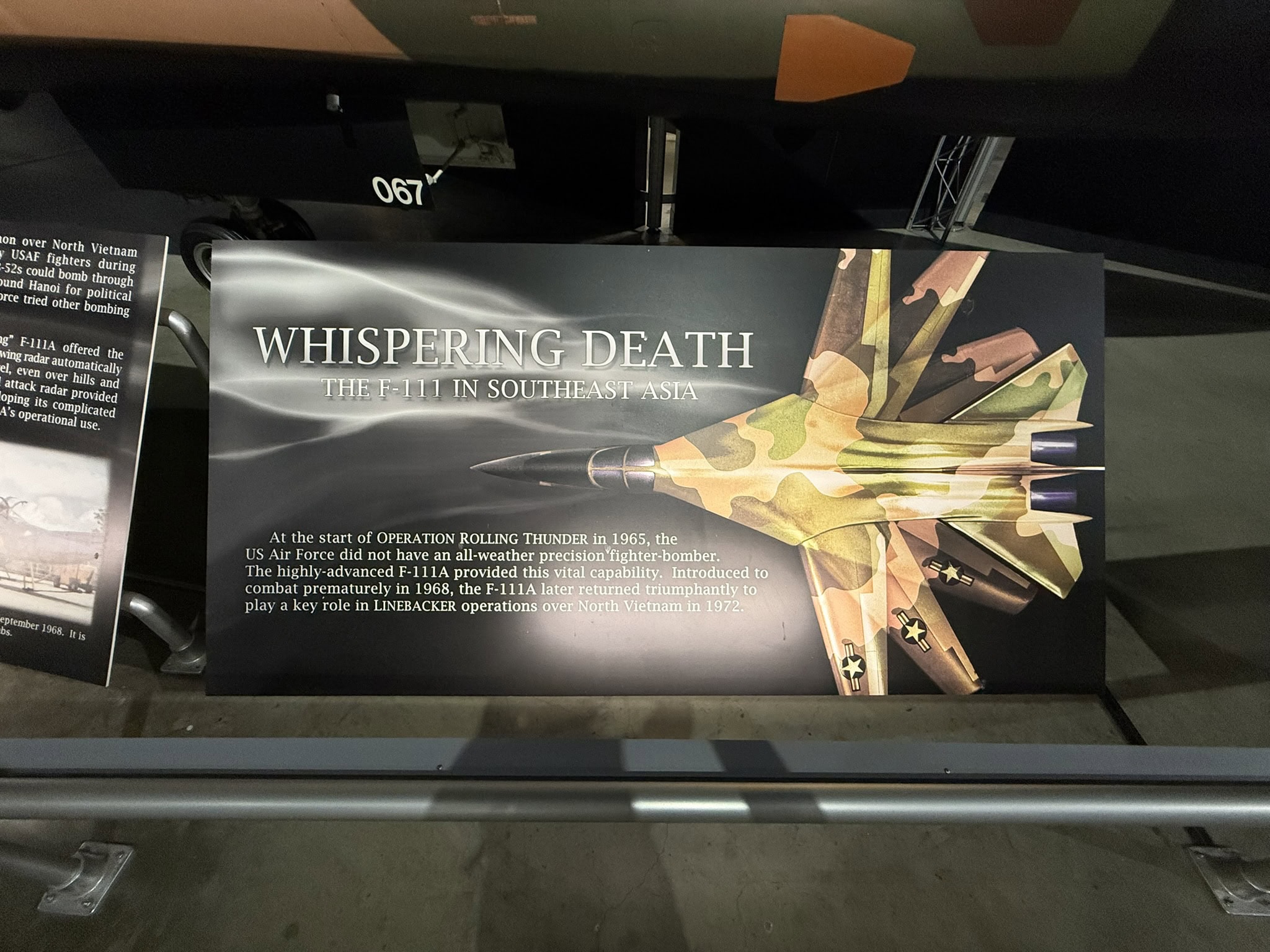
F-111 On Display at the National Museum of the U.S. Air Force. Take on July 19, 2025 by Harry J. Kazianis for 19FortyFive.com
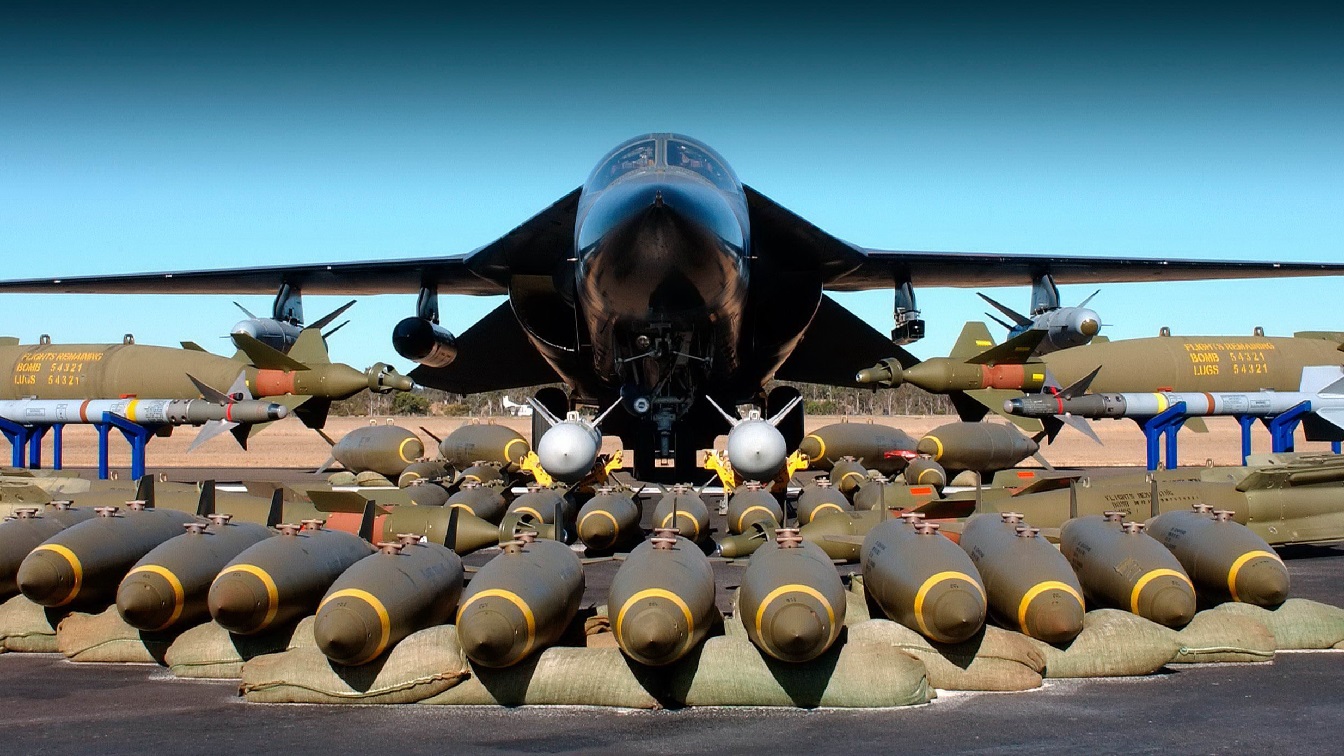
F-111. Image Credit: Creative Commons.
A swept-wing sky beast developed by General Dynamics/Grumman, the F-111B would have been the naval variant of the massive bird.
The Navy needed a new carrier-based plane capable of conducting long-range fleet interception missions.
The Soviets were developing tactics meant to threaten the US aircraft carrier force. Soviet bombers were being loaded with anti-ship ballistic missiles (ASBMs).
Their mission, should the Cold War have ever turned hot, would have included launching those ASBMs in large salvos to overwhelm the carrier’s defenses and damage (or sink) American carriers.
The Navy wanted carrier-based planes that could extend the ship’s defensive perimeter and intercept Soviet bombers and their lethal ASBMs.
But the Navy’s requirements were very different from the Air Force’s. The F-111B was too heavy, too sluggish, and far too hard for naval designers to adapt to the rigors of carrier flight operations.
In fact, its biggest issue was a lack of proper thrust.
When launching from the shorter runway of an aircraft carrier, planes must be able to produce significant thrust far quicker than their land-based counterparts.
The F-111B could never match this basic requirement.
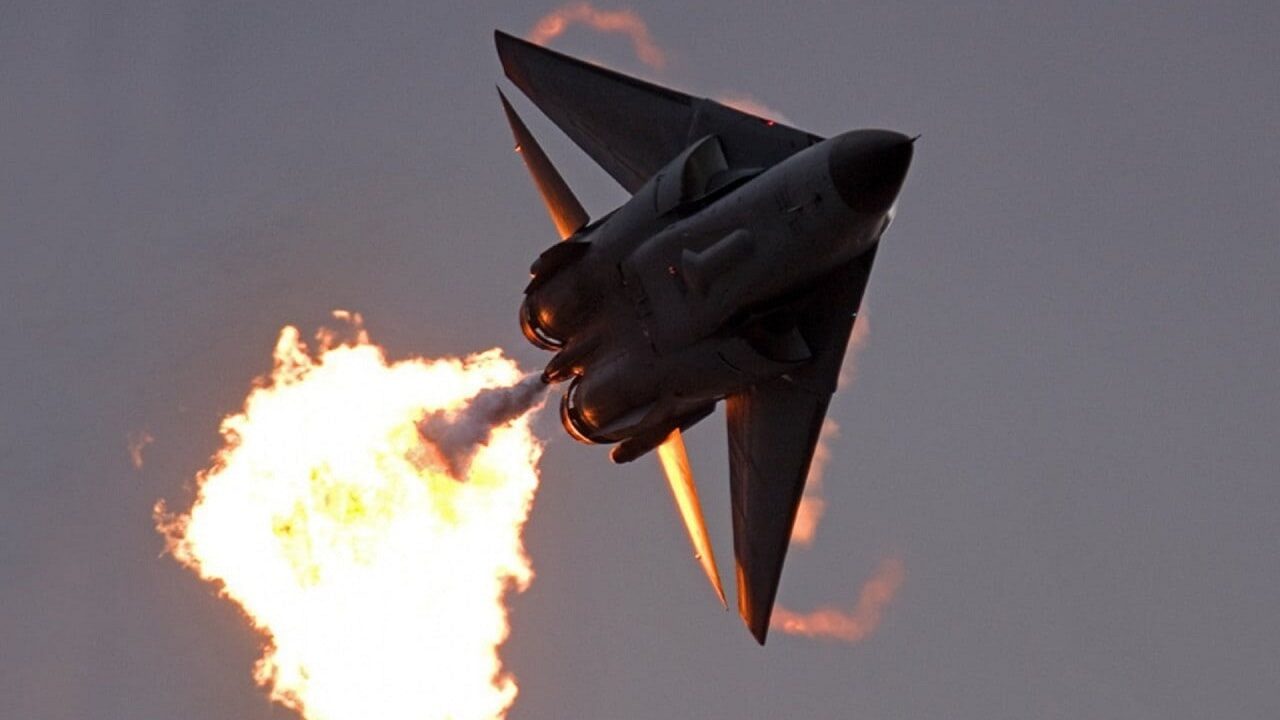
F-111. Image Credit: Creative Commons.
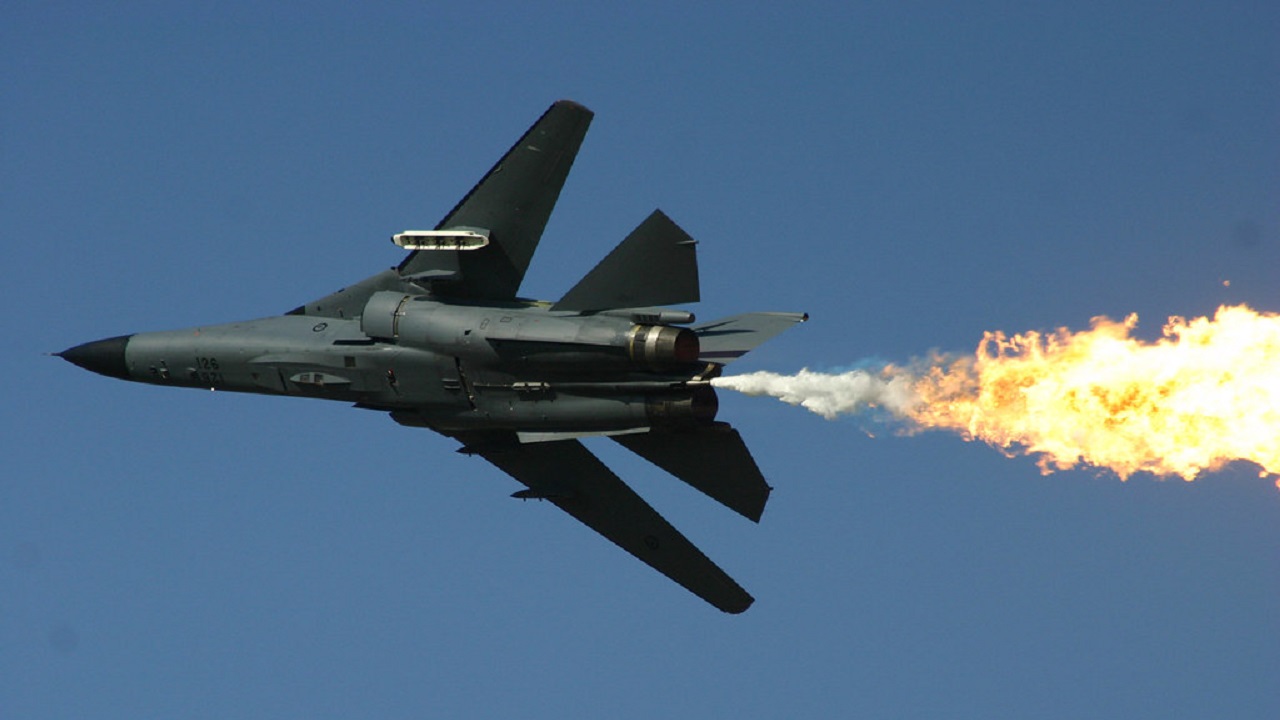
F-111. Image Credit: Creative Commons.
In fact, during a contentious 1967 congressional hearing about the F-111B, Vice-Admiral Thomas “Tom” Connolly famously quipped that “there isn’t enough thrust in Christendom” that could make the F-111B viable for carrier flight operations.
The need for the F-111B originated with former Defense Secretary Robert McNamara’s Tactical Fighter Experimental (TFX) program. McNamara wanted the Air Force and Navy to share a common aircraft design that would reduce development time and procurement costs.
The only problem was that the Air Force and Navy wanted–and needed–fundamentally different planes.
The Air Force needed a large, long-range bird capable of penetrating enemy territory at high speeds and low altitudes (hence, the swing-wing design) while carrying a heavy load of weapons and aviation fuel.
On the other hand, the Navy needed an interceptor that could loiter far from its home carrier and knock out Soviet bombers before they could ever pose a threat to the carrier.
General Dynamics built the Air Force variant, while Grumman, which had extensive experience building interceptors for the Navy, built the naval variant of the F-111. Like the Air Force version, the F-111B received variable-sweep wings.
However, it was given a shorter nose.
A two-man crew would fly the plane, with one of the two fliers operating the advanced Hughes AN/AWG-9 radar, paired with the AIM-54 Phoenix missile.
Interestingly, the AIM-9 could track up to 24 targets and direct six Phoenix missiles against different targets simultaneously.
This design made sense on paper. But the Navy and Grumman could never get enough performance from the F-111B to make it viable for carrier flight operations.
Not Enough Thrust in All of Christendom
The Navy originally wanted a 55,000-pound interceptor for its carrier force.
Those requirements soon changed, and Grumman was forced to increase the weight.
By the time the first F-111B was ready for demonstration, it was 77,000 pounds gross weight, while its projected takeoff weight was a staggering 80,000 pounds.
Grumman tried to put the F-111B on a serious diet.
But the proposed weight improvements could reduce the weight by only a few thousand pounds.
Meanwhile, the Pratt & Whitney TF30 engines could not handle the increasing weight (which gets us back to Vice-Admiral Connolly’s 1967 exasperated statement to Congress).
Early F-111Bs used the TF30 turbofan that produced 18,500 pounds of thrust per engine.
More powerful versions were planned, resulting in the TF30-P-12, rated at roughly 20,250 pounds of maximum thrust (according to available designs).
But the F-111B was too fat for its own good.
Not even the TF30s could compensate for that weight, despite Grumman putting the plane on a diet.
When the Navy reviewed the plane that Grumman designed, their assessment was highly damaging to the program’s viability.
The Navy determined that the F-111B was unlikely ever to meet the maritime branch’s requirements for combat ceiling, maneuverability, weight, carrier wind-over-deck requirements, or any of the Navy’s major needs.
Oh, and the F-111B was so heavy that, naturally, its drag was higher than expected–meaning this plane would never be able to take off from a carrier flight deck.
The F-111 B also raised real safety concerns.
A fighter on final approach to a carrier might suffer engine failure.
Under those conditions, the plane would still need to wave off, meaning that the bird needed sufficient power to climb away from the ship.
The original specifications called for a single-engine climb rate of 595 feet per minute (at military thrust). But Navy estimates for later F-111B configurations were only about 267-315 feet per minute.
Basically, the F-111B struggled under a thrust-to-weight-and-drag problem. No engine, therefore, was powerful enough to overcome the aerodynamically compromised plane’s performance.
Engineers proposed multiple redesigns.
The Navy’s leadership, however, had decided the F-111B was dead on arrival.
By the time that Connolly made his statement to Congress, he had spoken for most Navy leaders who were fed up with the F-111B.
It was evident that the F-111B, unlike its Air Force sibling, was a pre-failed project. Had Congress forced the Navy to go forward with the program, the maritime branch would have been set back for years.
The Need for Speed Arises
Many of the ideas and technologies that went into the F-111B, though, proved very helpful.
The Navy still needed a long-range fleet interceptor for carrier operations.
And Grumman was still on the hook for delivering that plane to the maritime branch.

F-14 Tomcat Fighter in USS Intrepid Deck. Image taken late on 2025 by Jack Buckby for 19FortyFive. All Rights Reserved.
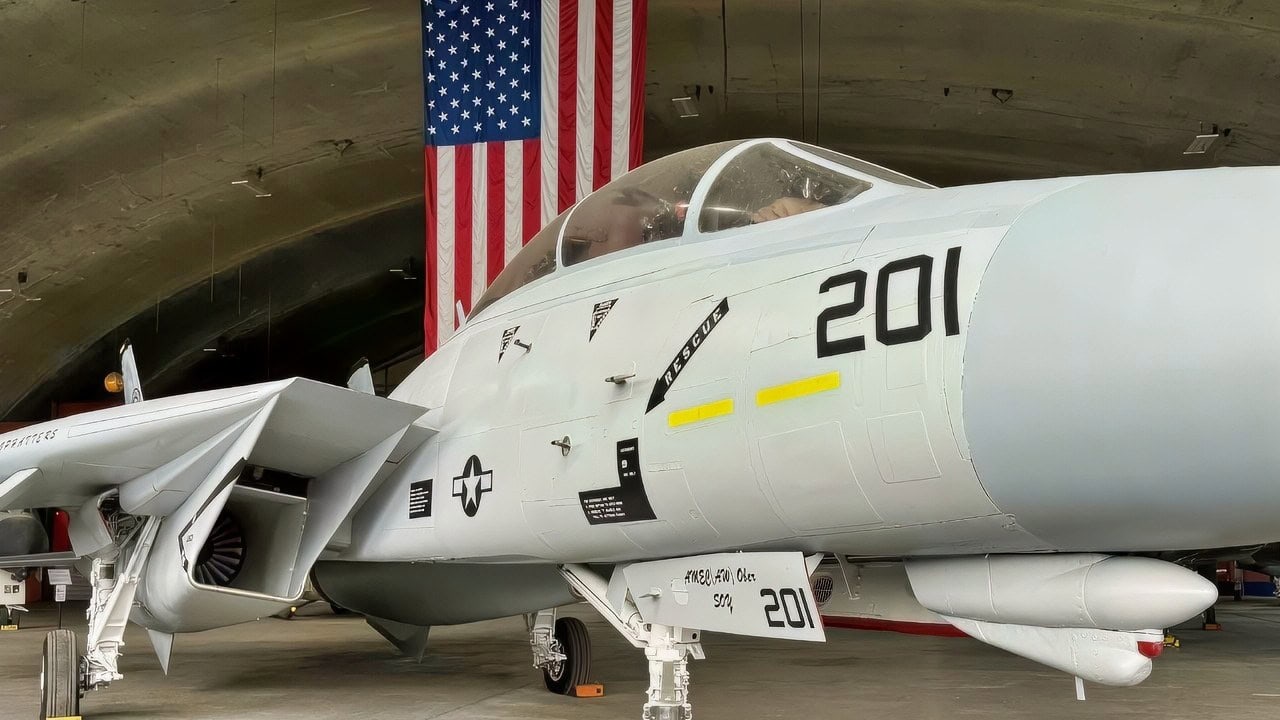
F-14 Tomcat Fighter U.S. Navy. 19FortyFive Field Research Image.

F-14 Tomcat in Museum. Image was taken by Jack Buckby for 19FortyFive.com. All rights reserved.
So, the defense contractor took many of the underlying concepts–such as the variable-wing design–and paired them with innovative technologies, like the AIM-54 Phoenix long-range air-to-air missiles and the powerful AN/AWG-9 pulse-doppler radar system, to give the Navy the impressive F-14 Tomcat.
Vice-Admiral Connolly needed speed in 1967.
Grumman delivered it with the F-14, a few years after the Navy canceled the disastrous F-111B. In a way, then, the Navy would have never gotten its iconic F-14 Tomcat without the pain of the F-111B failure. That’s what I’d call snatching victory from the fangs of defeat.
MORE – X-20 Could Have Been a Mach 22 Monster
MORE – The X-30 Might Have Hit Mach 25
About the Author: Brandon J. Weichert
Brandon J. Weichert is the Senior National Security Editor at 19FortyFive.com. He also manages The Weichert Brief on Substack. Weichert also hosts “National Security Talk” on Rumble. He is the author of four bestselling national security books, the most recent of which is A Disaster of Our Own Making: How the West Lost Ukraine (Encounter Books). Follow him via Twitter/X @WeTheBrandon.