
By mid-morning on June 6, 1944, the Dog White sector of Omaha Beach was a strip of shingle and seawall crowded with the pinned, the wounded, and the dead, and into it walked a 51-year-old brigadier general who declined, as a matter of policy, to crouch. Norman “Dutch” Cota, assistant commander of the 29th Infantry Division, found a knot of soldiers sheltering behind the wall, asked what outfit they were, and was told: 5th Rangers. What he said next was heard by the survivors around him and remembered, as battlefield words always are, in slightly different forms. The most commonly attested version runs: “Well, God damn it then, Rangers, lead the way!”
In the Army Historical Foundation’s cleaner telling, it is simply “Rangers, lead the way.”
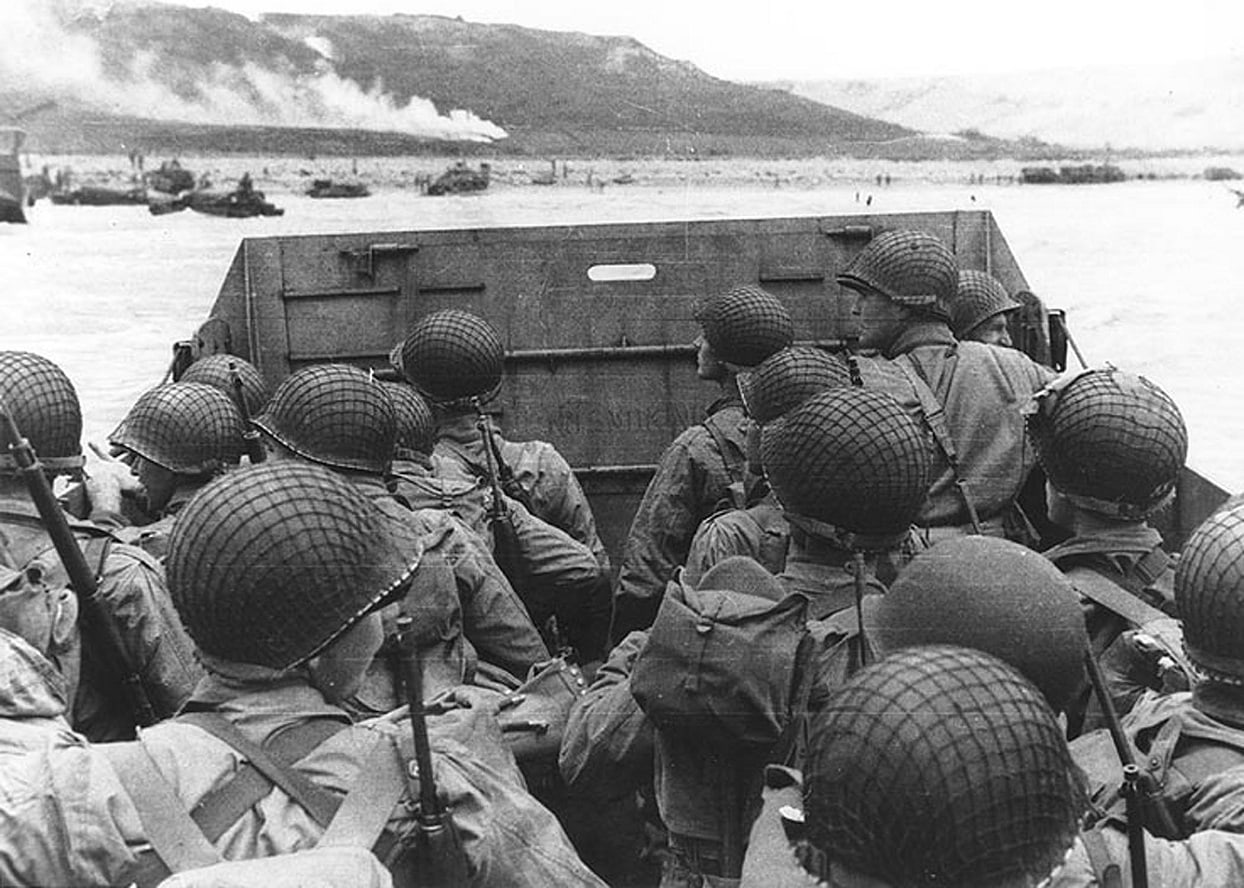
Troops in an LCVP landing craft approach Omaha Beach on D-Day, June 6, 1944 Note the helmet netting, faint “No Smoking” sign on the LCVP’s ramp, the M1903 rifles and M1 carbines carried by some of these men.
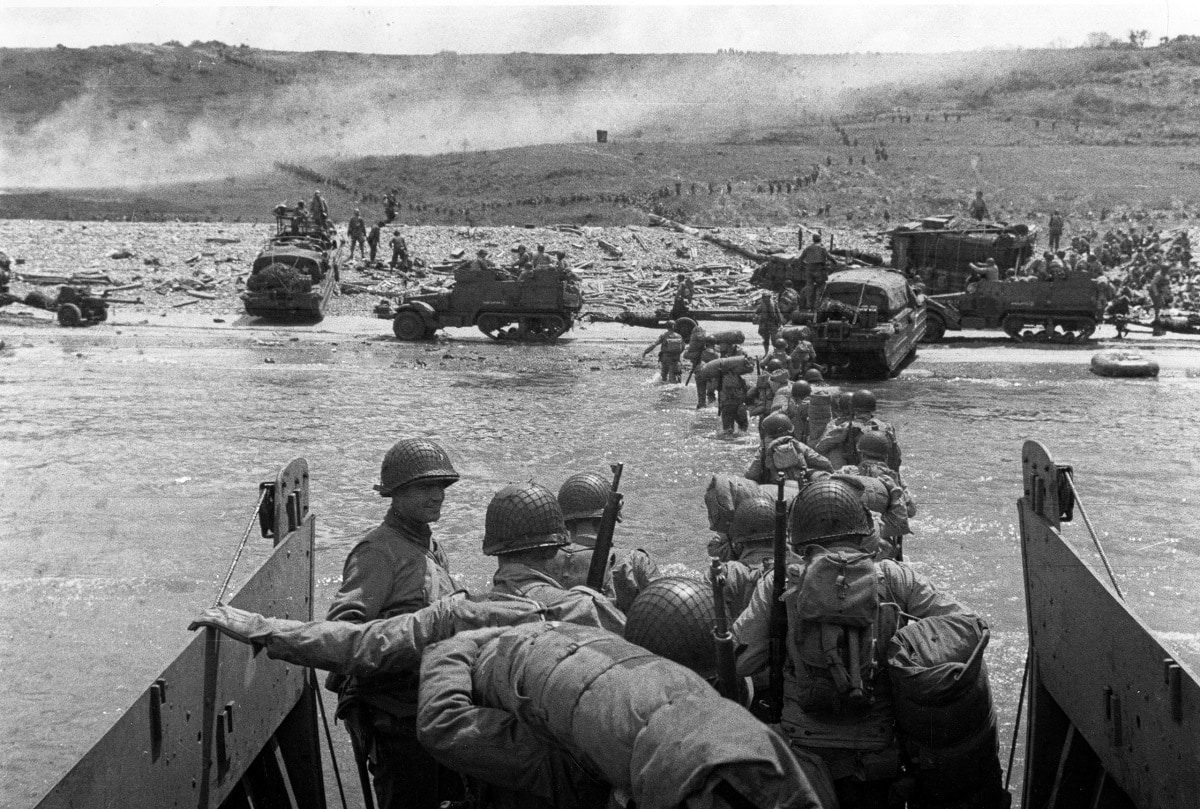
Troops wade ashore from a LCVP landing craft, off Omaha Beach, 6 June 1944. Note DUKWs and half-tracks at the water line, lines of men headed inland, and M1903 and M1 rifles carried by some of the troops leaving the landing craft. Photograph from the Army Signal Corps Collection in the U.S. National Archives.
The wording wobbles; every account agrees on the substance and on what happened next. The Rangers blew the wire, led the way up the bluff, and kept the three words forever. Eighty-two years later, “Rangers Lead The Way” is the motto of the 75th Ranger Regiment, the sign-off of every Ranger letter, and the answer to every Ranger greeting, all of it traceable to one sentence on the worst beach of the twentieth century. Here is the story of the morning that earned it, which is three stories at once.
The Mission Nobody Else Could Do
The Rangers came to Normandy because of six guns. Allied planners believed the clifftop battery at Pointe du Hoc, between Utah and Omaha, held 155mm pieces with the reach to savage both beaches and the invasion fleet, and neutralizing them ranked among the invasion’s most urgent tasks.
The plan handed to Lieutenant Colonel James Earl Rudder’s 2nd Ranger Battalion read like a dare: three companies, D, E, and F, would land at the base of the Pointe at H-Hour, scale cliffs roughly a hundred feet high using rocket-fired grapnels, ropes, and extension ladders, under fire, and destroy the guns. Captain Ralph Goranson’s Company C would land on Omaha’s western edge and climb there.
And Lieutenant Colonel Max Schneider’s force, the entire 5th Ranger Battalion plus two more 2nd Battalion companies, would wait offshore: if Rudder signaled success, they would follow him up the ropes; if the signal failed to come in time, they would land at Omaha and fight overland to relieve him.
The Cliffs
Heavy seas and a navigation error put Rudder’s companies ashore at 7:10 a.m., 40 minutes late, with one landing craft lost on the way in.
The Rangers went up the wet ropes with Germans firing down the cliff face, cutting lines, and rolling grenades over the edge, and within minutes, the first men were over the top into a moonscape of bomb craters.
Then came the astonishment at the heart of the story: the casemates were empty. In place of the guns stood wooden poles, decoys like telephone poles, as First Sergeant Leonard Lomell remembered them, the battery having been pulled inland, a fact Allied intelligence had missed. The Rangers did not stop to feel deceived.
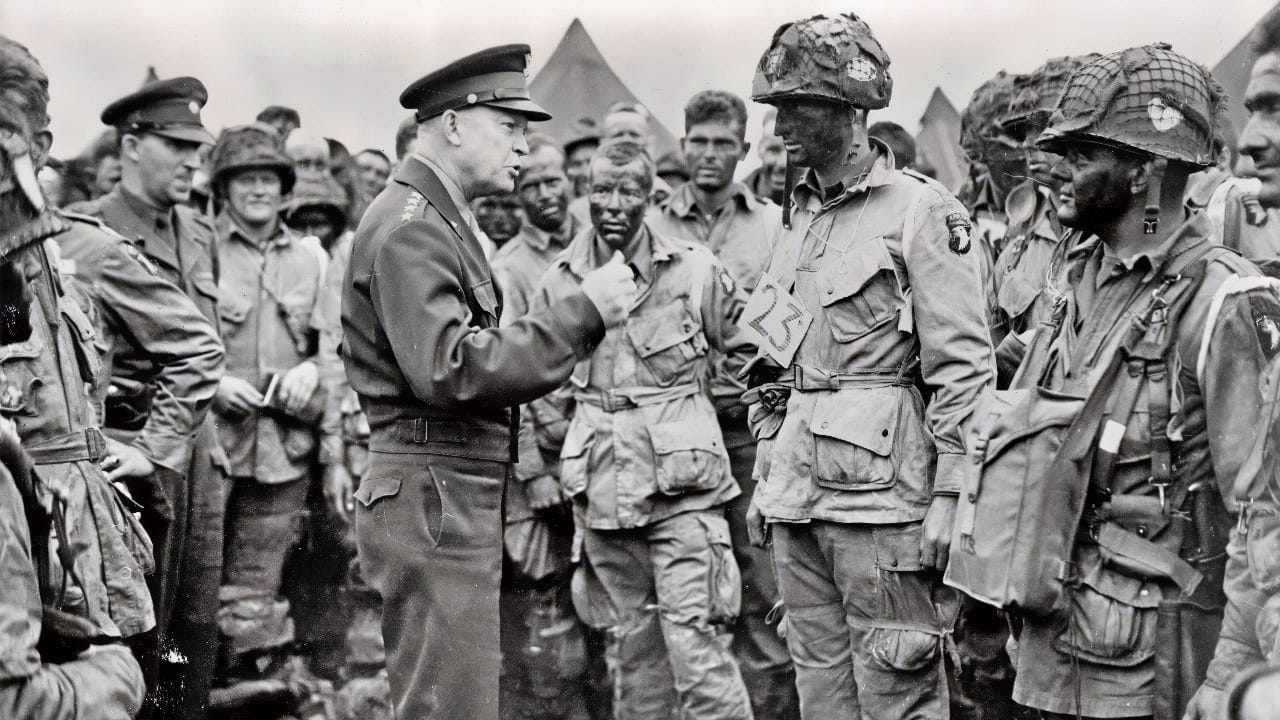
Dwight D. Eisenhower D-Day 1944. Image Credit: Creative Commons.
They fought through to cut the coastal highway, and around 9:00 a.m. Lomell noticed fresh tire tracks pressed into a sunken farm lane and followed them with Staff Sergeant Jack Kuhn covering him. In a hedgerow-screened orchard they found five of the six missing guns, camouflaged, stocked with ammunition, and trained toward Utah Beach, with a German force assembled a short walk away.
Kuhn watched the Germans; Lomell went to the guns alone, fusing the traversing gear of two of them solid with thermite grenades and smashing the sights of a third, and after he went back for more grenades a second patrol from Company E finished the battery and set its powder stores burning.
The sixth gun was never found. By roughly 9:00 in the morning, the priority target of the American D-Day had been destroyed by a two-man patrol and a follow-up team, at a moment when much of Omaha Beach was still pinned at the waterline.
The price came due afterward: cut off and forgotten for two days, Rudder’s men beat back German counterattacks through two nights, and of the roughly 225 Rangers who had gone up the ropes, only around 90 were still able to fight when relief finally reached them on June 8, and some counts run lower still.
Bloody Omaha, and the Sentence
Schneider’s force, waiting offshore, never got Rudder’s signal in time, so it turned for Omaha as the plan required, and sailed into the catastrophe.
The first waves at the Dog Green sector, the 116th Infantry and the 2nd Battalion’s A and B Companies, were machine-gunned to pieces in the surf below the Vierville draw, while Goranson’s Company C, landing beside them, lost heavily and then climbed the cliff anyway, by one National Park Service account the first unit to gain the bluff top at Omaha’s western end.
Watching the slaughter from his approaching boats, Schneider, a veteran of three Ranger campaigns, made the decision that saved his battalion: he shifted his landing east, putting the 5th Rangers ashore at Dog White largely intact, where they piled in behind the seawall with the remnants of the 116th under a rain of mortar and machine-gun fire.
That is where Cota found them. He had come ashore at H+60 with the 116th’s command group, three men killed at the ramp of his own landing craft, and had spent the morning as the highest-ranking American walking upright on the sand, rallying the stunned, two officers killed within feet of him, urging, by the account his aide preserved, that they were being killed on the beaches anyway and might as well go inland and be killed doing something about it. Then came the exchange with the Rangers, in whichever exact wording history owes to adrenaline and memory.
Beyond dispute, the words worked.
Bangalore torpedoes blew the wire, the 5th Rangers surged through the gap and up the bluff, the largest organized body to crack the beach defenses in that sector, in a morning that earned the battalion a fistful of Distinguished Service Crosses, and by the day’s end Vierville had fallen and the breakthrough off Omaha ran through the hole the Rangers led.
Cota received the Distinguished Service Cross himself; his later war carried him into the Hürtgen Forest at the head of the 28th Division, a chapter history judges far more harshly, but on June 6, no American general did more with his own two feet.
The Motto
The Rangers paid heavily for the morning, with casualties across the D-Day force running past half, and they kept the sentence.
“Rangers Lead The Way” became the official motto of what is now the 75th Ranger Regiment, rendered RLTW in a million signature blocks, spoken and answered at every graduation and change of command since, and cited in the congressional push to award the World War II Rangers the Gold Medal.
There is a fitting symmetry in its origin that the D-Day generation would appreciate: the most famous compliment ever paid to the Rangers came from a general who was not one, standing in the open on a beach where standing in the open was close to certain death, telling the best assault troops in the American Army the plain truth of the moment, which was that somebody had to go first and everybody present knew who it would be.
The survivors argued ever after about his exact words.
Nobody ever argued about what the Rangers did when they heard them.
They got up, went through the wire, and led the way, and they have declined to stop introducing themselves that way for 82 years.
About the Author: Harry J. Kazianis
Harry J. Kazianis (@Grecianformula) was the former Senior Director of National Security Affairs at the Center for the National Interest (CFTNI), a foreign policy think tank founded by Richard Nixon based in Washington, DC. Harry has over a decade of experience in think tanks and national security publishing. His ideas have been published in the NY Times, The Washington Post, The Wall Street Journal, CNN, and many other outlets. He has held positions at CSIS, the Heritage Foundation, the University of Nottingham, and several other institutions related to national security research and studies. He is the former Executive Editor of the National Interest and the Diplomat. He holds a Master’s degree focusing on international affairs from Harvard University.

