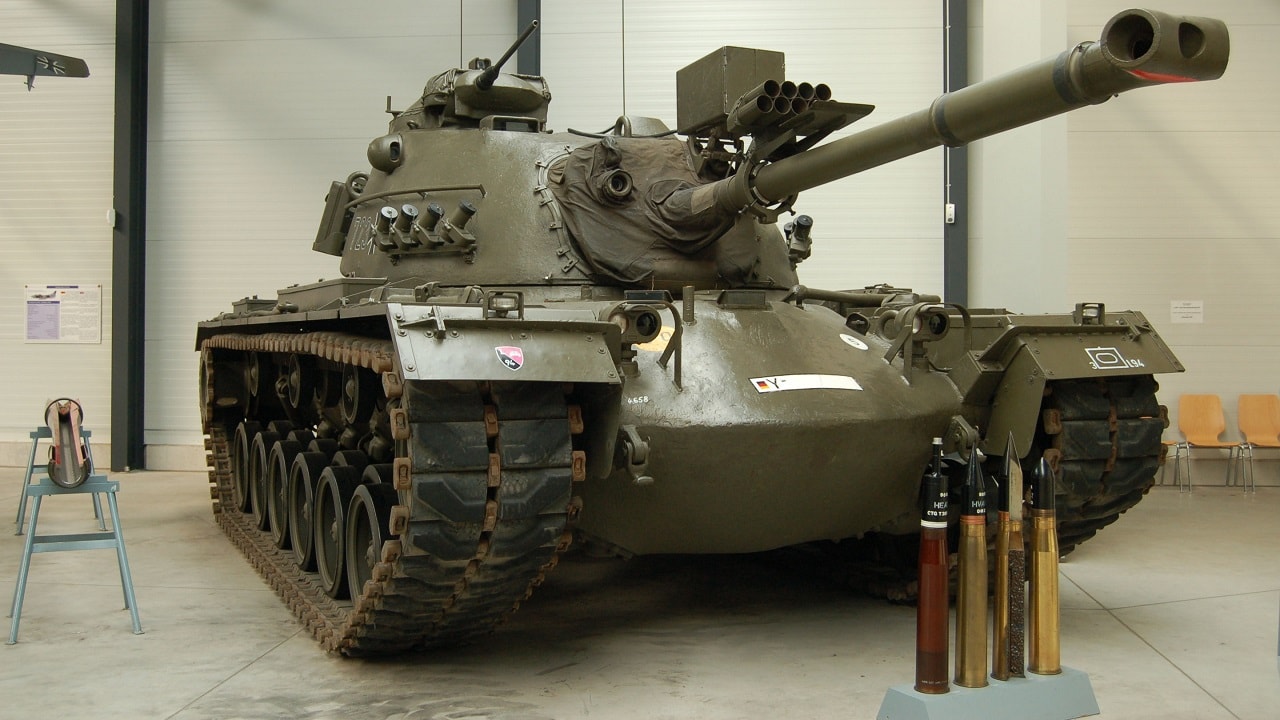
The M48 Patton is the third and, if you don’t count the M60, the final addition to the Patton line of tanks. It was designed to address the M47’s deficiencies and quickly became the workhorse for the United States and armies worldwide.
While hardly spectacular by today’s standards, the tank was decent for its time and served as an excellent testbed for potential upgrades, though it was not as versatile as the M60.
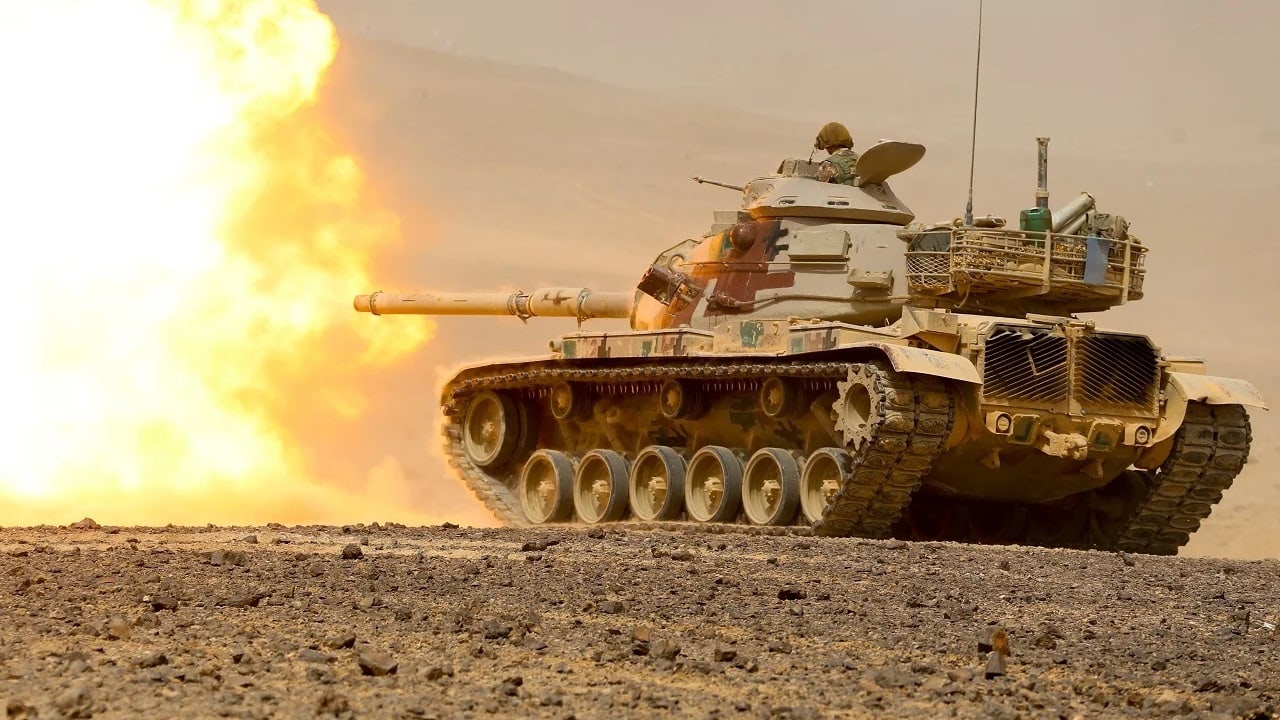
M60 Tank. Image Credit: Creative Commons.
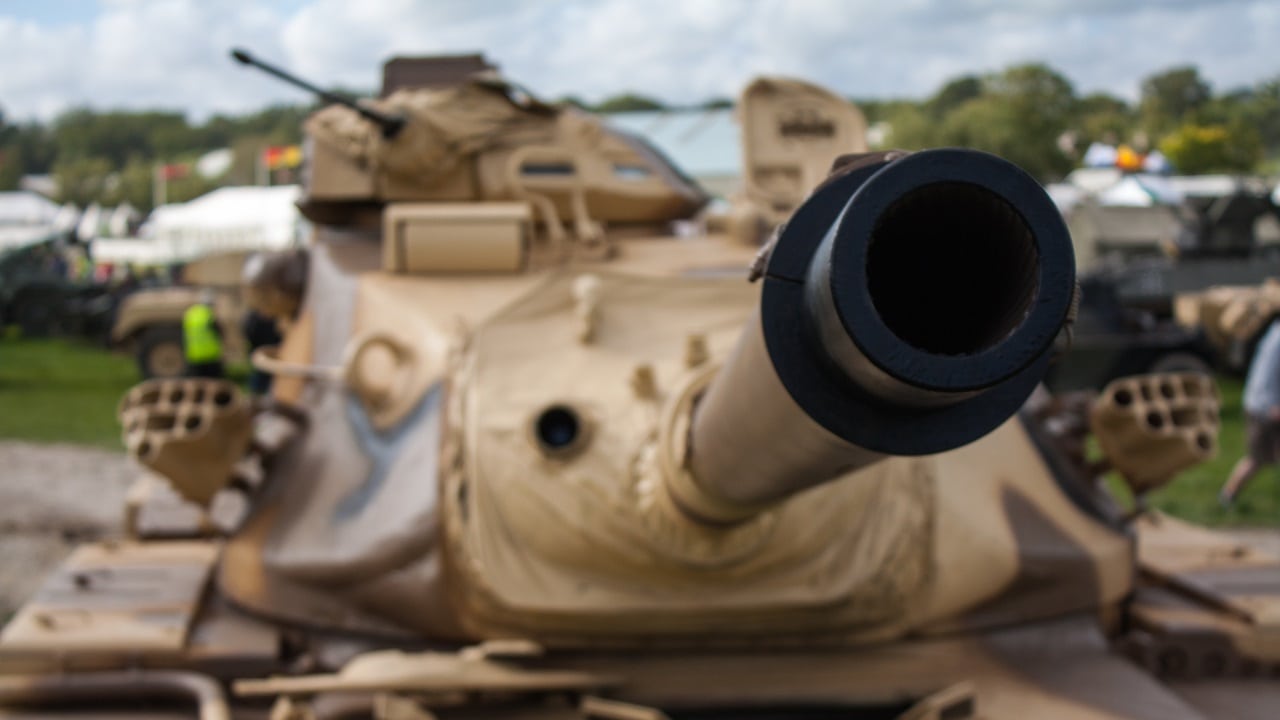
M60 Tank. Image Credit: Creative Commons.
This is evident in the fact that some militaries still retain a couple of their modernized M48S because of their reliability and versatility.
Designing America’s Last Medium Tank
In 1951, the M47 Patton became the Army’s main medium tank; the designation “medium tank” was on its way out, with future tanks being classified by the caliber of their guns instead.
However, the M47 suffered from several reliability problems that prevented its use in the Korean War, forcing the Army to rely on its older M26 and M46 medium tanks.
The Korean War prompted new tank studies by the U.S., which feared it was falling behind the Soviet Union in both quality and quantity.
During this period, new tanks underwent testing, development, and production simultaneously to ensure they reached troops on time.
This unfortunately meant that many new models were delivered before major problems were identified and fixed.
In this environment, the T48 project was born to fix the deficiencies in the M47’s design.
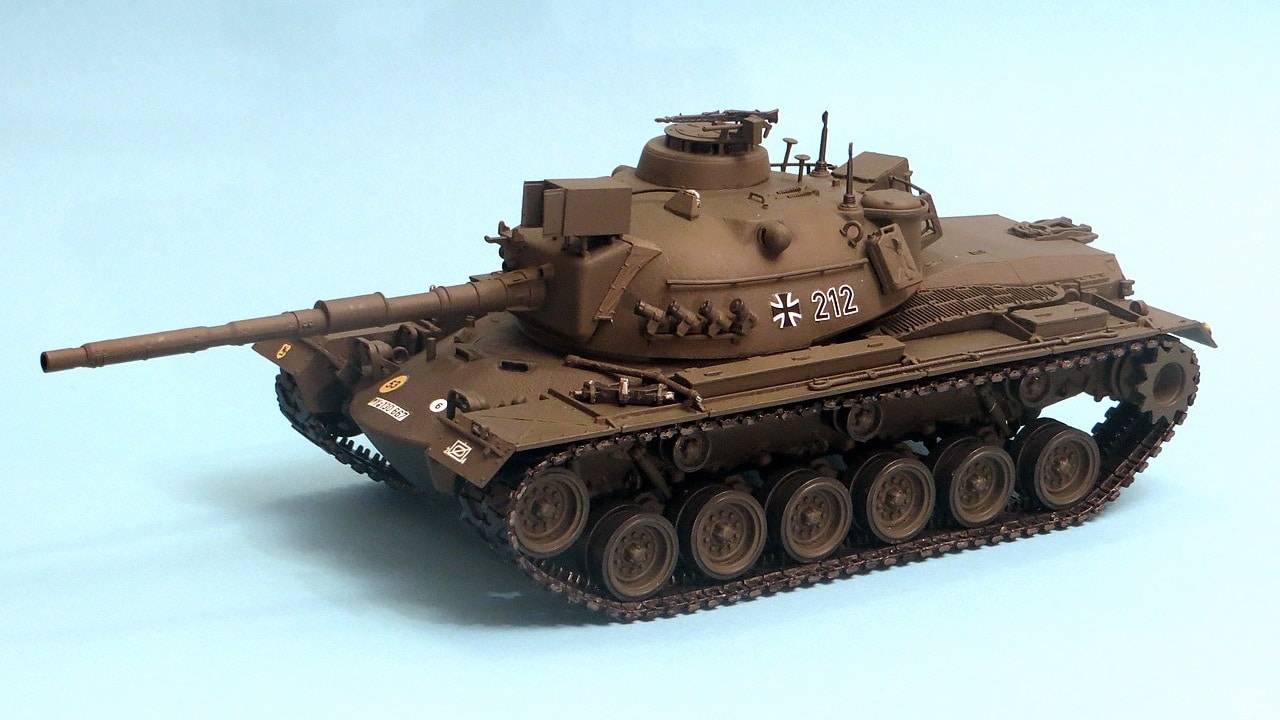
M48A2GA2 Bundeswehr Modell in 1:35
Although the M48 and M47 are often grouped together under the same “Patton” designation, the two tanks feature completely different designs.
The T48’s hull was redesigned to move the driver to the front center of the tank, completely removing the bow machine gunner entirely and reducing the crew to four members.
The hull’s frontal glacis was sloped as opposed to the M47’s flat welded design to offer better ballistic protection.
The T48 entered trials in 1952, but the Soviet threat prompted the Army to fast-track development and press the tank into service as quickly as possible.
Consequently, the M48 would require numerous subsequent upgrades to iron out some of the kinks from its rushed development timeline.
Specs and Capabilities
The M48 Patton officially entered service in 1952, just one year after the M47.
Although the tank underwent numerous modifications, many of the base features remained the same. The tank was armed with a 90mm rifled M41/T139 gun, although the M48A5 replaced this with a 105mm M68/T254E2 gun.
This cannon was lighter, allowing the barrel to be replaced more easily for maintenance.
It also allowed the tank to fire new high-explosive anti-tank (HEAT) rounds, which could more reliably penetrate thick armor.
With the introduction of heavy Soviet tanks like the IS-3, the U.S. feared that the M47’s gun would not be able to reliably penetrate the IS-3’s heavy armor.
The M48’s gun was therefore seen as a cost-effective improvement, increasing its penetration without requiring an upgrade to a higher caliber.
Mobility, admittedly, took a few tries to perfect. The M48 underwent multiple engine changes, each offering improved performance.
Early M48 tanks were equipped with the Continental AV1790 V12, air-cooled, gasoline engine, which produced 810 hp.
These early tanks suffered from a myriad of engine, transmission, track, and suspension problems.
The M48A2 featured a modified engine that was both more reliable and offered better performance.
Starting with the M48A3, however, the tanks were equipped with a Continental AVDS-1790 V12, air-cooled, twin-turbo, diesel engine, which increased their combat range from 135 miles to 288 miles.
The tank could reach speeds of up to 48 km/h when driving on paved roads.
Throughout its service history, engine maintenance would remain a persistent thorn in the M48’s side.
The M48 in Action
The M48 made its first combat debut in the Vietnam War, where American ground troops used it extensively.
Over the course of the war, the U.S. deployed more than 600 Pattons to Vietnam.
The U.S. also supplied hundreds of M48 tanks to the South Vietnamese Army, which engaged with Soviet-supplied T-54 and PT-76 tanks.
By all accounts, the M48 fared well against its Soviet-made adversaries, although when the U.S. pulled out of Vietnam, Congress placed an embargo on South Vietnam, forbidding the sale of spare parts.
The South Vietnamese operated their tanks until the bitter end, until they ran out of fuel and ammo, and were subsequently abandoned.
Israel became a prevalent operator of the M48 and used them to great effect in the Six-Day War and the Yom Kippur War.
In the Six-Day War, Israeli M48s, armed with a 105mm gun, fared well against Soviet-made IS-3 and T-54/55 tanks sold to Egypt.
In the Yom Kippur War, Israel’s tanks again performed well against Egyptian and Syrian tanks, although both sides took heavy casualties.
This time, however, the Syrians were armed with Soviet 9M14M Malyutka (NATO designation: Sagger) anti-tank guided missiles, which were more than capable of penetrating the M48’s armor.
Today, the M48 is still in service with several armies around the world, including Greece, Taiwan, Thailand, Iran, Lebanon, and more.
About the Author: Isaac Seitz
Isaac Seitz, a Defense Columnist, graduated from Patrick Henry College’s Strategic Intelligence and National Security program. He has also studied Russian at Middlebury Language Schools and has worked as an intelligence Analyst in the private sector.