
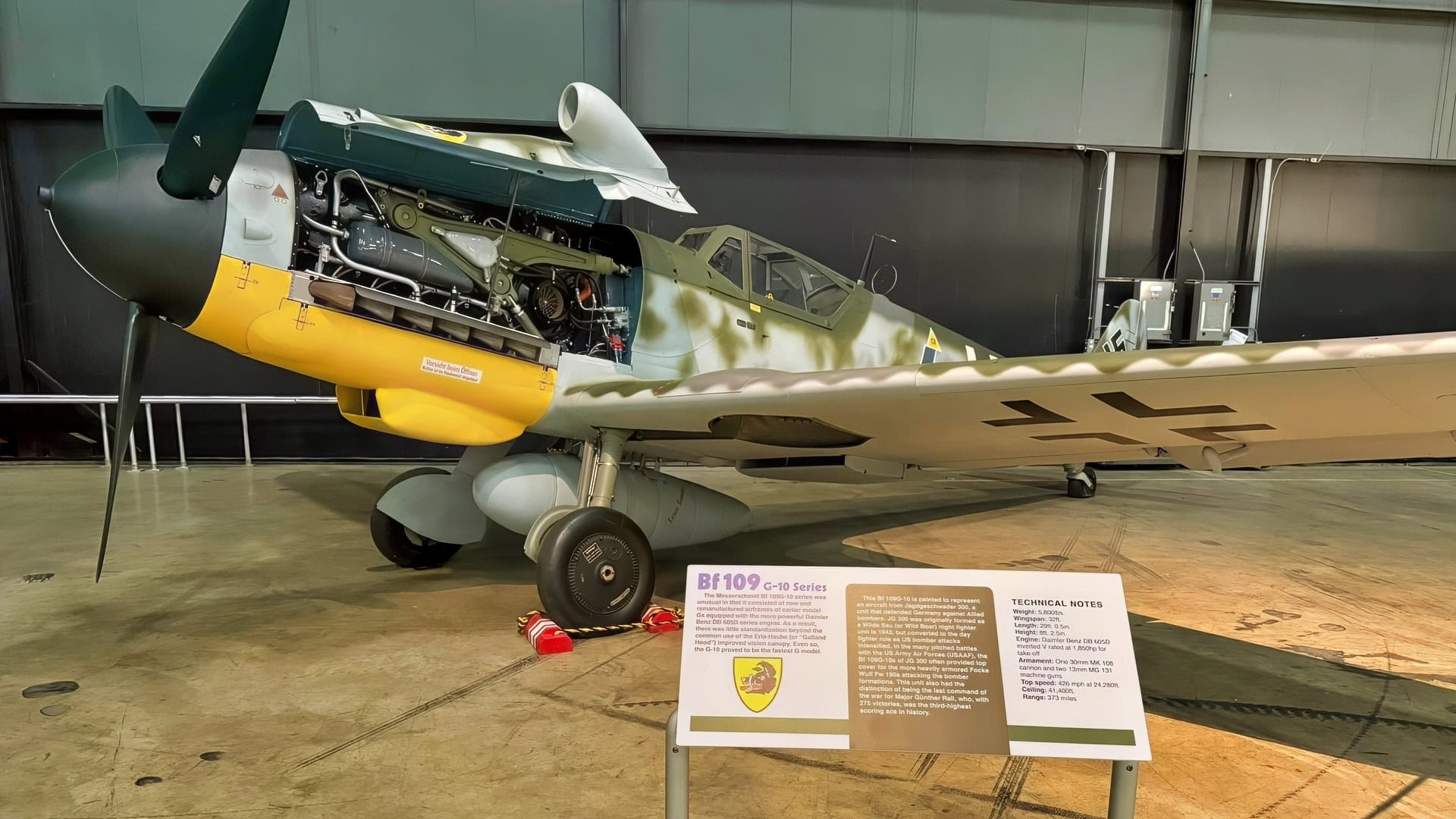
Nazi Germany was truly a vile and nightmarish regime, no doubt. But as the saying goes, “Give the devil his due.” That evil regime’s military industry—guided by Minister of Armaments Albert Speer—produced some of the most impressive weapons in history, exemplars of that world-renowned German engineering, particularly in the arena of warplanes.
Today we focus on the most famous of the Third Reich’s fighter planes, indeed so famous its name practically became generic to Hollywood audiences in the same sense that the Mitsubishi Zero became a generic label for Imperial Japanese fighters of World War II: the Messerschmitt Bf 109, aka Me 109.
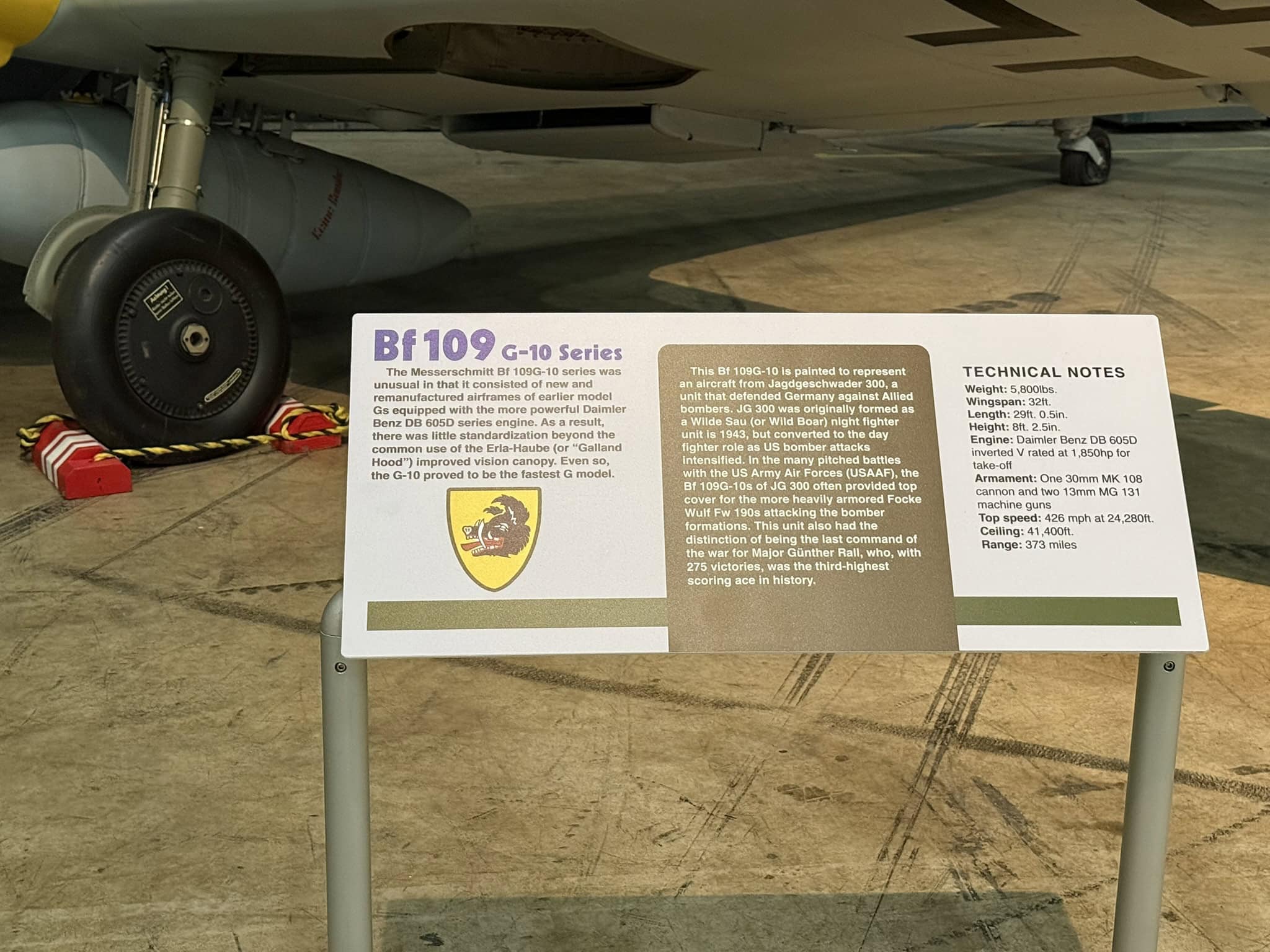
Messerschmitt Bf 109 19FortyFive Photo from 2025 at the National Museum of the US Air Force.
And, indeed, as we like to do, we visited this plane in the flesh. We were at the National Museum of the US Air Force last summer. We have some amazing photos from that visit that we have shared and embedded in this article that show off this fighter.
“Bf” or “Me,” What Should It Actually Be?
Before we delve into the operational history and tech specs of this famously deadly German fighter, a quick semantic clarification is in order about the correct alphanumeric abbreviation.
Logically, one would be inclined to think of “Me” as the correct abbreviation for any Messerschmitt-produced aircraft, in the same vein as: “Do” for Dornier, e.g. Dornier Do 217; “FW” for Focke-Wulf, e.g. Focke-Wulf Fw 190; “He” for Heinkel, e.g. Heinkel He 111; and “Ju” for Junkers, e.g., Junkers Ju 88.
However, in the case of Herr Willy Messerschmitt’s best-known warbird design, that logical assumption would be only partially correct. Bayerische Flugzeugwerke (BFW/Bavarian Aircraft Works) initially manufactured the plane.
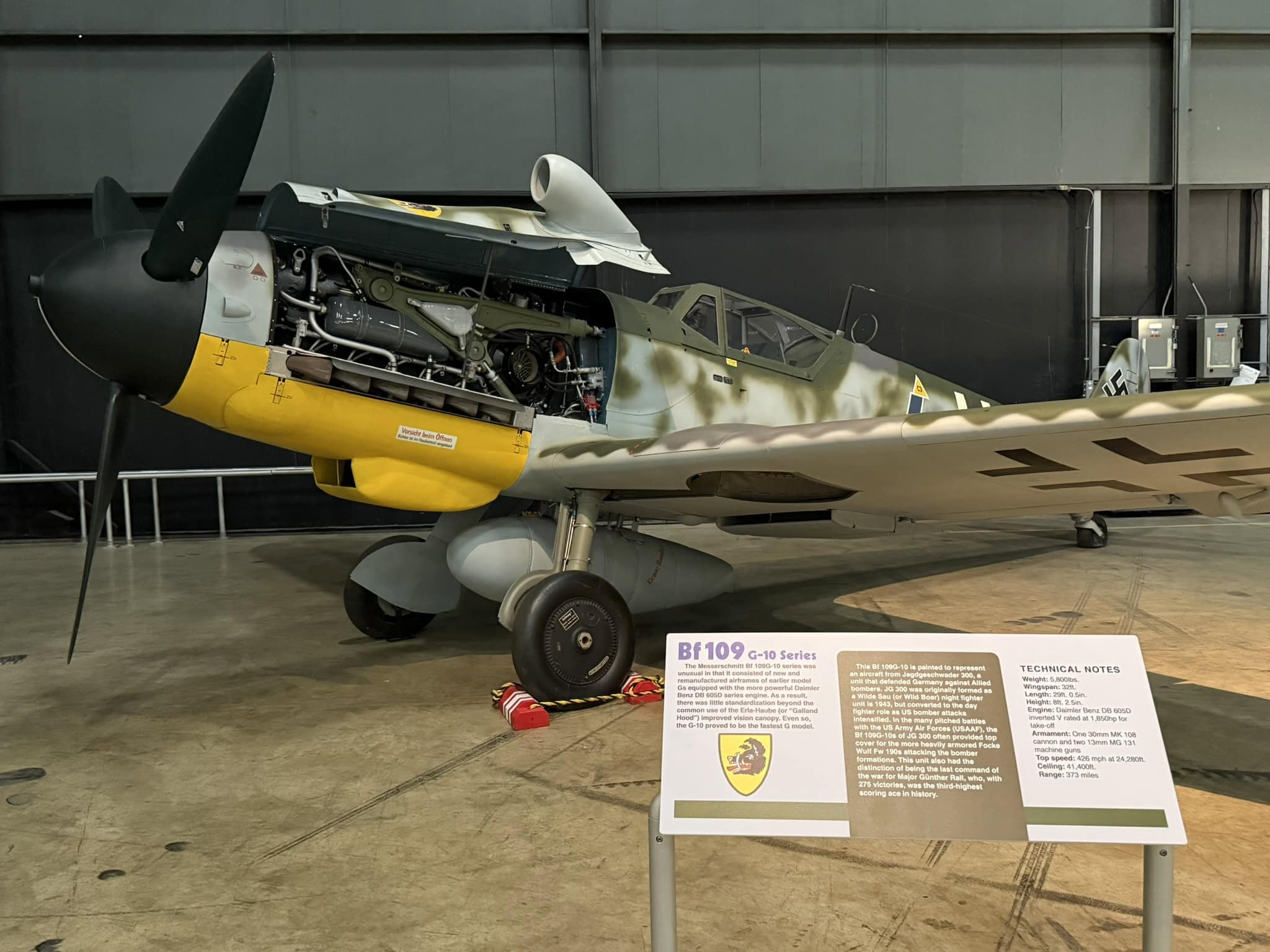
Messerschmitt Bf 109 19FortyFive Photo from 2025 at the National Museum of the US Air Force.
Accordingly, the “Bf” designation was still used for pre-WWII aircraft designs, whilst “Me” was used for later aircraft such as the Me 163 Komet rocket plane.
To muddy the proverbial waters a bit further, various sources tell us that the “Bf” designation would be correct for the 109 variants produced up until 1938, while those developed afterward, including the highly regarded 109E, F, and G models, are technically and truly Me 109s.
Initial History, Tech Specs, and Vital Stats
It turns out that there’s good reason the Bf/Me 109 became so generically famous: it was *THE* most heavily produced fighter in history, with a total of 33,984 airframes churned out from early 1936 to April 1945.
Only the Soviet Ilyushin Il-2 “Shturmovik (NATO reporting name: “Bark”) was produced in greater numbers, and that was a ground-attack warbird. Yes, even the ubiquitous MiG-21 “Fishbed” jet fighter of the Cold War era was outproduced by the 109.
The 109 warbird made its maiden flight on 29 May 1935 and was officially adopted into the service of the Third Reich in February 1937.
A total of 17 other nations wound up using the fighter as well, whether via purchase or via capture…the most ironic example of which we’ll discuss in a bit.
Technical specifications included a fuselage length of 29 feet 4 inches, a wingspan of 32 feet 7 inches, a maximum takeoff weight (MTOW) of 7,496 lb., and a max airspeed of 399 mph. Armament consisted of 2 × 13mm synchronized MG 131 machine guns and 1 x Rheinmetall 30mm MK 108 cannon.
Combat History Part I
It turns out that there’s *another* good reason the Bf/Me 109 became so generically famous: it was credited with more aerial kills than *ANY* other aircraft of World War II.
Given the many excellent fighter planes produced by the Axis and Allies alike during that war, that’s saying a lot.
Indeed, the highest-scoring fighter ace in history, Major Erich Alfred Hartmann (1922 – 1993), tallied the entirety of his mind-numbing total of 352 air-to-air kills in a 109.
As if that individual feat weren’t impressive enough, consider this: No less than 105—yes, **one hundred and five!!**–Bf 109 pilots were each credited with the destruction of 100 or more enemy aircraft, and moreover, 13 of those fighter jocks scored more than 200 aerial victories! To put that in perspective for you, America’s all-time highest-scoring ace, Maj. Richard Ira “Dick” Bong, bagged a mere 40 kills.
Though WWII was obviously where this plane earned its greatest claims to fame, it was actually first “blooded” in combat during the Spanish Civil War of July 1936 – March 1939, wherein it was operated by the Luftwaffe’s Condor Legion that fought in support of Generalissimo Francisco Franco’s Nationalist faction.
Combat History Part Deux: Oi Vey, the Irony
Needless to say, the greatest evil perpetrated by the Nazi regime was the Holocaust, wherein 6 million Jews were murdered, mostly—though not entirely—without resistance offered in return.
Out of the literal and figurative ashes of the Holocaust rose the Jewish state, the State of Israel.
Officially declaring independence on 14 May 1948, it required the 14-month-long Arab-Israeli War of 1948 to secure that independence.
And the first fighter plane to be used by the then-fledgling Israeli Air Force was, would you believe, a war machine designed by the same nation that had inflicted the Holocaust: the Messerschmitt 109.
If you want to nitpick, the Israelis actually used the Avia S-199, a post-WWII Czech-made copy of the Bf 109. The S-199 had a rather inauspicious performance in the 1948 war, but it did enough to help win Israel’s independence and to plant the seeds for the elite and ultramodern Israeli Air Force that we now know.
Where Are They Now
The Spanish Air Force was the last entity to officially retire the Bf 109, doing so with its Hispano Aviación HA-1112 variant in December 1965.
As the most widely produced fighter plane of all time, the Bf 109’s odds were good that a goodly number still survive today, whether as museum static displays, current restoration projects, or even airworthy samples, with flyable specimens in Belgium, Germany, the United Kingdom, and the United States. Aviation historian Harold A. Skaarup has devoted a full-length article to Bf 109s preserved in the USA. To name two airworthy examples:
-Reg. No. N342FH, Flying Heritage & Combat Armor Museum, Everett, Washington
-Reg. No. N109GY, Military Aviation Museum, Virginia Beach, Virginia
About the Author: Christian D. Orr
Christian D. Orr is a Senior Defense Editor. He is a former Air Force Security Forces officer, Federal law enforcement officer, and private military contractor (with assignments worked in Iraq, the United Arab Emirates, Kosovo, Japan, Germany, and the Pentagon). Chris holds a B.A. in International Relations from the University of Southern California (USC) and an M.A. in Intelligence Studies (with a concentration in Terrorism Studies) from American Military University (AMU). He is also the author of the book “Five Decades of a Fabulous Firearm: Celebrating the 50th Anniversary of the Beretta 92 Pistol Series,” the second edition of which was recently published.