
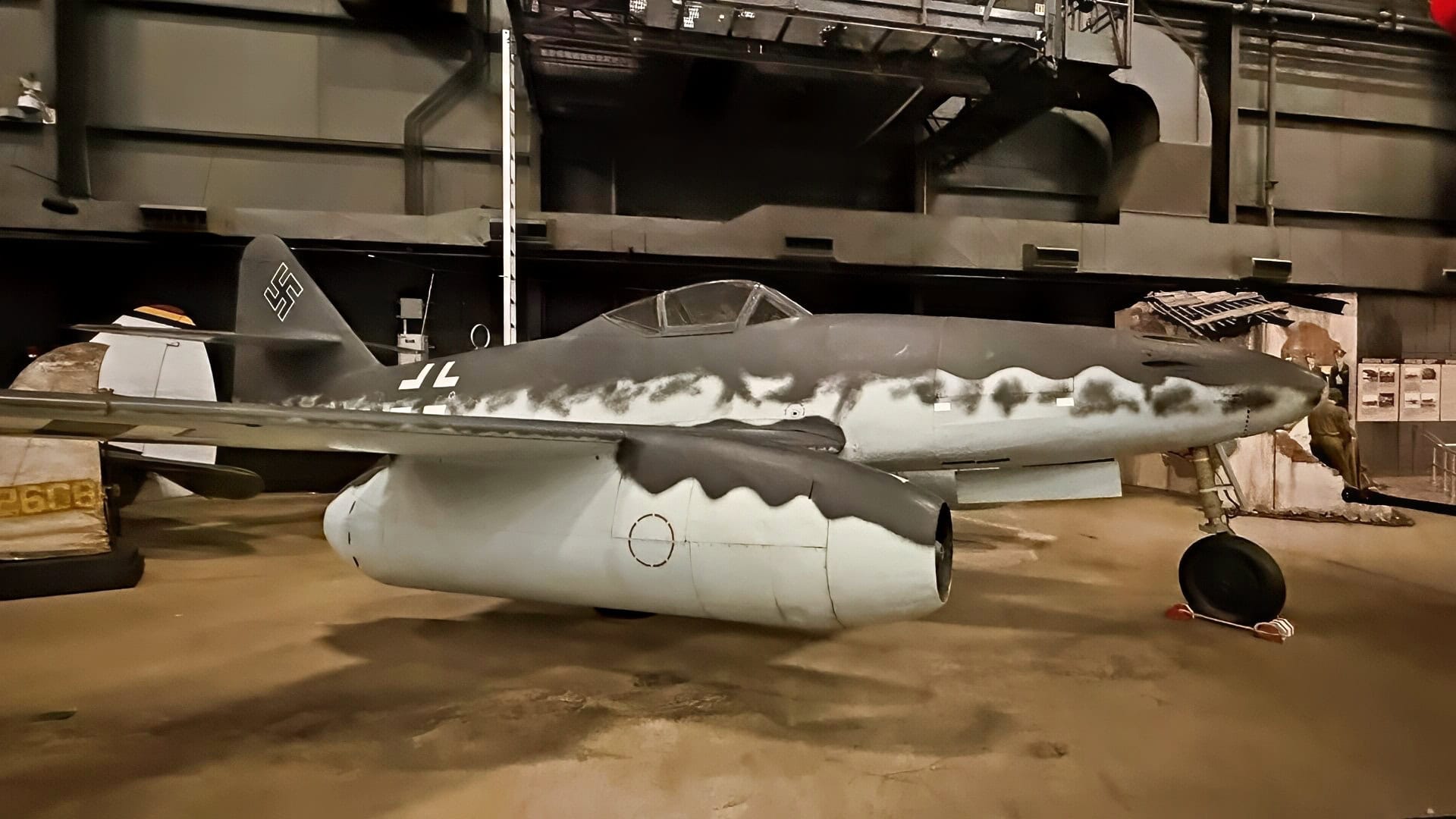
As part of our work at 19FortyFive, we regularly visit military facilities and museums to document aircraft that helped shape modern warfare. In July of last year, we photographed the Messerschmitt Me 262 at the National Museum of the United States Air Force in Dayton. The photographs in this report are from that visit.
The Me 262 remains one of the most consequential aircraft of the Second World War. It was the world’s first operational jet-powered fighter, fielded by Nazi Germany during World War II. While it arrived too late and in insufficient numbers to alter the outcome of the conflict, its technology and speed signaled the end of the propeller era of aircraft and helped usher in a new era of air combat.
This profile examines how this revolutionary aircraft was conceived, the pressures that shaped its development, the technology that powered it, and its performance in combat.
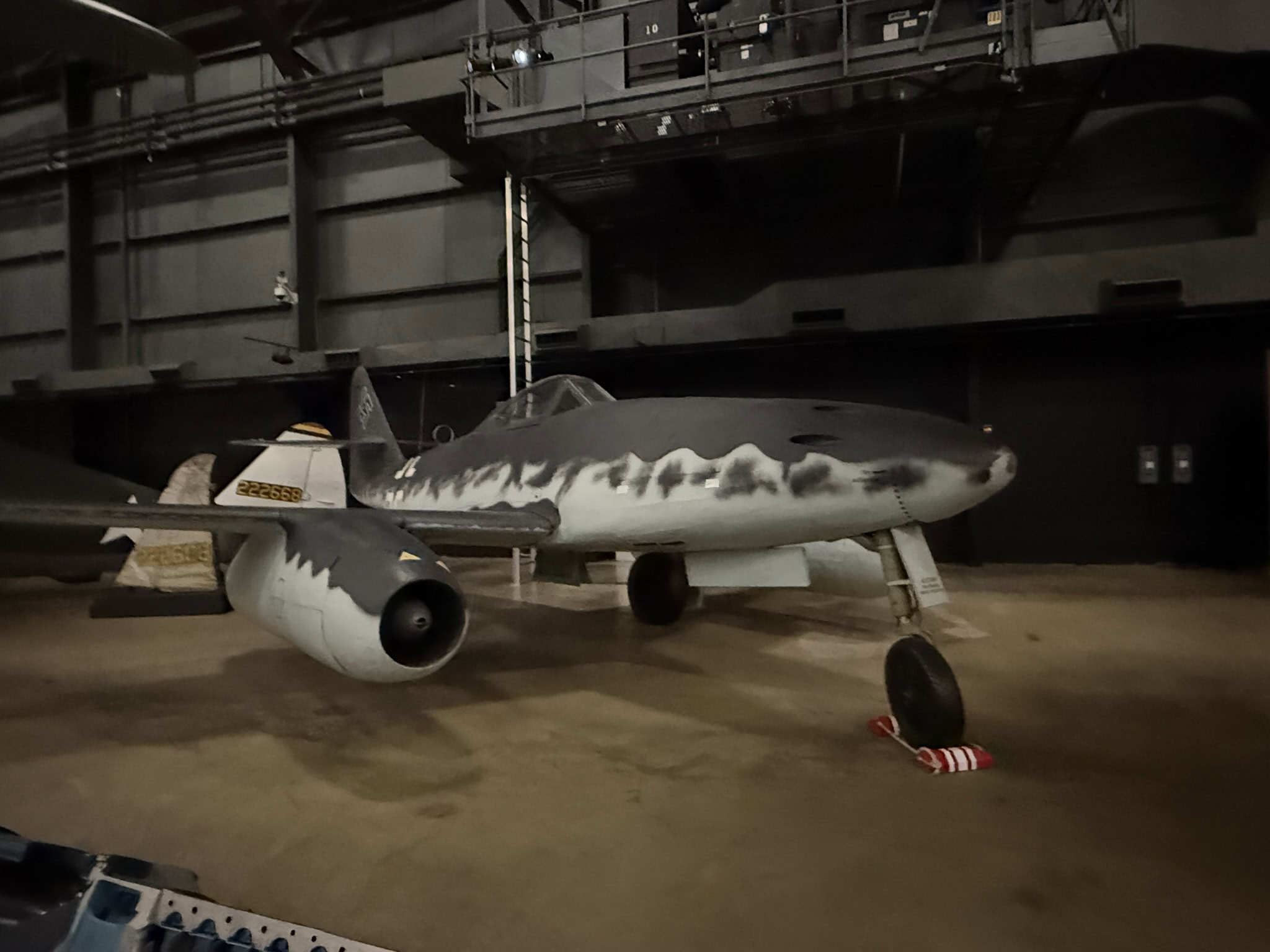
Me 262 Fighter. Image taken by Harry J. Kazianis at the National Museum of the U.S. Air Force back in July of 2025.
The Me 262 Was Developed Under Pressure
Work on what would become the Me 262 began before the war. In 1938, the German aircraft manufacturer Messerschmitt AG initiated a design study for a jet-powered fighter. The project emerged from broader German research into jet propulsion led by engineers such as Hans von Ohain, whose work on early turbojets laid the groundwork for operational jet flight. The aircraft first flew under jet power on July 18, 1942, but the path from prototype to production was not smooth.
The biggest obstacle in its development was its engine, the Junkers Jumo 004. Early jet engines suffered from short service lives and poor reliability due to limited access to high-temperature alloys. Wartime shortages and Allied bombing campaigns compounded those problems.
Politics also got in the way, further delaying its deployment. While Luftwaffe officers viewed the aircraft as a fighter, Adolf Hitler insisted that it be used as a fast bomber. That requirement necessitated several redesigns and delayed its introduction into frontline service. It was only by mid-1944 that the Luftwaffe began fielding the aircraft in significant numbers – and by then it was too late.
Design and Performance
The Me 262’s layout was a significant change from earlier designs. Two turbojet engines were mounted in nacelles (streamlined housing) under slightly swept wings. The aircraft was faster than any Allied fighter of its time.
Depending on load and altitude, it could reach approximately 540 miles per hour – roughly 120 miles per hour faster than the propeller-driven North American P-51 Mustang, which was the most widely recognized Allied fighter of World War II.
The standard fighter version carried four 30 mm MK 109 cannons in the nose, and its heavy armament enabled it to destroy bombers with short bursts of fire. Some versions also carried R4M rockets, enabling attacks from beyond the range of bomber defensive guns.
But its performance came with vulnerabilities. For example, the Jumo 004 engines were prone to flameouts and had very short lifespans. Pilots were particularly vulnerable during takeoff and landing, when the aircraft was slow, and engines were prone to failure. Allied fighters learned to exploit those weaknesses by attacking Me 262s near their airfields.
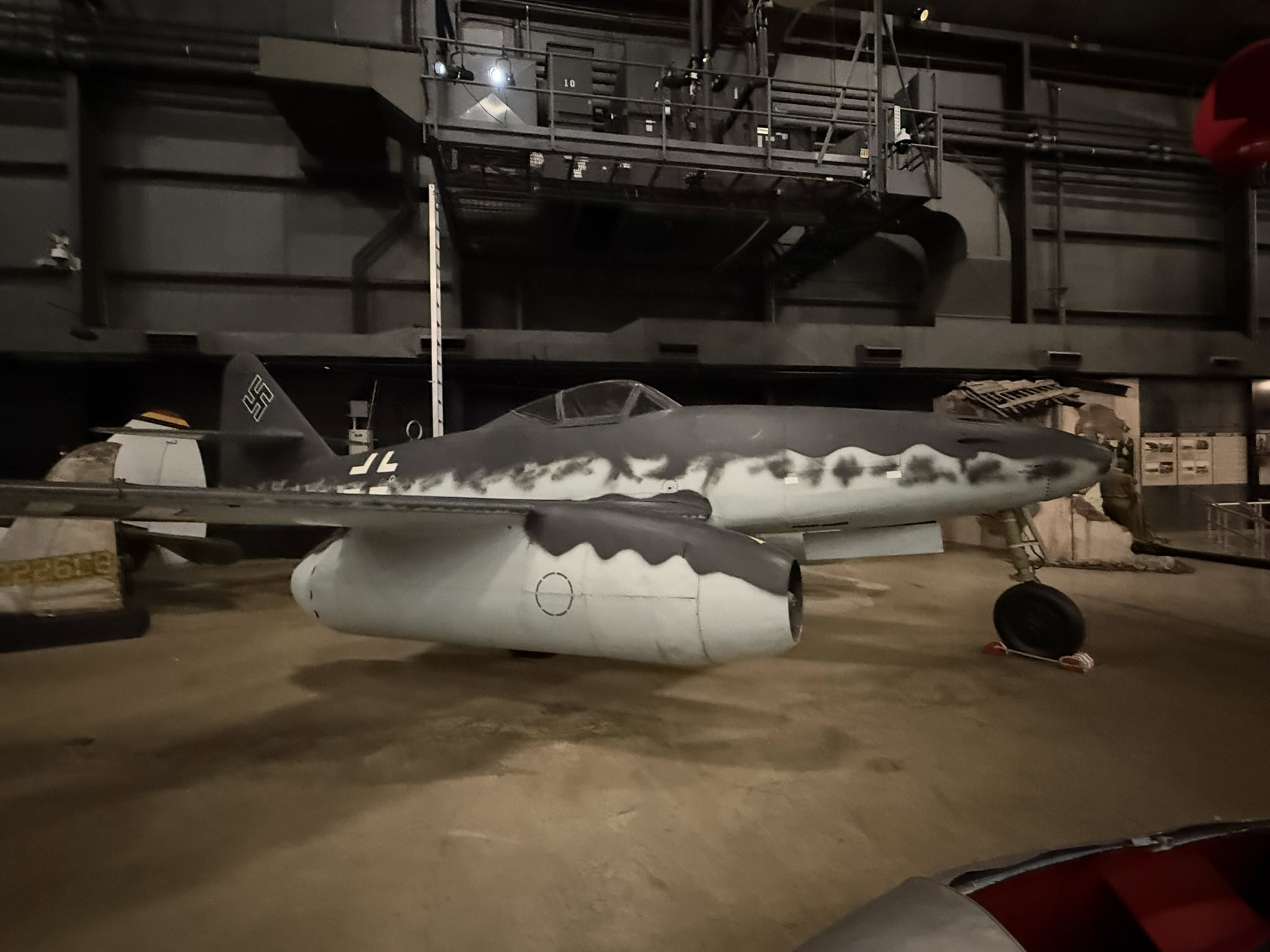
Me 262 Fighter. Image taken by Harry J. Kazianis at the National Museum of the U.S. Air Force back in July of 2025.
Combat Record
The Me 262 entered operational service in mid-1944. Units equipped with the jet scored notable successes against Allied bomber formations, as its speed allowed it to close quickly, attack, and disengage before escort fighters could even respond. However, its impact was limited by its small numbers and known mechanical issues.
Of the roughly 1,400 aircraft produced, fewer than 300 ever reached combat units. Between fuel shortages and production bottlenecks, operational readiness remained low throughout its service life. Production facilities were dispersed because they were frequently targeted by Allied bombing campaigns, and the late-war collapse of German logistics meant that many completed aircraft sat idle due to a lack of engines, spare parts, trained pilots, and other problems. Even when the aircraft were available, the German fuel situation was catastrophic by late 1944. Synthetic fuel facilities had been heavily targeted, and the high fuel consumption of early jet engines made the aircraft even harder to keep operational.
But when the aircraft reached combat units, its performance was immediately apparent. The Me 262 could approach bomber formations at speeds that left defensive gunners and escort fighters very little time to react. Pilots used high-speed attacks in which they fired brief and devastating bursts of 30 mm cannon fire before accelerating and speeding away.
The aircraft was capable of inflicting severe damage on bomber formations when employed in coordinated attacks. However, those successes were infrequent, and allied escort fighters quickly adapted, focusing on intercepting Me 262s during takeoff and landing. During those moments, the aircraft was slow and vulnerable, and unable to fully exploit its main advantage: speed.
In response to the threat, Allied planners also intensified the bombing of jet airfields and production facilities. As a result, even though the Me 262 represented a major technological advance, its operational impact was limited by strategic factors beyond Germany’s control.
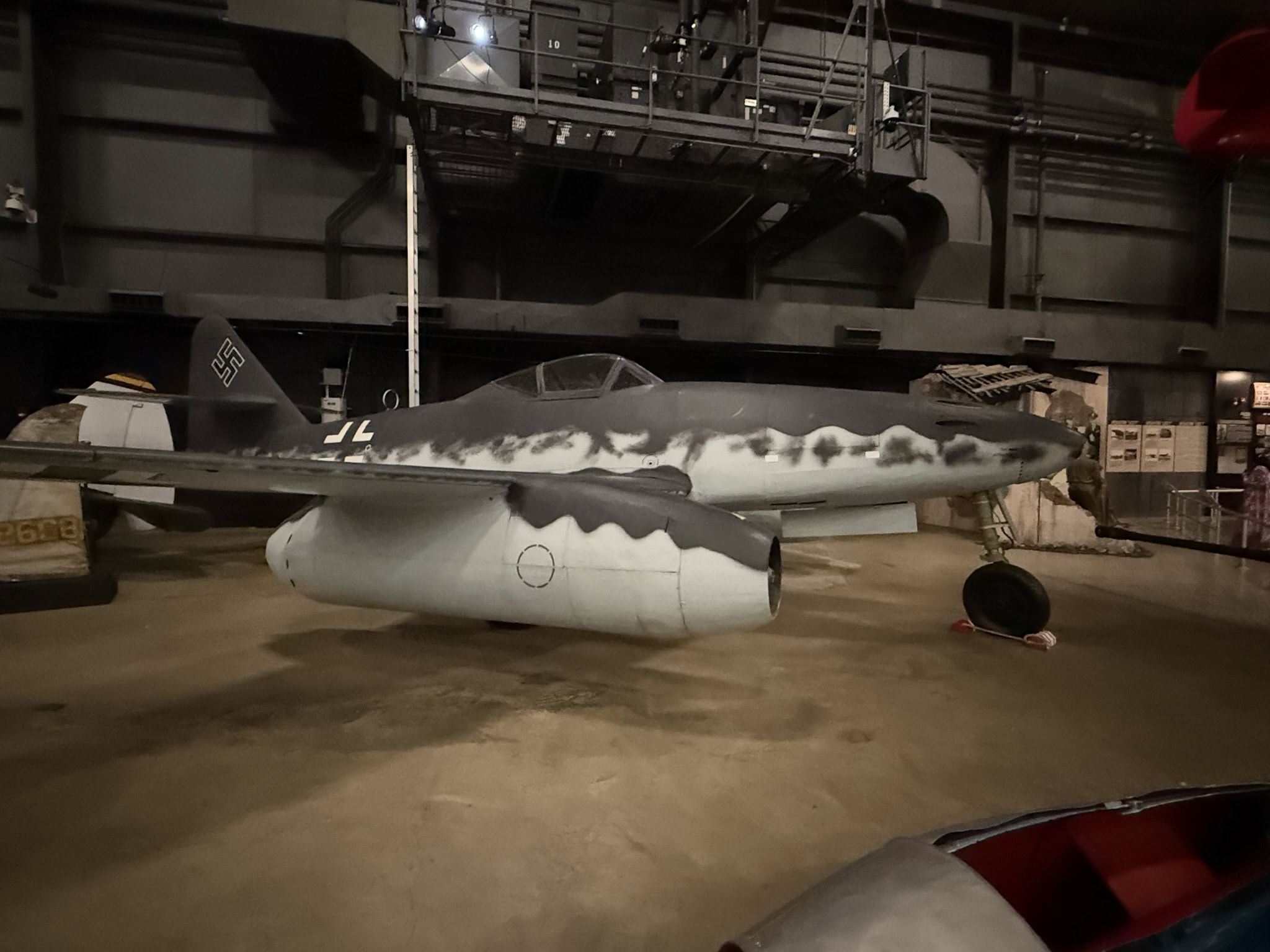
Me 262 Fighter. Image taken by Harry J. Kazianis at the National Museum of the U.S. Air Force back in July of 2025.
Its Legacy and Influence on Future Aircraft
Although the Me 262 did not alter the outcome of the war, its influence on post-war aviation is well documented. Captured examples of the aircraft were extensively evaluated by the United States and the United Kingdom, with allied test pilots and engineers examining its structure and propulsion system, flight characteristics, and other elements of German design. Studying the aircraft influenced the first generation of post-war fighters seen across Europe, where the shift from piston engines to jet propulsion was accelerated by lessons learned from German research.
The jet age that followed drew heavily on concepts that were first demonstrated by the Me 262. For example, early post-war fighters incorporated aerodynamic principles and design features validated by German jet programs, including swept wing designs intended to improve high-speed performance. The transition to jet-powered air forces was a fundamental shift in how aircraft function, what was expected of them, their combat tactics, and aircraft engineering in general.
The aircraft’s design also had a long-term impact on doctrine. Because it could achieve significantly higher speeds, and because post-war aircraft followed in its footsteps, air forces changed how they approached bomber defense and air superiority. So while the Me 262 was introduced too late to affect the outcome of World War II, it provided a glimpse at how future conflicts would be fought in the air.
Walter Nowotny and the Reality of Early Jet Combat
Perhaps one of the best ways to understand aircraft is to hear the stories of the pilots who flew them, and Walter Nowotny is one such aviator who piloted the famed Me 262. Nowotny was one of Germany’s most accomplished fighter pilots, credited with 258 aerial victories on the Eastern Front before being appointed to lead the first operational jet fighter unit, Kommando Nowotny, in late 1944.
His task was to introduce the Me 262 into frontline service while simultaneously developing tactics for an aircraft no air force had ever used in combat.
Operating from bases in Germany, Nowotny’s unit demonstrated the jet’s huge potential, claiming multiple bomber kills. The aircraft’s vulnerabilities began to be exposed at this point, too.
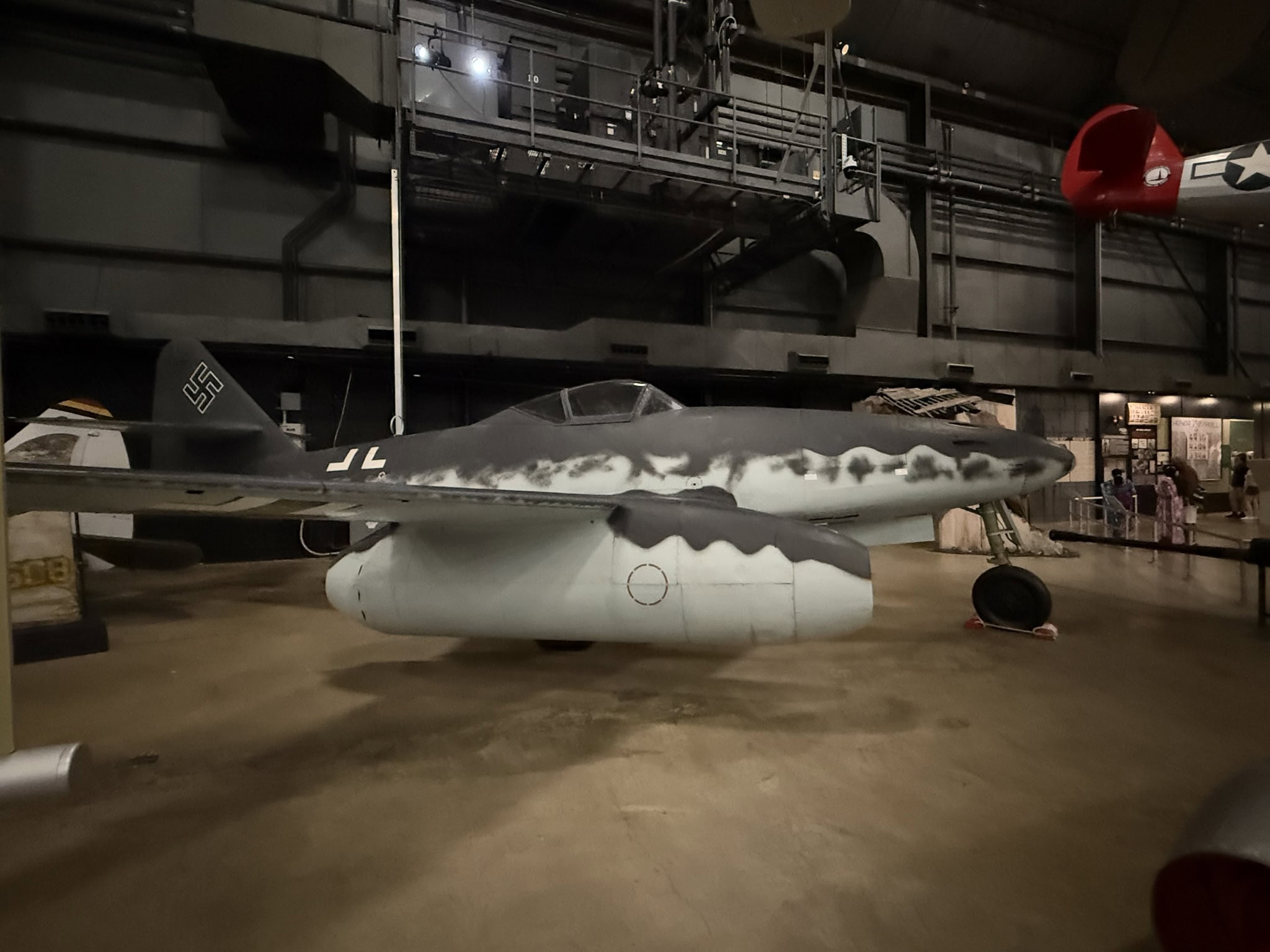
Me 262 Fighter. Image taken by Harry J. Kazianis at the National Museum of the U.S. Air Force back in July of 2025.
On November 8, 1944, after engaging a formation of American bombers, Nowotny’s aircraft was attacked during its return to base. His Me 262 was shot down, and he was killed. The aircraft’s speed made it formidable in attack, but engine reliability issues and its vulnerability during landing remained fatal weaknesses.
About the Author: Jack Buckby
Jack Buckby is a British researcher and analyst specializing in defense and national security, based in New York. His work focuses on military capability, procurement, and strategic competition, producing and editing analysis for policy and defense audiences. He brings extensive editorial experience, with a career output spanning over 1,000 articles at 19FortyFive and National Security Journal, and has previously authored books and papers on extremism and deradicalization.